


Lynden Pindling International Airport (NAS) is the main gateway to Nassau and Paradise Island, and for most visitors the very first Bahamian experience is a taxi ride. Understanding how taxis work here, what you should pay, and where to stand when you walk out of the terminal can spare you stress, overpaying, and unnecessary arguments after a long flight. This guide walks you through the entire process from curbside pickup to paying your driver, using current on-the-ground information and real examples of what visitors typically pay in 2026.
Get the latest updates straight to your inbox!
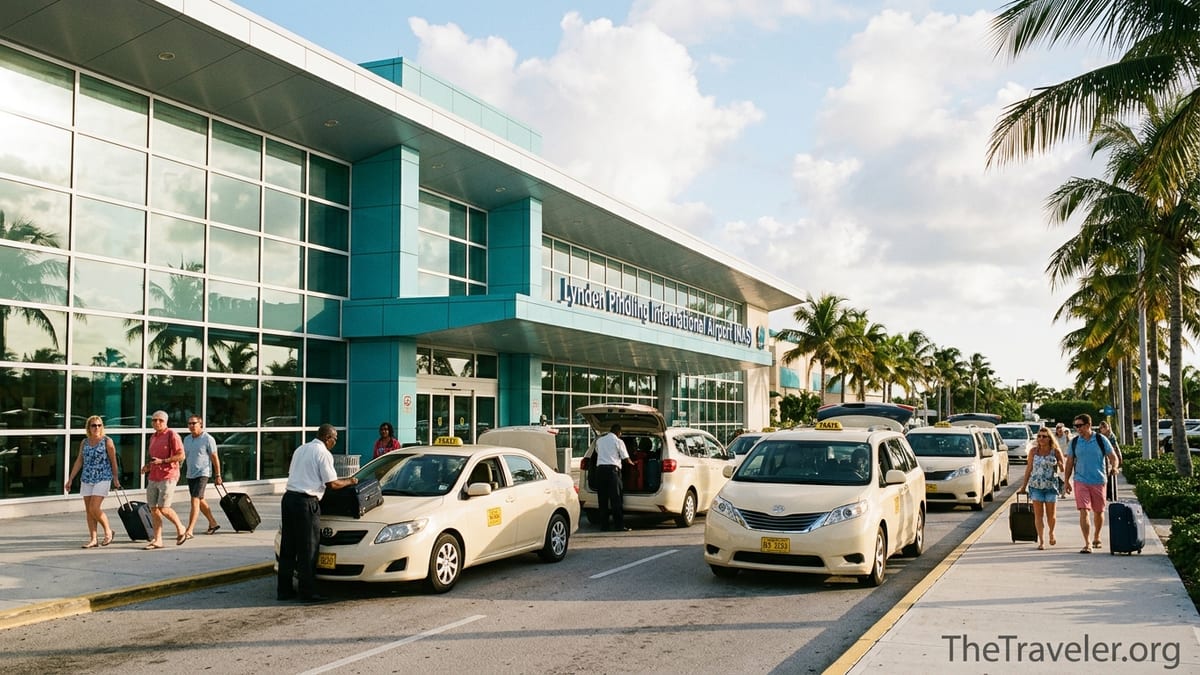
Where to Find Official Taxi Pickups at Lynden Pindling
All arriving passengers at Lynden Pindling International Airport follow the same basic route: you clear immigration, collect your bags, pass customs, then exit into the public arrivals hall and out through sliding doors to the curb. Whether you land on a U.S., international, or domestic flight, the official taxi pickup areas are located just outside the terminal on the arrivals curb, where uniformed airport staff and dispatchers help match travelers with licensed cabs. Look for the line of cream or white sedans and vans with government-issued taxi plates, usually starting with “T” followed by numbers.
For flights arriving from the United States, you will come out of the U.S. terminal’s arrivals doors on the ground level. Taxis queue along the curb directly opposite the exit. During busy bank times when multiple flights land from cities like Miami, Atlanta or New York, an airport representative often stands near the doors, asking where you are headed and then directing you to the next available taxi in line. There is no separate Uber or Lyft lane here, because rideshare apps do not operate in Nassau in the same way they do in U.S. cities, so the taxi line is the main option for most visitors.
Passengers arriving on international routes from Canada, Europe or regional Caribbean connections exit a similar ground-level arrivals area. The pickup layout is almost identical: you walk straight out and see taxis lined up along the curb. The key is to approach the official queue rather than accepting offers from anyone walking beside you. Domestic flights from other Bahamian islands use the domestic terminal, a smaller building on the same airport campus, and there you will usually still find a small taxi rank outside, with drivers recognizable by their vehicles’ taxi plates and often by ID badges in the windshield.
If in doubt, ask the airport information desk inside the arrivals hall or a uniformed airport security officer to point you toward the official taxi stand. A simple question such as “Where is the official taxi queue?” can help you avoid informal drivers who may be standing closer to the doors, trying to catch travelers before they reach the regulated line.
Understanding Nassau’s Zone-Based Taxi Fares
Unlike metered systems in cities such as New York or Toronto, Nassau taxis from Lynden Pindling International Airport use a government-regulated zone fare system. That means prices are set by distance bands and typical destinations rather than by a running meter. Official documents and local taxi operators describe fixed base fares that cover the first one or two passengers, with an additional small charge per extra person, along with a government-controlled fuel surcharge that is periodically updated.
For a concrete sense of cost, taxi guides and local tourism resources in 2026 describe typical fares from the airport of roughly 30 to 40 US dollars to central downtown Nassau and Bay Street, about 30 to 35 dollars to the resort strip at Cable Beach, and about 45 to 55 dollars to Paradise Island hotels such as Atlantis or the Ocean Club for one to two passengers. These examples reflect what most visitors report paying on the ground, though individual quotes can vary a little depending on vehicle size, late-night hours, or driver interpretation of the zone boundaries.
Several local companies also publish example fares online, confirming these ballpark figures. A commonly cited Paradise Island fare from Lynden Pindling includes around 48 dollars as the base zone rate for up to two travelers, plus a separate bridge toll to cross the harbor. Similarly, informal accounts from travelers and local drivers in 2025 and 2026 mention paying around 32 to 40 dollars from the airport to hotels near downtown such as the British Colonial, and around 25 to 35 dollars to large resort complexes like Baha Mar on Cable Beach. These are not official statistical averages, but they are realistic scenarios you can expect to encounter as a leisure traveler.
Because the fares are set by regulation and updated periodically, you should think in terms of ranges rather than exact pennies. Fuel price changes or government adjustments can nudge the figures up over time. A helpful strategy is to check an up-to-date Nassau taxi fare chart from a reputable local operator before you fly, then write down what you expect to pay from the airport to your specific hotel. When you step into the taxi, you can politely confirm: “We are going to Atlantis, and I understand the rate is about 50 dollars plus bridge toll for the two of us, correct?” This anchors the conversation around the official structure and reduces room for inflated quotes.
Sample Fares to Popular Nassau and Paradise Island Destinations
To make budgeting easier, it helps to look at a few common point to point examples from Lynden Pindling International Airport. A typical couple heading to a downtown Nassau hotel such as the British Colonial or a boutique property near Bay Street can expect a taxi quote in the low to mid 30 dollar range under the current zone grid, sometimes a little higher in heavy traffic or late at night. Travelers posting recent experiences in 2026 often describe fares between about 32 and 40 dollars for this route, which is roughly a twenty to twenty-five minute drive depending on congestion along West Bay Street.
If you are staying on Cable Beach, home to large resorts like Baha Mar, Breezes or Sandals Royal Bahamian, the distance from the airport is shorter, and taxi zone fares reflect that. For two passengers, drivers frequently quote around 25 to 35 dollars for the ride, with many visitors reporting paying about 30 to 35 dollars to Baha Mar in the current season. The drive usually takes fifteen to twenty minutes in normal traffic, making taxis an efficient transfer option compared with renting a car for a short stay.
Paradise Island sits across the harbor from downtown Nassau and is reached via the Paradise Island bridges, which have a separate toll for vehicles leaving the main island. Because of the extra distance and toll, airport fares to Atlantis Resort, the Ocean Club, or other Paradise Island hotels are higher. In practice, visitors often pay around 45 to 55 dollars for up to two passengers, plus a small bridge toll that is typically about 2 dollars. Some travelers report paying closer to 60 dollars in high-demand periods or when using larger vans with more luggage, which remains broadly consistent with the regulated zone ranges currently in place.
Groups of three or more should expect an additional per-person charge, which is modest compared with the base rate but can add up for larger families. For example, a family of four going from the airport to Atlantis might be quoted a base of around 50 dollars for the first two travelers, plus a few extra dollars for each additional passenger and the bridge toll. Split among four people, that total may still compare favorably to prebooked private shuttles that charge per person. Because vehicle types vary from compact sedans to eight seat vans, it is wise to mention your group size and baggage when you first speak to the dispatcher so they can assign the right taxi and give a realistic quote.
Luggage, Extras and Late Night Arrivals
Most standard Nassau taxis will place your suitcases in the trunk or the rear cargo area at no extra charge. However, official zone regulations allow for modest surcharges for additional or oversized baggage, and drivers may apply these on busy days when vehicles are running full. If you are traveling with multiple large checked bags, golf clubs, or collapsible strollers, it is sensible to clarify before pulling away from the curb. A quick question like, “We have three big suitcases and a stroller, is the luggage included in the price you quoted?” helps avoid misunderstandings at drop off.
Families with young children should know that taxis in Nassau are not required to provide child safety seats as standard equipment. Some drivers may have basic booster seats, but many do not. If a car seat is important to you, consider bringing a lightweight travel seat from home or arranging a prebooked transfer with a company that explicitly advertises infant and child seats. In practice, many visitors choose to hold small children on their laps, but that is a personal safety decision rather than a formal recommendation.
For late night or very early morning arrivals, such as flights landing after 11 p.m. from major U.S. hubs, taxis still operate from the official ranks, but the number of vehicles waiting at any given time may be smaller. Some drivers prefer to quote slightly higher rates after midnight, pointing to lower overall demand and the inconvenience of off hours. While the official zone fares do not suddenly double overnight, it is realistic to encounter quotes toward the top of the usual range for each destination. For example, where a daytime fare to Paradise Island might sit around 48 to 50 dollars for a couple, a 1 a.m. arrival could result in a quote closer to 55 or 60.
Travelers arriving late should also think about grocery stops or detours. Many visitors staying in condo style resorts ask drivers to stop at a supermarket on the way from the airport to stock up on breakfast items and snacks. This is common, and most taxi drivers are used to it, but they will typically charge either a small waiting fee per minute or a flat extra amount for a 20 to 30 minute stop. To keep the experience friendly, mention your request as soon as you reach the taxi line: “We are going to Paradise Island and would like a 20 minute grocery stop on the way. How much extra would that be?”
Cash, Cards and Using U.S. Dollars in Nassau Taxis
One of the biggest practical questions visitors have is whether they need Bahamian cash to pay their taxi from the airport. The Bahamian dollar is pegged one-to-one with the U.S. dollar, and in practice Nassau taxi drivers are very comfortable accepting U.S. currency. Many travelers never handle Bahamian notes at all during short stays, paying in U.S. dollars for taxis, meals, and activities. If you hand over U.S. bills, you may receive change in a mix of Bahamian and U.S. currency, but the face value is the same on the islands.
Credit card acceptance in taxis around Lynden Pindling is more mixed. Some individual drivers now carry portable card readers or link to digital payment services, but many still operate on a cash only basis, particularly independent owner operators. Recent visitor reports from 2025 and 2026 suggest that you should not assume card payments are possible for airport taxis unless you have arranged a specific company in advance that confirms it. For walk up rides from the curbside ranks, carrying enough cash to comfortably cover your fare, tip, and any tolls remains the safest strategy.
To manage this, plan to withdraw or carry at least 60 to 80 U.S. dollars in small denominations for couples headed to central Nassau or Paradise Island, and more if you are a larger group. Small bills make it easier to pay exact or near exact amounts and to tip without negotiating over change. If you do find yourself short on cash on arrival, there are ATMs inside the terminal buildings, but using them after holding up the taxi line can feel awkward, so it is better to have cash in hand before landing when possible.
When paying, tipping norms are similar to those in many North American cities. A gratuity of about 10 to 20 percent of the total fare is customary, with many travelers rounding up to the nearest 5 dollars. For example, if your Airport to Baha Mar fare comes to 32 dollars, handing 35 dollars and saying “Thank you, that is including your tip” is entirely appropriate. Drivers often appreciate clear verbal confirmation that you do not expect change, particularly when there is a language or accent difference between visitor and local.
How to Avoid Overcharging and Informal Drivers
Because zone fares are not shown on a running meter, misunderstandings and occasional overcharging do occur. Most Nassau taxi drivers are straightforward and professional, but a few may test higher quotes with passengers who seem unsure of the going rates. The best defense is gentle preparation. Before your trip, look up the most recent zone fare guidance and make a note: for instance, “Airport to downtown: roughly mid 30s; airport to Paradise Island: roughly 50 plus toll.” Arrive with that mental framework, then confirm the fare with your driver before the vehicle starts moving.
At the curb, avoid getting into a taxi without clarifying at least the approximate fare. A simple opening such as, “We are two people going to Atlantis. About how much will that be?” gives the driver a chance to state a reasonable figure in line with zone expectations. If the quote feels much too high compared with what you have researched, it is acceptable to respond politely: “I thought the usual fare was closer to 50 dollars for two people. Can you clarify what is included?” This is often enough to bring the discussion back within normal bounds or encourage the driver to explain any extras such as late night or large group surcharges.
You should also be cautious about informal drivers who approach you inside the terminal or just outside the exit doors offering a ride, especially if they are not standing near the marked taxi queue. Official guidance from Bahamian authorities encourages visitors to use licensed taxis only. Licensed vehicles display government plates and typically have a company name or taxi number on the doors or windshield. An individual in plain clothes, without a clearly marked taxi, offering “cheap ride to Atlantis” is someone you should avoid. Unlicensed vehicles may not carry proper insurance, may not adhere to regulated fares, and can be harder for authorities to trace if you leave items behind.
If you suspect you have been overcharged by a licensed taxi, you can note the vehicle number or license plate and raise the issue with your hotel concierge or with airport staff on your return journey. Hotels that deal with high visitor volumes to and from Lynden Pindling often have established relationships with reputable drivers and can help you clarify whether a given fare was within the acceptable range. This is another reason to write down the quoted fare at the start of the ride; a quick note on your phone like “Taxi from NAS to hotel, two people, driver said 48 dollars plus 2 dollar toll” gives you a clear reference later.
Alternatives to Walk-Up Taxis and When to Prebook
Walk up taxis from the official ranks serve the vast majority of visitors arriving at Lynden Pindling, but they are not the only option. Several private transfer companies in Nassau offer prebooked airport transfers with meet and greet services in the arrivals hall. These can be especially appealing for families, large groups, or travelers arriving very late at night who want the certainty of seeing their name on a sign and walking straight to a reserved vehicle. Prebooked rates are usually a little higher than standard taxi fares, but in return you often get guaranteed vehicle size, prearranged child seats, and clear confirmation of whether you can pay by credit card.
Some local taxi operators also function like private drivers when booked in advance. For example, a driver might offer a flat day rate to take a couple from Lynden Pindling to Cable Beach on arrival day, then provide sightseeing to sites such as the Fish Fry at Arawak Cay, Fort Charlotte, and downtown Nassau over several hours before dropping them at their resort. These more flexible arrangements are best negotiated directly with the driver by email or messaging before your trip, or through your hotel’s concierge desk, and they can be cost effective if you plan to explore beyond your resort without renting a car.
On the budget end, public buses known as jitneys run between downtown Nassau and many residential and resort areas on New Providence, including routes that pass reasonably close to Cable Beach. However, jitneys do not serve the airport terminal itself in a convenient, visitor friendly way and are not practical as an arrival transfer when you are carrying suitcases. They can be a fun local experience once you are settled at your hotel, but most first time visitors are better off using taxis for the airport leg.
Finally, it is worth reiterating that U.S. style rideshare platforms do not operate in Nassau in the same structured way they do in many American cities. There are a few local app based services and informal ride networks that some residents use within Nassau, but these are not set up as primary airport transfer options for short term visitors. If you are accustomed to tapping a button in a rideshare app as soon as you collect your luggage, shift your expectations here and plan around the taxi or prebooked transfer system instead.
The Takeaway
Arriving at Lynden Pindling International Airport sets the tone for your entire Bahamas trip, and understanding how taxis work there can make that first hour on the ground smooth and stress free. Official taxis line up directly outside all arrivals terminals, and the simplest way to start on the right foot is to walk straight past anyone soliciting rides inside the building and join the clearly marked taxi queue. From there, a short conversation with either the dispatcher or your driver about destination, fare and group size positions you to enjoy the ride instead of worrying about the meter you cannot see.
In practical terms, most couples currently pay somewhere in the 30 to 40 dollar range to reach downtown Nassau or Cable Beach, and roughly 45 to 55 dollars plus a small bridge toll to reach Paradise Island resorts like Atlantis. Bringing enough U.S. cash to cover these amounts with a comfortable margin and a tip, assuming that credit cards may not be accepted, remains the most reliable approach. For families and larger groups, clarifying any per person supplements, baggage surcharges, and grocery stops ahead of time helps keep the experience transparent.
Ultimately, Nassau’s taxi system is straightforward once you know that fares are zone based rather than metered, that U.S. dollars are widely accepted, and that licensed taxis at the airport are the safest and most predictable choice. With a little preparation, you can step out into the warm Bahamian air, confirm your fare, and focus on the turquoise water views and palm lined roads on your way into town, rather than worrying about whether you are paying too much for the journey.
FAQ
Q1. How much should I expect to pay for a taxi from Lynden Pindling Airport to Paradise Island?
Most couples pay roughly 45 to 55 U.S. dollars from Lynden Pindling International Airport to Paradise Island hotels such as Atlantis, plus a small bridge toll that is usually around 2 dollars.
Q2. Are there fixed taxi fares from the airport or do drivers use a meter?
Taxis in Nassau use a government regulated zone fare system rather than meters, with set base prices for typical routes like airport to downtown, airport to Cable Beach, and airport to Paradise Island.
Q3. Where exactly do I find official taxis when I exit the airport terminal?
After collecting your bags and clearing customs, walk through the sliding doors to the arrivals curb. The official taxi queue is directly outside, where cream or white taxis line up and airport staff often help assign vehicles.
Q4. Can I pay my Nassau airport taxi with a credit card?
Some individual drivers have card machines, but many taxis remain cash only, so you should plan to pay with cash unless you have prebooked a service that explicitly confirms card acceptance.
Q5. Do taxis at Lynden Pindling Airport accept U.S. dollars?
Yes. U.S. dollars are widely accepted in Nassau, including by taxi drivers, and the Bahamian dollar is pegged one to one with the U.S. dollar, so there is no complex conversion.
Q6. Is it safe to accept a ride from someone who approaches me inside the terminal?
It is safer to decline unsolicited offers and use only licensed taxis from the official curbside queue, where vehicles display government taxi plates and can be monitored by airport staff.
Q7. Are tips expected for Nassau taxi drivers?
Yes. A gratuity of around 10 to 20 percent of the fare is customary, with many visitors simply rounding up to the nearest 5 dollars and clearly telling the driver that the extra is their tip.
Q8. What happens if my flight arrives very late at night?
Taxis still serve late night and early morning flights, but there may be fewer vehicles waiting and you may be quoted fares toward the higher end of the usual range for each destination.
Q9. Can I ask my taxi driver to stop at a grocery store on the way from the airport?
Yes. Many drivers will accommodate a grocery stop, especially for guests staying in condos or villas, but they will usually charge a small extra fee for the waiting time, so agree on this before leaving the airport.
Q10. Do Nassau airport taxis provide child car seats?
Most standard taxis do not carry child safety seats as a matter of course, so families who need them should bring a travel seat from home or prebook a transfer service that guarantees appropriate child restraints.