


More news on this day
Malawi has introduced a new Ebola-related travel advisory requiring anyone arriving from, or who has recently been in, the Democratic Republic of the Congo (DRC) to complete 21 days of monitored self-isolation after entry, a move authorities say is aimed at keeping the Bundibugyo-strain Ebola outbreak in DRC from reaching the country.
Get the latest news straight to your inbox!
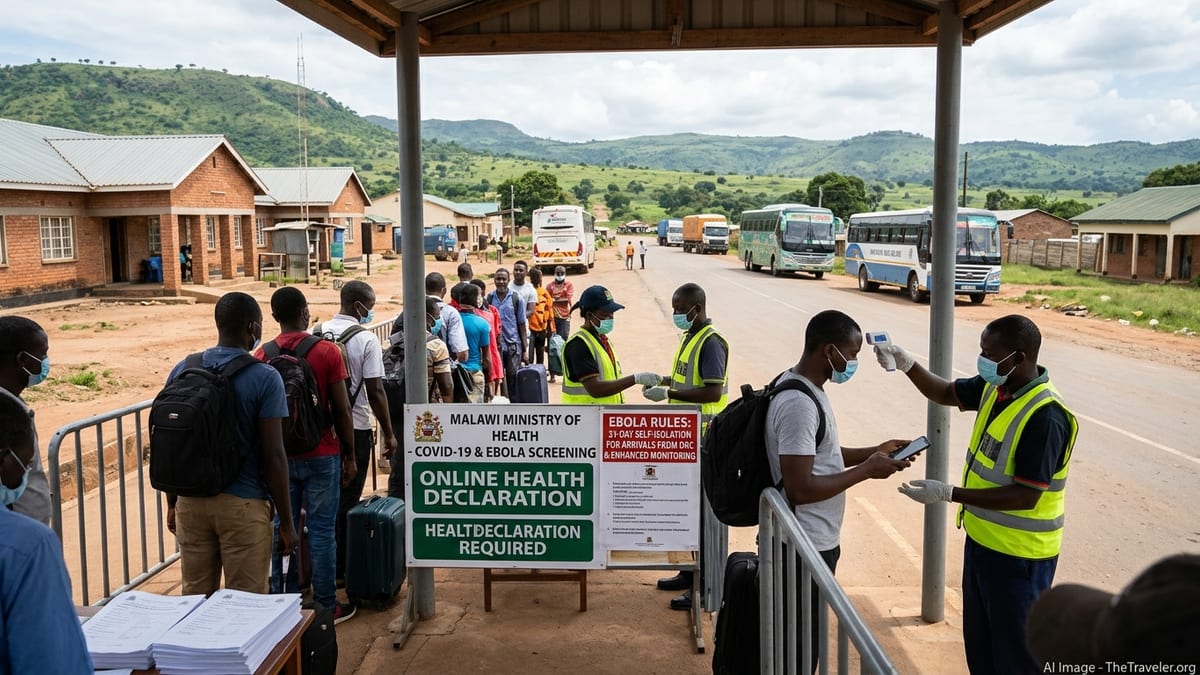
How Malawi’s new Ebola rules work at the border
The advisory, issued by Malawi’s Ministry of Health and reported locally on 22–23 November 2026, does not bar entry from the DRC. Instead, all arrivals are now required to complete an online Traveller Health Declaration Form, either before travel or on arrival, listing every country visited in the previous 21 days. Officials are using this form, together with temperature screening on arrival, to identify passengers who have recently been in DRC.
Travelers who indicate any presence in DRC during that 21-day lookback period, including short transits, are being classified for Ebola risk assessment. According to the ministry’s advisory and local media, these travelers may continue their trip into Malawi but must proceed to their stated residence or accommodation and begin a 21‑day period of self‑isolation counted from the date of arrival in Malawi.
For now, the policy applies based on recent travel history rather than nationality or direct flights. This means travelers who routed through DRC on complex itineraries, or who combined overland travel with regional flights, should expect close questioning at the border and should be prepared to document their movements over the previous three weeks.
What 21 days of self-isolation in Malawi involves
Malawi’s advisory frames the measure as self‑isolation at the traveler’s declared address rather than transfer to standardized government facilities. Travelers from or transiting through DRC are expected to remain at that address for 21 days, limit in‑person contacts and monitor their health, while public health workers conduct daily follow‑up checks, typically by phone or visit depending on local capacity.
The guidance does not spell out uniform conditions for isolation or enforcement across the country, and practice may vary by district. However, travelers are being warned that inaccurate information on the declaration form or failure to comply with monitoring could trigger further public health action under Malawi’s communicable disease laws. Those who develop Ebola‑compatible symptoms during the self‑isolation period are expected to report immediately to health authorities for assessment.
Because the incubation period for Bundibugyo‑strain Ebola is up to 21 days, the requirement effectively restricts movement within Malawi for the full window during which symptoms might first appear. Visitors with short stays should factor in that they may be unable to move freely around the country, attend large events or continue overland trips during that period.
Different rules for other outbreak-linked countries
While travelers with recent DRC exposure face mandatory self‑isolation, Malawi is applying lighter-touch measures to passengers arriving from other countries that have recorded Bundibugyo‑strain cases during the current outbreak, notably Uganda, Kenya and Nigeria. Current reporting indicates that these travelers are also required to complete the health declaration and undergo temperature screening, but are placed under “enhanced monitoring” rather than full isolation.
Enhanced monitoring typically involves regular check‑ins by health officials and instructions to self‑monitor for symptoms for 21 days, without a formal requirement to remain at a single address, although the precise procedures have not been detailed publicly. The country list associated with these additional checks is being reviewed against regional and World Health Organization updates and could change quickly as more information on the outbreak emerges.
Travelers whose itineraries include several African countries should therefore scrutinize not only DRC segments but also any recent stays in states that appear on updated advisories. Airlines and bus operators serving Malawi may adjust their own screening questions to align with the ministry’s evolving list.
Outbreak backdrop: why Malawi is tightening controls
Malawi’s move comes against the backdrop of a large Bundibugyo‑strain Ebola outbreak centered in the Democratic Republic of the Congo and extending to a small number of cases in other countries. The World Health Organization first declared this epidemic a Public Health Emergency of International Concern in mid‑May 2026 and has reaffirmed that status through subsequent reviews, noting continued growth in confirmed cases in DRC into October and November.
Recent WHO situation updates describe this as the largest recorded Ebola outbreak in DRC in terms of total cases, with infections spread across multiple provinces and a pattern of occasional international exportation to countries including Uganda, Kenya, Nigeria and France. No vaccine or specific antiviral treatment has yet been approved for Bundibugyo‑strain Ebola, which has led many states to lean heavily on border screening, contact tracing and movement restrictions for travelers with potential exposure.
Malawi has not reported any confirmed Ebola cases linked to the current outbreak as of late November 2026, and its advisory is explicitly framed as a preventive measure. Officials have cited high levels of regional mobility, particularly informal overland routes, as a reason to strengthen entry screening and post‑arrival follow‑up while keeping formal borders open.
What travelers should check before flying to Malawi
The advisory took effect immediately on publication, so anyone planning to enter Malawi from 22 November 2026 onward who has spent time in DRC in the previous 21 days should plan on a 21‑day self‑isolation period in country, including those who only transited DRC airports. This may affect safari itineraries, regional work trips and overland journeys that combine DRC with Zambia, Tanzania or Mozambique before crossing into Malawi.
Because outbreak conditions and national responses are changing quickly, travelers should recheck official guidance from Malawi’s Ministry of Health and contact their airline or travel agent shortly before departure to confirm the latest entry rules, including any updates to the list of countries subject to enhanced monitoring. Travel insurance policies should also be reviewed carefully to understand how post‑arrival isolation requirements and possible itinerary changes are treated.
Given that other governments and carriers are also adjusting their own Ebola‑related measures around the DRC outbreak, passengers connecting through regional hubs should verify requirements at every stage of their journey. Building in extra time at borders, keeping copies of onward tickets and accommodation bookings, and maintaining up‑to‑date contact details in the Traveller Health Declaration Form will help reduce complications once Malawi’s health teams begin their 21‑day follow‑up.