


More news on this day
Greek seafarers’ unions have confirmed a nationwide 24-hour ferry strike on Wednesday 25 November 2026, halting most domestic island sailings and altering key Adriatic departures in a move that underscores how dependent Greece and other coastal countries remain on uninterrupted ferry links.
Get the latest news straight to your inbox!
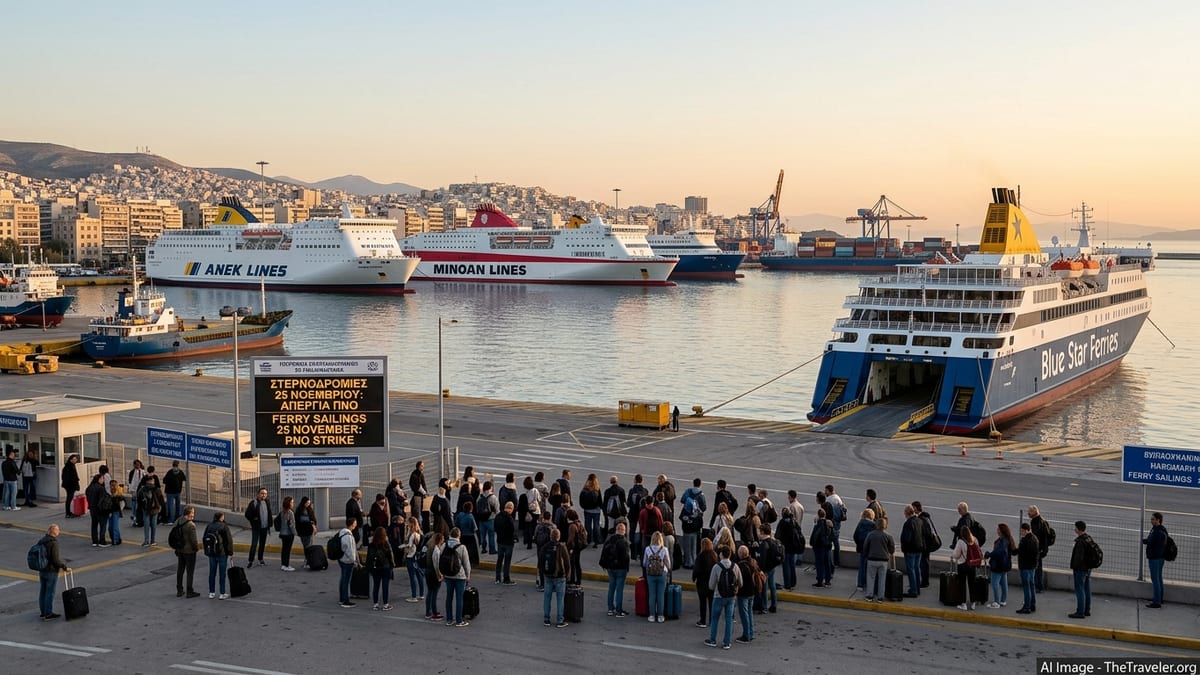
What has been confirmed for 25 November
Unions PEMEN, PENEN and STEFENSON have formally called a 24-hour nationwide strike covering all categories of vessels from 00:01 to 24:00 on Wednesday 25 November 2026. Union announcements describe the action as a panhellenic strike that applies across the fleet, including passenger ferries that connect the Greek mainland with the islands and international routes. The timing means that almost the entire operating day is affected, apart from a limited number of late-night departures that operators have shifted to depart just before or just after the core strike window.
The independent strike calendar maintained by Greek labor-tracking services lists a 24-hour ferry strike by PEMEN and PENEN on 25 November 2026, aligning with the unions’ own statements that all categories of ships will be covered. At the time of writing there is no court ruling suspending the action, and unions and operators are continuing to brief passengers based on the strike going ahead as planned. However, participation by every individual union and ship is not yet fully documented, which leaves scope for minor last-minute adjustments.
Domestic routes most clearly affected include major corridors from Piraeus to the Saronic Gulf, Cyclades and Crete, while international Adriatic routes such as Patras–Igoumenitsa–Ancona and Patras–Igoumenitsa–Bari are publishing revised schedules rather than normal operations. The precise mix of cancellations and retimed sailings varies by company, and operators are directing passengers to official notices and call centers for route-specific confirmation.
How operators are adjusting timetables
Aegina Ferries, which operates between Piraeus and the island of Aegina, states explicitly on its timetable page that all sailings from Piraeus on Wednesday 25 November 2026 will be suspended due to the strike. Local Saronic Gulf information portals carry matching notices, confirming that services from several operators, including Aegina Ferries and other Saronic providers, will remain non-operational that day. For travelers, this means there will be no same-day conventional ferry option between Piraeus and Aegina on 25 November unless a last-minute exemption is announced.
By contrast, companies on longer routes are largely modifying rather than canceling their sailings. Anek Lines has published detailed changes for 25 November 2026 that shift certain departures outside the core strike hours. For example, an updated notice shows overnight sailings timed to leave Piraeus or island ports close to midnight and to arrive at intermediate islands and back to Piraeus later the following morning, with the company emphasizing that ticket changes are not required for affected departures. This approach allows some continuity of service while formally respecting the strike’s 24-hour window.
Minoan Lines has issued a similar advisory for the Piraeus–Milos–Heraklion corridor on 25 November. Its revised schedule lists a 23:00 departure from Piraeus toward Milos and onward to Heraklion, and a retimed Heraklion–Milos–Piraeus sailing later that night, again framed as a strike-related update rather than a standard timetable. In the Adriatic, international operators serving Greek ports have published PDF bulletins that flag adjusted Patras and Igoumenitsa departure times on 25 November as part of a broader set of winter schedule changes, explicitly labeling that date for revised sailings due to industrial action.
What travelers can realistically expect
For most passengers, the practical consequence is that same-day island travel on 25 November 2026 cannot be assumed to run as booked. Travelers holding ferry tickets for that date, particularly on shorter domestic routes out of Piraeus such as Piraeus–Aegina or other Saronic islands, face a high risk of outright cancellation. On longer Aegean and Adriatic routes, sailings are more likely to operate on altered timetables, often late at night, but the exact pattern varies by company and by ship.
This disruption matters not only for holidaymakers but also for island residents who rely on ferries for access to medical care, education and work on the mainland. Anyone with a same-day flight connection in Athens or a hotel check-in tied to a 25 November ferry arrival should be prepared for missed or delayed connections. Airlines, airports and hotels have not announced any automatic waivers linked to the ferry strike, so onward travel changes typically depend on individual fare rules and policies, and may incur additional cost if not covered by flexible tickets or insurance.
Refund and rebooking conditions for the ferries themselves differ between operators and are not fully harmonized. Anek Lines and Minoan Lines both stress in their strike notices that existing tickets on retimed departures remain valid without the need for reissue, whereas companies cancelling all sailings on a route, such as Aegina Ferries on the Piraeus–Aegina leg, are handling changes and refunds through their agencies and booking partners. Passengers should therefore verify options directly with their carrier or agent, rather than assuming a standard response across the industry.
Union demands and recent precedent
The 25 November strike is part of a wider national day of industrial action and follows a similar 24-hour ferry strike held on 30 October 2026. In their latest communiqués, the seafarers’ unions outline a platform of demands that includes a 12 percent wage increase, unified collective agreements across vessel types, a 35-hour working week, increased crew complements and enhanced safety and medical provision on board. They also call for stronger protections for crews operating in or near conflict zones, reflecting concerns about both working conditions and security on certain international routes.
Union statements frame these demands as necessary to maintain safe manning levels and prevent what they describe as deterioration in working and living standards at sea. While the unions criticize government and employer responses to their previous actions, they do not call for a boycott of tourism or an extended shutdown of Greek maritime services. Instead, the strike is scheduled as a defined 24-hour stoppage, after which regular timetables are expected to resume unless new actions are announced.
For travelers, this recent pattern of short, nationwide stoppages means ferry reliability is mostly affected on specific strike days rather than across an entire season. However, it also underscores that even outside the peak summer months, key transport links can be paused at relatively short notice. The October strike, which disrupted services on many of the same routes, serves as a near-term reminder that Greece’s busy ferry network is exposed to labor disputes as well as weather and technical issues.
Wider lessons for ferry-dependent destinations
Greece’s experience on 25 November highlights the structural vulnerability of countries whose islands and coastal communities depend on ferries for basic connectivity. From the Piraeus hub, ferries fan out to the Cyclades, Dodecanese, Crete and the Saronic Gulf, serving routes that in many cases have no practical alternative other than occasional flights. A single-day strike can therefore interrupt supply chains and essential travel in ways that go beyond tourism, even if most services resume quickly afterward.
Comparable patterns exist in other ferry-reliant regions such as Italy’s smaller islands, Croatia’s Adriatic archipelagos and parts of Scandinavia, where boats function as everyday public transport. Labor disputes, regulatory changes or safety concerns in those systems could, in theory, create similar short-term disruptions, although there is currently no evidence of coordinated or imminent copycat strikes linked directly to the Greek action. The Greek case nonetheless offers a live example of how operators and authorities might communicate schedule changes, protect overnight links and manage passenger expectations when ferry crews stop work.
For now, the focus for travelers should be practical rather than speculative. Anyone scheduled to sail in Greece on or around Wednesday 25 November 2026 should monitor operator websites and port authority notices up to departure time, watch for any late legal decisions that could modify or postpone the strike, and be ready to adjust plans if a critical sailing is cancelled or retimed. Beyond this date, there is no confirmed timetable for further ferry strikes, and standard Greek ferry services are expected to operate according to published winter schedules unless and until new industrial actions are announced.