


More news on this day
Hotels across New Jersey with centralized hot water systems now face a firm December 12, 2026 deadline to have Legionella-focused water management programs fully up and running, under a statewide law that aims to cut the risk of Legionnaires’ disease in large buildings.
Get the latest news straight to your inbox!
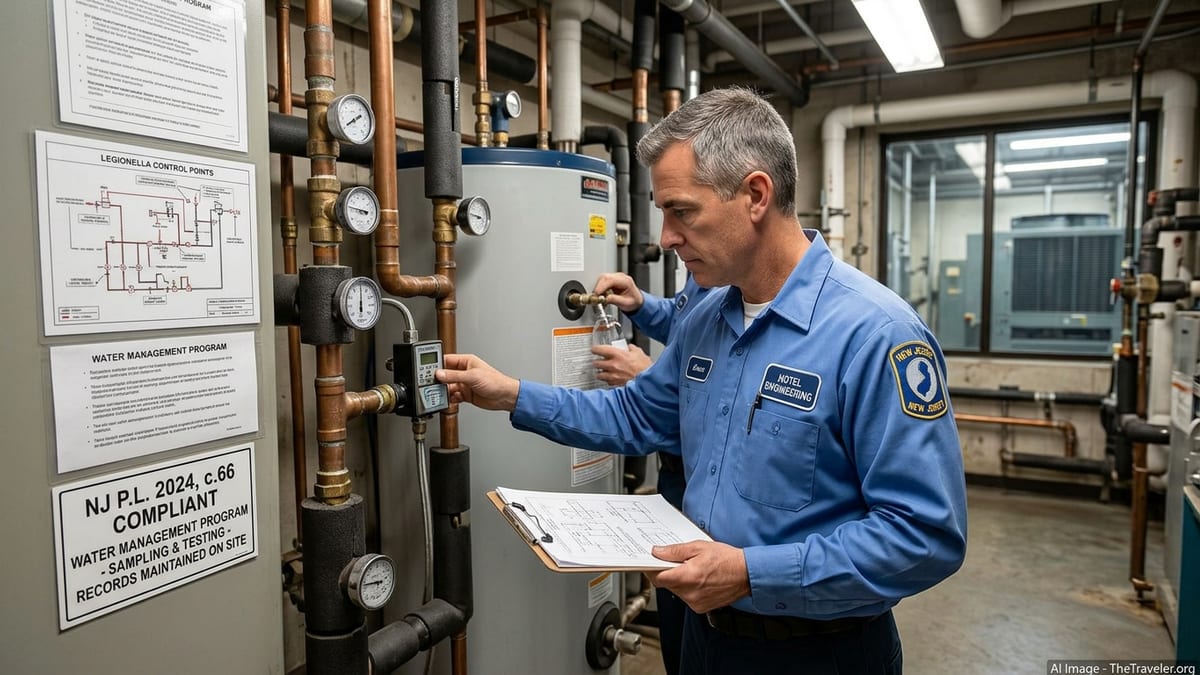
What New Jersey’s Legionella law requires from hotels
New Jersey’s P.L. 2024, c.66, in force since September 12, 2024, requires owners of “covered buildings” to create and run formal water management programs to control Legionella bacteria in on-site water systems. Covered facilities include hotels and motels that use centralized potable hot water to serve at least 25 transient units, as well as certain multi-story residential buildings and any property with features such as cooling towers, spas or pools that fall under the law’s criteria.
The statute sets two statewide compliance milestones. Owners must develop a written water management program consistent with ASHRAE Standard 188-2018, or a comparable nationally recognized standard, within 24 months of the effective date, which is by September 12, 2026. They then have an additional three months to put that program into operation, making December 12, 2026 the implementation deadline after which civil penalties can be imposed for noncompliance.
Legal advisories published in late 2026 emphasize that, for hotels, having a plan on paper will not be enough after December 12. To meet the law’s requirements, properties will need to show that procedures are being followed, monitoring and testing are occurring where required, and records are being maintained in line with New Jersey Department of Health rules and ASHRAE 188-aligned best practices.
What a Legionella water management program looks like in practice
Under P.L. 2024, c.66 and supporting New Jersey health materials, a compliant water management program is a structured, documented system rather than a single test or one-time upgrade. Hotels must designate a program team responsible for Legionella control, document their building water systems with written descriptions and schematics, and identify points where Legionella could grow or spread, such as hot water tanks, long pipe runs, cooling towers, decorative fountains or spas.
For each identified hazard location, the program must define control measures and limits, set out how conditions will be monitored, and specify corrective actions when limits are not met. Verification and validation steps are also required so that owners can demonstrate that the program is both implemented as designed and actually reducing risk. State guidance stresses that these programs are meant to be living documents, updated as building systems or operating conditions change.
Sampling and testing, where required, must at minimum include Legionella pneumophila and be carried out in a way that is consistent with rules and procedures developed by the New Jersey Department of Health and with ASHRAE 188-consistent best practices. The law also obliges owners to keep program documents and related records on site for at least five years, and to follow federal Centers for Disease Control and Prevention guidance when they interpret and respond to positive Legionella results.
Why this matters now: recent outbreaks and traveler risk
Legionnaires’ disease is a severe form of pneumonia caused by inhaling small droplets of water that contain Legionella bacteria, which can grow in warm, stagnant water in large or complex building systems. According to CDC data, a noticeable share of reported cases in the United States occurs in people who traveled during their exposure period, and hotels, cruise ships and other accommodations are among the settings where investigations sometimes begin.
In 2026, several high-profile Legionnaires’ disease investigations linked to large buildings, including hotels and cooling-tower-equipped properties in major U.S. cities, have underscored how building water systems can amplify the bacteria when controls fail or are absent. A recent outbreak on New York City’s Upper East Side, for example, involved dozens of cases and multiple large buildings with cooling towers that tested positive for Legionella, drawing renewed attention to water management lapses in dense urban areas. These incidents are separate from New Jersey’s situation, but they illustrate the type of risk the state’s law is designed to reduce.
New Jersey health authorities note that Legionnaires’ disease remains relatively uncommon at the population level, yet it can be serious, particularly for adults aged 50 and over, smokers, people with chronic lung disease and those with weakened immune systems. Risk is highest in buildings where water systems are poorly designed, inadequately maintained or lack systematic Legionella controls, which is why regulators and the CDC frame comprehensive water management programs as the primary strategy for prevention in hotels and other high-risk facilities.
How travelers may experience the changes in New Jersey hotels
Most of the work required to comply with New Jersey’s Legionella law will take place out of public view, in mechanical rooms, maintenance schedules and documentation systems. Guests staying in covered hotels should not expect to see prominent changes at the tap or shower beyond the standard safety and comfort measures, but over time the law aims to make infrastructure and operating practices more consistent across the state’s larger and more complex properties.
For travelers in higher-risk groups, CDC resources suggest that it can be reasonable to ask large hotels, especially older buildings or resorts with features like spas and cooling towers, whether they have an active Legionella water management program and how they maintain their water systems. While New Jersey’s statute does not require hotels to share detailed internal plans with guests, properties that have engaged seriously with the new rules should be able to confirm that a program exists and is being followed.
Health agencies caution that staying in a compliant property does not reduce Legionnaires’ disease risk to zero, but it does significantly lower the likelihood that building water systems will be a source of exposure. Travelers who develop pneumonia-like symptoms such as cough, fever, shortness of breath or muscle aches within about two weeks of a hotel stay are advised to seek medical care promptly and mention recent travel.
What happens after the December 12, 2026 implementation deadline
Once the December 12, 2026 implementation deadline passes, New Jersey authorities can begin enforcing the Legionella law’s provisions across covered buildings, including hotels and motels with qualifying central hot water systems. The statute provides for civil penalties starting at 2,000 dollars per violation, rising to 5,000 dollars and then 10,000 dollars for subsequent offenses, and also allows for injunctive relief to compel compliance in serious or persistent cases.
Specific enforcement actions, inspection priorities and hotel-by-hotel compliance levels have not yet been widely documented. The New Jersey Departments of Health and Environmental Protection are tasked with issuing detailed implementing regulations, and property owners are being advised to monitor official bulletins and technical guidance as those rules are finalized. Travelers planning New Jersey stays in late 2026 or beyond who are particularly concerned about Legionella may wish to check the latest state advisories and, if needed, ask individual hotels how they have responded to the law.
Because similar Legionella control requirements are being adopted in some other jurisdictions, including New York City and several states with their own building-water rules, New Jersey’s statewide deadlines also reflect a broader regulatory trend toward formal water management programs in the hospitality sector. For now, though, the December 12, 2026 implementation date and related penalties apply specifically to covered buildings within New Jersey, and travelers should rely on up-to-date state and local guidance to understand how those rules are being enforced over time.