


For most travellers heading from Cairns Airport to Port Douglas, the Daintree or the Atherton Tablelands, a rental car is the most flexible way to explore. The coastal and hinterland drives are spectacular, but picking the right hire car and understanding the local conditions will make a big difference to your budget and stress levels. This guide walks you through Cairns Airport car rental options, insurance and deposits, and what to expect when driving and parking in Port Douglas, the Daintree and the Tablelands.
Get the latest updates straight to your inbox!
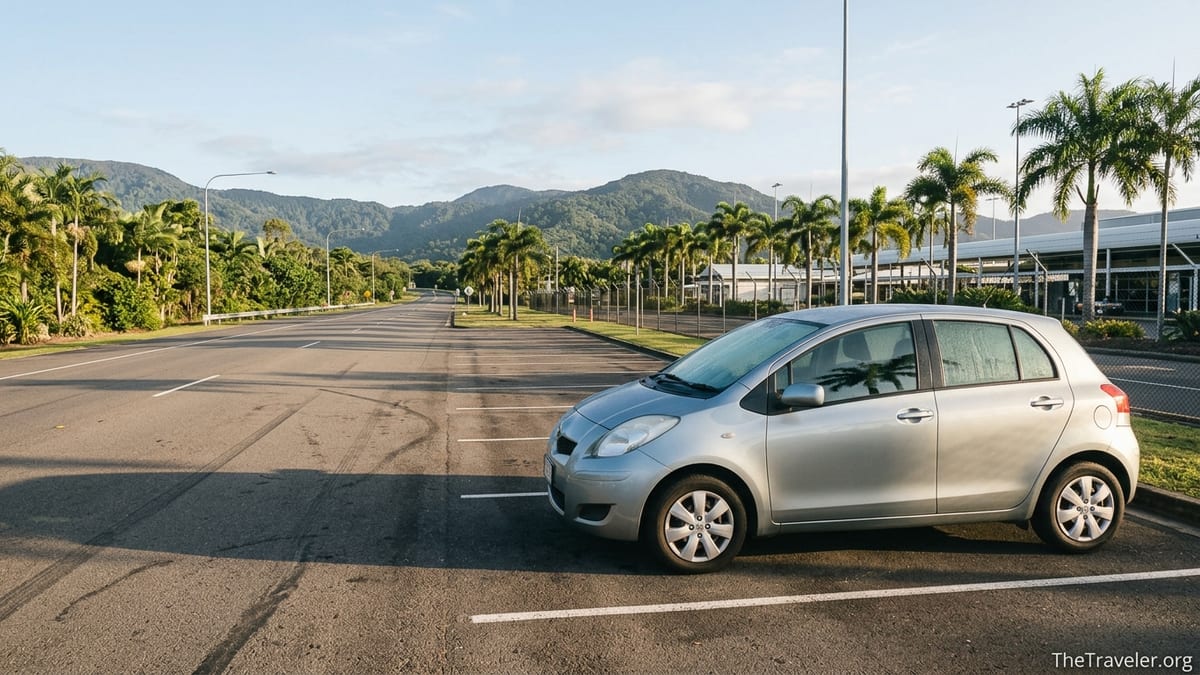
Cairns Airport car rental basics: on-airport vs off-airport
Cairns Airport is one of Queensland’s busiest regional gateways and has a wide choice of rental companies with desks in both the international (T1) and domestic (T2) terminals. Major brands such as Avis, Budget, Hertz, Europcar, Sixt, Thrifty, Alamo, Enterprise, National and Dollar all operate on-airport, with counters in the arrivals halls and dedicated car parks signposted from Airport Avenue and Airport Drive. On-airport rentals are the quickest option if you want to drive straight out toward Port Douglas or the Atherton Tablelands after landing.
Alongside the big international brands there is a cluster of off-airport operators based around Cairns city and the northern suburbs. Companies such as East Coast Car Rentals, Ace, Apex, Bargain, Jucy and local outfits like BettaCNS typically run free shuttle buses from outside the terminals to their depots. The trade-off is time versus price: you can often save a noticeable amount per day compared with on-airport desks, but you should allow an extra 20 to 45 minutes for pickup and drop-off depending on traffic and how busy the shuttle is.
As a rough guide, an economy hatchback picked up at the airport might start in the region of 70 to 100 Australian dollars per day in peak season, while an off-airport equivalent can sometimes be found for 20 to 30 dollars less per day if booked well in advance. Prices vary sharply with school holidays, major events and how close to arrival you book, so it is worth checking comparison sites and then cross-checking directly with a couple of preferred suppliers.
Opening hours also matter if your flight lands late at night. Most on-airport desks at Cairns usually align their hours with the day’s scheduled flights and some stay open until around 11 pm or midnight when there are late arrivals. Smaller off-airport depots may close earlier in the evening or charge after-hours pickup fees. If your flight is due after 9 pm, check and confirm your pickup time with the rental company in advance and provide your flight number so they can track delays.
Desks, pick-up, returns and practical airport details
At T2, the domestic terminal, rental counters are grouped in the arrivals hall at the northern end once you exit the baggage claim. At T1, the international terminal, desks are in the ground-floor arrivals area. In both terminals signage for “Car Hire” directs you towards the counters, and staff will either walk you to the car park level or provide directions to their signed bays in the adjacent car parks.
For on-airport rentals, vehicles are parked in designated rental car parks a short walk from the terminal doors. After completing paperwork at the desk, you will be given a bay number or row and the keys. Before driving away, take a slow walk around the car and photograph each side, the windscreens, wheels and any existing scratches or stone chips. Doing this in the airport car park, with reasonable lighting, can prevent disputes later about damage allegedly caused during your rental.
Returns are usually straightforward. When approaching Cairns Airport along Airport Avenue or from the Captain Cook Highway, follow signs for your terminal and then “Rental Car Returns.” Each brand has a clearly signed area. You simply park in a marked bay, gather your belongings and either meet an attendant for inspection or drop your keys at the company counter or key box if you are returning outside staffed hours. Many travellers returning very early in the morning choose to refuel the night before at a service station on Sheridan Street or the Captain Cook Highway to avoid hunting for fuel near the airport at dawn.
If you are using an off-airport provider with a shuttle, the process is reversed. You will usually call the depot once you have collected your luggage and they will tell you where to wait outside the terminal. On return, you drive back to their depot, complete the check-in and then board the shuttle back to your terminal. This can work smoothly if you build in generous time before your flight; most travellers aim to be at the depot two hours before a domestic departure or three hours before an international flight, especially in the June to October high season.
Insurance, excess and deposits: how coverage really works
Car rental pricing in Australia is built around a standard vehicle damage excess, sometimes called a deductible. At Cairns Airport, it is common for a standard contract on a small car to carry an excess in the range of 4,000 to 6,000 Australian dollars. This does not mean you will be charged that amount automatically; it is the maximum you could pay if the car is damaged or stolen. To manage this risk, most renters either buy the rental company’s excess reduction, use a separate standalone policy, or rely on a credit card’s travel insurance if it clearly includes rental car excess cover.
The rental company’s “peace of mind” or “full cover” package can often double the daily base rate, for example adding 35 to 50 dollars per day to bring the excess down to a few hundred dollars or sometimes to zero. A family hiring a mid-size SUV for a seven-day Port Douglas and Daintree trip might see a base quote of 700 dollars jump to more than 1,000 dollars when the in-house excess reduction is added. Specialist third-party excess insurance, bought online before your trip, can cost significantly less per day, but in that case you pay the rental company if there is damage and then claim reimbursement from the insurer later.
Deposits are normally taken as a pre-authorisation on your credit card at pickup. For on-airport rentals in Cairns, this can be anything from 200 to 500 dollars for low-excess bookings to around the level of the standard excess for bare-bones coverage. Some off-airport budget operators may require higher bonds, especially for younger drivers or debit card rentals. Make sure your credit card limit is high enough to accommodate both the bond and your travel spending, and remember that it can take several business days for a pre-authorisation hold to clear after you return the car.
Read inclusions carefully. Windscreen and tyre damage may not be covered by basic packages. This is important around Cairns, where the Captain Cook Highway, inland routes to the Tablelands and unsealed side roads can expose your car to stone chips and potholes, particularly after heavy rain. If you are planning to drive after dark in areas with more wildlife, such as the inland road between Mareeba and Atherton, check whether animal strikes are covered, and under what conditions.
Choosing the right car for Port Douglas, Daintree and Tablelands trips
For most travellers driving from Cairns Airport to Port Douglas or the main sealed attractions in the Daintree and Atherton Tablelands, a standard 2WD car is entirely adequate. The Captain Cook Highway between Cairns and Port Douglas is sealed and signposted, and the road to the Daintree ferry and Cape Tribulation village is also sealed, with steep and winding sections but no requirement for four-wheel drive in normal conditions. Similarly, popular Tablelands destinations such as Kuranda, Mareeba, Atherton, Yungaburra and Lake Eacham are connected by sealed highways and town roads.
A compact hatchback is usually enough for couples or solo travellers with one large suitcase each, and economy models are easiest to park on busy streets in Cairns or Port Douglas. Families or groups heading to Port Douglas for a week, with beach gear and shopping, may be more comfortable in a mid-size SUV or wagon, especially if travelling with child seats. Many rental counters at Cairns Airport carry popular models such as the Toyota Corolla, Hyundai i30, Mitsubishi ASX, Kia Sportage or Toyota RAV4; exact models are not guaranteed, but the size category and number of doors usually are.
Four-wheel drive is only really necessary if you intend to venture onto unsealed roads that are explicitly allowed by your rental contract. Some visitors are surprised to discover that many hire agreements around Cairns prohibit driving on certain unsealed roads north of Cape Tribulation or on remote forestry tracks into the Tablelands, even with a 4WD. If you are planning a more adventurous itinerary, for example to Bloomfield Track or inland state forest roads, you should search specifically for a 4WD operator that permits those routes and be prepared to pay a premium for both the vehicle and insurance.
Air conditioning is essential in the tropical climate, especially between November and March when daytime temperatures and humidity are high. When comparing deals, assume you will want a car with functioning air conditioning, Bluetooth or USB connectivity for navigation, and at least basic emergency equipment. Given the distances involved, particularly for Tablelands loops via Kuranda and Atherton, comfort and safety features are worth a modest extra cost.
Driving from Cairns Airport to Port Douglas, the Daintree and the Tablelands
The signature drive for many visitors is the run from Cairns Airport to Port Douglas along the Captain Cook Highway. Once you exit the airport precinct, you join the highway heading north, passing the northern beaches before the road hugs the coastline with sweeping ocean views. In normal conditions it takes around one hour to reach Port Douglas, but you should allow more time if you want to stop at viewpoints such as Rex Lookout or if there have been recent heavy rains affecting roadworks and speed limits.
The Captain Cook Highway is a beautiful but sometimes demanding coastal road, with winding sections, occasional roadworks and local traffic that may include trucks and caravans. Plan to drive this section in daylight if possible, especially if you are not used to driving on the left. Many travellers landing in the late afternoon at Cairns aim to be on the road by mid-afternoon so they can arrive in Port Douglas in full daylight, avoiding dusk when wallabies and other wildlife are more active near the road.
For the Daintree, most visitors base themselves in Port Douglas or Mossman and then drive north to the Daintree River ferry, which operates daily with fees payable at the crossing. From Cairns Airport to the ferry takes around 1 hour 45 minutes without extended stops. Beyond the ferry, the Cape Tribulation Road is sealed as far as Cape Tribulation village, but it is narrow and winding in places, with one-lane bridges and rainforest shade. Observe speed limits carefully, watch for speed bumps in small settlements and avoid driving back to Port Douglas late at night if you can.
The Atherton Tablelands can be reached from Cairns via the Kuranda Range Road or the Gillies Range Road. From the airport, many travellers take the Kuranda route, which climbs through rainforest to the plateau. Allow around 1 hour 30 minutes from Cairns Airport to Atherton township in normal traffic. These range roads are steep and twisty; use low gears on descents, allow extra time in wet conditions and avoid tailgating. Once on the Tablelands, most main roads between key sights like Malanda, Yungaburra and the crater lakes are straightforward sealed two-lane roads.
Parking in Port Douglas, Daintree and the Atherton Tablelands
Port Douglas is compact and walkable, with most restaurants, bars and shops concentrated along Macrossan Street and the surrounding grid of streets. Free parking is usually available on side streets and in the main public car park off Macrossan Street, although spaces around the centre fill quickly in the early evening and on Sunday market mornings. Many apartment-style resorts and holiday rentals on and around Davidson Street and Port Douglas Road include at least one on-site parking space per unit, which makes it easy to leave the car and explore on foot.
When visiting Four Mile Beach, there are informal parking areas at the northern end near Macrossan Street and more spaces scattered along the back streets behind the beach. During school holidays, these can be busy in the late afternoon when people drive down for a swim and sunset. In practice, most visitors who base themselves in Port Douglas for several days find they only use the car for day trips north to the Daintree or south to Cairns and the Tablelands, leaving it parked the rest of the time.
In the Daintree, parking is generally straightforward at major visitor sites. Attractions such as the Daintree Discovery Centre, boardwalks like Jindalba and Marrdja, and beaches near Cape Tribulation have dedicated car parks, often with unsealed surfaces but accessible to standard 2WD vehicles. During peak season, late morning and early afternoon can be busy, so arriving earlier in the day improves your chances of finding shaded spots and reduces the time spent circling for a space.
Across the Atherton Tablelands, small towns and natural attractions typically offer free parking close to the main sights. Lake Eacham, Lake Barrine, Millaa Millaa Falls and similar spots have car parks that can fill on sunny weekends, but turnover is steady as visitors complete walking circuits and move on. A practical approach is to plan a loop with multiple short stops rather than expecting to stay in one car park all day, particularly around the more popular waterfall circuit.
Is a rental car worth it compared with transfers and tours?
Whether a Cairns Airport rental car is worth the cost depends on your itinerary and travel style. For a couple flying in for a three-night stay at a Port Douglas resort who primarily want to relax in town, a shared airport transfer or private shuttle might be cheaper and simpler than hiring a car for the entire stay. A typical one-way shuttle fare per adult between Cairns Airport and Port Douglas can be competitive with a single day’s car hire, especially once fuel and overnight parking are considered, and some resorts are happy to arrange transfers that align with your flight.
On the other hand, if you are planning several day trips, a car quickly becomes economical. A family of four staying a week in Port Douglas who want to visit the Daintree, Mossman Gorge, Kuranda and perhaps do a Tablelands loop will likely save money and gain flexibility with a rental car compared with booking multiple separate tours and transfers. Being able to stop spontaneously at beaches, roadside fruit stalls and viewpoints along the Captain Cook Highway is a substantial advantage that scheduled coaches cannot easily replicate.
For travellers focused on reef trips and guided rainforest experiences, a hybrid approach can work well. You might rent a car only for two or three key days and rely on tour operator pickups from your accommodation for the rest of the time. For example, you could use a transfer from Cairns Airport to Port Douglas, then hire a car in Port Douglas for two days to explore Mossman and the Daintree at your own pace, and finally take a shared shuttle back to the airport. This can reduce both rental days and parking worries while still giving you independent days on the road.
It is also worth factoring in comfort and time. Self-driving from Cairns Airport allows you to leave as soon as your luggage is collected, avoid waiting for other passengers and manage your own rest stops. During the busiest months from June to September, when flights into Cairns are often full, airport transfer coaches and shuttles can take longer than the direct driving time once multiple hotel drop-offs are added. If you value control over your schedule, a rental car is usually the better option.
Local driving conditions, safety tips and weather considerations
Driving in Far North Queensland is generally straightforward, but local conditions deserve respect. You will be driving on the left-hand side of the road, with speed limits commonly set at 60 kilometres per hour in built-up areas, 80 or 100 on open sections of the Captain Cook Highway, and lower limits on steep range roads. Fixed and mobile speed cameras do operate in the region, and fines can be substantial, so using cruise control within limits on longer stretches is helpful.
Weather is the major variable. The period from roughly November to April corresponds to the wet season, when heavy rain, thunderstorms and occasional flooding can affect roads, particularly on the coast and in low-lying areas. Sections of the Captain Cook Highway and certain inland routes have been temporarily closed in recent years after intense rain events. Before setting out, especially after storms, check local traffic and road condition updates, and listen to advice from your accommodation hosts or rental staff regarding any closures or detours.
Wildlife is another consideration. At dawn, dusk and night, wallabies, kangaroos and occasional larger animals can be active near or on the road, particularly on rural sections north of Port Douglas and on the Tablelands. Hitting wildlife can cause serious damage and may not be fully covered by standard rental insurance, so avoiding non-essential night driving outside towns is sensible. If you must drive in the dark, reduce your speed, use high beams where legal and safe, and remain alert for movement at the road edges.
Finally, fatigue can creep in after a long flight and a winding coastal or range drive. If you are arriving from a long-haul international flight into Cairns and planning to drive straight to Port Douglas or the Tablelands, consider sharing the driving with a second licensed driver on the contract or booking an overnight stop in Cairns before continuing. Adding an additional driver to the rental may incur a daily fee, but it is often a modest cost for the extra safety and flexibility.
The Takeaway
Renting a car at Cairns Airport opens up some of Queensland’s most memorable coastal and rainforest drives, from the Captain Cook Highway to Port Douglas to the winding roads of the Daintree and Atherton Tablelands. On-airport desks from major brands offer speed and convenience at a price, while off-airport operators reward those willing to factor in shuttle time. Understanding how insurance excesses, deposits and coverage exclusions work will help you avoid surprises and choose the right level of protection for your comfort.
For most travellers whose plans include more than a simple resort stay, a rental car is usually worth the cost. It gives you freedom to stop at viewpoints, reach trailheads early, linger over lunch in Tablelands towns and adapt your plans if the weather shifts. Balancing a few car-based exploration days with reef tours and guided experiences can deliver a rich, flexible itinerary without overspending on transport.
Approach local roads with respect for the conditions, allow extra time in the wet season and avoid unnecessary night driving in wildlife-prone areas. With a little preparation at the rental desk and a realistic driving plan, the roads radiating from Cairns Airport become part of the adventure rather than an obstacle, letting you experience Port Douglas, the Daintree and the Atherton Tablelands on your own terms.
FAQ
Q1. Do I really need a car to get from Cairns Airport to Port Douglas?
Many travellers use shared shuttles or private transfers, but a rental car is useful if you plan day trips to the Daintree, Mossman Gorge or the Tablelands, or prefer full control over your schedule.
Q2. How long does it take to drive from Cairns Airport to Port Douglas?
In normal conditions the direct drive along the Captain Cook Highway takes around one hour, but you should allow extra time for traffic, roadworks and scenic stops.
Q3. Is the drive from Cairns to Port Douglas dangerous?
The Captain Cook Highway is winding and requires attention, but it is a standard sealed highway. Driving in daylight, keeping to speed limits and avoiding heavy rain or fatigue greatly reduces risk.
Q4. Do I need a 4WD to visit the Daintree and Cape Tribulation?
No, for the sealed road to the Daintree ferry and as far as Cape Tribulation village a regular 2WD car is normally sufficient, provided you stay on permitted sealed roads.
Q5. What about insurance for my Cairns rental car?
Most rentals include basic cover with a high excess. You can reduce this via the rental company’s package, a separate excess policy or eligible credit card insurance, depending on your risk tolerance.
Q6. Is parking easy in Port Douglas?
Yes, Port Douglas is small and has free street and public car park options near Macrossan Street, though spaces can be busy at peak dining times and on market mornings.
Q7. Can I rent a car only for part of my stay?
Yes, some visitors use an airport transfer to reach Port Douglas, rent a car locally for one or two exploration days, then rely on transfers or tours for the rest of the trip.
Q8. Are there fuel stations near Cairns Airport and Port Douglas?
There are service stations along Sheridan Street and the Captain Cook Highway between Cairns and Port Douglas, and a petrol station on the outskirts of Port Douglas for refuelling before return.
Q9. Do rental cars in Cairns come with unlimited kilometres?
Many airport rentals offer unlimited kilometres within a defined region, but some budget or specialty contracts have daily limits, so you should check your specific booking conditions.
Q10. Is it safe to drive in the wet season around Cairns?
It can be, provided you monitor weather and road condition updates, avoid flooded roads, reduce speed in heavy rain and are prepared to adjust plans if certain highways are temporarily closed.