


Landing at Manila’s Ninoy Aquino International Airport (NAIA) and heading straight to Makati’s business hotels, nightlife streets or serviced apartments is a common first step for many visitors to the Philippines. The good news: NAIA sits only around 7 to 10 kilometers from Makati, and in light to moderate traffic the journey can take as little as 25 to 35 minutes. The challenge is choosing the right transfer option for your arrival time, budget, luggage and comfort level in Manila’s sometimes chaotic traffic and taxi scene. This guide breaks down the main options and how they work in real life, from Grab to coupon and yellow taxis, private transfers and hotel cars, plus what to expect at the different terminals.
Get the latest updates straight to your inbox!
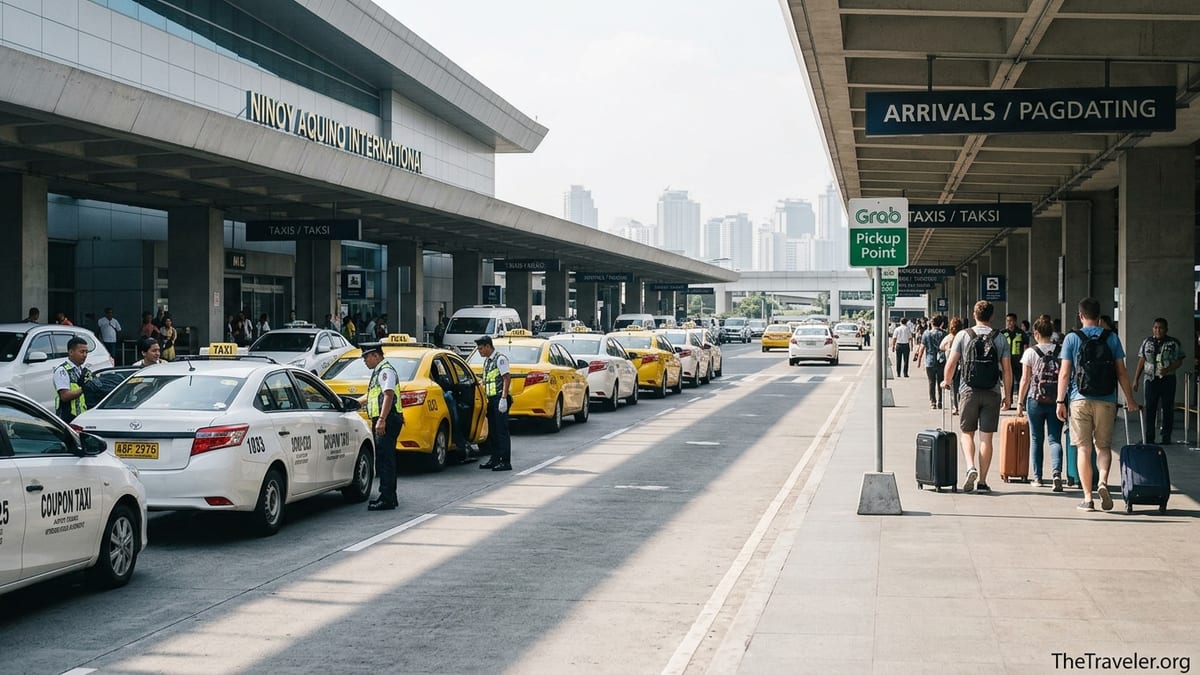
Navigating NAIA on Arrival: Terminals, Time and First Steps
NAIA has four passenger terminals spread between Pasay and Parañaque, south of central Manila and southwest of Makati. Most long-haul international flights land at Terminal 1 or Terminal 3, with some regional and domestic flights using Terminals 2 and 4. Regardless of terminal, you will exit into an arrivals area with currency exchange counters, ATMs, SIM card stalls and clearly marked transport bays just outside. For most travelers heading to Makati, you will follow signs for “Taxis,” “TNVS / Grab” or “Airport Transport” once you clear customs.
Travel time from NAIA to Makati is heavily dependent on traffic. Hotels near Ayala Avenue, such as The Peninsula Manila or Fairmont Makati, can be around 7 to 9 kilometers from Terminal 3. In free-flowing late-night traffic that can be a 20 to 30 minute drive, while late afternoon rush hour on a rainy weekday can easily stretch the same trip to 50 minutes or more. Many business travelers and returning Filipinos report typical journeys of 30 to 45 minutes to central Makati during the day, and about half an hour to more nightlife-oriented areas like Poblacion in the evening if there are no heavy downpours.
Before committing to any transfer, consider the time and day you land, how much luggage you are carrying, and whether you are comfortable using ride-hailing apps on mobile data right away. First-time visitors arriving after a long-haul flight at 22:00 with two checked suitcases will usually prioritize convenience and predictability. Younger backpackers landing at 13:00 with just a carry-on might instead prioritize cost and be happy to wait a little longer for a cheaper ride.
It is also wise to have your hotel’s full address and a nearby landmark saved on your phone. Many drivers are very familiar with major hotels like New World Makati, Citadines Salcedo, I’M Hotel or City Garden Grand in Poblacion. For smaller guesthouses, it helps to know which neighborhood you are in, such as Legazpi Village near Greenbelt, Salcedo Village near Ayala Triangle, or Rockwell near Power Plant Mall.
Grab From NAIA to Makati: Pros, Pricing and Practical Tips
For many independent travelers, Grab is the most straightforward way to get from NAIA to Makati. GrabCar operates widely in Manila, and there are official Grab booths in NAIA terminals with staff who can help you book a ride even if you have just landed and do not yet have a local SIM or a working app. You tell the staff your destination hotel, they input it into their device, and then direct you to a designated pickup bay where the driver meets you.
Typical fares for GrabCar from NAIA to central Makati, reported by frequent users in 2026, often sit in the range of roughly 350 to 600 Philippine pesos for a standard four-seater car in normal traffic, with the higher end more likely during evening peaks or wet weather. Travelers posting recent experiences commonly mention paying under 500 pesos from Terminal 1 or 3 to areas like Legazpi Village or Salcedo Village, and only occasionally higher when both traffic and demand spike at the same time.
One of the main advantages of Grab is transparency. The app gives you a fixed or near-fixed fare estimate before you confirm the ride, so there is less room for haggling or surprises. You also see the driver’s name, plate number and approximate arrival time, which is reassuring if you are new to Manila. Payment can be cash or card, depending on how you set up your account, and you can track the route via GPS on your phone.
There are a few practical points to keep in mind. First, the Grab pickup points are not directly outside the arrivals doors in every terminal; at Terminal 3, for example, you may have to walk to a specific bay where ride-hailing services are allowed to stop. Second, during very late hours or in heavy rain, the waiting time can lengthen if many passengers request rides at once. Third, if you have bulky luggage or are a group of four adults with big suitcases, consider booking a larger vehicle type. In Manila, many six-seater Grab vehicles like Toyota Innovas or Mitsubishi Xpanders will fold down their rear row to fit luggage, which means they realistically carry three or four passengers plus bags rather than six adults.
Coupon and Yellow Taxis: How the Official Airport Taxis Work
NAIA has two types of official taxi services that are generally easier and safer than hailing random white street taxis at the curb: coupon taxis and yellow airport taxis. Both have dedicated counters or lanes in each terminal. Coupon taxis work on a fixed fare basis that is set by government regulators and the airport authority for different zones around Metro Manila. You go to a coupon taxi desk in the arrivals area, tell the staff you are going to Makati and provide your exact address, then pay or receive a slip with the fixed fare to show the driver outside.
Recent guides and traveler reports suggest that coupon taxi fares from NAIA to areas of Makati typically fall in a band of roughly 330 to 500 pesos, depending on the specific zone within the city and any updates to official tariffs. Some visitors like coupon taxis because you know the total cost up front and the amount is printed on an official slip. For a solo traveler arriving at 23:00 and staying near Greenbelt, walking up to the coupon taxi counter by the exit of Terminal 1 and taking a fixed-fare ride to Makati can be one of the simplest options, especially if you are tired and do not want to set up apps or worry about mobile data immediately.
Yellow airport taxis, on the other hand, are metered but operate on a slightly higher tariff than regular street taxis. They have their own queue just outside the arrivals exit, and an airport staff member will usually give you a dispatch slip showing the taxi plate number and numbers to call if there is a problem. The flag-down rate is higher than standard city taxis, and then a per‑distance and per‑waiting‑time charge is added. In real terms, many travelers report paying in the broad range of 400 to 700 pesos for a yellow taxi from NAIA to various parts of Makati, with the upper end more likely in very heavy traffic.
Both coupon and yellow taxis are, in practice, often more straightforward than dealing with unregulated offers in the arrivals driveway. The vehicles are not always new, but they are part of established airport concessions, and the combination of dispatch slips and fixed or metered rates gives some protection against overcharging. If you choose either option, keep your slip until you reach your hotel. Should anything feel off, hotel security and front desk staff in places like The Peninsula Manila, Raffles Makati, or I’M Hotel are used to helping guests resolve taxi issues and can note the plate number from your slip.
Private Transfers and Hotel Cars: When Convenience Beats Cost
For travelers who want to remove almost all friction after a long flight, private transfers arranged in advance are worth serious consideration. Several reputable companies offer prebooked transfers from NAIA to Makati hotels using sedans, MPVs or vans, with an English‑speaking driver waiting in the arrivals hall holding a sign with your name. Services marketed through international platforms or their own websites typically price a one‑way private car transfer to Makati somewhere in the ballpark of 1,000 to 2,000 pesos for a standard sedan, with higher prices for premium vehicles or larger vans that can handle groups and multiple suitcases comfortably.
Well‑known Manila car services and regional operators focus on predictable door‑to‑door transfers between NAIA and central business districts like Makati and Bonifacio Global City. These providers emphasize that their drivers track your incoming flight, wait even if you are delayed at immigration, and help load luggage into the car. For many business travelers arriving from long‑haul routes from Europe or North America, paying a bit more than a taxi fare to step into a clean, air‑conditioned sedan with a driver holding a sign can feel like money well spent.
Some top‑end hotels in and around Makati also maintain their own limousine or car services. For example, five‑star properties in Makati’s Ayala Center traditionally offer chauffeured sedans or SUVs that can pick you up directly from NAIA at a premium price. Guests have reported hotel‑arranged airport pickups in the range of roughly 3,000 to 4,000 pesos or more per car for central Makati addresses, depending on vehicle type. While this is several times the cost of a Grab or coupon taxi, it includes the assurance that the hotel is fully responsible for your arrival experience.
Private transfers are especially attractive for late‑night arrivals, travelers carrying valuable equipment, families with small children, or older passengers who may not want to navigate crowded taxi queues. A family of four landing at 01:00 with two large checked bags each, staying in a serviced apartment near Rockwell, might book a prearranged MPV or van so there is no need to negotiate or squeeze into a smaller taxi. The driver meets them just beyond customs, helps with luggage and knows how to get straight to their building’s drop‑off entrance.
Traffic Patterns, Luggage and Late‑Night Arrivals
Even though the distance between NAIA and Makati is short on the map, Metro Manila’s traffic means that timing matters a lot. Morning rush hour toward Makati, roughly from 07:00 to 10:00 on weekdays, and evening rush hour leaving Makati, roughly 16:00 to 20:00, are the periods when journeys can stretch substantially. During these windows, a trip that might normally take 25 minutes can stretch past 45 minutes or even longer if there is heavy rain or a road incident on major arteries like EDSA or Skyway.
If you are arriving at NAIA in the late afternoon and heading to a 18:00 meeting near Ayala Triangle, build in extra buffer time. A traveler landing at Terminal 3 at 15:30 on a rainy Wednesday, booking a Grab to a hotel on Ayala Avenue, should not be surprised if the car takes 10 to 20 minutes to reach the pickup bay and then another 45 minutes to an hour to get through traffic. In such cases, paying a little extra for a more comfortable vehicle or a private transfer can soften the experience, but no transfer type can completely avoid congestion at peak hours.
Luggage is another practical constraint. Standard taxis and regular Grab sedans in Manila are often compact models where two large suitcases and two carry‑ons can already fill the trunk and part of the back seat. If you are traveling as a couple with hiking packs and a checked suitcase each, you may be fine in a car like a Toyota Vios. A group of three or four travelers with large roller bags may be better served by an MPV‑type vehicle, whether that is a larger Grab category, a private van transfer, or a hotel car. Especially late at night, when you are tired and the humidity hits you as you exit the terminal, the convenience of ample luggage space and air conditioning is worth factoring into your decision.
Late‑night arrivals, between about 23:00 and 05:00, can be both easier and trickier. Road traffic is usually lighter, so the drive to Makati might be as quick as 20 to 30 minutes. On the other hand, there may be fewer taxis waiting at the curb, and not all transport counters or booths operate 24 hours in the same way every day. Travelers arriving around midnight in recent months have reported that Grab and coupon taxi services were still available at NAIA, but queues and staffing levels can vary. If you know you are landing at 01:30 after a long international flight, arranging a private transfer in advance removes much of the uncertainty.
Best Drop‑off Zones in Makati for Popular Hotel Areas
Makati is not a single compact cluster but a patchwork of distinct zones, each with its own feel and hotel types. Where your driver drops you off will affect how easily you reach your hotel lobby and what you see on your first arrival in the city. The Ayala Center and Ayala Avenue corridor is the classic central business district, hosting large malls like Glorietta and Greenbelt and flagship hotels such as The Peninsula Manila, Fairmont Makati, New World Makati and Holiday Inn & Suites Makati. For these, drivers will usually aim for the hotel’s main driveway, but if they are unsure, asking to be dropped at “Makati Avenue and Ayala Avenue, near The Peninsula” or “Greenbelt 3 taxi stand” is a useful fallback, from where hotels are a short walk.
Legazpi and Salcedo Villages, just off Ayala Avenue, are dense with serviced apartments, boutique hotels and residential condominiums. If you are staying at a property like Berjaya Makati, Somerset Millennium or a smaller condo‑based rental, a practical drop‑off reference is often the nearest park or known cross street, such as Legazpi Active Park or Salcedo Saturday Market grounds (on market‑free days). From a drop‑off at a main road like Paseo de Roxas or Makati Avenue, it is usually a short walk to side‑street entrances that drivers may not know by name.
Poblacion and Kalayaan Avenue form Makati’s main nightlife and backpacker area, lined with bars, hostels and mid‑range hotels such as I’M Hotel and City Garden Grand. Drivers will usually know these hotel names, but smaller hostels may be better located by nearby landmarks like the Makati City Hall or Rockwell Center. Asking a Grab or taxi driver to drop you at the main entrance of I’M Hotel on Makati Avenue, for example, is a useful anchor even if your actual hostel is a three‑minute walk away.
Rockwell Center, anchored by Power Plant Mall, is another compact but popular zone of serviced residences and upper‑mid‑range hotels. Many drivers are familiar with being asked to go to “Power Plant Mall, Rockwell” or “Rockwell Center, Makati” and can then follow signage to residences like Aruga by Rockwell or nearby towers. If you are not staying at a major branded property, arranging to meet your Airbnb host or building security in the mall’s main drop‑off area can simplify your first hour in the city.
Scams, Safety and How to Choose for Your Travel Style
Most journeys from NAIA to Makati are uneventful, but it is sensible to be aware of common complaints so you can avoid them. The most frequent issues reported by visitors involve unregulated white taxis or drivers who try to negotiate a flat fare that is clearly higher than the going rate. Examples include offers of 2,000 or 3,000 pesos for a simple airport‑to‑Makati trip that should normally be a fraction of that amount, or metered taxis where the meter appears tampered with or runs unusually fast.
The simplest way to sidestep these problems is to stick with structured options: Grab booked via the app or official booth, coupon taxis obtained at the designated counter, yellow airport taxis from the signed queue, or prebooked private transfers. Politely turn down anyone approaching you inside the arrivals hall offering an unsolicited taxi or “special rate” to Makati, and walk instead to the clearly signed transport desks near the exit doors. If you find yourself already in a taxi and the driver tries to insist on a price that feels excessive, you can calmly say you want to be dropped off at the nearest well‑lit area, such as the entrance of a major hotel or mall, then settle the fare and seek assistance from hotel security if you are uncomfortable.
Safety along the route between NAIA and Makati is generally comparable to other major Asian cities. Roads are busy, and you will see a mix of private cars, buses and motorcycles, but incidents involving visitors in taxis or Grab vehicles are relatively rare. Standard precautions still apply. Keep your phone and small valuables out of open sight near windows, avoid counting large sums of cash in the back seat, and always check that you have all your belongings before getting out at your hotel. If you are arriving alone late at night, choosing a well‑lit hotel driveway or a big mall entrance as your drop‑off point is a simple way to feel more secure.
Ultimately, the best transfer option from NAIA to Makati depends on your budget and tolerance for minor hassles. Budget‑conscious solo travelers often favor Grab or coupon taxis, where total costs are modest and predictable. Business visitors with a company account, or families with tired children in tow, may prefer the comfort and certainty of a prebooked private car waiting in the arrivals hall. Knowing the realistic price ranges and what each option looks like at the airport will help you make a quick but informed decision as soon as you land.
The Takeaway
Despite its reputation for heavy traffic, Manila is relatively straightforward when it comes to getting from NAIA to Makati. The distance is short, and there is a healthy mix of ride‑hailing, official taxis and private transfer services to fit different budgets and comfort levels. For many independent travelers, booking a Grab from the terminal to a hotel in Legazpi or Salcedo Village offers the best balance of price, predictability and convenience. For others, particularly after overnight flights or when traveling with children or significant luggage, a prearranged sedan or van that meets you in the arrivals hall may be worth the extra cost.
If you would rather avoid apps and prebooking, coupon taxis and yellow airport taxis provide an on‑the‑spot solution inside the terminal, with fixed or regulated fares and dispatch slips that add a layer of security. Whatever you choose, keep in mind the likely traffic at your arrival time, the amount of luggage your group is carrying, and the exact location of your hotel or serviced apartment. With those details in hand, and a realistic expectation of spending anywhere from around 350 to 700 pesos for most standard options, you can step out of the arrivals hall confident that Makati’s hotels, malls and restaurants are less than an hour away.
FAQ
Q1. How long does it usually take to travel from NAIA to Makati?
In light to moderate traffic, many travelers report 25 to 40 minutes by car from NAIA to central Makati, while rush hour or heavy rain can stretch the trip to 45 minutes or more.
Q2. What is the typical cost of a Grab from NAIA to Makati?
Recent user reports suggest a typical GrabCar fare from NAIA to most parts of Makati falls roughly between 350 and 600 pesos, with the higher end more likely during busy periods.
Q3. Are coupon taxis from NAIA to Makati safe and reliable?
Coupon taxis operate from official counters in each terminal, use fixed government‑approved fares by zone and provide printed slips, which together offer a reasonably safe and predictable option for reaching Makati.
Q4. How do yellow airport taxis differ from regular taxis in Manila?
Yellow airport taxis queue at designated bays at NAIA, run on a higher official tariff than regular city taxis, and usually provide a dispatch slip, which can make them more reliable than hailing random street cabs.
Q5. When is a private transfer from NAIA to Makati worth the extra cost?
A private transfer is especially worthwhile for late‑night arrivals, travelers with heavy luggage or children, and anyone who values having a driver meet them inside the arrivals hall with their name on a sign.
Q6. Which Makati areas are most convenient for first‑time visitors from NAIA?
Ayala Center and Ayala Avenue are ideal for business travelers, while Poblacion and Rockwell appeal to leisure visitors; all are within a short drive from NAIA in normal traffic.
Q7. How can I avoid taxi scams when leaving NAIA for Makati?
Use Grab, coupon taxis, yellow airport taxis or prebooked private cars, decline unsolicited offers inside the terminal, and keep the dispatch or fare slip until you reach your hotel.
Q8. Is it easy to pay for rides from NAIA to Makati with a card?
Some Grab rides can be paid by card if your account is set up for it, but many taxis remain cash‑based, so it is wise to withdraw or exchange enough pesos for your first journey.
Q9. What should I tell the driver if my hotel is in a small side street?
Give the full address and also mention a well‑known nearby landmark, such as a major hotel, mall or intersection, then be prepared to walk a short distance if the side street is unfamiliar to the driver.
Q10. Are late‑night arrivals at NAIA a problem for getting to Makati?
Traffic is usually lighter late at night, and options like Grab, coupon taxis and private transfers still operate, but queues and staffing can vary, so prebooking a car can add peace of mind.