


Bonifacio Global City (BGC) is one of Metro Manila’s key business and hotel districts, and for many travelers it is the first stop after landing at Ninoy Aquino International Airport (NAIA). The distance is short in kilometers, but traffic patterns, toll roads and transport options can make the arrival experience very different depending on the choices you make. This guide focuses on realistic, on-the-ground routes from NAIA to BGC, with concrete examples for business travelers, hotel guests and first-time visitors.
Get the latest updates straight to your inbox!
Understanding the NAIA to BGC Corridor
NAIA sits in Pasay and Parañaque on the south side of Metro Manila, while BGC is in Taguig, just to the east of Makati’s central business district. On the map the straight-line distance from the airport to central BGC is roughly 7 to 10 kilometers, depending on your terminal and final stop, such as High Street, Uptown, or the offices around 5th Avenue. In free-flowing traffic, that is a 15 to 20 minute drive. In rush hour, it can easily stretch to 45 minutes or more.
The key piece of infrastructure linking the airport and BGC is the NAIA Expressway, commonly called NAIAX, which feeds into the Metro Manila Skyway and South Luzon Expressway. Most professional drivers and ride-hailing services will prefer a route that uses NAIAX plus the Skyway exit near Lawton Avenue or C5 to cut through congestion at ground level. A common pattern is NAIA Terminal 3 to NAIAX, then Skyway, then exit near Taguig and BGC.
On the ground, however, you will find that not every driver chooses the expressways, especially if traffic apps show heavy queues at the toll plazas or if a passenger explicitly asks for a cheaper route to avoid tolls. This is where ride-hailing apps like Grab, and fixed-price private transfers, can be useful, because they usually bake an expressway-based route into their estimates and clarify in advance whether tolls are included in the fare.
For a typical business traveler arriving on an evening international flight at Terminal 3 and heading to a hotel like Shangri-La The Fort or Grand Hyatt in Uptown, the most common itinerary today is to walk to the designated ride-hailing or taxi area, book a Grab or a private transfer, and take NAIAX toward BGC via Skyway to avoid the most congested surface roads in Pasay and Makati.
Grab From NAIA to BGC: How It Works in Practice
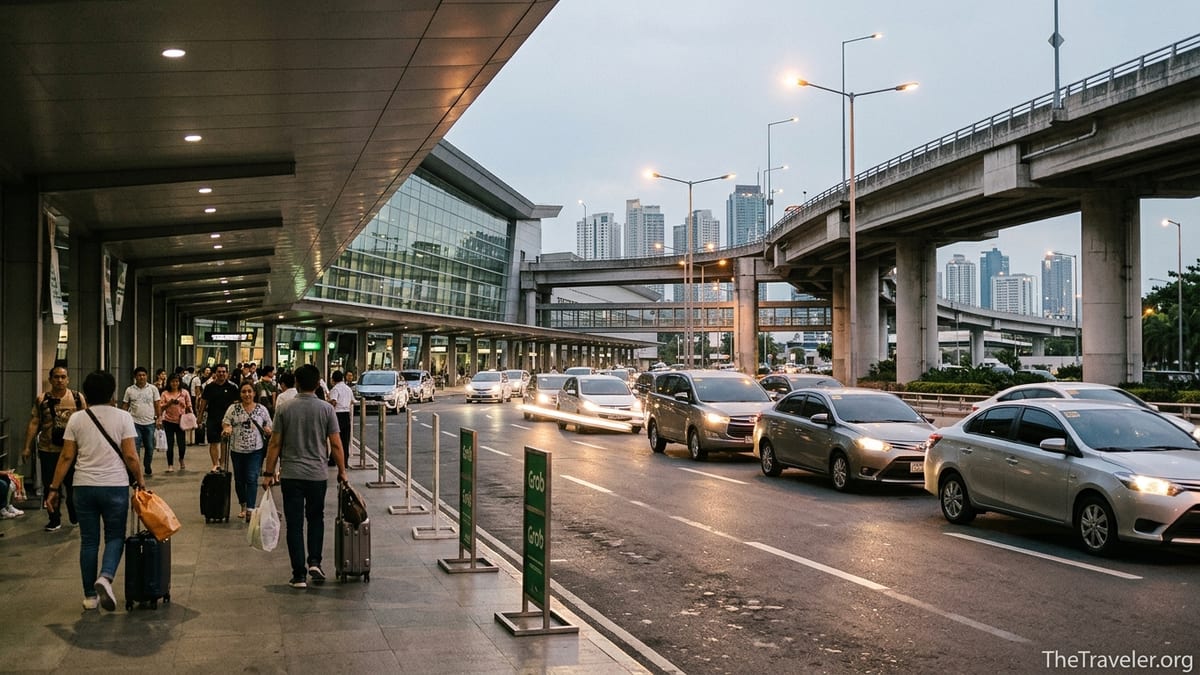
Grab is the dominant ride-hailing service at NAIA and is often the easiest option for tech-savvy travelers. The app allows you to set your pickup terminal, choose a vehicle category and see a fare estimate before you confirm. At NAIA, only accredited transport network services like Grab and similar providers are allowed to pick up passengers, and they use designated pickup zones that are well signposted at each terminal.
At Terminal 3, for example, you typically exit the arrivals hall and follow signs or staff directions to a Grab pickup zone that may be located at the curbside or in the nearby multi-level parking area, depending on current airport arrangements. At Terminals 1 and 2, look for ride-hailing signs or a Grab booth where staff can help you book if you do not have mobile data. In peak evening periods, there can be queues, both in the app and at the physical pickup point, especially when several wide-body international flights arrive within a short window.
For a standard GrabCar sedan from NAIA to central BGC, travelers commonly report fares in the region of around 350 to 600 pesos in normal traffic, before tolls. When rain, rush hour or holidays hit, dynamic pricing can push that closer to 700 or more. Skyway and NAIAX tolls are typically charged on top and can add roughly 150 pesos or so for a direct expressway route, depending on the toll combination used. Some drivers pay the tolls in cash then add the amount to the in-app fare as an “extra,” while in other cases the app will include a toll estimate. It is reasonable to confirm with the driver before departure that you are happy to use NAIAX and Skyway and to ask how tolls will be handled.
If you travel with larger luggage, such as two or three full-size suitcases, consider booking a larger vehicle category such as a six-seater. Many of these are compact MPVs like Toyota Innova or Mitsubishi Xpander. Drivers often fold the back row of seats to create a cargo area, which can reduce passenger capacity. It is common for a six-seater category to be realistically suitable for three adult passengers with big bags, rather than six, so keep that in mind if you are part of a business delegation or family group.
Airport Taxis: Yellow, Coupon and Metered Options
NAIA offers several kinds of taxis, each with its own pricing and reliability profile. The most visible are the yellow airport taxis, which line up at official taxi ranks outside each terminal. These are regulated, metered taxis operating on a higher tariff than ordinary white city cabs, with a higher flag-down rate but generally better oversight. There are also coupon taxis, which use fixed rates to specific destinations like BGC, and standard metered city taxis that sometimes operate from airport areas or nearby access roads.
As of 2026, regular city taxi fares in Metro Manila start with a flag-down of around 45 pesos, following fare adjustments approved by regulators. Airport taxis use a different, higher schedule, and coupon taxis charge set point-to-point rates. Public information from airport guides and travel providers suggests that a typical coupon taxi fare from NAIA to business districts like Makati or BGC can be in the broad range of roughly 800 to 1,200 pesos, depending on distance and vehicle size, though exact posted rates at the airport counters are the authority and can change without wide publicity.
In practice, many frequent travelers use the yellow airport taxis as a middle ground between convenience and cost. A yellow taxi ride from Terminal 1 or 3 to BGC in moderate traffic might land somewhere in the mid-hundreds of pesos on the meter, plus tolls if the driver uses NAIAX and Skyway. If you want to lower the cost and you are arriving outside rush hour, you can ask the driver to skip the expressways and use surface roads via Nichols, Lawton Avenue and McKinley. This can save tolls but may add unpredictable delay if there is a backlog at intersections around Villamor and Taguig.
There has been a long history of overcharging and unsolicited “special rates” among some unregulated drivers around NAIA. The current airport management and regulators publicly warn against unaccredited operators and periodically act against reported scams, but new visitors should still be cautious. If a driver proposes a flat price far above a reasonable benchmark – for example, several thousand pesos for a simple NAIA to BGC trip – it is safer to decline, return to the official taxi queue or ride-hailing pickup, and, if appropriate, inform airport staff.
Private Transfers for Business and Hotel Arrivals
For corporate travelers, conference delegates or families arriving after long-haul flights, pre-booked private transfers can be the least stressful way to reach BGC. These services are offered by international aggregators and by local companies that specialize in airport shuttles, chauffeur services and hotel transfers. Typical inclusions are a meet-and-greet at the arrivals area, assistance with luggage, flight tracking and a fixed price that already includes expressway tolls and airport fees.
Based on recent quotes from airport transfer providers, a private sedan transfer from NAIA to BGC for up to two or three passengers usually falls in a range of roughly 800 to 1,500 pesos, depending on the company, time of day and vehicle size. Vans and premium vehicles cost more, but the total per person can be reasonable for groups. A corporate team of four heading to an office near Bonifacio High Street might book a van for approximately 2,000 to 2,500 pesos and split the cost, gaining extra luggage space and minimizing wait time.
Many four and five-star hotels in BGC, such as Shangri-La The Fort and some international brands in Uptown, can arrange airport transfers through their concierge or reservations team. Hotel-arranged cars are often more expensive than third-party providers, sometimes charging over 2,500 pesos for a sedan, but they offer the comfort of direct coordination with your accommodation. For example, a visiting executive arriving on a late-night flight and heading straight into meetings may justify the higher cost to ensure a seamless pickup after customs, with the driver already briefed on the exact hotel entrance and any company billing arrangements.
These pre-booked transfers almost always take the NAIAX and Skyway route to BGC, barring major incidents. The driver tracks your flight, adjusts pickup time if there are delays and waits at the arrivals area with a signboard. For groups carrying presentation materials, sample products or technical equipment, having a dedicated vehicle with generous trunk space reduces stress, because you do not need to negotiate vehicle size at the curb or hope that a standard taxi can fit everything.
Skyway, NAIAX and Realistic Travel Times
The NAIA Expressway and Metro Manila Skyway have significantly changed the airport-to-city dynamic. In ideal off-peak conditions, a car leaving NAIA Terminal 3 can merge onto NAIAX, transition onto the Skyway and reach a BGC access point near Lawton Avenue or C5 in around 15 minutes of driving time. However, this ideal assumes light traffic at airport ramps and toll plazas, as well as minimal congestion near BGC exits, which is rarely the case during weekday peaks.
For practical planning, it is better to think in ranges. On a weekday mid-morning or late evening, you might reasonably expect 20 to 30 minutes from wheels rolling at the terminal to drop-off in central BGC through NAIAX and Skyway. During weekday evening rush hour, especially between about 5 p.m. and 8 p.m., the same trip can take 40 to 60 minutes, as queues build near Skyway segments and Taguig access roads. On payday Fridays, heavy rain days or just before long weekends, these times can stretch beyond an hour even on tolled routes.
If you choose to avoid tolls and travel at grade level via roads like Airport Road, Domestic Road, Roxas Boulevard, EDSA and McKinley or C5, you should be prepared for more variability. At quiet times, this can still be a 30 to 40 minute journey, but at rush hour it may easily approach or exceed 90 minutes. For example, a traveler arriving at Terminal 1 at 4:30 p.m. on a weekday and catching a standard taxi through surface streets to a hotel near Serendra might experience slow traffic around Nichols, the Villamor area and the intersections near McKinley Hill, even before entering BGC proper.
Most business travelers heading to morning meetings in BGC are advised to allow at least one and a half to two hours from scheduled landing to arrival at the office. This buffer accounts for potential immigration and baggage delays, walking to the pickup zone, waiting for a car and traffic on the way. If you are departing from BGC back to NAIA for an international flight, many locals recommend leaving BGC at least three hours before departure time for off-peak flights, and even earlier in the late afternoon and evening, especially if your airline advises arriving three hours before check-in closes.
Luggage, Vehicle Choice and Group Logistics
Luggage size and group composition are often underestimated when planning NAIA to BGC transfers. A standard sedan, whether booked through Grab or as a private transfer, can comfortably fit two large checked suitcases and two cabin bags in the trunk and back seat. Once you add a third large suitcase or hard case, you may face a very tight fit, particularly if the vehicle is a compact sedan, or you may need to place a bag on the front passenger seat, which is not ideal for safety and comfort.
This is why travelers in pairs or groups with large checked luggage often choose an MPV or van category. For instance, three colleagues attending a conference at a BGC hotel with one large suitcase each will have a smoother experience in a six-seater category than in a sedan. As noted earlier, drivers of MPVs frequently fold down the rear-most row of seats to create a flat cargo area. This means the vehicle might strictly carry three or four passengers with luggage rather than the advertised six. It is better to book for a higher capacity than you think you need rather than hope to squeeze in at the curb.
When traveling with bulky items such as golf bags, trade-show materials or musical instruments, inform your transfer provider in advance. Many private transfer booking forms have a field for special luggage, and some will dispatch a high-roof van or larger MPV when they see sports equipment or exhibition gear listed. For example, an events team flying in to stage a corporate function at a BGC hotel might reserve a dedicated van for equipment and a separate sedan for senior executives, allowing them to travel at different paces and use different arrival entrances.
Families with young children should note that child seats are not standard in Philippine taxis or ride-hailing services. Some private transfer companies and higher-end hotel car services can provide child seats if requested ahead of time, sometimes for an extra fee. If you are arriving late at night with a toddler and several bags, arranging this in advance can make the NAIA to BGC segment considerably calmer, as you avoid last-minute negotiations in the crowded arrivals hall.
Choosing the Best Option for Your Situation
The “best” route from NAIA to BGC depends on your priorities: cost, time, predictability, comfort or a mix of all four. For solo travelers and couples who are comfortable with ride-hailing apps and have local data, Grab offers a good balance of cost and convenience. You see a price estimate, can choose your vehicle type, and track the car on your phone. Just be ready for potential peak-time surges and queues at the pickup zones, especially for late-night and early-evening international arrivals.
If you prefer to step out of the terminal and get on the road quickly without using an app, yellow airport taxis and coupon taxis are practical alternatives. They are particularly convenient for travelers whose mobile phones do not immediately connect to local networks or whose roaming plans are limited. To stay on the safe side, always join the official queue, look for airport staff overseeing the line, and ask for an approximate fare or check the posted coupon rates before you get into the vehicle. If you feel pressured into accepting an excessively high flat fare, it is perfectly acceptable to decline and wait for another taxi or go back inside to consider other options.
For business travelers on tight schedules, VIPs, or families arriving after long-haul flights, pre-booked private transfers are often worth the premium. The ability to walk out of customs and see a driver waiting with your name, knowing the price is fixed and the vehicle has enough space for your party and luggage, reduces uncertainty. Some companies also offer add-ons such as bottled water, in-car Wi-Fi or multilingual drivers, which can be attractive for visiting executives or older travelers.
Whatever option you choose, planning ahead matters. Think about your arrival time, the day of the week, your baggage volume and your familiarity with Metro Manila. For instance, an executive landing at 10 p.m. on a Tuesday with only hand luggage may be fine with a Grab sedan via NAIAX and Skyway, while a family of five with multiple suitcases landing at 5 p.m. on a Friday might be far better served by a pre-booked van that factors in heavy traffic and tolls.
The Takeaway
Travel between NAIA and BGC is a short journey on the map but can feel long if you are unprepared. Today’s combination of NAIAX, the Skyway and a growing ecosystem of ride-hailing services, taxis and private transfers means there is a solution for almost every type of traveler, from backpackers staying in budget accommodation in the edges of BGC to executives checking into flagship hotels on 5th Avenue.
Grab and other ride-hailing options provide flexibility and transparent pricing, especially appealing to frequent travelers who already use the apps elsewhere in Southeast Asia. Yellow airport taxis and coupon taxis remain staples at the terminals, giving travelers without mobile data a straightforward way into the city. Private transfers and hotel cars offer a more curated experience, trading higher cost for predictability, especially when toll roads and traffic are factored in.
What really determines the quality of your NAIA to BGC transfer is how much thought you give it before landing. Check your arrival time against typical Manila traffic patterns, consider your baggage and group size and decide which balance of speed, price and comfort fits your trip. With realistic expectations and a chosen plan, your first ride into BGC can be efficient, safe and surprisingly smooth, setting the tone for a productive business visit or a relaxed start to your stay.
FAQ
Q1. How long does it usually take to travel from NAIA to BGC?
In light traffic using NAIAX and the Skyway, the drive can take around 20 to 30 minutes once you leave the terminal. During weekday rush hours and bad weather, it is safer to expect 40 to 60 minutes or more.
Q2. How much should I budget for a Grab ride from NAIA to BGC?
For a standard GrabCar sedan, most travelers see base fares in the rough range of 350 to 600 pesos in normal conditions, plus around 100 to 200 pesos in tolls if the driver uses NAIAX and the Skyway. In peak times, dynamic pricing can push the fare higher.
Q3. Are airport taxis safe and reliable for getting to BGC?
Official yellow airport taxis and coupon taxis are generally considered safe and are regulated, though service quality can vary. Always use the official taxi rank, check that the meter is running for metered cabs, and ask about approximate fares or posted coupon rates before committing.
Q4. What is the difference between a yellow airport taxi and a coupon taxi?
A yellow airport taxi runs on a meter with a higher airport tariff, so the final price depends on traffic and route. A coupon taxi uses fixed rates from NAIA to specific destinations like BGC, which you pay in advance at a desk, giving more price certainty but sometimes at a higher cost.
Q5. Should I insist that my driver use NAIAX and the Skyway?
Using NAIAX and the Skyway usually shortens the trip and makes travel times more predictable, especially during busy periods, but it adds toll costs. If you value time and comfort over a small saving, it is sensible to agree with the driver to use the expressways and confirm how tolls will be paid.
Q6. Is it necessary to pre-book a private transfer from NAIA to BGC?
It is not strictly necessary, as Grab and airport taxis are widely available, but pre-booking a private transfer is very helpful for late-night arrivals, large groups, travelers with heavy luggage or business visitors who need a guaranteed, fixed-price pickup.
Q7. How early should I leave BGC for NAIA before an international flight?
Many locals recommend leaving BGC at least three hours before your flight’s scheduled departure, and more during late afternoon and evening peaks. This allows time for traffic, security, check-in and immigration, especially at busy terminals.
Q8. What is the best option for a family with children and several suitcases?
A larger vehicle such as an MPV or van booked through Grab or a private transfer company is usually the most comfortable choice. It provides extra space for luggage and makes it easier to keep children seated safely, particularly on longer-than-expected drives in heavy traffic.
Q9. Can I pay for taxis and Grab with a credit card?
Many Grab rides can be paid by credit or debit card through the app if you add your card details in advance. Most standard taxis are cash-only, so it is wise to withdraw or exchange some Philippine pesos at the airport before heading to BGC.
Q10. What should I do if I feel overcharged or uncomfortable with a driver?
If you believe a fare is unreasonable or a driver is pressuring you, it is acceptable to decline, step away and seek help from airport staff or security. For Grab and other ride-hailing services, you can review the fare breakdown in the app and use the in-app help or feedback tools to report issues after the trip.