


Landing or taking off from Marrakech Menara Airport can feel confusing the first time, especially when it comes to understanding the difference between Terminal 1 and Terminal 2. Airport websites, airline emails and even boarding passes are not always perfectly clear, and the fact that both terminals sit in one continuous building can make it harder to know where you actually need to go. This guide breaks down exactly how Marrakech Airport’s terminals work in 2026, which one you are likely to use, and how to avoid unnecessary stress, missed flights and frantic last-minute sprints through the terminal.
Get the latest updates straight to your inbox!
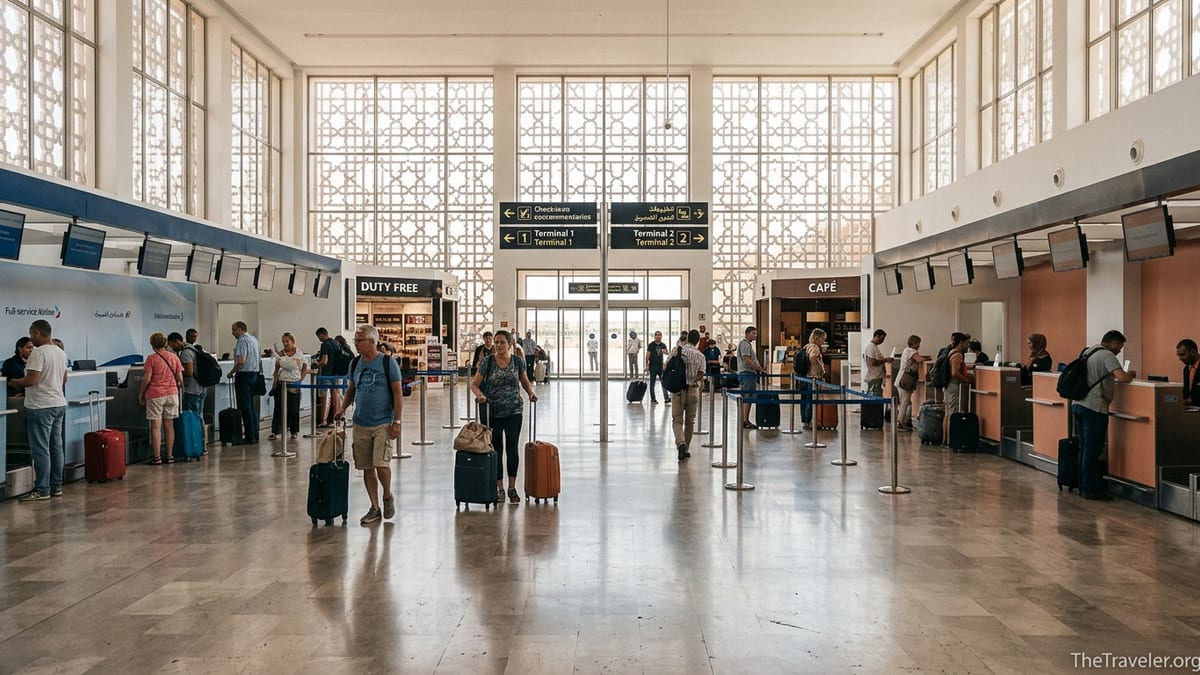
Marrakech Airport Today: One Building, Two Terminals
Marrakech Menara Airport (RAK) is the main international gateway to the city and one of Morocco’s busiest airports. It has two passenger terminals, Terminal 1 and Terminal 2, housed within a single modern terminal complex rather than separate, far-apart buildings. From the curb outside, it looks like one long structure with different entrance zones for each terminal, and once you pass security, much of the departures area feels like a shared space.
Unlike some airports where Terminal 1 and Terminal 2 can mean a long shuttle ride apart, in Marrakech you are essentially dealing with two wings of one building. Passenger facilities such as cafes, duty-free and many seating areas are arranged along a central departures hall, with different check-in islands and boarding gate clusters identified as belonging to T1 or T2. This layout is convenient if you arrive a little confused, because walking from one side to the other usually takes minutes, not half an hour.
The key practical point is that Terminal 1 and Terminal 2 at Marrakech are not separate airports. They are connected physically and operationally, and most travelers experience the airport as a single space with slightly different check-in and gate areas. That said, knowing which side your airline uses will save you time and help you make smarter choices about airport transport and where to be dropped off.
Terminal 1 vs Terminal 2: What Each One Is Used For
In 2026, both Terminal 1 and Terminal 2 at Marrakech Menara handle international flights, along with some domestic services to Moroccan cities such as Casablanca and Agadir. There is not a strict “domestic vs international” split. Instead, the distinction is more about how airlines and gates are allocated inside a shared building, and this can change over time as schedules and renovation projects evolve.
Terminal 1 is the historic core of the airport and generally handles a wide mix of full-service and leisure carriers. Travelers flying with airlines such as Royal Air Maroc, Air France, Turkish Airlines or Qatar Airways are frequently processed through Terminal 1 areas, especially for connections to large hubs like Casablanca, Paris or Istanbul. Many package-holiday flights from European tour operators also use T1 check-in islands even when gate areas blend into T2 further down the concourse.
Terminal 2 is often associated with high-volume point-to-point traffic and low-cost or value-focused airlines. Ryanair, easyJet, Wizz Air and several European leisure carriers regularly operate from gate areas and check-in desks designated as Terminal 2. If you are arriving on a springtime Ryanair flight from London Stansted or a winter sun easyJet service from Manchester, for example, you will likely be funneled through the T2 side of the building, even though you may barely notice the transition from one terminal zone to the other.
Because T1 and T2 occupy a single structure, airport information sometimes lists Marrakech as having “one terminal with two zones,” while other sources still talk about two terminals. For practical purposes, it is safest to think in terms of “which side of the building your airline uses” rather than separate terminals with completely different facilities.
Finding Your Terminal: Airline Examples and Booking Tips
The single most reliable way to know whether you should head for Terminal 1 or Terminal 2 is to check the information given by your airline close to the date of departure. When you check in online with airlines such as Ryanair, easyJet, Royal Air Maroc, TUI, Transavia or Vueling, they typically show “Terminal 1” or “Terminal 2” next to your flight number on the boarding pass or in the app. This will usually match the signage at the airport entrance and on flight information screens.
For example, UK holidaymakers flying TUI or Jet2 from airports like Birmingham or Manchester to Marrakech may find their flights assigned to Terminal 2 check-in areas, reflecting the heavy leisure and low-cost use of that side of the building. On the other hand, a business traveler flying Royal Air Maroc from Marrakech to Casablanca to connect onward to New York is more likely to be handled at Terminal 1 counters, in line with Royal Air Maroc’s role as Morocco’s national carrier with hub-style operations.
Travelers from mainland Europe see a similar pattern. EasyJet flights from Paris Charles de Gaulle or Geneva frequently use T2 desks, while an Air France or Turkish Airlines connection is more often associated with T1. However, these allocations can shift with schedule changes or airport works. If you booked far in advance, check again 24 to 48 hours before departure in your airline’s app rather than relying on an old confirmation email.
Third-party booking sites sometimes omit terminal details or list generic information such as “Marrakech Menara – Terminal.” If this happens, look at your airline’s own website or mobile app instead. Terminal allocations are controlled at airline and airport level, and they may be updated seasonally, especially during busy periods such as Easter, summer holidays and the December festive season when extra flights are added.
Check-in, Security and Departures: What to Expect in Each Terminal
On arrival at the airport by taxi, hotel transfer or ride-hailing service, you will see signs pointing drivers to Terminal 1 or Terminal 2 drop-off areas. If you know which terminal your airline uses, ask to be left near that entrance. Check-in lines for large flights can spill into the general hall, so starting on the right side can easily save 10 to 20 minutes in peak times when several European flights depart around the same hour.
Inside, Terminal 1 and Terminal 2 each have their own clusters of check-in desks with overhead monitors showing airline logos and flight numbers. Low-cost carriers like Ryanair and Wizz Air often emphasize online check-in and bag-drop only counters, so signage will direct you to self-service kiosks or baggage drop belts rather than full-service desks. Full-service airlines in the T1 zone tend to have staffed counters for ticket changes and special assistance, useful if you need to adjust a connection or check in oversized luggage like surfboards or bicycles.
After check-in, international passengers from both terminals merge into a shared security and passport control area or closely linked zones. This means that even if you checked in at a T2 counter, your gate might be located further toward the T1 wing. Security lines can fluctuate sharply depending on the time of day. Early morning and mid-afternoon waves, when multiple flights depart for major European hubs such as London, Paris, Brussels and Amsterdam, can lead to longer waits, so arriving 2 to 3 hours before departure is a sensible rule of thumb, regardless of terminal.
Once you are airside, the distinction between T1 and T2 becomes less important. The post-security departures area includes duty-free shops selling Moroccan argan oil, spices and souvenirs, cafes serving mint tea and snacks, and general seating areas. Gate numbers and screens will make it clear where to go for boarding. If your boarding pass says Terminal 2 but your gate appears closer to the T1 wing, do not panic; the internal layout is continuous, and it is normal for walking routes to cross notional terminal boundaries.
Arrivals, Baggage Claim and Ground Transport
The arrivals flow at Marrakech Menara is straightforward, but the distinction between Terminal 1 and Terminal 2 still appears on signs and screens. When your aircraft parks, buses or jet bridges may bring passengers to dedicated arrival corridors for each terminal zone. You will pass through passport control, then down into baggage reclaim halls marked as T1 or T2, where carousels are numbered and flight numbers displayed on overhead boards.
If you are meeting someone at the airport, ask them to check live arrival screens or your flight details to see whether you emerge from the Terminal 1 or Terminal 2 exit doors. In practice, the two exits lead into adjacent sections of the same public arrivals area, with ATMs, currency exchange counters, car rental desks from brands like Avis, Hertz and local Moroccan agencies, and kiosks for official airport taxis. If your ride is unsure where to stand, agree on a landmark, such as the main taxi rank or a specific car rental counter, rather than relying only on “outside T1” or “outside T2.”
Baggage handling standards are broadly similar for both terminals. On busy days when several low-cost flights land within a short window, the T2 reclaim belts can feel crowded. Travelers arriving from European package holidays often wait alongside independent backpackers and city-break passengers in this zone. Meanwhile, some long-haul or connecting flights arriving via Casablanca or other hubs feed into T1 baggage belts, which at times can be slightly quieter. However, flows vary with the schedule, so it is unwise to assume that one terminal is always faster than the other for bags.
Once you exit into the public area, you will find that car parks and transport options serve the whole airport complex. Airport buses, taxis and many private transfers do not differentiate much between T1 and T2; instead, they make stops along the same frontage. This makes onward travel into central Marrakech, the Palmeraie district or out to resorts in the Atlas foothills relatively simple from either terminal zone.
Low-cost Flights and “Wrong Terminal” Confusion
Because so many visitors arrive in Marrakech on low-cost airlines from Europe, confusion about terminals most often affects these flights. Travelers used to airports where all low-cost carriers use a dedicated low-cost terminal sometimes expect Marrakech Terminal 2 to work that way. In reality, while many budget carriers are concentrated on the T2 side, there is no absolute rule. Seasonal charter flights, extra weekend services or aircraft swaps can lead to a Ryanair or easyJet departure showing at T1 counters, or a full-service flight boarding from a gate usually associated with T2.
A common real-world scenario is a traveler who booked a cheap return flight on a site like Skyscanner, then relied on a very old confirmation email or generic airport information showing “Terminal 1” without checking closer to departure. Arriving by taxi, they may tell the driver Terminal 1, only to discover at the curb that current airport screens list their Ryanair service from the T2 side of the building. Fortunately, because the building is continuous, they can simply walk across inside or along the front, but in peak traffic this can add extra delay and stress.
Another example is passengers connecting themselves between a low-cost European carrier and a separate ticket on Royal Air Maroc. They might land in the T2 arrival zone, collect bags, then assume that their onward RAM flight will also leave from T2 because it is “the same airport.” In practice, RAM flights often use the T1 check-in area, meaning they need to cross to the other side of the hall and navigate different desk layouts. Self-connecting travelers should build in extra buffer time for this kind of shuffle, especially if they must also re-clear security and passport control.
The simplest way to avoid wrong-terminal stress is to treat every journey through Marrakech as if terminal allocations could have shifted slightly since you booked. Check your airline’s latest emails or app notifications the day before departure, and verify your flight on airport screens as soon as you step inside the hall. If you are unsure, airport staff at the entrance doors and information desks are used to this question and can point you quickly toward the correct counters.
Practical Tips to Navigate the Layout Smoothly
Because both terminals sit within the same large structure, walking between T1 and T2 is relatively quick. Once inside, you will see overhead signs with clear arrows and color coding for each terminal and for departures, arrivals, baggage claim and exits. If you accidentally enter at the wrong side, simply follow the signed corridor for departures; it will guide you through the central hall where you can re-orient yourself using the large flight information boards.
Families or groups with a lot of luggage should still try to be dropped off at the correct side to avoid a long drag with suitcases. For instance, a family arriving in an early-morning hotel shuttle for a TUI or easyJet flight might ask the driver specifically for the Terminal 2 drop-off, which is usually closer to the low-cost check-in islands. Solo travelers or those with only a cabin bag have more flexibility; if the driver stops in front of Terminal 1 but your app says Terminal 2, walking time is generally manageable.
Inside security, gates can be a moderate walk from central lounges and cafes, particularly at peak times when queuing and crowding slow movement. If you are flying on a winter weekend when numerous city-break flights depart within an hour or two, avoid lingering too long on the terminal border between T1 and T2. Instead, head toward your gate area once boarding time approaches, watching for last-minute announcements if your airline reallocates a nearby gate.
Finally, be careful not to confuse Marrakech Menara with other Moroccan airports when planning connections. Some travelers, for example, fly domestically between Marrakech and Casablanca Mohammed V Airport, where Terminal 1 and Terminal 2 are much more clearly separated and may require longer walking or transfers. When reading online advice or forums, always double-check that comments about “Terminals 1 and 2” are actually about Marrakech and not another Moroccan or international airport that uses similar numbering.
The Takeaway
For most travelers, the most important thing to know about Marrakech Menara Airport is that its Terminal 1 and Terminal 2 form part of a single, connected building. While airlines are broadly grouped, with many full-service and hub flights on the T1 side and a heavy concentration of low-cost and leisure services on the T2 side, there is no rigid divide. Check-in, security and departures spaces overlap, and once you are inside the main hall, you can usually walk between terminal zones within a few minutes.
If you remember to check your airline’s latest information just before departure, arrive with a little buffer time, and confirm your flight and gate on the airport’s information screens, you are very unlikely to run into serious terminal-related problems. Even if you do get dropped at the “wrong” door, the continuous layout allows you to correct course quickly. With a clear understanding of how Marrakech’s terminals actually work, you can focus less on terminal numbers and more on enjoying your first tagine, mint tea or riad rooftop as soon as you reach the city.
FAQ
Q1. Do Marrakech Airport Terminal 1 and Terminal 2 handle different types of flights?
Terminal 1 and Terminal 2 both handle international and some domestic flights. The split is more about airline and gate allocation than a strict domestic versus international rule.
Q2. Which terminal do low-cost airlines like Ryanair and easyJet usually use?
Many low-cost and leisure airlines are concentrated on the Terminal 2 side of the building, but allocations can change, so always check your boarding pass or airline app before you travel.
Q3. How do I know whether my flight leaves from Terminal 1 or Terminal 2?
The most reliable source is your airline’s own information close to departure. Check your boarding pass, mobile app or recent email notifications for the terminal shown next to your flight number.
Q4. What happens if I get dropped off at the wrong terminal in Marrakech?
Because both terminals are part of one building, you can walk between them inside the main hall or along the frontage. It may cost you a few extra minutes but you are unlikely to need a shuttle.
Q5. Is baggage claim different in Terminal 1 and Terminal 2?
Each terminal zone has its own baggage reclaim area with carousels and screens, but standards and facilities are similar. Follow the signs and screens that show your flight number when you arrive.
Q6. Are the shops and cafes the same in both terminals?
After security, the departures area is largely shared, with duty-free, cafes and seating spread along the concourse. You do not need to worry about missing out on services just because your flight uses T1 or T2.
Q7. How early should I arrive at Marrakech Airport, whichever terminal I use?
Plan to arrive about 2 to 3 hours before scheduled departure time. Security and passport control queues can be longer during busy periods, especially for popular European flights.
Q8. Can I walk from Terminal 1 arrivals to Terminal 2 departures for a self-connection?
Yes. After collecting your bags and exiting into the public arrivals area, you can walk across the terminal complex to the other side and check in again. Allow extra time to re-clear security and passport control.
Q9. Are ground transport options different for Terminal 1 and Terminal 2?
No. Taxis, buses and most private transfers serve the entire airport frontage. You can reach central Marrakech, the Medina and resort areas easily from either terminal exit.
Q10. Could terminal assignments change between the time I book and the day I fly?
Yes, especially during seasonal schedule changes or airport works. Always re-check your flight’s terminal a day or two before departure and again on the airport screens when you arrive.