


More news on this day
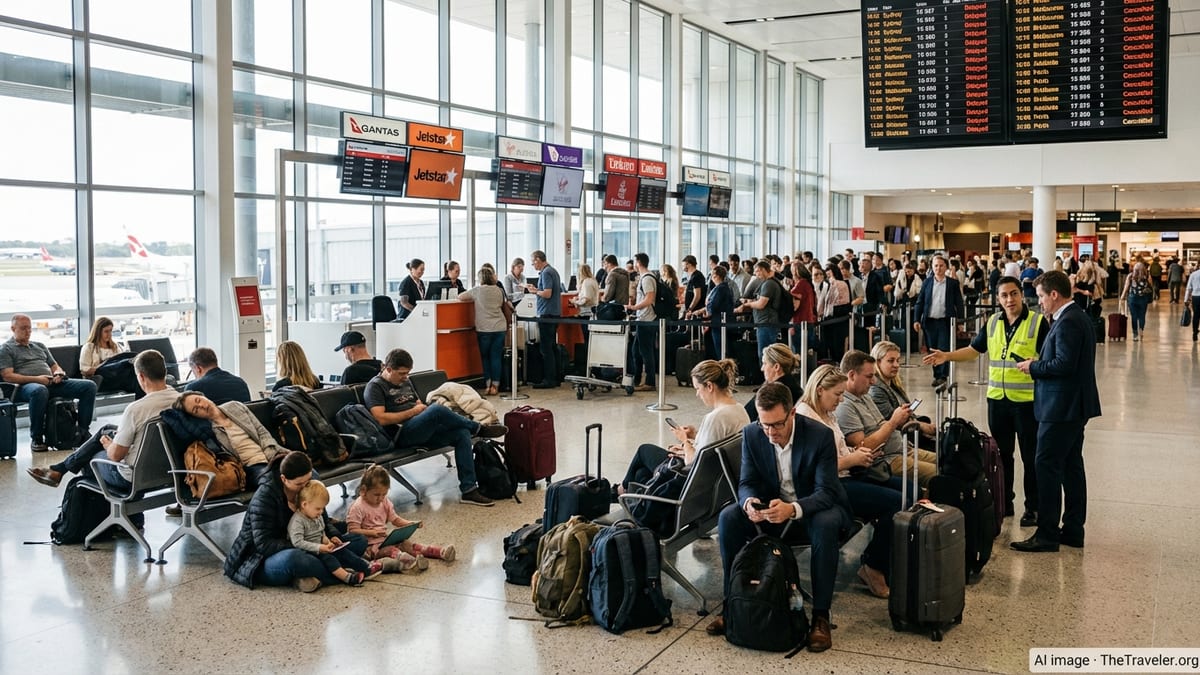
Wide ranging flight cancellations and delays across New Zealand and Australia have thrown travel plans into disarray, disrupting services at key hubs including Auckland, Wellington, Christchurch, Sydney, Melbourne and Brisbane and affecting operations at major carriers such as Qantas, Jetstar, Virgin Australia, Air New Zealand and regional operators including Sounds Air.
Get the latest news straight to your inbox!
Major Hubs Across Both Countries Face Heavy Disruption
Published coverage and live flight tracking data indicate that service disruptions are being felt most sharply at the busiest international and domestic hubs in both countries, with Auckland, Wellington and Christchurch in New Zealand and Sydney, Melbourne and Brisbane in Australia all reporting elevated levels of cancellations and late departures. Recent monitoring of Oceania flight disruption patterns pointed to more than 200 delayed services and several dozen outright cancellations on trans Tasman and domestic routes over a short period, underscoring the vulnerability of these corridors to operational shocks.
The impact is particularly notable on the dense web of links between New Zealand’s three main centres and Australia’s east coast gateways. Routes connecting Auckland and Wellington with Sydney and Melbourne, as well as services linking Christchurch with Sydney, Melbourne and Brisbane, form the backbone of trans Tasman traffic. When cancellations cascade across these city pairs, disrupted aircraft rotations quickly spill into secondary destinations, amplifying delays for regional travellers.
Regional airports are also feeling the strain. Reports highlight that smaller carriers such as Sounds Air have had to cancel a proportion of services from airports like Blenheim and other provincial centres when aircraft and crews are out of position. While traffic volumes are lower at these locations, the limited frequency of flights means each cancellation can leave travellers with very few same day alternatives.
Disruptions are not limited to a single day or weather system. Publicly available performance data and recent incident summaries suggest a pattern of intermittent disruption over recent months, driven by a mix of operational, staffing and infrastructure pressures on both sides of the Tasman.
Qantas, Jetstar, Virgin Australia and Air New Zealand Under Pressure
Across Australia and New Zealand, the largest carriers remain at the centre of the current travel chaos. Qantas and its low cost subsidiary Jetstar have been frequent subjects of punctuality and cancellation statistics released by competition and transport agencies, with recent monthly data in Australia showing higher cancellation rates for these brands than for some rivals. Analysts note that even small percentage shifts translate into significant numbers of disrupted flights on trunk routes such as Sydney to Melbourne and Sydney to Brisbane, and on busy trans Tasman links.
In New Zealand, Air New Zealand’s dominant domestic position means any operational hiccup has nationwide repercussions. Published performance figures from transport authorities show the flag carrier accounting for the bulk of departures at Auckland, Wellington and Christchurch. When aircraft go out of rotation or when staffing constraints force schedule changes, knock on effects can be felt on services to Australia as well as on domestic connections feeding those flights.
Virgin Australia, which concentrates on key domestic Australian routes and selected international services including trans Tasman flights, has also been caught in recent disruption cycles. Industry monitoring of on time performance suggests that while Virgin Australia has at times recorded lower cancellation rates than some competitors, its role on routes such as Brisbane to Auckland and Sydney to Queenstown means that irregular operations still contribute to broader network instability.
Low cost operator Jetstar remains a crucial player on price sensitive trans Tasman corridors. Earlier this year, the airline announced reductions to certain Australia New Zealand services, citing higher fuel costs and other operational pressures. Public statements indicated that flights between Auckland and Sydney and between Auckland and Brisbane, as well as some services on core domestic New Zealand routes, would be trimmed, a move that reduced overall capacity and left remaining services more vulnerable to overcrowding when cancellations occur.
Fuel Costs, Weather, Staffing and Airspace Constraints Intersect
Several overlapping factors are contributing to the instability seen across the Australia and New Zealand aviation markets. Rising jet fuel costs, linked in part to geopolitical tensions and refinery constraints, have prompted carriers to reassess marginal routes and consolidate frequencies. Announcements from trans Tasman low cost operators in March pointed directly to higher fuel bills as a reason to reduce schedules between Australia and New Zealand and on selected domestic sectors.
Challenging winter weather across the southern hemisphere adds further complexity. Fog, low cloud and strong winds at coastal airports such as Wellington and Sydney can reduce runway capacity and trigger flow control measures that ripple through airline schedules. When aircraft are forced into holding patterns or diversions, the resulting delays often push crew beyond their regulated duty limits, forcing airlines to cancel subsequent sectors.
Air traffic control staffing and airspace management constraints have also come under scrutiny. Public reports from regulators in recent months have cited air traffic control related disruptions at Sydney, contributing to congestion and longer taxi and airborne holding times. These bottlenecks have a direct impact on on time performance for airlines operating dense schedules, particularly during morning and evening peaks when trans Tasman flights are heavily concentrated.
The combination of high aircraft utilisation, tight turn times, and constrained airport infrastructure leaves little room for recovery once a disruption begins. As a result, what starts as a localised weather or staffing issue can quickly escalate into network wide delays and cancellations spanning multiple cities and carriers.
Regional and Niche Carriers Struggle to Maintain Reliability
While major airlines capture most of the public attention, smaller and regional operators are facing their own challenges. Sounds Air, which operates a network of short haul services linking regional centres in New Zealand with Wellington and other hubs, has recorded notable cancellation rates on some routes during recent disruption events, according to specialist aviation coverage. With small fleets and limited spare aircraft, any technical or weather related issue can force multiple cancellations in a single day.
Other regional airlines across Australia and New Zealand, including those feeding traffic from provincial centres into Sydney, Melbourne, Brisbane, Auckland and Christchurch, are susceptible to similar pressures. When larger partners adjust schedules or when connecting flights arrive late, regional operators can struggle to maintain reliable connections, leading to missed onward flights and extended waits for replacement services.
For communities that rely heavily on air links to access healthcare, education and business opportunities, these disruptions carry broader social and economic implications. Local media reports from affected regions frequently highlight concerns from businesses and residents about the reliability of air services, particularly during peak travel periods and school holidays.
Industry analysts note that while regional carriers often deliver strong on time performance in normal conditions, their limited capacity to absorb shocks means they are disproportionately affected when national networks come under strain.
Travellers Face Long Queues, Rebookings and Limited Alternatives
For passengers, the most visible effects of the current disruption cycle are long queues at check in counters, crowded customer service desks and extended waits in departure lounges. Social media posts and local news coverage from airports in Auckland, Wellington, Christchurch, Sydney, Melbourne and Brisbane describe travellers queuing for hours to rebook flights after same day cancellations or missed connections.
Because many trans Tasman and domestic routes are already operating with constrained capacity following earlier schedule reductions, rebooking options can be limited. On some city pairs, passengers whose flights are cancelled are being shifted to services one or two days later, particularly when travelling in larger groups or during busy school holiday windows. Last minute one way fares on remaining services are often significantly higher than advance purchase prices, adding financial stress for those forced to buy new tickets.
Accommodation and ground transport are emerging as additional pain points. Reports from travellers indicate that hotel rooms near major airports can sell out quickly during large disruption events, pushing stranded passengers into city centres or nearby suburbs at short notice. Rental car availability is also tight on some routes, as travellers seek alternative ways to complete domestic legs when flights are cancelled.
Consumer advocates are using the latest wave of cancellations to renew debates about passenger rights and compensation frameworks in both Australia and New Zealand. Commentators are calling for clearer communication, more consistent rebooking policies and better support for vulnerable travellers, particularly families and those connecting to long haul international services whose itineraries are thrown off course by regional flight disruptions.