


Thailand’s property market has entered a mature and more volatile phase, characterised by large unsold inventories in some segments, slowing end-user demand and higher financing costs. For individuals considering relocation and potential home purchase, understanding whether conditions resemble a speculative bubble or a more contained cyclical slowdown is central to risk management. This briefing evaluates structural and short-term indicators of bubble risk across Thailand’s residential property market, with particular focus on condominiums in Bangkok and key resort destinations.
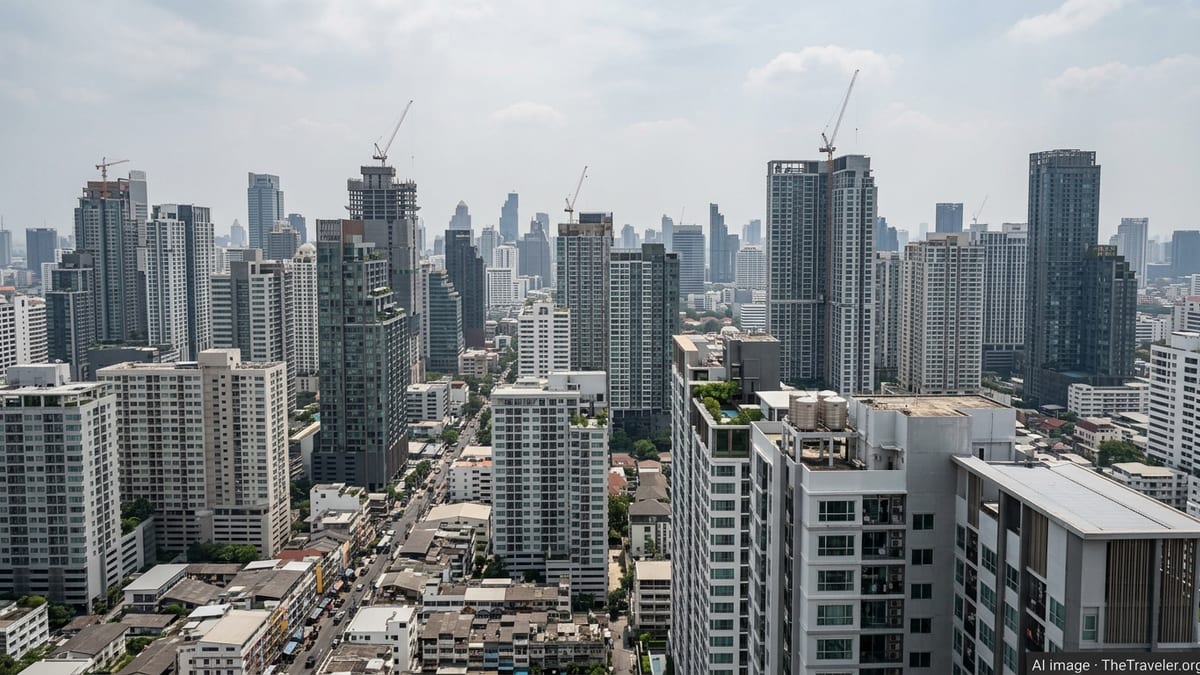
Thailand Property Market Overview and Price Dynamics
Bubble risk analysis begins with price behaviour. Nationally, Thailand’s house price indices have shown modest real growth rather than explosive surges over the past decade. Various datasets indicate that nationwide house prices have generally risen at low single-digit annual rates since around 2015, with some years of flat or slightly negative real growth. This contrasts with classic pre-crisis bubbles where prices typically rise by double digits for several consecutive years.
Bangkok condominium prices tell a more nuanced story. Market reports show that mid- to high-end condo prices in central Bangkok moved up steadily in the late 2010s, paused during the pandemic and have since shown only limited nominal gains, with effective prices in some fringe locations under pressure from discounts. Evidence of widespread price cuts, promotional campaigns and stagnant resale values in certain buildings points to an overhang of supply rather than broad-based speculative price inflation.
The divergence between relatively contained price growth and persistent construction activity is important. It suggests that the main vulnerability is not that prices have run far ahead of fundamentals nationwide, but that certain micro-markets now face prolonged absorption risk. For relocating households, this implies that bubble-like conditions, where sharp future price corrections are likely, are concentrated by product type and location rather than uniform across Thailand.
In summary, at the national level Thailand more closely resembles a market with moderate price appreciation and cyclical stress rather than an economy-wide housing bubble. Bubble risk is much higher, however, in specific submarkets with heavy development aimed at investors and foreign buyers.
Supply, Unsold Inventory and Construction Cycle Risks
Oversupply is the clearest quantitative warning signal in Thailand’s current cycle. Industry data for late 2024 describe roughly 235,000 unsold residential units in Greater Bangkok alone, the highest level since the late 2010s. Nationwide, estimates of remaining unsold housing stock in the mid-2020s exceed 350,000 units. This inventory reflects years of aggressive project launches during a period of subdued household income growth and tightening mortgage conditions.
Bangkok’s condominium segment is particularly exposed. Reports for the end of 2024 show approximately 58,000 unsold condo units in Bangkok, with thousands more scheduled for completion through 2025. In some quarters of 2024, newly launched condo supply in parts of the city jumped several hundred percent compared with previous quarters, even as absorption rates weakened. A significant share of this stock consists of small, investor-grade studios in fringe or outer-ring locations where true end-user demand is thinner.
Developers have responded by scaling back or postponing some new launches. Data from large listed firms indicate noticeable year-on-year declines in new condominium project launches in 2024, particularly in central business district locations where land prices and financing costs are high. However, construction pipelines are long, and previously launched projects continue to deliver new units into an already saturated market, especially in Bangkok’s fringe, some eastern coastal cities and major resort provinces.
From a bubble-risk perspective, this pattern signals a high probability of prolonged oversupply and selective price discounting rather than an imminent nationwide crash. For relocating buyers, the oversupply increases bargaining power and choice but also raises the risk that certain buildings will suffer from weak resale liquidity and downward price pressure for an extended period.
Demand Fundamentals, Credit Conditions and Leverage
Classic housing bubbles are usually fuelled by rapid credit expansion and highly leveraged households. Thailand’s picture is mixed. Household debt is elevated by emerging-market standards, with debt-to-GDP ratios in recent years at uncomfortable levels, and consumer credit has grown faster than overall economic output. Yet housing loans have expanded at a relatively moderate pace in the low single digits annually, and the central bank has tightened underwriting standards at various points to curb speculative borrowing.
Macroprudential rules, including loan-to-value caps on multiple mortgages and second homes, have made it more difficult for highly leveraged investors to accumulate large numbers of units. Mortgage rejection rates have risen, especially among lower- to middle-income buyers, reflecting both cautious bank risk management and high household indebtedness. While this has cooled some speculative demand, it has also reduced the pool of genuine end-users who can qualify for financing, exacerbating the unsold inventory problem.
On the demand side, Thailand’s demographics and income growth patterns do not currently support a strong argument for sustained, broad-based price surges. The population is aging, household formation growth is modest, and wage growth has been uneven. The recovery in foreign demand following the pandemic has been significant in selected condo markets, but foreign buyers are still subject to a 49 percent ownership cap in condominium buildings and face currency-control and legal-structure complexities, which naturally limit speculative frenzy.
Taken together, these factors indicate that credit-driven systemic bubble risk is more contained than in the late 1990s, when heavily leveraged developers and foreign-currency borrowing played a central role in Thailand’s crisis. The current configuration points instead to a slower-burning risk: localized stress among overextended developers or projects alongside soft prices where investor interest fades.
Segment and Location Hotspots: Where Bubble Risk Is Highest
Bubble risk in Thailand is highly uneven. Several distinct hotspots warrant attention from potential relocators considering property purchases.
First, Bangkok’s outer-ring and fringe condominium markets face the highest oversupply. Many projects in areas far from established mass-transit hubs offer small units targeted primarily at investors seeking rental yield, rather than owner-occupiers. Reported gross rental yields in central Bangkok have compressed from around 5 to 6 percent in 2019 to roughly 3.5 to 4.5 percent in 2024 in many core areas, while fringe locations often achieve even lower effective yields after vacancy and costs. Where yields are low, price-to-income ratios are stretched and there is a heavy reliance on capital gains, bubble risk is elevated.
Second, resort and tourism-led markets such as Phuket and parts of the eastern seaboard display characteristics of speculative cycles. Research based on Real Estate Information Center data points to sharply rising unsold values in some coastal provinces, alongside aggressive marketing of off-plan units and optimistic pre-sale percentages. In these locations, demand is heavily exposed to external shocks such as currency swings, changes in foreign buyer regulations and fluctuations in international visitor flows. This sensitivity raises the probability of abrupt price corrections if foreign demand slows.
Third, the luxury villa and high-end condominium segments show signs of froth in certain micro-markets. Asking prices for prime branded residences in Bangkok and resort areas have reached levels comparable to some Western capitals, despite lower local income levels. That said, these segments often cater to very high net worth individuals, many of whom pay cash or have diversified wealth sources, which can cushion forced selling dynamics. Price volatility can still be high, but systemic risk transmission is more limited.
By contrast, mid-priced townhouses and low-to-mid segment landed housing in established Bangkok suburbs and major provincial cities appear more anchored in local end-user demand. Supply in these segments is tighter, and developers have become more cautious with new launches. For relocators prioritising capital preservation, these submarkets generally carry lower bubble risk than highly marketed condominium clusters in speculative corridors.
Institutional, Regulatory and Structural Risk Mitigants
Thailand’s institutional framework has evolved since the 1997 financial crisis to limit systemic property market excess. Supervisory authorities now monitor developer leverage, residential lending quality and unsold inventory more closely, and they have introduced macroprudential tools when overheating signs emerge. The establishment of specialised real estate information agencies has improved transparency around remaining stock, price trends and construction pipelines, even if some data are still fragmented.
On the regulatory side, conservative foreign-ownership limits for condominiums, restrictions on foreign land ownership and the need to use specific legal structures for long-lease arrangements serve as natural brakes on uncontrolled foreign speculation. They can, however, shift risk into more opaque structures in resort markets, where some projects rely on complex leasehold or hotel-pool arrangements marketed to overseas investors.
Financial-sector resilience is another partial mitigant. Banks’ exposure to residential developers and mortgage borrowers is significant but better diversified than in previous cycles. Corporate bond markets now play a role in developer financing, which introduces different risks, including rollover challenges in periods of tight liquidity, but also spreads risk beyond the banking system. Recent research on the Thai condominium market suggests that bank flexibility in restructuring loans can moderate fire-sale dynamics in downturns compared with rigid capital-market debt.
These factors reduce the probability that a property downturn would trigger a full-scale financial crisis. They do not remove project-level or location-specific risks. Relocating buyers should consider that while the national system is more robust, individual developments can still fail or experience severe value impairment if launched on overly optimistic assumptions.
Forward-looking Scenarios and Implications for Relocators
Looking ahead from 2026, three broad scenarios capture the range of bubble-related outcomes in Thailand’s property market: soft landing, extended stagnation and sharper localized corrections.
In a soft-landing scenario, developers continue to slow new launches, household incomes gradually improve, and unsold inventories are worked down over several years. Prices in many segments remain roughly flat in real terms, with small nominal gains tracking inflation. Under this path, the market does not resemble a bursting bubble but rather a long digestion phase. For relocators, this scenario favours patient buyers who prioritise quality construction, strong locations and conservative financing.
An extended-stagnation scenario would see persistent oversupply in fringe condominiums and some resort markets, combined with mediocre economic growth. Nominal prices in oversupplied segments could drift sideways or slightly downward for many years, producing weak overall returns and low liquidity. For people relocating with an eye to eventual resale, this scenario creates opportunity in negotiating initial prices but increases the risk of being locked into a slow-moving asset with limited exit options.
The third scenario involves sharper localized corrections where speculative pockets unwind. These could be triggered by macro shocks, changes in foreign buyer regulations, bond market stress for overleveraged developers or a prolonged tourism downturn. Price drops could be significant in specific corridors or buildings, particularly where investor ownership is dominant and rental yields are already thin. While such corrections can present deep-value entry points for sophisticated buyers, they pose material downside risk for new arrivals who purchase at or near previous peak prices without sufficient margin of safety.
Across all scenarios, the common thread is that Thailand’s property risks are highly segmented. This favours a selective rather than broad-brush approach for anyone relocating and considering property acquisition.
The Takeaway
Overall, Thailand’s current property market does not exhibit the classic hallmarks of a nationwide speculative bubble about to burst. National price indices show only modest appreciation, macroprudential policies have constrained the most extreme leverage, and financial-sector buffers are stronger than in past crises. However, significant bubble-like conditions exist in defined segments, particularly oversupplied condominiums in Bangkok’s outer areas and certain tourism-driven coastal and resort markets.
For relocation decision-makers, the key is not whether Thailand’s property market will “crash” in aggregate, but how concentrated the risks are in the specific product types and locations under consideration. High unsold inventories, compressed rental yields and a heavy reliance on foreign or investor demand are red flags that bubble dynamics may be present.
Cautious buyers considering a move to Thailand can mitigate these risks by favouring established neighbourhoods with demonstrable end-user demand, focusing on fundamental value rather than promotional incentives, and assuming conservative future appreciation. Renting first to observe market conditions on the ground, especially in more speculative areas, can further reduce exposure to any adverse price adjustments.
Thailand remains a complex and segmented property market. A relocation strategy that acknowledges segment-specific bubble risks, rather than treating the country as a single homogeneous market, is essential for preserving capital and flexibility.
FAQ
Q1. Is Thailand currently in a nationwide property bubble?
Most evidence suggests Thailand is not in a broad nationwide bubble, but certain segments, especially some condominium and resort markets, show elevated bubble-like risks.
Q2. Which areas of Thailand have the highest property bubble risk?
Highest risks are found in oversupplied condominium corridors in Bangkok’s fringe and outer-ring zones, and in tourism-driven resort markets such as some parts of Phuket and coastal cities.
Q3. How serious is the condo oversupply problem in Bangkok?
The condo oversupply in Bangkok is substantial, with tens of thousands of unsold units and many more in the pipeline, creating prolonged absorption risk and pressure on prices in weaker locations.
Q4. Are property prices in Thailand rising too fast to be sustainable?
At the national level, price growth has generally been moderate. The concern is less about runaway prices and more about pockets of oversupply and weak underlying demand.
Q5. How do foreign buyers affect bubble risk in Thailand?
Foreign buyers add demand and can amplify cycles in resort and prime city markets, but ownership caps, legal limitations and currency rules temper the risk of an unchecked foreign-driven bubble.
Q6. What role does household debt play in Thailand’s property risk?
Household debt is high and limits new borrowing, which can restrain speculation but also suppress genuine end-user demand, contributing to unsold inventory and segment-specific stress.
Q7. Could a downturn in Thailand’s property market trigger a financial crisis?
Regulatory safeguards and more diversified financing make a 1997-style systemic crisis less likely, though individual developers and projects may still face severe financial stress.
Q8. Are landed houses in Thailand exposed to the same bubble risk as condos?
Landed houses in established suburban and provincial markets tend to be more closely tied to local end-user demand and generally carry lower bubble risk than investor-focused condominiums.
Q9. How might interest rate changes impact Thailand’s property bubble risk?
Higher interest rates raise borrowing costs and reduce affordability, which can depress prices in highly leveraged or speculative segments, while a rate-cut cycle could stabilise or support demand.
Q10. What is a prudent strategy for relocators worried about a property bubble?
A prudent approach is to rent initially, assess local conditions on the ground, focus on quality assets in demand-driven locations and use conservative financial assumptions when buying.