


Miami International Airport is one of the busiest U.S. gateways to Latin America and Europe, and departures here can feel intense if you are not prepared. With three main terminal areas, ten security checkpoints, and a mix of domestic and international flights spread across multiple concourses, knowing how early to arrive and where to go can save you real stress. This guide walks you through check-in, security, passport control, terminal layout, food and shopping options, and lounge choices so your departure from Miami feels efficient rather than chaotic.
Get the latest updates straight to your inbox!
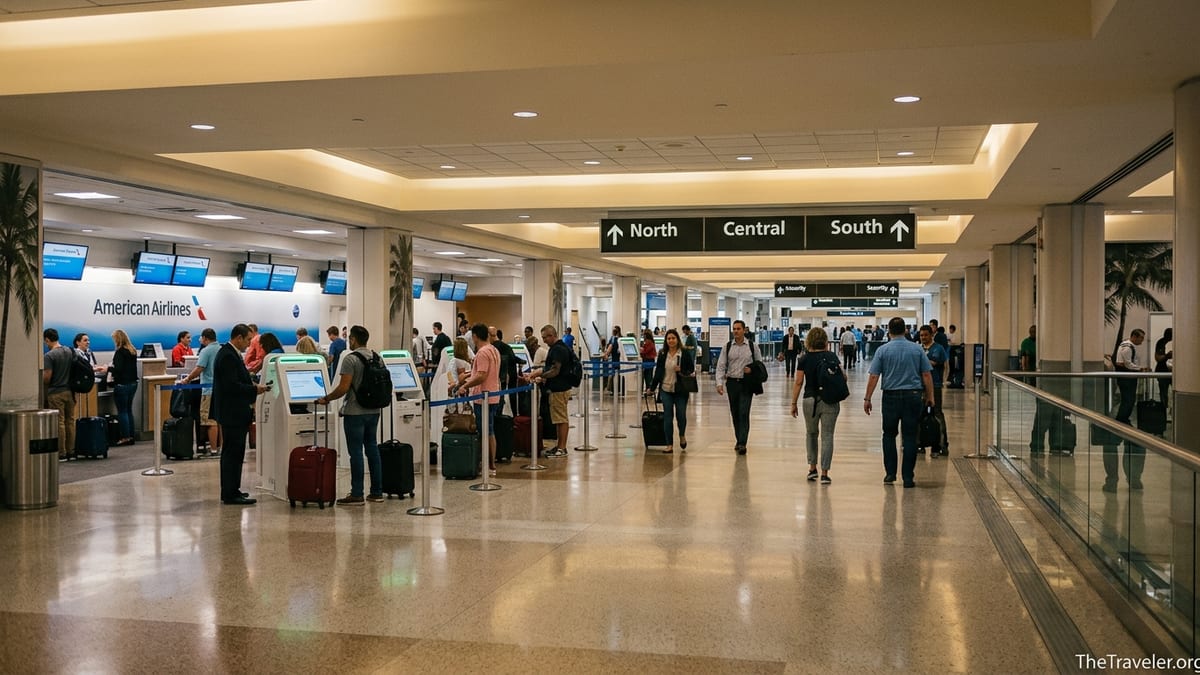
Understanding Miami International Airport’s Layout
Miami International Airport is organized into a long, curved terminal building divided into three main sections: North Terminal, Central Terminal and South Terminal. Within these areas sit the concourses, labeled D in the North Terminal, E, F and G in the Central Terminal, and H and J in the South Terminal. Concourse D is dominated by American Airlines, which runs the majority of domestic and many international flights. Concourses H and J handle a large share of international departures on carriers such as Delta, LATAM, Avianca, Air France, KLM, Lufthansa and others.
All check-in areas sit landside on the upper departures level, while gates and most restaurants and shops are airside after security. The concourses are technically connected airside, but walking between them can take significant time. For example, walking from an early D gate near the American Express Centurion Lounge area around D12 to a late D gate close to D60 can easily take 15 to 20 minutes at a normal pace, even with the Skytrain that runs along Concourse D. If you need to move from D to J, you should budget 25 to 30 minutes or more, especially at busy times.
The airport’s signage has improved, but many travelers still find the layout confusing, particularly where the Central Terminal (E, F, G) meets the North and South sections. As a rule of thumb, match your airline first, then your concourse. American and most oneworld partners will use D or E, many U.S. domestic carriers like United and Southwest operate from G or F, and SkyTeam and Star Alliance carriers with international flights often depart from H or J. Screens throughout the check-in halls show airline and concourse pairings; it is worth pausing to confirm before you commit to a long walk.
Because of the distances involved, you should think of Miami International as three adjacent but distinct terminal zones. If you want to grab a meal at a specific restaurant or visit a certain lounge before departure, make sure it sits in your concourse or in an easily reachable neighboring one. Changing concourses after security just to find better food or a lounge can eat up a surprising amount of time and may not be realistic before a short-haul domestic flight.
How Early to Arrive and Check-In Timing
How early you should arrive at Miami International depends on three factors: whether your flight is domestic or international, whether you are checking bags, and whether you have trusted traveler benefits such as TSA PreCheck or CLEAR. As a baseline, the airport and most airlines serving it recommend arriving at least two hours before a domestic departure and at least three hours before an international departure. In practice, many frequent flyers who know the airport well aim for around 2.5 hours for domestic and 3 to 3.5 hours for international flights from Miami, especially at peak times.
For example, if you are taking a morning American Airlines domestic flight to New York departing around 8:00 a.m. from Concourse D with no checked bags and TSA PreCheck, arriving at 6:00 a.m. is usually adequate. You can check in online the night before, use a bag-drop counter if you have luggage, and often be through security in 15 to 30 minutes. In contrast, a family flying in economy on a late evening LATAM or Avianca departure to South America from Concourse J, with two or three checked suitcases each and no trusted traveler status, would be wise to plan for a full three hours. Large tour groups and heavily loaded long-haul flights mean check-in counters can back up and security queues can grow quickly.
Most major airlines at Miami open their counters about three hours before an international departure and about two hours before domestic flights, but this can vary. Carriers such as Turkish Airlines, Air France or Lufthansa that operate one or two flights a day often time their check-in windows very tightly to those specific departures. It is common, for example, to see a single queue open at H or J three hours out for an evening flight to Istanbul, Paris or Frankfurt, with passengers arriving right at opening to secure preferred seats or early bag check. If you arrive much earlier than three hours, you may find the counter simply closed and have to wait landside.
Online and app-based check-in is widely supported and recommended. American, Delta, United, JetBlue and Southwest all allow mobile boarding passes on flights from Miami, and most international carriers support them for U.S. departures as well. Checking in online at the 24-hour mark helps you choose seats and avoid the longest lines, and you can still visit a staffed counter if you need a paper boarding pass or have special luggage such as sports equipment or pets.
Security Screening and TSA PreCheck at MIA
Miami International has around ten security checkpoints spread along the terminal, with checkpoints in the North Terminal serving Concourse D, several in the Central Terminal for E, F and G, and additional ones in the South Terminal for H and J. At busy times, security wait times can vary dramatically between checkpoints. For example, a late afternoon queue at one D checkpoint can stretch to 30 or 40 minutes, while another checkpoint a short walk away has a much shorter line. Electronic boards and some airline apps now show approximate wait times, but you still need to allow a generous cushion, especially at holiday periods, spring break, or major events in South Florida.
TSA PreCheck is available at Miami, with separate lanes at the main checkpoints in the North, Central and South terminals. During typical morning and evening peaks, PreCheck lines here often run between 5 and 15 minutes, but they can be longer on heavy travel days. CLEAR operates at several checkpoints as well, including in the American-dominated North Terminal, and members can combine CLEAR with PreCheck for a faster experience. A traveler with both CLEAR and PreCheck catching a 7:00 a.m. domestic flight from Concourse D might realistically clear security in under ten minutes on a normal weekday, while someone in the standard lane without PreCheck could wait half an hour or more.
Security rules at Miami follow standard TSA requirements. That means liquids in containers of no more than about 100 milliliters each, all fitting in a small transparent bag, and laptops and large electronics typically removed from carry-ons unless you are in a PreCheck lane or using upgraded scanners that permit them to stay inside. Belts, metal objects and jackets usually need to go into trays. At Miami, pay particular attention to signage near the front of each lane, as some checkpoints use newer computed tomography scanners that have slightly different rules about removing electronics and liquids. Agents will often remind you verbally if you are approaching the wrong scanner with a full backpack or large roller bag.
If you are traveling with children, adults over 75, or mobility devices, allow extra time at security. Families heading off on cruises from Miami often bring large amounts of luggage, souvenirs, or new electronics, which can trigger additional bag searches if items are densely packed. It is not uncommon for a security experience that would normally take 15 minutes to stretch to 30 or more if an officer needs to inspect multiple bags or if you are selected for additional screening. Building that potential delay into your schedule is one of the simplest ways to keep stress levels down.
Passport Control, International Departures and Connections
For departures, passport control at Miami mostly affects travelers on international flights leaving from concourses that handle departures to countries requiring exit checks or additional documentation. While U.S. airports generally do not have outbound passport control booths like many European or Latin American airports, your airline will verify travel documents very carefully at check-in and at the gate. If you are flying American, Iberia or British Airways to Europe from Concourse D or E, for example, staff will confirm passport validity and any required visas at the check-in desk or at boarding. Many carriers also carry out additional checks for itineraries connecting beyond the first foreign gateway, so passengers bound for smaller European or African cities via Madrid or London should expect a few extra questions.
Premium passengers and those with certain frequent flyer status levels can sometimes use priority check-in lanes for these document checks. At Miami, it is common to see separate, clearly signed lanes for business or first class and for elite status customers on long-haul flights. On a busy evening departure bank at J, a business-class passenger heading to Santiago might clear check-in formalities in ten minutes while the general economy queue snakes far back into the hall. Even so, all passengers still undergo the same TSA security screening after check-in, so time saved at the counter does not eliminate the need for an early arrival.
If you are connecting in Miami from a domestic flight to an international departure, the good news is that your bags are typically checked through and you only need to follow the signs to your next gate. For instance, a traveler flying from Dallas to Miami on American and connecting to a flight to Lima usually collects both boarding passes at the origin city, then lands at a D gate in Miami and walks to the international departure gate, often also in D or E. However, connections that involve changing from one airline to another, such as a JetBlue domestic arrival in F followed by a Lufthansa departure in J, may require a longer terminal transfer and occasionally a stop at a transfer desk to reprint boarding passes or verify documents.
International arrivals connecting to departures at Miami must always clear U.S. immigration and customs, collect checked baggage, and then recheck bags for onward flights. That process is located in a separate arrivals hall and can be time consuming. If you are arriving internationally and departing again from Miami within a few hours, you should aim for connection times of at least two hours on a single ticket and more if you are traveling on separate bookings. This is especially important for morning arrival waves from Europe and South America, when immigration lines can be long and baggage carousels busy. If your onward departure is on a different airline or from a different concourse, giving yourself three hours or more is prudent.
Food, Drinks and Shopping Before Your Flight
Miami International has a broad mix of food and beverage options spread across its concourses, although quality and variety can vary by terminal. Concourse D, as the largest and most heavily trafficked, has the widest selection. Here you will find familiar fast-food names such as Burger King and Pizza Hut, casual sit-down spots offering Cuban sandwiches and pressed paninis, and coffee bars serving espresso and pastries. In recent years the airport has added more local brands, including cafes that serve Cuban coffee and pastelitos, giving travelers a taste of Miami culture before they depart.
In the South Terminal, concourses H and J also offer solid pre-flight dining, particularly for international travelers leaving in the evening. Wine bars and tapas-style venues sit alongside grab-and-go counters where you can pick up salads, sandwiches and bottled drinks to take on board a long-haul flight. Duty-free shops in these concourses carry the usual range of spirits, cosmetics, perfumes and chocolates, and passengers on flights to Europe and Latin America regularly stock up on local rum brands or high-end fragrance lines before boarding.
The Central Terminal concourses E, F and G feel slightly older and more utilitarian, but you can still find recognizable chains such as Starbucks, Dunkin and generic bar-and-grill concepts that serve burgers, wings and draft beer. If you are departing from a smaller or more remote gate, it is wise to buy food earlier in the concourse rather than assuming something will be available near your exact gate. A traveler leaving from an F gate on a late-night domestic flight to a smaller U.S. city might find only one bar with limited snacks open, while half a dozen options are open closer to the security checkpoint.
Shopping at Miami International reflects both its role as a hub airport and its Miami location. In addition to duty-free outlets, there are boutiques selling sunglasses, resort wear, beach accessories and luxury fashion, along with the standard newsstands, electronics stores and souvenir shops. Prices are typical for a major airport, with a basic pair of wired headphones often going for a noticeable premium compared to city prices and bottled water costing more than in town. If you need last-minute travel essentials such as travel-size toiletries, phone chargers or neck pillows, you will find them easily in all concourses, but if you are price sensitive you may want to purchase such items before arriving at the airport.
Lounges and Quiet Spaces at MIA
Miami International has a strong lineup of lounges across its terminals, ranging from airline-specific clubs to credit-card and Priority Pass spaces. In Concourse D, American Airlines operates multiple Admirals Club lounges and a Flagship Lounge aimed at premium long-haul passengers. Nearby, an American Express Centurion Lounge serves eligible cardholders, offering complimentary hot meals, a full bar, showers and workspaces. Regular travelers often remark that the Centurion Lounge’s food and beverage selection stands out compared with many standard airline clubs, although it can become crowded during afternoon and evening departure peaks.
In the South Terminal, the Delta Sky Club in Concourse H gives Delta’s SkyMiles Medallion members and premium cabin passengers access to a quieter environment with snacks, drinks and work areas. Concourse J hosts several international airline and partner lounges. Examples include the LATAM VIP Lounge and spaces shared by carriers such as Avianca and TAP Air Portugal. These lounges often serve substantial hot food in the evening, reflecting the long overnight flights to South America and Europe that depart from this part of the airport. Priority Pass access is available at some of these lounges, and at certain restaurants that offer a credit against your bill in exchange for a lounge visit.
Day passes are an option at several Miami lounges. For instance, non-elite travelers flying in economy on American can often purchase entry to an Admirals Club for a fee that tends to sit in the high double digits per person, subject to capacity. That can make sense for a family facing a long delay or a business traveler needing a quiet place with reliable Wi-Fi and power outlets to work before an important meeting. Travelers without airline status but holding premium credit cards may find that their card grants complimentary access to some lounges, particularly the Centurion Lounge and certain partner lounges in H and J.
Outside of formal lounges, there are a few quieter corners throughout the airport where you can rest if you do not have lounge access. Seating areas at the far ends of some concourses, such as near the later D or G gates, may be less crowded between departure waves. The airport hotel, which is located within the terminal complex, can be a refuge for travelers facing very long layovers, as day-use rooms are sometimes available. However, for most passengers, a lounge remains the best way to secure comfortable seating, charging points and a relatively calm environment before a long flight, especially in the evening rush period between about 5:00 p.m. and 10:00 p.m.
Practical Timing Strategies and Real-World Scenarios
To turn all of this information into a workable plan, consider a few common scenarios. A solo traveler with TSA PreCheck flying American from Miami to Chicago on a weekday at 1:00 p.m., with a single carry-on bag, might arrive around 11:00 a.m. They could check in on the airline app before leaving their hotel in downtown Miami, take a rideshare that reaches the D check-in area by 11:00, walk to the nearest PreCheck security entry, and often be airside by 11:20 or 11:30. That leaves time to grab a sandwich in D, stop by a lounge if they have access, and reach the gate 25 to 30 minutes before boarding.
Contrast that with a family of four flying economy from Miami to Madrid on an evening flight departing from E just before 7:00 p.m., with two checked bags each and no trusted traveler benefits. Because that departure falls right in the evening international departure wave, arriving at 3:30 p.m. or 4:00 p.m. is sensible. They might spend 30 to 45 minutes in the airline’s economy check-in line as staff check passports and visas, then another 30 to 40 minutes in regular security. By the time they are airside, it could be around 5:15 p.m., leaving about 90 minutes for a sit-down meal, a duty-free stop and a stroll to the gate, where boarding for a long-haul flight will likely begin 45 minutes or more before departure.
A third scenario involves a connecting passenger. Imagine someone arriving from Orlando on a 10:00 a.m. domestic flight that lands at a D gate, then connecting to a 12:30 p.m. international flight to Lima from J. On a single ticket with through-checked baggage, they would not need to re-clear security, but they would have to make the cross-terminal walk or use the internal connector routes between D and J. Even walking briskly, that journey can take 20 to 25 minutes, especially if you are not familiar with the signage. That leaves about an hour upon reaching J, which is enough but not luxurious. This traveler should prioritize heading straight to J first, then decide whether there is time to visit a lounge or restaurant near the departure gate.
Whatever your situation, two principles will help at Miami. First, decide in advance how much of a buffer you are comfortable with, then add an extra 30 minutes as insurance against traffic jams on the highway, an unexpectedly long TSA line, or last-minute gate changes that move your flight across the terminal. Second, anchor your plans on your departure concourse. Because Miami’s concourses are long and not always intuitive to navigate, it is almost always better to get to your concourse area first and then look for food, shopping or a lounge nearby instead of detouring to another part of the airport hoping to find better options.
The Takeaway
Departing from Miami International Airport does not have to be a stressful experience, but it does reward preparation. Understanding the basic terminal layout, knowing which concourse your airline uses, and planning realistic arrival times for domestic versus international flights can dramatically reduce anxiety on departure day. With multiple security checkpoints, a full range of lounges, and plenty of food and shopping, Miami can be a comfortable place to begin a trip if you allow enough time to navigate it.
As you plan your departure, think about your specific circumstances: checked bags or carry-on only, trusted traveler status or standard security, solo or with a family, and peak or off-peak travel times. Use those details to decide whether you aim for two hours, three hours, or more at the airport. Once you are checked in and through security, Miami’s concourses offer a blend of local flavors, international brands and quiet corners where you can relax and shift into travel mode before boarding. With a little planning, your departure from Miami International can set a smooth, confident tone for the rest of your journey.
FAQ
Q1. How early should I get to Miami International Airport for a domestic flight?
For most domestic flights from Miami, aim to arrive about two hours before departure if you have checked baggage and standard security. If you have TSA PreCheck, no checked bags and are traveling at an off-peak time, 90 minutes can be enough, but many regular travelers still prefer a full two hours for peace of mind.
Q2. How early should I arrive at MIA for an international flight?
For international departures, plan to be at the airport at least three hours before scheduled departure, and consider 3.5 hours during holidays, school breaks or major events. Airlines at Miami often begin boarding long-haul flights 45 minutes or more before departure, and check-in lines plus security can easily consume an hour or more.
Q3. Which terminal or concourse does American Airlines use at Miami?
American Airlines primarily uses Concourse D in the North Terminal for its domestic and many international flights, with some additional operations and partner flights in neighboring Concourse E. If your ticket shows a D gate number, you should follow signs for the North Terminal and Concourse D check-in and security areas.
Q4. Is TSA PreCheck available at all security checkpoints at MIA?
TSA PreCheck is offered at major checkpoints in each terminal zone at Miami, including those serving concourses D, E, F, G, H and J. However, not every single lane at every checkpoint has PreCheck, and hours can vary, so check airport displays and follow PreCheck signage to ensure you join the correct line.
Q5. Are there CLEAR lanes at Miami International Airport?
Yes, CLEAR operates at selected checkpoints in the North, Central and South terminal areas, including those commonly used by American and other major carriers. CLEAR members can typically pair the service with TSA PreCheck for a faster identity check followed by the expedited PreCheck screening lane, especially useful during busy morning and evening periods.
Q6. What are the main lounges available at MIA?
Miami has several prominent lounges, including American Airlines Admirals Clubs and a Flagship Lounge in Concourse D, an American Express Centurion Lounge also in D, a Delta Sky Club in Concourse H, and multiple international airline and partner lounges in Concourse J. Some of these accept Priority Pass members or sell day passes, while others are reserved for premium cabin and elite status passengers.
Q7. Can I buy a day pass for a lounge at Miami if I do not have status?
At several lounges, yes. For example, many economy passengers on American can purchase a one-time Admirals Club entry for a fee that typically runs in the high double digits per person, subject to capacity limits. Policies change periodically, so it is best to confirm current prices and availability with your airline or lounge operator shortly before travel.
Q8. What food options can I expect before my flight?
Across Miami’s concourses you will find a mix of fast-food outlets, coffee shops, casual bars and sit-down restaurants, plus grab-and-go counters. Concourse D has the widest variety, including spots serving Cuban sandwiches and local coffee, while H and J offer good choices for international travelers in the evening. Central Terminal concourses E, F and G have simpler but still adequate options, so it is wise to eat closer to the main hubs of each concourse.
Q9. How long does it take to walk between concourses at MIA?
Walking times vary, but moving within a single long concourse such as D can take 15 to 20 minutes, even using the Skytrain. Walking from D to J can easily take 25 minutes or more at a normal pace, especially if you are not familiar with the layout. Travelers with tight connections should go directly toward their next gate rather than detouring for food or shopping in another concourse.
Q10. Is Miami International Airport particularly busy at certain times of day?
Yes. Early morning hours between roughly 6:00 a.m. and 9:00 a.m. see heavy domestic and regional departures, while late afternoon and evening, from about 4:00 p.m. to 10:00 p.m., are busy with both domestic flights and long-haul international services to Europe and Latin America. During these windows, security lines grow longer and lounges and restaurants fill up, so adding extra time to your schedule is advisable.