


Landing at Miami International Airport (MIA) can feel intense, especially after a long international flight. The terminal is busy, signage shifts between English and Spanish, and there are multiple options for getting into the city or straight to your cruise ship. This practical arrivals guide walks you step by step through what happens after touchdown, from immigration and baggage claim to SIM cards, ATMs, the free MIA Mover train, taxis, rideshares, rental cars, and cruise transfers.
Get the latest updates straight to your inbox!
Navigating Terminals, Immigration and Baggage Claim
Miami International Airport has three main terminal areas arranged in a long horseshoe: North (D), Central (E, F, G) and South (H, J). Most American Airlines and oneworld flights arrive in the North Terminal, while many European and Latin American carriers use the Central and South terminals. After your aircraft parks, overhead signs for “Arrivals” and “Baggage Claim” will guide you into the Federal Inspection area if you are arriving from abroad.
For international arrivals, you will first go through U.S. Customs and Border Protection. MIA uses automated passport control kiosks and facial biometrics for many travelers, which can speed up the process for eligible U.S. citizens and some visa waiver passengers. Global Entry members have dedicated kiosks and usually clear immigration much faster, which can be a major advantage in the evening peak when multiple widebody flights from Europe and South America land within minutes of each other.
Once your passport is stamped or electronically cleared, you are directed to baggage claim. North Terminal’s international arrivals facility, for example, has a large second‑level baggage hall with multiple carousels and electronic boards listing flight numbers and corresponding belts. If you are connecting onward within the United States on the same ticket, you still need to collect your checked bags here, clear customs and then re‑check them at the dedicated transfer belt just past the customs exit.
Allow realistic time for this process. On a quiet weekday morning, you might clear immigration and collect luggage in 30 to 45 minutes. In the evening or during winter high season, it can easily take 60 to 90 minutes, particularly if you are not a Global Entry member and arrive with a bank of flights from Mexico, Brazil and Europe at once. If you have a same‑day cruise departure or a tight connection, plan accordingly and give yourself a generous buffer.
Clearing Customs and Exiting to the Arrivals Level
After collecting your bags, you pass through customs, where officers can ask questions about your stay and may direct you to secondary screening. Travelers must declare items such as certain foods, high‑value purchases and large amounts of cash. Duty‑free purchases from your departure airport, like liquor or perfume, can usually pass through if properly packaged, but be ready to show receipts.
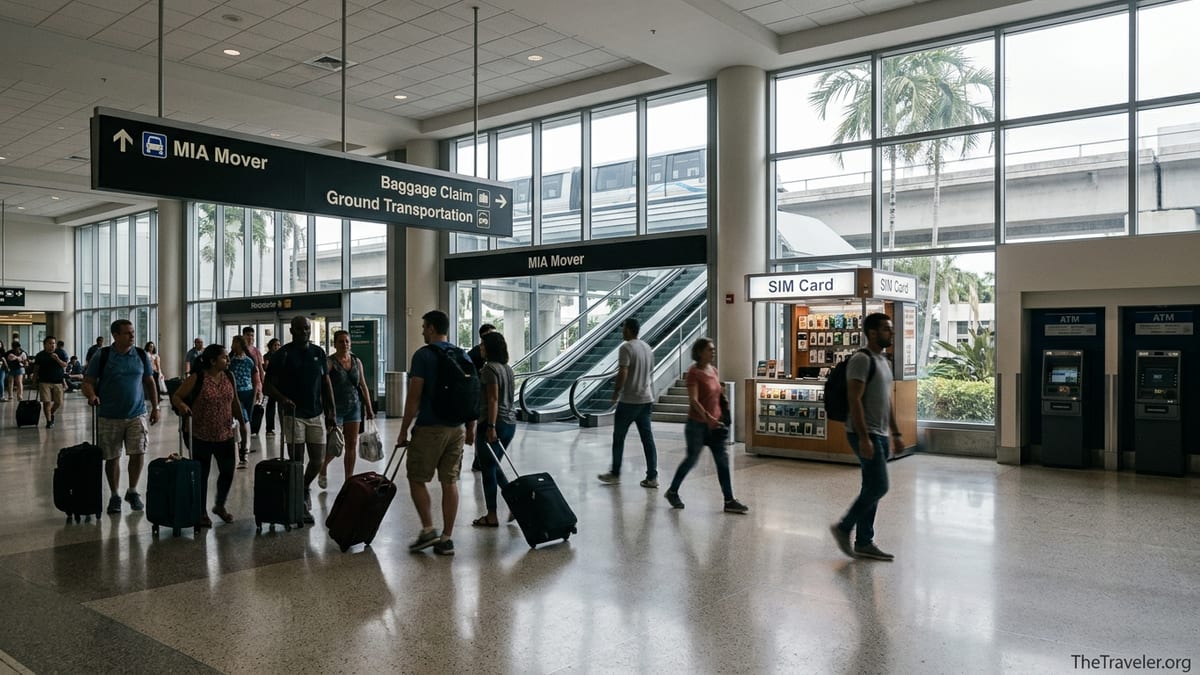
Once customs releases you, sliding doors open into the public arrivals hall on the first level. Here you will find crowds of greeters, hotel and cruise representatives holding signs, and clear signage pointing toward ground transportation, the MIA Mover train, and inter‑terminal connections. If you need to move between terminal areas before leaving, the airport’s Skyride walking system on the upper level connects different concourses and leads to the MIA Mover station above the central parking garages.
Before heading outside, this is a good moment to reorganize. There are restrooms, information desks with uniformed Miami‑Dade Aviation staff, and seating areas where you can repack duty‑free items or retrieve documents from your carry‑on. Keeping your passport, customs slip and any onward travel vouchers handy is useful if you need to speak to ground staff or a tour operator waiting in the arrivals hall.
If someone is picking you up by private car, let them know that all public curbside pickups for private vehicles are on the lower arrivals level, outside baggage claim. It often takes 15 to 25 minutes between leaving the aircraft and reaching the curb on a domestic flight, and considerably longer after an international arrival, so it is better for your driver to wait in the cellphone lot and come when you text from outside.
Getting Connected: SIM Cards, eSIMs, Wi‑Fi and ATMs
Staying connected as soon as you land is especially important at MIA, where you may need mobile data to order a ride app or contact your cruise line. The airport provides complimentary Wi‑Fi throughout the terminals, which is usually fast enough for messaging and app downloads, though speeds can slow during heavy peaks like early evenings. Many travelers use the Wi‑Fi to activate an eSIM or log in to ride‑share apps before stepping outside.
Physical SIM cards are available from several travel and telecom kiosks in the terminal. These are often located near arrivals halls and in mixed‑use shops in the Central Terminal where you can buy currency exchange services, prepaid SIMs and simple unlocked phones. Prices change frequently, but you can expect an airport kiosk to charge a premium. A typical U.S. prepaid SIM from a major brand like T‑Mobile or AT&T might cost in the region of 40 to 60 dollars for a month of service with unlimited or high‑cap data if purchased at the airport, compared with lower promotional prices at city stores.
Because of that markup, many visitors now arrive in Miami with an eSIM already installed from international providers that specialize in U.S. data bundles. These can usually be purchased online before departure, then activated over the airport Wi‑Fi while you wait at baggage claim. For travelers who prefer a local number for calls and text, another option is to use the airport Wi‑Fi to arrange a ride into the city and then pick up a lower‑cost prepaid SIM later from big‑box retailers or drugstores along major streets like Biscayne Boulevard or in neighborhoods such as Coral Gables.
ATMs are common throughout MIA, including near baggage claim and in the arrivals halls. Machines from major U.S. banks and independent operators are side by side. Bank‑branded ATMs typically charge a lower usage fee than third‑party machines, although your home bank may add a foreign transaction fee. With cabs and many cafes now accepting cards or contactless payments, you do not need large amounts of cash; withdrawing 60 to 100 dollars is usually enough to cover a taxi, a snack and small tips on arrival.
Using the Free MIA Mover, Public Transport and Shuttles
The MIA Mover is a free elevated train that transports passengers between the airport terminal complex and the Miami Intermodal Center, where the Rental Car Center, Tri‑Rail, Metrorail and several bus services are located. The station is on the third level of the airport, accessible via moving walkways that pass over the central parking garages. Trains typically run every few minutes throughout the day and the ride takes around three minutes, making it the fastest way to access rental cars and rail connections without navigating traffic.
If you plan to use public transport into the city, you will likely take the MIA Mover first. From the Intermodal Center, the Metrorail Orange Line runs into downtown Miami, stopping at stations such as Earlington Heights and Government Center, where you can transfer to the Metromover or local buses. The Miami Beach Airport Express bus, commonly known as Route 150, runs from the airport area to Miami Beach, stopping along major stretches of Collins Avenue for a modest fare that is much cheaper than a taxi or rideshare. Paying with a contactless transit card or compatible bank card is usually the fastest approach.
Many hotels in airport‑area clusters near Blue Lagoon Drive, Doral or along NW 36th Street run courtesy shuttles that pick up guests at designated zones outside the arrivals level. These shuttles are free for hotel guests and can save you the cost of a short taxi ride if you are staying near MIA before an early flight or cruise. Always confirm shuttle frequency and operating hours in advance; some properties run them every 20 to 30 minutes during the day but reduce service late at night.
For pre‑booked shared shuttle services to destinations like Key Largo, West Palm Beach or Orlando, drivers usually meet passengers at clearly marked shuttle meeting points on the lower level. Because there have been complaints about unreliable operators that fail to show up or charge unexpected surcharges, it is wise to book with a well‑reviewed company and ensure you have a customer service number saved in your phone before departure.
Taxis and Rideshare: What to Expect and Typical Costs
Official taxis at MIA queue at taxi stands on the lower arrivals curb, outside each terminal’s baggage claim area. Look for uniformed airport staff and standard yellow cabs with roof lights and company markings. Miami‑Dade County regulates these vehicles and meter rates, including a minimum fare for trips originating at the airport and an airport surcharge. As of mid‑2026, the historical flat‑fare zones to Miami Beach have been eliminated, so trips now run on the meter instead, with SUVs and vans typically subject to a higher rate than standard sedans.
In practical terms, a daytime metered taxi from MIA to South Beach or the Art Deco district on Ocean Drive often falls somewhere in the 40 to 60 dollar range depending on traffic, route and whether you travel in a standard sedan or larger vehicle. A cab to downtown Miami or Brickell tends to cost less, roughly in the 25 to 40 dollar band at off‑peak times. If you are carrying golf clubs or multiple large suitcases, an airport dispatcher can direct you to a larger taxi, but be aware that a percentage surcharge may apply to vans and SUVs.
Rideshare services such as Uber and Lyft are widely available at MIA. Pick‑up zones are separate from the taxi ranks and are clearly signed as “Ride App Pickup.” After collecting your luggage, you can use the airport Wi‑Fi or your mobile data to request a car, then walk to the designated area indicated in the app, which typically specifies a lettered or numbered zone. Prices fluctuate based on demand, time of day and special events, but travelers regularly report ride‑share fares to South Beach and central Miami neighborhoods that are competitive with, and sometimes lower than, taxi prices, particularly outside peak evening hours.
For budget‑conscious travelers, checking both a taxi and a rideshare quote before leaving the terminal is worthwhile. For example, on a weekday afternoon you might see an UberX estimate of around 30 to 40 dollars to Miami Beach, while a metered taxi could land slightly higher if congestion around downtown is heavy. During major events like Art Basel or the Miami Grand Prix, surge pricing on ride apps can reverse that equation, making regulated taxis a more predictable choice.
Renting a Car at the Miami Rental Car Center
If you plan to explore South Florida beyond central Miami or drive to destinations such as the Florida Keys, the Everglades or Orlando, renting a car may be the most flexible option. All major brands, including Avis, Budget, Enterprise, Hertz, Alamo, National and others, cluster at the Rental Car Center next to the Miami Intermodal Center, accessible by the MIA Mover. After you exit customs, follow signs for “MIA Mover” or “Rental Car Center,” take the escalator or elevator to the third level and board the free train.
At the Rental Car Center, rows of counters line a large arrivals hall where you can pick up existing reservations or arrange a walk‑up rental. Booking in advance almost always produces better pricing, particularly during winter high season when Miami receives a surge of visitors escaping colder climates. In December and January, daily rental rates for compact cars can rise steeply compared with shoulder‑season months like May or September, and some categories such as convertibles or SUVs may sell out on busy weekends.
When budgeting, remember that Miami rental quotes often do not include everything you will actually pay. Taxes and local surcharges, young driver fees for renters under 25, and optional extras like SunPass toll packages or additional drivers can significantly increase the total. If you plan to drive frequently on toll‑heavy routes like the Dolphin Expressway or to Orlando on Florida’s Turnpike, a toll package may be convenient, but for a short stay in Miami Beach or Brickell it might be more economical to pay tolls individually or avoid toll roads altogether.
Finally, consider whether you truly need a car. Parking in popular areas like South Beach, Wynwood and Coconut Grove can be challenging and expensive, with hotel valet rates easily reaching several dozen dollars per night. If your plans mainly involve staying in one neighborhood and making occasional excursions, combining taxis, rideshare, public transport and walking can be simpler and cheaper than navigating Miami traffic yourself.
Heading for the Port: Cruise and PortMiami Transfers
Many visitors land at MIA specifically to board a cruise from PortMiami, one of the busiest cruise hubs in the world. The port sits on Dodge Island, a short drive across the MacArthur or PortMiami Causeway from downtown. Without heavy traffic, the ride from the airport to most cruise terminals is roughly 15 to 25 minutes, though roadworks and weekend congestion can stretch that time, especially on Saturday mornings when multiple large ships embark at once.
Cruise lines often sell dedicated airport transfers, either by coach or shared shuttle, for passengers who book flights through them or add transfers separately. Prices vary by company, but a typical one‑way transfer might be in the 20 to 30 dollar range per person. These buses usually depart from clearly marked meeting points near baggage claim or outside the arrivals level, with staff holding cruise line signs. The convenience is high, especially for older travelers or those anxious about logistics, but families and groups may find a private taxi or rideshare more economical overall.
Taking a regular taxi or ride app directly from MIA to PortMiami is straightforward. After collecting your luggage, walk to the official taxi queue or rideshare zone, enter your cruise terminal number in the app if using a ride service, and expect a fare in the general range of 20 to 35 dollars in normal conditions. For a couple or small family, this often undercuts the cost of multiple per‑person cruise line transfers and lets you travel on your own schedule rather than waiting for a coach to fill up.
For travelers spending a night in Miami before or after their cruise, many downtown and Brickell hotels offer special cruise packages or arrange third‑party shuttles to the port. If you stay in areas like Bayside, Brickell Key or near the Metromover stations, a short taxi or rideshare to PortMiami on embarkation morning is usually quick and affordable. Always build in extra time on departure day, particularly in hurricane season or when there are large events in town that can impact traffic patterns.
The Takeaway
Arriving at Miami International Airport can be smooth and manageable if you know what to expect after landing. Give yourself enough time for immigration, baggage claim and customs, especially on international flights during busy evening banks. Use airport Wi‑Fi or an eSIM to get connected quickly, and treat airport SIM kiosks and currency exchange counters as premium‑priced conveniences rather than your only option.
The free MIA Mover is your lifeline to the Rental Car Center, Metrorail and buses, while clearly signposted taxi ranks and ride‑app pickup zones provide flexible options for getting to Miami Beach, downtown or PortMiami. Consider whether you really need a rental car given Miami’s parking costs and traffic, and compare the cost of per‑person cruise transfers with a single taxi or rideshare, particularly for families and groups.
With a realistic timeline, a basic understanding of MIA’s layout and a rough idea of taxi and rideshare prices, you can step off the plane, pick up your bags and be on your way to the beach, city or cruise ship with far less stress. Miami rewards a little advance planning, and starting your trip with a confident arrival sets the tone for the rest of your South Florida stay.
FAQ
Q1. How long does it usually take to clear immigration and customs at MIA?
On a quiet day you might be through in 30 to 45 minutes, but during busy evening waves and peak season it can easily take 60 to 90 minutes or more, especially if you are not a Global Entry member.
Q2. Is the MIA Mover train free and how do I find it?
Yes, the MIA Mover is free. Follow signs for “MIA Mover” or “Rental Car Center,” take the escalator or elevator to the third level over the central parking garages, and board the train to the Intermodal Center.
Q3. Can I buy a local SIM card when I land at Miami International Airport?
Yes, several airport shops and kiosks sell prepaid SIM cards and basic phones, although prices are usually higher than in city stores. Many travelers instead use airport Wi‑Fi to activate an eSIM or arrange a ride, then buy a cheaper prepaid SIM later in town.
Q4. Where do I meet Uber or Lyft at MIA?
Ride‑share pickups take place at signed “Ride App Pickup” areas on the lower arrivals level outside baggage claim. After requesting your ride in the app, follow the signs to the designated lettered or numbered zone shown on your screen.
Q5. How much does a taxi from Miami Airport to South Beach cost?
Since the flat‑fare zones were removed, taxis use the meter. Typical fares to South Beach are often in the 40 to 60 dollar range depending on traffic, route and vehicle type.
Q6. Is it worth renting a car at MIA?
Renting a car is useful if you plan to explore beyond central Miami, visit the Keys or drive to other Florida cities. For stays focused on Miami Beach, Brickell or downtown, many visitors find that taxis, ride apps, public transport and walking are easier and cheaper once parking costs and traffic are considered.
Q7. How do I get from Miami Airport to PortMiami for a cruise?
You can buy a cruise line transfer, book a shared shuttle, or simply take a taxi or ride app directly from the arrivals level. In normal traffic, the ride takes about 15 to 25 minutes, and fares are generally in the 20 to 35 dollar range for a private car.
Q8. Are there hotels near MIA with free airport shuttles?
Yes. Many airport‑area hotels in zones like Blue Lagoon Drive, Doral and along NW 36th Street operate complimentary shuttles that pick up at designated curbside areas. Always check the hotel’s shuttle schedule, as late‑night or very early‑morning service may be limited.
Q9. Do I need cash to pay for transport from the airport?
Most taxis, ride apps and public transport options accept cards or contactless payments. Having a small amount of cash, such as 60 to 100 dollars, is still helpful for tips, small purchases and older taxis that may have card terminals offline.
Q10. What should I do if someone inside the terminal offers me an unofficial taxi?
Politely decline and walk to the official taxi stand on the lower arrivals level, where uniformed airport staff manage the queue. Unofficial drivers inside the terminal may charge inflated fares or operate without proper licensing, so sticking with official taxis or recognized ride apps is safer.