


Planning a South Florida getaway means making one early decision that can shape the rest of your trip: should you fly into Miami International Airport (MIA) or Fort Lauderdale-Hollywood International Airport (FLL)? The choice can affect everything from your airfare and hotel budget to how long you spend in traffic, how easy it is to reach Miami Beach or your cruise ship, and even how relaxed you feel when you land. This guide compares the two airports with real-world examples so you can pick the one that best fits your itinerary, whether you are here for beaches, business, or a Caribbean cruise.
Get the latest updates straight to your inbox!
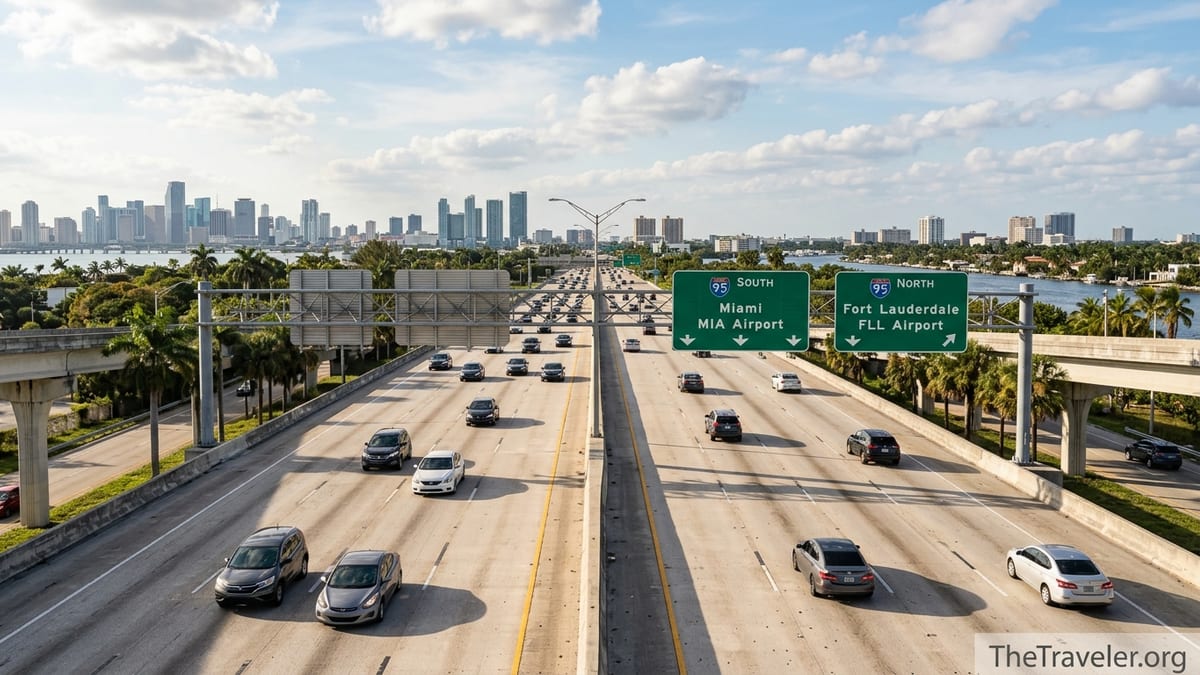
Big Picture: How MIA and FLL Fit Into South Florida
Miami International Airport sits on the mainland just northwest of downtown Miami, roughly 8 miles from Miami Beach and close to the major highways that feed the city. It is the primary international gateway for South Florida, with hundreds of daily flights across North America, Latin America, Europe, and beyond. For many travelers, MIA feels like the “default” option for a Miami trip, especially if they are staying in Brickell, Downtown Miami, or South Beach.
Fort Lauderdale-Hollywood International Airport lies about 30 miles north of downtown Miami, directly south of downtown Fort Lauderdale and only a few miles from Port Everglades cruise terminals. It is smaller and often calmer, with shorter walking distances between check-in, security, and gates. Many domestic carriers and low-cost airlines use FLL heavily, which can translate into cheaper fares if you are flexible about where you land and depart.
In practice, the distance gap between the two airports is not as large as it looks on the map. FLL is only about 10 to 15 miles farther from Miami Beach than MIA, but South Florida’s traffic patterns and your exact destination can make that extra distance feel much longer, especially at rush hour or on busy cruise weekends. Your choice should be guided first by where you plan to stay and sail from, and second by where you can find the best combination of flight schedule, price, and airport experience.
Think of MIA as the best fit if “Miami” is truly the center of your visit, and FLL as the smart alternative when you want a quieter airport, a base in Fort Lauderdale or Hollywood, or you are chasing lower fares and do not mind an extra 30 to 45 minutes on the road.
Access to Miami Beach and Downtown: Time vs Money
If your main goal is staying on Miami Beach, MIA usually wins for pure convenience. Taxi guides and recent airport transfer summaries put the distance from MIA to South Beach at around 12 miles, with typical drive times of 20 to 30 minutes outside peak rush hour. A metered taxi from the official taxi stands at MIA usually lands in the 35 to 45 dollar range to South Beach, while Uber or Lyft often fluctuate between about 25 and 40 dollars depending on demand. There is also the Miami Beach Airport Express bus (Route 150), which runs from the airport to several stops along Miami Beach for only a few dollars per person, a strong value for solo travelers or couples with light luggage.
From FLL to Miami Beach, you are dealing with closer to 30 to 35 miles. In light traffic, that can still be a 40 to 50 minute ride, but in weekday rush hour or on winter weekends when both cruise ports are busy it can easily stretch past an hour. Rideshare fares commonly fall somewhere in the 60 to 90 dollar range from FLL to South Beach, and taxis can be similar or slightly higher because you are crossing county lines. There is no direct inexpensive bus from FLL to Miami Beach, so you would need to combine local buses or a train with a rideshare, which tends to be more hassle than it is worth for most short-term visitors.
On the other hand, if you are staying in Downtown Fort Lauderdale, Las Olas, or Hollywood Beach, the calculus flips. From FLL, those areas are often 10 to 20 minute rides that might cost 15 to 30 dollars with Uber or Lyft. The same neighborhoods from MIA could require 45 minutes or more in the car and cost double or more. So while MIA is the clear winner for a classic South Beach stay, FLL is far more convenient if your trip is centered on Broward County beaches or you simply want a quieter base with easier driving and lower hotel rates.
One middle-ground option some visitors choose is to use the Brightline train between Miami and Fort Lauderdale’s downtown stations and then connect to airport shuttles. Brightline runs frequent trains between the two cities, and both MiamiCentral and Fort Lauderdale stations have shuttle links to their respective airports. This can make sense for travelers staying several days and splitting time between the two cities, but it adds transfers and will not beat a direct rideshare in pure door-to-door simplicity.
Cruise Connections: PortMiami vs Port Everglades
South Florida is the busiest cruise hub in the world, and which airport you choose matters a lot if you are sailing from PortMiami or Port Everglades. PortMiami is only about 8 to 10 miles from MIA, typically a 15 to 25 minute drive without heavy traffic. Many taxi zones offer flat fares from the airport to the port that fall in the 25 to 30 dollar range, and rideshares hover in a similar band depending on demand and time of day. For an early boarding time or a same-day return flight, the short hop between MIA and PortMiami is a major advantage.
From MIA to Port Everglades in Fort Lauderdale, expect a much longer ride, often around 45 minutes in light traffic and up to 60 or more in peak periods. Uber or Lyft for this route can land anywhere from about 60 to 100 dollars for a standard car. Some cruisers mitigate this by taking a shuttle or prebooked van service shared with other passengers, which can bring the per-person cost down, but those services add waiting time and set departure schedules.
If your ship sails from Port Everglades, FLL is almost always the more sensible choice. The airport is only a few miles from the cruise terminals; taxis, rideshares, and hotel shuttles routinely complete the trip in 10 to 15 minutes. Cab fares tend to be in the 15 to 25 dollar range, and some hotels near the port offer free or low-cost shuttles bundled with a one-night stay. For families or groups who want a low-stress embarkation morning, flying into FLL the day before and staying in a nearby hotel is an easy win.
Plenty of travelers still mix and match: for example, flying into FLL a day early because the flights are cheaper, staying in Fort Lauderdale for a beachfront evening, then paying roughly 70 to 90 dollars the next morning for an Uber to PortMiami. That can still be cost-effective if the airfare savings are substantial or your preferred airline only flies nonstop into FLL. Just be conservative about timing. If you are landing at FLL on the same morning your ship leaves Miami, plan for at least 90 minutes of buffer beyond whatever drive time your maps app predicts, especially during winter high season and on Saturdays or Sundays when four to six ships may be turning over passengers at once.
Flight Options, Prices, and Airlines
Miami International Airport is the larger and more globally connected of the two airports. It is a major hub for American Airlines and a primary entry point for flights from Latin America, the Caribbean, and Europe. That means you will often find more nonstop options into MIA from cities like London, Madrid, Sao Paulo, or Mexico City, as well as a dense network of domestic connections through American and other major carriers. If you are trying to minimize total travel time or avoid domestic connections, MIA may simply be the only airport that offers a nonstop on your preferred airline.
Fort Lauderdale, by contrast, has become a stronghold for low-cost and leisure-focused carriers. Airlines such as Spirit and JetBlue operate extensive networks from FLL, and many US cities see competitive fares to Fort Lauderdale that undercut equivalent routes into MIA. In practical terms, it is common to see a traveler from a mid-size US city find, for example, a 180 dollar round-trip fare into FLL on a budget airline versus 260 to 320 dollars into MIA on a legacy carrier for the same dates. Those differences fluctuate constantly and can reverse during sales or peak holiday periods, but FLL is often where the more aggressive promotional fares appear.
Several analyses of South Florida airfare patterns have noted that average base fares at MIA can trend slightly higher than at FLL, though the gap is not fixed and may only amount to a modest percentage on many routes. Where travelers can really save is by being flexible, watching for flash sales into Fort Lauderdale, and then comparing the extra ground transportation cost to the net ticket savings. For a solo traveler, a 70 dollar cheaper flight into FLL might vanish quickly once you add an 80 dollar Uber to South Beach. For a family of four, however, saving 60 or 80 dollars per ticket can easily outweigh a single 80 dollar car ride, especially if you are also willing to stay a night in Fort Lauderdale to break up the journey.
It is also worth looking at your return flight timing. Early morning departures before 8 am can be less stressful out of FLL if you are ending your trip in Broward County, where morning traffic is often lighter than in central Miami. Conversely, if you disembark a cruise at PortMiami and want to catch an 11 am or noon flight home, flying out of MIA reduces the risk compared with racing north to FLL and potentially encountering congestion on Interstate 95 or the airport access roads.
On-the-Ground Experience: Size, Layout, and Stress Levels
MIA’s scale is both a strength and a drawback. On the plus side, the airport offers a wide array of dining and shopping options, from well-known coffee chains and fast food to sit-down Cuban restaurants and duty-free boutiques. The Miami Intermodal Center, connected via the MIA Mover people mover, gathers rental cars, trains, and buses in one complex, which simplifies onward travel around the region. The airport is also well integrated with local transit, including Metrorail and Metrobus services that can take you downtown without ever getting in a car.
The trade-off is that MIA can feel chaotic and overwhelming, especially in peak seasons like winter holidays, spring break, and major events. Long walks between gates are common, security queues can be unpredictable, and signage may be confusing for first-time visitors. For example, a connecting passenger arriving on an international flight into the D concourse may need to clear immigration, retrieve and recheck bags, re-clear security, and then change concourses, a process that can easily consume an hour or more in busy periods.
FLL, by contrast, is notably more compact. Many passengers appreciate that the terminals are easier to navigate, and walking times from security to gates are shorter. Families with strollers, older travelers, or anyone who prefers a smaller, less intense airport environment often report feeling more relaxed at FLL. Wait times at security can still spike, but overall the airport tends to maintain a calmer atmosphere than MIA, and baggage claim areas are usually closer to the exits and ride-share pickup zones.
For rental cars, both airports host the major brands. At MIA, rentals are concentrated in the large rental car center, accessible via the MIA Mover. At FLL, rental counters and garages are generally within or adjacent to the terminals, so you may find yourself at the car by walking or taking a short shuttle. If you plan to explore beyond Miami and Fort Lauderdale, such as driving to the Florida Keys or West Palm Beach, rental car availability and pricing are typically similar at both airports, though FLL sometimes offers slightly cheaper daily rates thanks to strong leisure travel demand.
Ground Transportation and Public Transit Options
One of MIA’s strongest advantages is its integration with public transit. From the terminals, the MIA Mover takes you directly to the Miami Intermodal Center, where you can board the Metrorail Orange Line into Downtown and Brickell, the Metrobus network, or the commuter Tri-Rail line heading north toward Broward and Palm Beach counties. For example, a traveler staying in Brickell can take Metrorail from the airport for just a few dollars and be downtown in roughly 25 to 30 minutes, avoiding both traffic and rideshare surge pricing.
Miami Beach is also reasonably well served thanks to the Miami Beach Airport Express bus. This bus runs between the airport and key stops along the beach, reaching popular areas like 41st Street and the South Beach historic district. For budget travelers, this route is a standout: instead of paying 35 or 40 dollars for a taxi, you may spend only a small transit fare per person and still get to your hotel in under an hour, provided you are comfortable wheeling your luggage a few blocks.
FLL’s public transit connections are improving but remain more limited. Local Broward County Transit buses stop at the airport and can take you to downtown Fort Lauderdale or link to routes serving Port Everglades and nearby neighborhoods. The Tri-Rail commuter line also serves the airport area, but you typically need a short shuttle ride from the terminals to the rail station. From there, trains run south to the Miami Intermodal Center, where you could transfer to Metrorail or buses. This option is cheapest in pure dollars, but it involves multiple transfers, longer waits, and more walking with luggage, so it is better suited to experienced budget travelers rather than first-time visitors on a tight schedule.
For most visitors, especially those with suitcases or traveling in groups, rideshares and taxis remain the default choice from both airports. A common pattern looks like this: a couple flies into FLL on a discounted low-cost carrier fare, shares a 70 to 80 dollar Uber to a South Beach hotel, splits the cost between two people, and still comes out ahead financially versus a more expensive nonstop into MIA. Another traveler flying solo for a short business trip chooses MIA instead, pays 30 dollars for a taxi to Brickell, and saves 40 minutes each way compared with going through Fort Lauderdale and using trains or express buses.
Which Airport Fits Different Types of Trips?
For a classic Miami Beach vacation, MIA is usually the better fit. The short transfer time, direct express bus, and dense hotel cluster in South Beach and Mid-Beach make it easier to land, check in, and quickly get onto the sand or Ocean Drive. If your flights into MIA are only slightly more expensive than FLL, the time savings and simplicity often justify paying a bit more, particularly for trips of three or four days where every hour counts.
For a Fort Lauderdale or Hollywood Beach stay, FLL wins comfortably. Flying into MIA only to backtrack north rarely makes sense unless airfare differences are substantial or your loyalty program locks you into a specific airline hubbing at MIA. Travelers who prefer quieter beaches, long beachfront promenades, and more relaxed nightlife often find Fort Lauderdale a better match, and having the airport 10 to 20 minutes away reduces stress on both arrival and departure days.
For cruise passengers, the rule of thumb is straightforward. If your ship sails from PortMiami, prioritize MIA when the flight options and prices are reasonable. The short taxi ride helps on both embarkation and disembarkation days, and minimizes the risk of missing a flight because of highway congestion. If your ship leaves from Port Everglades, favor FLL, where quick shuttles, short hops, and port-area hotels cater directly to cruisers.
For budget travelers and families, it can pay to treat South Florida as a two-airport region and search fares into both. A family of four from the Midwest might see a total saving of 300 to 400 dollars by flying into FLL instead of MIA, even after paying for a private van or SUV rideshare to Miami Beach. In contrast, a solo traveler on a short work trip or a couple visiting for a long weekend may find that the 40 or 50 dollars they save in airfare is not worth the extra transfer time and complexity of routing through Fort Lauderdale.
The Takeaway
Choosing between Miami International Airport and Fort Lauderdale-Hollywood International Airport is less about which one is objectively “better” and more about which one aligns with your specific South Florida plans. MIA puts you closest to Downtown Miami, Brickell, Little Havana, and Miami Beach, and it offers the widest range of international and domestic connections. It is the smart choice when your time is limited, your hotel is in central Miami, or your cruise leaves from PortMiami.
FLL, in contrast, offers a calmer, more compact airport experience and often features competitive fares on low-cost and leisure carriers. It shines when your trip centers on Fort Lauderdale or Hollywood, when you have a bit more flexibility with transfer time, or when airfare savings are large enough to easily cover an Uber to or from Miami. For many visitors, especially families and cruise passengers, the sweet spot is to price both airports side by side and then layer in the realistic cost and time of ground transport before booking.
If you are staying on Miami Beach for a long weekend and can find reasonably priced flights into MIA, choosing Miami’s main airport will keep your arrival and departure days simple. If you are sailing from Port Everglades or plan to enjoy Fort Lauderdale’s beaches and waterfront along Las Olas Boulevard, FLL will likely feel more convenient and more relaxed. Whichever you choose, factoring in transfers, traffic patterns, and the rhythm of cruise days will help ensure your South Florida trip starts and ends on a smooth note.
FAQ
Q1. Is Miami International or Fort Lauderdale airport closer to Miami Beach? MIA is significantly closer to Miami Beach, usually about a 20 to 30 minute drive versus 40 minutes to over an hour from FLL, depending on traffic.
Q2. How much does a taxi or Uber from MIA to South Beach typically cost? From MIA to South Beach, a metered taxi often runs around 35 to 45 dollars, while Uber or Lyft can range roughly from 25 to 40 dollars depending on time and demand.
Q3. Is there a cheap public transport option from MIA to Miami Beach? Yes. The Miami Beach Airport Express bus connects MIA with multiple stops on Miami Beach for only a few dollars per person, making it the best low-cost option if you travel light.
Q4. Does Fort Lauderdale airport have a direct bus to Miami Beach? No. From FLL, reaching Miami Beach usually requires a rideshare, taxi, or a combination of local buses or train plus a car, which adds time and complexity.
Q5. Which airport is better if my cruise departs from PortMiami? MIA is better for PortMiami cruises, with a short 15 to 25 minute drive to the port and taxi or rideshare fares that are typically in the 25 to 35 dollar range.
Q6. Which airport should I use for a cruise from Port Everglades in Fort Lauderdale? FLL is the clear choice for Port Everglades, as it sits only a few miles from the cruise terminals, with taxi or shuttle rides of about 10 to 15 minutes.
Q7. Are flights usually cheaper into Fort Lauderdale than Miami? Often, but not always. Low-cost carriers at FLL frequently advertise lower fares, yet you should compare total trip cost including the added transfer expense if you are staying in Miami.
Q8. Is Fort Lauderdale airport really less stressful than Miami International? Many travelers find FLL easier to navigate because it is smaller and less hectic, with shorter walks and simpler layouts, although it can still be busy during peak travel periods.
Q9. Can I use trains between the two cities if I fly into the “wrong” airport? Yes. Tri-Rail and Brightline trains connect the Miami and Fort Lauderdale areas, but you will still need short shuttle or rideshare rides between airport terminals and train stations at each end.
Q10. If I want to visit both Miami and Fort Lauderdale, which airport makes more sense? Either can work. Many travelers choose the airport with the best flight schedule and price, then use Brightline or a rental car to move between the cities during their stay.