


More news on this day
The fragile post-pandemic recovery in global air travel is being shaken in 2026 as escalating conflict centered on Iran and Israel, a jet fuel price shock and cascading airspace restrictions combine to erode airline profitability and disrupt passenger and cargo flows across multiple continents.
Get the latest news straight to your inbox!
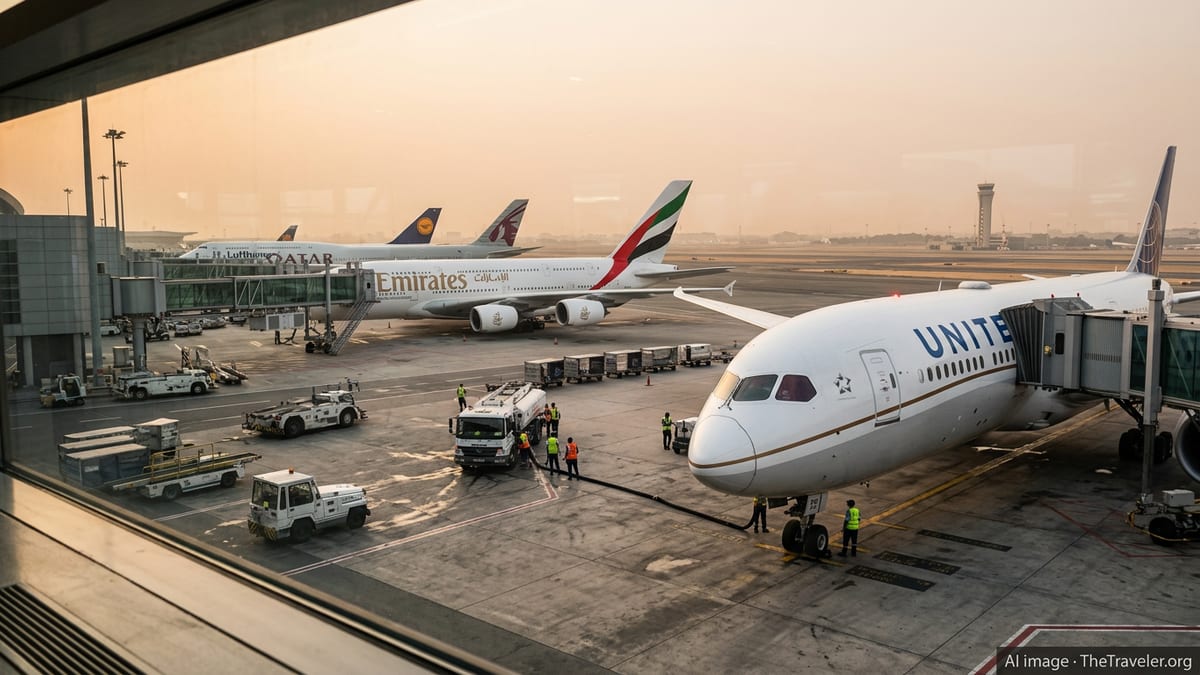
Airspace Closures Turn the Middle East Into an Aviation Bottleneck
The outbreak of large-scale hostilities involving Iran, Israel, the United States and several Gulf states since late February 2026 has rapidly transformed the Middle East from a vital aviation bridge into a chokepoint. Publicly available flight-tracking data and industry reports indicate that Iranian airspace was largely emptied of civilian traffic after joint strikes on Iranian targets, with neighboring states including Iraq, Jordan, Kuwait, Qatar, Bahrain and the United Arab Emirates imposing full or partial closures or tight restrictions.
Safety advisories from regulators in Europe and elsewhere extend conflict-zone warnings across much of the Persian Gulf and Levant region, reflecting continued risks from missile and drone activity. The European Union Aviation Safety Agency has prolonged its conflict-zone bulletin for the wider Middle East into 2026, underscoring how the airspace disruption is no longer viewed as a short, isolated episode but as a structural constraint on route planning.
The result is the effective shutdown or severe curtailment of operations at several major hubs that had become central to global connectivity, including airports in the UAE and Qatar. These hubs previously channeled large volumes of traffic between Europe, Africa, South Asia, China and Southeast Asia. With key corridors severed, aircraft are being rerouted over longer paths, often via the Arabian Peninsula, Central Asia or the eastern Mediterranean, adding hours of flying time in some cases.
For travelers, the knock-on impact is immediate and highly visible. Many carriers in Europe, Asia and the Americas have either suspended services to parts of the Middle East outright or reduced frequencies sharply, while also trimming connecting flights beyond the region. Published schedules show waves of cancellations and diversions stretching well into the northern summer season, leaving passengers facing fewer choices, higher fares and extended journey times.
Jet Fuel Shock Deepens the Financial Squeeze
The conflict-linked disruption is colliding with a parallel crisis in jet fuel markets. Since the start of the Iran war and related tensions around the Strait of Hormuz, benchmark oil prices and jet fuel spreads have climbed steeply, according to energy market analyses and airline financial research. Industry data presented at recent aviation briefings show jet fuel prices in 2026 surging far above assumptions built into many airline budgets, with cracks between crude oil and refined aviation fuel widening as refiners struggle to keep pace with shifting flows.
Financial analysts tracking major carriers in North America and Europe have revised fuel cost forecasts sharply higher for 2026, with some large airlines facing double-digit percentage increases in expected fuel bills compared with earlier projections. Research from market intelligence firms points to margin expectations falling by nearly a full percentage point for several listed carriers, even before factoring in additional costs from rerouting and operational disruption.
The squeeze is particularly acute for airlines with limited fuel hedging or weaker balance sheets. While a handful of European and Asian groups entered 2026 with partial hedges in place, many operators had reduced hedging activity in prior years as prices stabilized, leaving them more exposed to the sudden spike. At the same time, regulatory moves that push carriers toward greater use of sustainable aviation fuel, which typically trades at a multiple of conventional kerosene, are adding another layer of cost exactly as budgets are under strain.
Industry economic assessments, including those from global airline trade bodies, had projected record nominal profits for 2025 and a further, modest improvement in 2026. Those forecasts were built on assumptions of stable fuel markets and open airspace. The scale and speed of the current fuel and security shock now threaten to turn what was expected to be a year of margin stabilization into one defined by profit warnings, capacity cuts and renewed financial stress.
From the Gulf to Europe, Asia and the Americas: A Global Network Under Strain
The closure and restriction of airspace over Iran, Israel and parts of the Gulf reverberate far beyond the immediate region because Middle Eastern hubs sit at the crossroads of global long-haul networks. Airlines based in the United Arab Emirates, Qatar and Saudi Arabia have built business models around connecting traffic between Europe, Africa, China, India, Southeast Asia and Australasia. With their core corridors compromised, they are cutting frequencies, redeploying aircraft to secondary markets and, in some cases, grounding capacity.
Carriers in Europe and Asia are being forced to redesign long-haul routes that once overflew Iran and neighboring countries to reach destinations in India, China and Southeast Asia. Publicly available route maps now show flights tracking north of the Caspian Sea or skirting the southern edge of the conflict zone, adding distance, fuel burn and scheduling complexity. These changes follow earlier detours around Russian and Ukrainian airspace, compounding the operational challenge.
In North and South America, the impact is felt in thinner long-haul schedules and volatile fares. Airlines in the United States and Brazil, for example, depend on stable transatlantic and transpacific flows, as well as connectivity into the Gulf region. With Middle Eastern demand collapsing and fuel costs elevated, several carriers are prioritizing higher yielding domestic and regional routes, trimming marginal international services and delaying planned expansions to markets in the Gulf, South Asia and East Asia.
China and Vietnam are also caught in the crosscurrents. Both countries have been key nodes in the restoration of Asia Pacific travel, yet their carriers now face higher operating costs on Europe bound routes, while inbound tourism from the Middle East softens. Travel data providers report a pattern of reduced capacity and higher average fares across multiple long-haul city pairs touching these markets as airlines attempt to protect yields.
Historic Profit Pressures and the Risk of Airline Failures
While industrywide forecasts still point to aggregate profitability, the distribution of that profit is becoming far more uneven. Research from consultancies and credit analysts indicates that legacy network carriers with diversified route structures and stronger liquidity buffers are better placed to weather the storm, even if margins tighten. By contrast, smaller and highly leveraged airlines, particularly low cost and leisure-focused operators, are confronting conditions that resemble earlier crisis periods.
The combination of surging fuel bills, disrupted schedules, compensation obligations and weaker demand on conflict-exposed routes has already pushed some carriers into distress. Public filings and media coverage document airlines suspending operations or seeking court protection in several regions, citing the 2026 jet fuel spike and Middle East conflict as decisive blows on top of existing debts and post-pandemic recovery costs.
For travelers, the risk is not only higher prices but also reduced competition as weaker players exit. If consolidation accelerates in 2026 and 2027, certain markets could see fewer carriers and thinner route maps, especially from secondary cities in Europe, Brazil, the Gulf and parts of Asia. That would further entrench the dominance of large hub operators and airline groups that can absorb shocks and reallocate capacity globally.
Credit rating agencies are flagging aviation as one of the sectors most exposed to an extended Iran Israel conflict scenario, highlighting the possibility that a prolonged fuel and security crisis could transform a cyclical earnings dip into structural financial damage for parts of the industry.
What Passengers Can Expect for the Remainder of 2026
For the rest of 2026, travelers should prepare for a more fragile and less predictable global flight network. Booking data and fare trackers already show higher average ticket prices on many international routes, especially those linking Europe with Asia, Africa and Australasia, where aircraft are flying longer paths and burning more fuel. Promotional sales have become rarer, and deeply discounted long haul fares that briefly reappeared during the early recovery phase are once again difficult to find.
Operational reliability is another concern. With schedules constantly adjusted around evolving airspace restrictions and constrained spare capacity, airlines have less flexibility to recover from weather disruptions, technical issues or crew shortages. Industry observers suggest that same day rebooking options will be more limited, particularly on complex itineraries touching the Middle East or connecting between Europe and Asia.
The wider tourism sector, from hotels and cruise operators to destination marketing organizations in countries such as Portugal, Brazil, the United Arab Emirates, Qatar, Saudi Arabia, China and Vietnam, is watching closely. Many destinations that had benefited from resurgent demand in 2024 and 2025 now face the prospect of slower growth as air access tightens and travel budgets feel the strain of higher ticket prices.
Unless there is a sustained easing of geopolitical tensions and a normalization of jet fuel markets, the turbulence facing airlines and their passengers in 2026 is likely to persist well into the following year. For now, the industry that helped power the post-pandemic recovery is once again on the front line of a global crisis, navigating a convergence of conflict, cost and capacity shocks rarely seen in its modern history.