


More news on this day
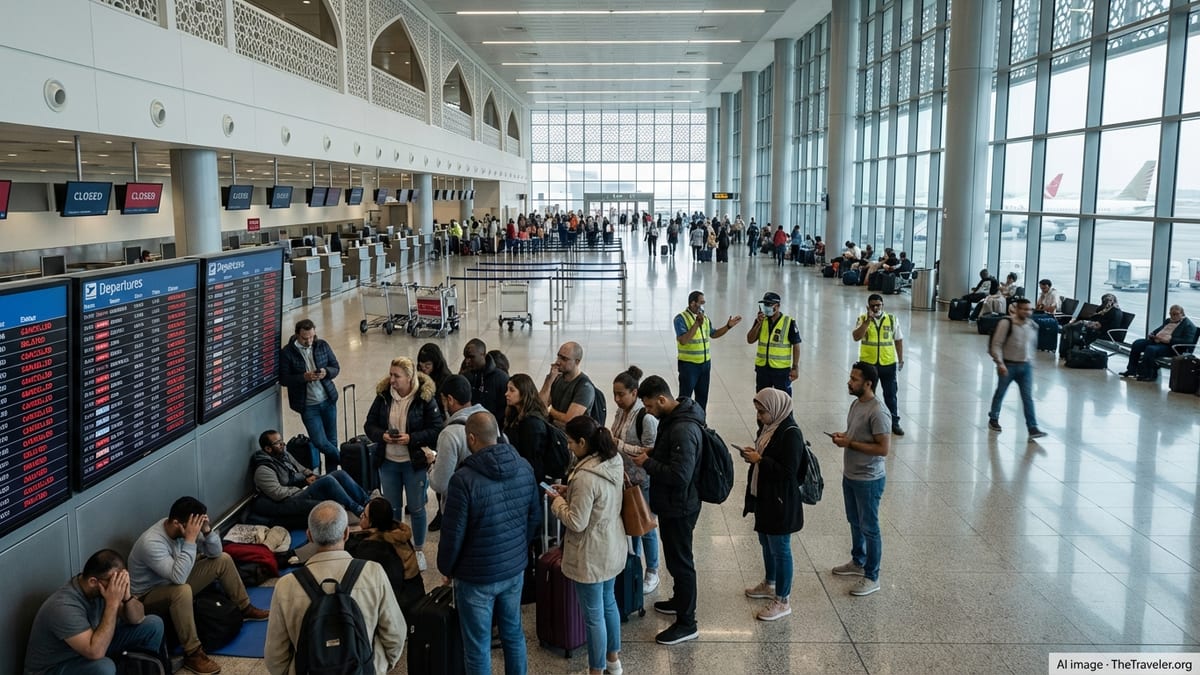
Air travel across the Middle East has entered a new phase of disruption as reports indicate at least 44 flights cancelled and more than 230 delayed across Kuwait, Bahrain, the United Arab Emirates, Oman, Qatar and neighboring states, snarling operations for major carriers and ripple-effecting routes from Muscat’s Seeb Airport and Doha to Cairo, Paris and other long haul destinations.
Get the latest news straight to your inbox!
Fresh Shock to a Region Already on Edge
The latest bout of travel chaos comes against the backdrop of months of intermittent airspace restrictions, drone and missile incidents, and rolling schedule cuts across Gulf and Levant hubs. Publicly available aviation data and regional media coverage suggest that Kuwait, Bahrain, the UAE, Oman and Qatar have once again borne the brunt, with clusters of cancellations and extended delays recorded in the early hours of June 6 and into the weekend.
In Kuwait, the civil aviation regulator temporarily halted air traffic in the early morning after hostile projectiles were reported in national airspace, triggering diversions and ground holds. Services later resumed, but the knock-on impact left multiple flights either cancelled outright or pushed back for several hours as airlines worked to reposition aircraft and crews.
Further south, Oman’s aviation sector is contending with both acute disruption and longer term suspensions. Muscat’s Seeb Airport has seen day-of-travel cancellations layered on top of pre-existing route suspensions by carriers such as SalamAir and Oman Air, which have already curtailed services to Kuwait, Doha, Dubai, Bahrain and several other cities because of security and operational constraints.
These developments have unfolded while the wider Gulf region is still adjusting to earlier airspace closures linked to the 2026 Iran conflict, which triggered extensive rerouting and capacity reductions. For passengers, the result is a fragile network where relatively contained incidents can quickly cascade into multi-country disruption.
Major Gulf Carriers Struggle to Stabilize Schedules
The latest figures of 44 flight cancellations and 234 delays cut across a broad swath of the region’s airlines, including Emirates, Saudia, Gulf Air, Flydubai and a range of smaller and low cost operators. Flight status boards in Dubai, Doha and Muscat have reflected a pattern of rolling delays interspersed with sudden cancellations, as carriers adjust in real time to evolving security assessments and airspace permissions.
Emirates and Flydubai, both heavily reliant on tightly timed hub-and-spoke operations through Dubai, are facing particular challenges whenever air corridors narrow or adjacent airspaces impose new restrictions. Published coverage earlier in the spring described temporary suspensions at Dubai International Airport following security incidents, with gradual resumptions under constrained schedules. The latest wave of disruption adds new pressure on already stretched rotations.
Saudi Arabia’s Saudia has also been repeatedly forced to trim and reshuffle services. Recent advisories have shown suspensions and delays on routes linking Jeddah and Riyadh with Bahrain, Kuwait, Doha, Dubai and other regional destinations, with today’s events at Kuwait and continuing instability around Doha contributing to another round of timetable volatility.
For Gulf Air and other Bahrain based carriers, the challenge is compounded by the island’s dependence on a single international gateway. Even modest adjustments to approach paths or overflight permissions can quickly translate into cancellations and tight turnaround times, especially on high frequency regional sectors that connect to longer haul flights to Europe and Asia.
Doha, Seeb, Cairo and Paris See Ripple Effects
While many of the disruptions originate in Gulf airspace, the impact is being felt far beyond the region. Doha’s Hamad International Airport, a critical connecting hub between Europe, Africa and Asia, has been operating under various constraints since airspace was curtailed in late February. Travel advisories and official schedules indicate that Qatar based operations have been rebuilt gradually through limited corridors, with periodic reductions whenever tensions increase.
These limitations have complicated services between Doha and major cities such as Cairo and Paris, where departures and arrivals are highly sensitive to small shifts in routing and block times. Passengers on multi leg itineraries frequently discover that a cancellation on a short regional hop into Doha or Dubai unravels onward connections to Europe, the Americas or East Asia, forcing overnight stays or complete rebookings.
Muscat’s Seeb Airport sits at the southern fringe of the most volatile airspace, but public notices from Omani carriers show that it remains deeply exposed. When Muscat based airlines suspend or thin out flights to Kuwait, Bahrain, Doha and Dubai, knock-on effects reach destinations as varied as Cairo, Istanbul, Moscow and South Asian capitals, given the role of Gulf hubs as essential bridges between Europe, Africa and Asia.
European airports, including Paris Charles de Gaulle, continue to experience intermittent schedule adjustments tied to the Middle East situation. Long haul services that rely on Gulf connections, particularly via Doha and Dubai, remain vulnerable to missed minimum connection times and rolling retimings, complicating operations for both regional and European carriers.
Security Tensions, Airspace Closures and Regulatory Caution
The current spike in cancellations and delays cannot be separated from the broader security climate in the Middle East and adjacent waters. Since late February, a series of strikes, retaliatory attacks and heightened military postures have led multiple states, including Iran, Iraq, Israel and several Gulf monarchies, to close or partially restrict their airspace at various points.
Regional and international advisories describe a patchwork environment in which certain corridors open for limited windows while others close with little notice. Civil aviation authorities and airlines must therefore continually recalculate risk, often erring on the side of caution by cancelling services rather than attempting complex diversions that add fuel, time and crew duty complications.
Airlines based in Kuwait, Bahrain, the UAE, Oman and Qatar have been particularly affected because many of their core routes rely on overflights of sensitive areas or proximity to military targets. Even when airports remain physically undamaged and technically open, operators may suspend flights if missile or drone activity is detected in nearby regions or along usual flight paths.
This regulatory environment has also encouraged some carriers to impose medium term suspensions on selected routes rather than day to day tinkering. Announcements from Oman based airlines, for example, show multi week pauses on services to Kuwait and Beirut that extend into mid July, reflecting an expectation that volatility will continue for some time.
Passengers Face Uncertainty, Limited Alternatives and Compensation Mazes
For travelers caught in the middle of this evolving crisis, the experience is one of persistent uncertainty and shrinking options. With at least 44 flights cancelled and 234 delayed in the latest reporting window alone, many passengers find their itineraries disrupted with only a few hours’ notice, especially on early morning departures when airspace decisions are updated overnight.
Because Gulf hubs function as critical connectors between continents, rebooking often proves complex. A cancelled regional leg into Doha, Dubai or Muscat can sever access to long haul flights to Paris, London, New York, Johannesburg or Sydney, particularly where daily frequencies have already been trimmed. Some travelers are being rerouted through alternative hubs in Europe or South Asia, though capacity there is finite and fares can surge when demand spikes suddenly.
Public guidance from aviation regulators and consumer organizations underscores that compensation and care entitlements vary widely depending on the airline’s home jurisdiction, the departure airport and the cause of the disruption. European passengers on flights starting in the EU may have clearer rights than those on itineraries that begin and end entirely within the Middle East, where regimes and enforcement differ.
Travel experts are advising passengers to monitor flight status closely in the 24 hours before departure, to build in longer connection times when transiting Gulf hubs, and to consider flexible or refundable fares where budgets allow. For now, the combination of security tensions, airspace restrictions and operational strain suggests that the Middle East’s aviation network will remain vulnerable to further bouts of large scale disruption in the weeks ahead.