


Finland has dozens of national parks, but two names come up again and again when travelers crave wild trails and Arctic landscapes: Oulanka National Park in northeast Finland and Urho Kekkonen National Park in Finnish Lapland. Both offer roaring rivers, deep forests, and tundra fells under the midnight sun, yet the experiences on the ground feel very different. Choosing between them is really a question of travel style. This guide breaks down what each park is like in practice, from trail character and difficulty to access, seasons, and how “wild” your adventure will actually feel.
Get the latest updates straight to your inbox!
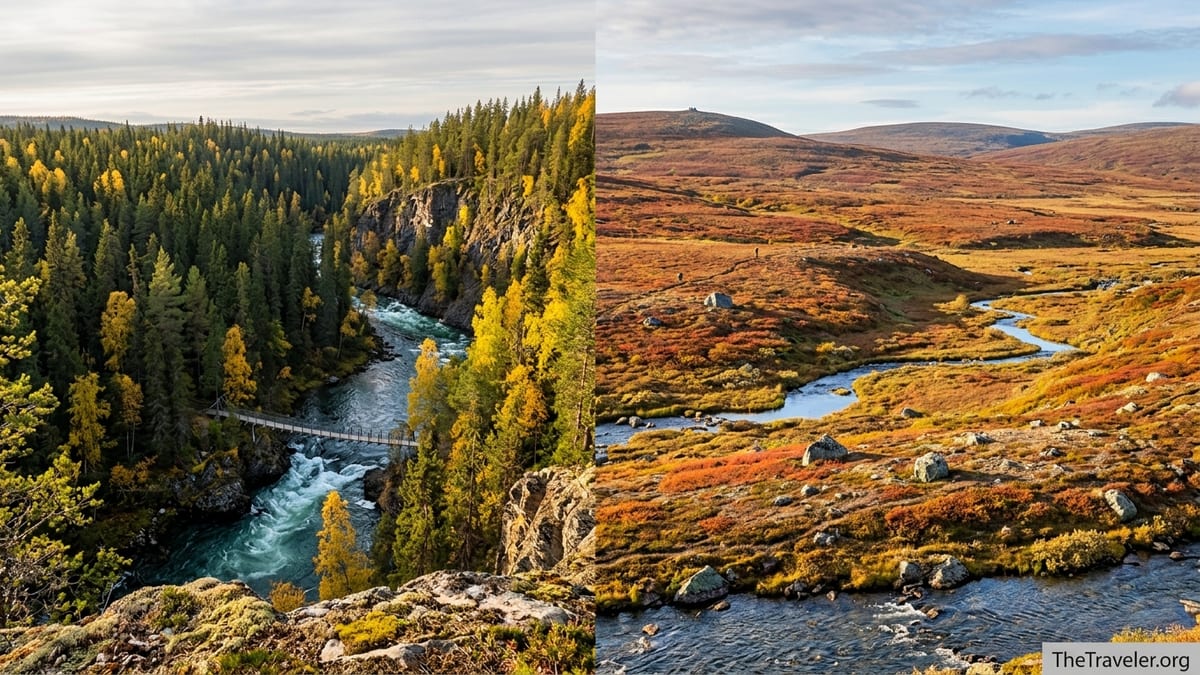
Understanding the Characters of Oulanka and Urho Kekkonen
Oulanka National Park sits in northeastern Finland, near Kuusamo and the Ruka ski resort, close to the Russian border. It is best known for the Karhunkierros, or Bear’s Trail, a roughly 80 to 82 kilometer long-distance route that follows river canyons, roaring rapids and suspension bridges through dense boreal forest. The scenery is dramatic by Finnish standards, with steep riverbanks, wooden boardwalks over wetlands, and several photogenic waterfalls such as Kiutaköngäs.
Urho Kekkonen National Park, usually shortened to UKK, sprawls across a huge area of Finnish Lapland east of the resort village of Saariselkä. Here the feeling is of big, open country. Rounded fells rise above treeline, wide valleys are filled with mires and streams, and in the interior there are long stretches without marked trails at all. Backpackers often spend four to seven days crossing the park between entry points such as Kiilopää, Aittajärvi and Raja-Jooseppi, relying on wilderness huts and their own navigation.
In practice, Oulanka is the better choice if you want a structured, well-marked long-distance trail with plenty of infrastructure, shorter day hikes, and easier logistics. Urho Kekkonen appeals more to hikers who dream of real wilderness: fewer people, more freedom to pick your own route, and long views over treeless fells, especially if you are comfortable with map, compass or GPS.
Both parks can be visited year-round, but for most hikers the prime season is from roughly mid-June to late September. July and August bring warmest temperatures and the busiest trails, while late September is prized for ruska, the flamboyant autumn colors that light up birch and tundra shrubs in both regions.
Which Park Fits What Kind of Traveler?
If you enjoy structured adventure with clear waymarking, regular shelters, and the option to turn a multi-day trek into easier sections, Oulanka is typically the better match. The Karhunkierros can be walked in 4 to 7 days, but many visitors only sample the most scenic stretches, such as the popular 12 kilometer Pieni Karhunkierros loop that packs in suspension bridges, rapids and canyon views in a single day. You can base yourself in Ruka or Kuusamo, sleep in a hotel or cabin, and use local buses or transfers to reach trailheads.
Oulanka also suits mixed-ability groups. For example, a family might spend one day on the easy Kiutaköngäs day hike to see the red rock canyon and rapids, another on a 5 kilometer nature trail near the Oulanka Visitor Centre, while the strongest hikers tackle a 20 kilometer section of the Bear’s Trail. Everyone still feels they have “done Oulanka” without committing to a full expedition.
Urho Kekkonen, by contrast, is usually a better fit for self-reliant trekkers. While there are marked summer and winter trails around Kiilopää and Saariselkä, much of the park’s interior is trackless wilderness. A typical route might see you hike three days from Kiilopää over low fells and through Paratiisikuru gorge to the well-known Luirojärvi wilderness hut area, then loop back via a different valley. Here you decide your daily distance based on terrain and weather rather than a fixed stage between huts.
If your ideal trip involves plotting a route on a 1:50,000 topographic map, crossing rivers without bridges, and camping wherever you find a good dry hummock above the bogs, UKK will feel exciting. If you are not yet comfortable with that level of autonomy, it can still work as long as you stick to the denser network of marked trails starting from Saariselkä and Kiilopää and treat it more as a day-hiking and short-overnight destination.
Trail Experience: From Boardwalks to Pathless Fells
The classic Oulanka experience is the Karhunkierros trail. This route, usually given as about 80 to 82 kilometers, is clearly waymarked with orange paint and signposts, and is designed to be walked in several stages. You encounter long sections of wooden duckboards across marshy ground, sturdy suspension bridges over the Oulankajoki and Kitkajoki rivers, staircases in the steepest spots, and frequent fireplaces, lean-to shelters and wilderness huts. The trail is physically demanding, especially with a pack, but navigation is straightforward and you are rarely more than a few hours from the next shelter.
On a practical level, you might plan a four-day Karhunkierros hike by overnighting at open wilderness huts such as Taivalköngäs and Jussinkämppä. These huts are free but first come, first served, with wooden bunks, a stove and usually water nearby. In high season they can fill up, so many hikers bring a lightweight tent and use the huts when space allows. Shorter loops like Pieni Karhunkierros give you a taste of the same terrain in a compact package, often starting and ending near roads and parking areas.
In Urho Kekkonen, the feel is more open and less engineered. Around Kiilopää and Saariselkä you will find marked summer trails ranging from 5 to 20 kilometers, but once you push east into the park, bridges are fewer and duckboards mostly disappear. Classic destinations like Paratiisikuru, Lumikuru and the Sokosti fell area involve long sections on unmarked terrain where you follow river valleys or ridgelines rather than waymarks. Paths exist in popular corridors but can be faint or braided, especially in wet ground.
This different trail character directly affects who feels comfortable where. A hiker who is happy on rocky, sometimes muddy paths with lots of wooden infrastructure and occasional crowds will likely love Oulanka’s main routes. Someone who feels constrained by boardwalks and prefers to pick their own line across tundra will gravitate toward UKK. Neither is inherently more “difficult,” but Urho Kekkonen demands more decision-making and route-finding, especially in poor visibility.
Accessibility, Bases and Logistics
From a logistics standpoint, Oulanka is generally easier for first-time visitors to Finland. The nearest gateway town is Kuusamo, which has an airport with domestic flights from Helsinki and bus connections to Ruka and Oulanka area trailheads. Ruka itself is a compact ski resort village with supermarkets, gear shops selling gas canisters and stove fuel, and accommodation ranging from simple cabins to higher-end hotels. Many hikers overnight in Ruka before starting or after finishing a section of the Bear’s Trail.
Trailheads like Hautajärvi or Ristikallio are accessible by regional buses in summer and autumn, or by pre-booked transfers through local outfitters who also offer luggage storage and shuttles. For example, it is common to pay roughly 20 to 40 euros per person for a shared shuttle from Ruka to the northern starting point, depending on season and group size. Water is generally easy to find along the route from streams and rivers, with most hikers treating water via filters or boiling for peace of mind.
Urho Kekkonen is served mainly through Saariselkä and Kiilopää. Travelers usually fly or take the night train to Rovaniemi, then continue by bus for several hours north to the Saariselkä area. Saariselkä is a small but well-developed resort village with grocery stores, rental shops, and a wide range of lodging, from simple cabins and hostels to full-service spa hotels. The Kiilopää Fell Centre, a short drive away, functions as a focused hiking base with trails starting literally from the doorstep and easy access to the park boundary.
Once you leave the road network in UKK, services thin out quickly. Your logistics planning shifts from shuttle timetables to questions like how many days of food you can comfortably carry, where you can reasonably expect to find a hut with space, and whether you need to plan a resupply in Saariselkä mid-trip. For many travelers this remoteness is the main draw. Others may find the infrastructure in and around Oulanka more reassuring, especially for a first multi-day trek abroad.
Accommodation Styles: From Cabins to Wilderness Huts
Both Oulanka and Urho Kekkonen are dotted with Finnish-style open wilderness huts, reservable huts and lean-to shelters. Understanding the differences is key to choosing the right park for your style of adventure. Open wilderness huts are simple cabins with bunks and a wood stove, free for one-night stays on a first come, first served basis. Reservable huts and rental cabins can be booked in advance for a nightly fee, offering more privacy and certainty at the cost of flexibility.
Along the Karhunkierros in Oulanka, the density of such infrastructure is relatively high. You will typically pass several designated campfire sites and overnight spots each day, and many hikers rely on a combination of open huts and tent camping. Because the route is Finland’s best-known long-distance trail, peak season crowds are possible. It is not unusual in July for a hut to be fully occupied by early evening, which is why experienced hikers recommend bringing a tent even if you plan to sleep under a roof when possible.
Urho Kekkonen’s hut network is sparser, but several iconic wilderness huts act as informal hubs for backpackers. The Luirojärvi hut cluster, for instance, sits beside a lake under the slopes of Sokosti and often forms the centerpiece of a 4 to 7 day Lapland trek. Here you can combine tent camping on nearby pitches with nights inside the hut if space allows. Some of these huts include traditional saunas, creating a memorable contrast between long, cold days on the trail and the deep heat of a wood-fired steam in the evening.
For travelers who prefer to end each day in a proper bed with a shower and perhaps a restaurant meal, Oulanka is easier to adapt. You can base yourself outside the park in a cabin near Ruka or in Kuusamo, drive or take transfers to day-hike trailheads, and return to comfort every night. In Urho Kekkonen this style is also possible if you restrict yourself to day hikes from Saariselkä or Kiilopää. Once you push further into the park, though, you commit to hut or tent life for the duration of your route.
Seasonal Differences, Weather and Northern Lights
Choosing between Oulanka and UKK is not only about trails but also about what season and atmosphere you want. In both parks, summer hiking season usually runs from roughly mid-June to late September, with snow lingering into early June on shaded slopes in Lapland and returning by October. July often brings the warmest daytime temperatures, but also mosquitoes, especially in marshy areas. Lightweight head nets and long sleeves are common sights on both the Bear’s Trail and on Lapland fells.
Oulanka, at a slightly lower latitude than Saariselkä, can feel a bit milder and more forested. You are mostly under tree cover, walking in cool shade along rivers and through spruce forests, which can be welcome on hot days but can also keep views relatively close. UKK, by contrast, quickly opens up above treeline into big-sky country. In July, long days under the midnight sun mean you can hike late into the evening on the fells in soft golden light, often with only reindeer for company.
Autumn is a special time in both parks. From roughly early to late September, ruska colors paint the landscape. In Oulanka, birch leaves glow yellow against dark conifers and red rock river gorges. In Urho Kekkonen, dwarf birch and groundcover turn crimson and gold on the treeless slopes, creating wide, painterly vistas. Nights begin to lengthen, and with them the chance of seeing the northern lights, especially in Lapland. Saariselkä and Kiilopää have aurora-focused accommodations that cater to travelers who want to combine day hikes into UKK with night-time sky watching.
Winter and spring open a different comparison. Oulanka becomes a quieter, snowbound forest landscape where guided snowshoe tours and short ski loops appeal to those based in Ruka. Urho Kekkonen, with its extensive cross-country ski trail network starting from Saariselkä and Kiilopää, is a prime destination for multi-day ski tours hut to hut, often between February and April when light returns and snowpack is stable. If your travel style leans toward skiing and snow-based adventure, UKK has a clear edge.
Costs, Services and Guided Options
Costs for visiting either park can be kept moderate by using public transport and self-catering, or increased by adding guided services and higher-end lodging. In Oulanka, a common pattern for international travelers is to fly to Helsinki and then on to Kuusamo, stay one or two nights in a mid-range hotel or cabin in Ruka for around 100 to 150 euros per night in high season, and then spend several days on the trail using free wilderness huts and camping. Food costs are similar across Finland, with supermarket shopping allowing a frugal traveler to keep daily hiking rations under 15 to 25 euros per person.
Guided versions of the Karhunkierros exist for those who prefer to hike in a group with a local leader. These typically cost several hundred euros for a multi-day trip including accommodation in huts or tents, most meals and shuttle logistics. For travelers short on time, day tours from Ruka to parts of Oulanka can include transportation, a guide, and picnic-style meals for a per-person price comparable to a full-day excursion in other European national parks.
In Urho Kekkonen, costs depend heavily on how independent you want to be. Staying in Saariselkä or Kiilopää in high season can be similar in price to Ruka, with basic cabins available from local operators and larger apartments or spa hotels charging more. Multi-day guided treks into UKK, often focused on 3 to 6 day hut or tent tours, cater to hikers who want Lapland wilderness without handling every detail themselves. These trips bundle guiding, food, stove fuel and sometimes equipment rental, which can make the total more predictable but also significantly higher than a do-it-yourself route.
In both parks, budget-conscious travelers can take overnight trains from southern Finland to Rovaniemi or nearby stations instead of domestic flights, then continue by bus. Because Finland’s national parks do not charge entrance fees, your core expenses will be transport, food, lodging and any hut reservations or gear rentals. If your travel style is to spend money on comfort in town and then minimize costs on the trail, Oulanka’s clear stage-based structure makes it slightly easier to plan. If you prefer to invest in logistics and gear up-front and then roam freely for a week, UKK rewards that approach.
The Takeaway
Choosing between Oulanka National Park and Urho Kekkonen National Park is less about which is “better” and more about which suits your idea of a satisfying adventure. Oulanka lends itself to clearly defined routes, scenic day hikes, and a classic Finnish long-distance trail with frequent infrastructure and relatively easy logistics from Kuusamo and Ruka. It is ideal if you want to experience river canyons, suspension bridges and spruce forest without needing advanced navigation skills.
Urho Kekkonen, sprawling across Finnish Lapland, is better for travelers who crave space and solitude. Beyond the first ridges from Saariselkä and Kiilopää, you step into genuine wilderness, where you follow valleys and fells rather than boards and bridges. Here the rewards are wide horizons, a strong feeling of remoteness, and the possibility to shape your own multi-day route. If you value big landscapes, northern lights potential and are comfortable with self-reliant travel, UKK is likely to match your style.
If you are unsure, consider combining both in a single longer trip: a few structured days on Oulanka’s Bear’s Trail to get acquainted with Finnish hiking culture, followed by a shorter, hut-based loop in Urho Kekkonen to taste Lapland’s open fells. Either way, you will come home with the particular quiet that comes from days in the north, where the sun barely sets in summer and the forests and fells seem to go on forever.
FAQ
Q1. Which park is better for first-time hikers, Oulanka or Urho Kekkonen?
Oulanka is usually better for first-time hikers, because trails like the Bear’s Trail and Pieni Karhunkierros are clearly marked, have frequent shelters, and are easy to access from Ruka and Kuusamo. Urho Kekkonen can work for beginners too, but it is safest to stick to marked day trails near Saariselkä and Kiilopää or join a guided trip for the interior fells.
Q2. If I have only three days, which park should I choose?
With three days, Oulanka offers more straightforward options. You can base yourself in Ruka, hike the 12 kilometer Pieni Karhunkierros one day, a 15 to 20 kilometer section of the Bear’s Trail another day, and a shorter nature loop or waterfall hike on the third. In Urho Kekkonen, three days is enough for an introduction via day hikes from Saariselkä or Kiilopää, but you will not get as deep into the wilderness.
Q3. Which park is better for seeing the northern lights?
Urho Kekkonen has an advantage for northern lights because it lies farther north in Lapland, with darker skies and wide, treeless fells that open to the horizon. Visiting between roughly late August and early April gives you a chance to see aurora on clear nights. Oulanka also sees northern lights, but the lower latitude and dense forest can limit sky views unless you seek open areas.
Q4. Can I hike in either park without a guide?
Yes, many people hike both parks independently. In Oulanka, navigation on the main trails is simple and suitable for experienced but non-expert hikers. In Urho Kekkonen, independent travel is best left to those comfortable with topographic maps, GPS and changing weather in open terrain. If you lack this experience but still want to see UKK’s interior, a guided tour is a safer choice.
Q5. Are there entrance fees for Oulanka or Urho Kekkonen National Parks?
No, there are no entrance fees for either park. You pay for your travel to the region, lodging, food, and any optional services such as hut reservations, saunas, guided tours or shuttles. Wilderness huts that are free to use operate on a first come, first served basis, while reservable and rental huts require advance payment.
Q6. Which park is more family friendly?
Oulanka tends to be more family friendly for most visitors. Short, well-marked trails like the Kiutaköngäs day hike and Pieni Karhunkierros loop provide big scenery with manageable distances and good safety infrastructure such as bridges and duckboards. Families can stay in comfortable cabins around Ruka and choose hikes each day based on energy levels. In Urho Kekkonen, family trips are usually best kept to shorter day walks near Saariselkä or done with an experienced adult who knows wilderness travel.
Q7. What kind of fitness level do I need for the Bear’s Trail in Oulanka?
To walk the full 80 to 82 kilometer Bear’s Trail over four to seven days, you should be comfortable hiking 15 to 25 kilometers per day with a backpack on varied terrain, including stairs, roots and some steep sections. You do not need technical climbing skills, but basic hiking fitness, broken-in footwear, and experience carrying a pack for several hours at a time will make the trip far more enjoyable.
Q8. How wild is Urho Kekkonen compared to other European national parks?
Urho Kekkonen is wilder than many central European parks. Large areas have no marked trails, infrastructure is minimal once you leave the main entry points, and you can travel for days seeing only a few other hikers. It is still managed and relatively safe by global standards, but the combination of distance from roads, changeable Arctic weather and sparse services gives it a genuine wilderness character.
Q9. Can I visit both parks in a single trip to Finland?
Yes, with at least 10 to 14 days you can realistically include both. A practical plan is to fly into Kuusamo for Oulanka, spend several days hiking there, then travel by bus or domestic flight and bus to Saariselkä for another several days exploring Urho Kekkonen. Combining them lets you experience both river canyon forests and open Lapland fells in one journey.
Q10. How do I choose if my group has mixed experience levels?
If your group ranges from beginners to very experienced hikers, Oulanka generally accommodates everyone more easily. You can split into subgroups, with some tackling longer sections of the Bear’s Trail and others focusing on shorter loops, all while staying at the same base in Ruka or Kuusamo. If the most experienced members strongly want a wilder feel, consider adding a short, guided overnight or a couple of moderate day hikes in Urho Kekkonen after Oulanka, rather than basing the entire trip in the more demanding park.