


More news on this day
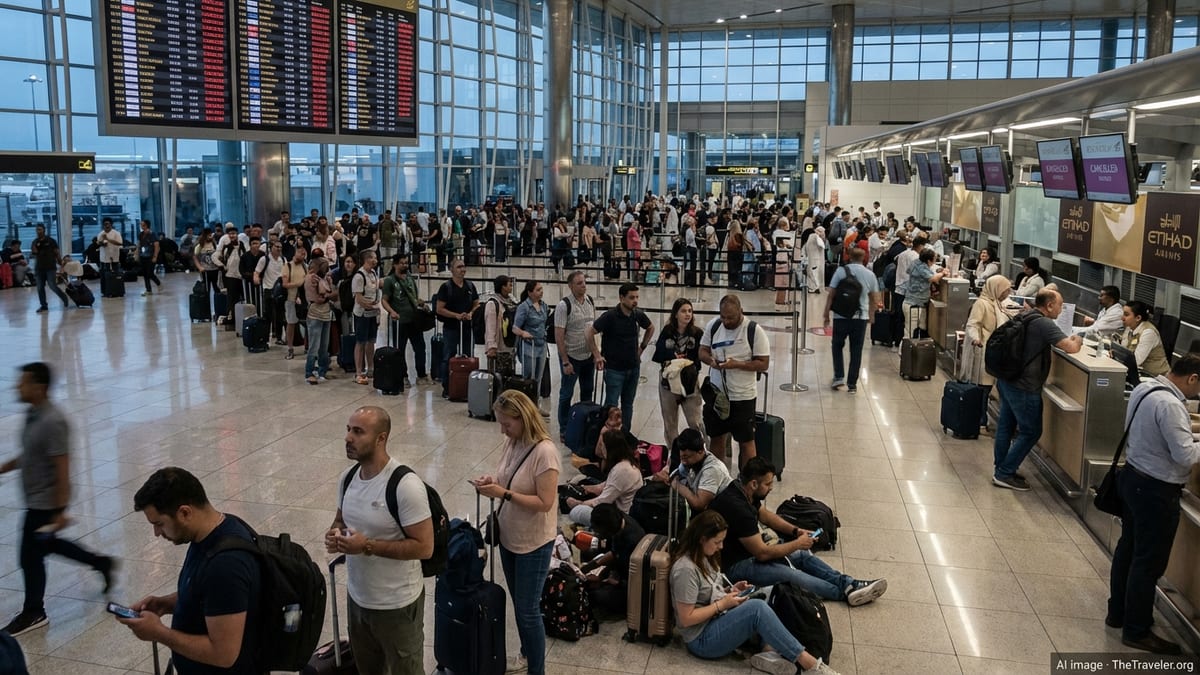
Flight disruption across the Middle East is intensifying, with hundreds of services cancelled or severely delayed as airlines grapple with shifting airspace restrictions, security concerns and the lingering impact of regional conflict.
Get the latest news straight to your inbox!
Conflict-linked airspace closures keep pressure on hubs
Publicly available data shows that airspace closures and restrictions linked to the conflict involving Iran, the United States and Israel continue to reshape traffic patterns across the Middle East. Wide areas of airspace over Iran, Iraq and parts of the Gulf have periodically been designated high risk, forcing carriers to reroute or suspend services on short notice.
Earlier waves of disruption in late winter and spring saw thousands of flights to and from the region cancelled, with major hubs in the United Arab Emirates, Qatar and Saudi Arabia absorbing much of the shock. Although some routes have since been restored, flight tracking and schedule information indicates that the network remains fragile, with operators regularly adjusting their plans in response to security assessments.
Analysts note that the closure or partial closure of key flight corridors between Europe and Asia has had knock-on effects far beyond the Middle East itself. Airlines have been forced onto longer routings that skirt conflict zones, adding flying time, fuel burn and crew costs, while also reducing flexibility to recover when delays or further restrictions occur.
Industry briefings point out that even when airports in the region remain open, overflight restrictions can sharply limit the number of viable routings, leading carriers to consolidate frequencies or suspend marginal routes. That pattern continues to be visible in mid-July schedules, with long-haul services prioritised over secondary regional links.
Airlines slowly restore routes but maintain suspensions
Factbox-style updates from international newswires in recent weeks indicate that a growing number of airlines have resumed at least some flights into the Middle East, particularly to major hubs such as Dubai, Doha and Riyadh. Several European and Asian carriers have brought back selected services after earlier blanket suspensions, but many have retained reduced frequencies and longer-term cancellations on specific routes.
Schedules published by these airlines show that services to destinations considered closer to active conflict areas, including Tel Aviv and certain points in the Gulf, remain limited or suspended well into the summer season. Some carriers have pushed back planned route launches or the resumption of previously served cities, with fresh dates now stretching into September and beyond.
Data from a Nordic carrier, for example, indicates that flights to Doha will remain cancelled until the early autumn, while its aircraft continue to avoid the airspace of Iran, Iraq, Syria and Israel. Other long-haul airlines in Europe and Asia have adopted similar strategies, focusing on a smaller portfolio of Middle Eastern destinations that can be served via safer routings.
Regional carriers have also been forced to trim and retime services. While Gulf-based airlines have moved quickly to rebuild their networks where possible, several have publicly acknowledged operating on reduced schedules compared with pre-conflict plans, particularly on routes that require overflights of currently restricted zones.
Abu Dhabi–Bahrain and other Gulf routes hit by fresh disruption
The latest wave of disruption has again highlighted the vulnerability of short-haul Gulf routes. In mid-July, an Etihad Airways service from Abu Dhabi to Bahrain was forced to turn back after disruption at Bahrain International Airport, prompting the cancellation of additional Abu Dhabi–Bahrain flights that day. Reports indicate that at least one Pakistan-based low-cost carrier and an Indian airline also experienced diversions and delays on routes transiting the same airspace.
This episode underlines how quickly operational conditions can change for airlines in the region. Even when broader conflict lines appear stable, localised security incidents or airspace advisories can lead to sudden schedule changes, affecting passengers with little warning. For business travellers and expatriate communities who rely on frequent shuttles between Gulf capitals, the cumulative effect is mounting uncertainty.
Gulf hubs remain central to global connectivity between Europe, Asia and Africa, and operational data from airports such as Dubai, Abu Dhabi and Doha suggests they continue to handle high volumes of transfer traffic. However, recurrent disruptions on short regional legs, particularly to Bahrain, Kuwait and secondary Saudi cities, are complicating onward connections and increasing the risk of missed long-haul flights.
Airlines have responded by adding buffer time into schedules, provisioning additional fuel for potential reroutes and, in some cases, proactively cancelling rotations that are deemed too exposed to disruption. While these measures can improve safety and predictability from an operational perspective, they also reduce total capacity and contribute to the high number of delayed and cancelled services being recorded.
Ripple effects for European skies and global networks
The impact of the Middle East crisis is being felt in European airspace data as well. Recent traffic and delay briefings from the pan-European air navigation organisation show that controllers in Greece and neighbouring regions are managing higher-than-usual volumes of overflights as airlines route around the eastern Mediterranean and Middle East. These briefings report that traffic linked to the crisis is adding complexity and contributing to higher en route delays in certain sectors.
Europe’s already busy summer schedules mean that even small increases in traffic on key airways can lead to bottlenecks. Capacity constraints, staffing challenges and weather disruptions in parts of Europe are combining with Middle East-related reroutings to push delays higher on some days. For passengers, this can translate into missed connections on itineraries that touch both regions, even if their own flight does not enter restricted airspace.
Airline planners also face tighter aircraft utilisation windows, as longer detours cut into turnaround times. Industry analysts say that this leaves less slack in the system to recover from unexpected events, increasing the likelihood that a disruption in one region cascades quickly into another. When hundreds of flights are delayed or cancelled in a single day in the Middle East, the effects can reverberate across hubs from London and Frankfurt to Singapore and Hong Kong.
Network-wide, publicly available data points to an industry that is trying to sustain near-peak summer capacity while operating under more constrained routing options. That combination is likely to keep punctuality under pressure in the weeks ahead, especially on itineraries connecting Europe and Asia through Middle Eastern hubs.
Travellers face uncertainty as carriers adjust day by day
For passengers, the continuing disruptions mean that even confirmed itineraries can change at short notice. Flight status boards at major Middle Eastern airports have repeatedly shown clusters of cancellations and multi-hour delays, affecting both regional and long-haul services. Social media posts and traveller reports describe crowded terminals, long rebooking queues and difficulty securing alternative routings on already full services.
Travel advisories from governments and airlines consistently urge passengers to monitor their bookings closely and allow extra time for connections, particularly where itineraries involve multiple stops in or near the Middle East. Some carriers are offering more flexible change policies on affected routes, allowing date changes or rerouting without standard fees, although availability can be limited during the peak holiday period.
Industry observers suggest that the situation is unlikely to stabilise fully until there is a clearer easing of regional tensions and a restoration of more direct air corridors. Even then, airlines may take time to rebuild capacity, with some marginal routes potentially remaining suspended if demand patterns have shifted.
Until that happens, hundreds of cancellations and delays each week across Middle Eastern airports are expected to remain a feature of the global aviation landscape, as airlines balance safety, regulatory requirements and commercial pressures in an environment shaped by conflict and uncertainty.