


More news on this day
A woman was airlifted from a Carnival cruise ship about an hour after it left port, according to multiple news and Coast Guard reports, prompting a rapid response that briefly interrupted the start of a planned vacation for thousands of passengers.
Get the latest news straight to your inbox!
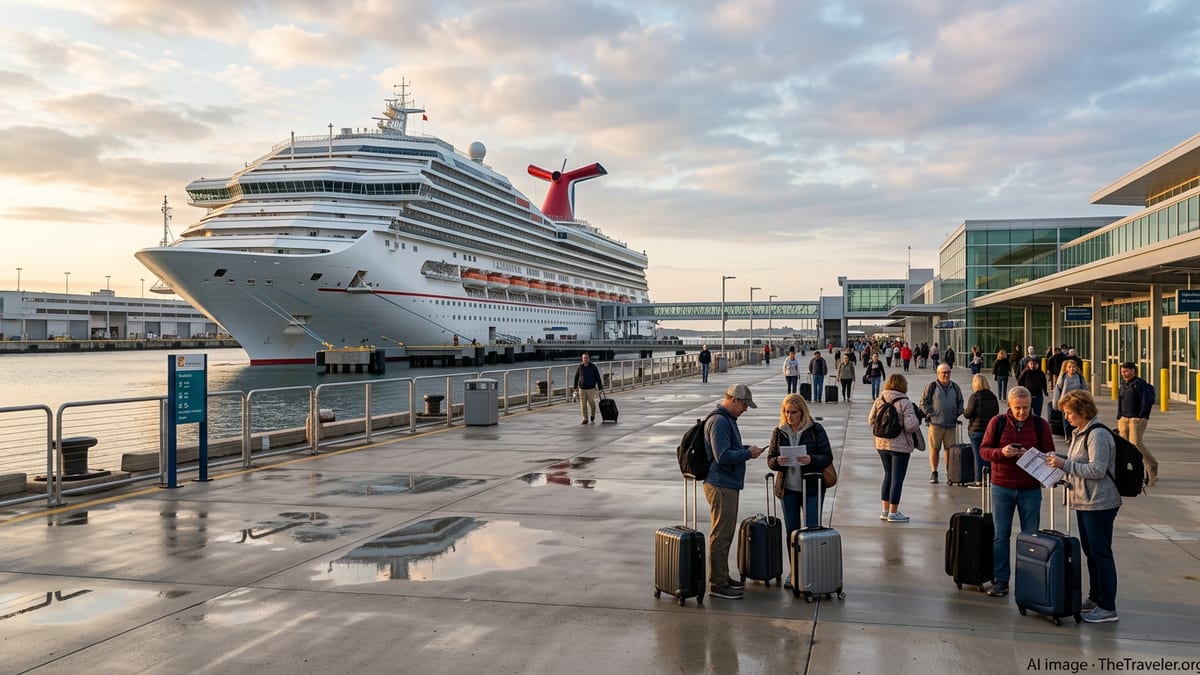
Medical Emergency Develops Soon After Sailaway
Reports indicate that the medical emergency unfolded shortly after the Carnival vessel cleared the harbor and began making way into open water. Passengers described a routine sailaway that shifted quickly once crew members began responding to a serious health issue involving a female guest.
Publicly available information shows that the ship notified the Coast Guard after the woman began experiencing acute symptoms that onboard medical staff believed required care beyond what could be safely provided at sea. While large cruise ships carry medical facilities and trained personnel, complex or potentially life-threatening cases are often transferred to shore-based hospitals as quickly as possible.
The incident occurred within roughly an hour of departure, a window when many travelers are still exploring the ship, attending muster drills, or watching the coastline recede. That early timing helped position the vessel within relatively close range of shore-based resources, allowing aviation crews to reach the ship more quickly than if the emergency had emerged later in the itinerary.
Passengers posting on social media described announcements directing guests away from upper decks while the operation was underway, and noted a temporary reduction in speed and course adjustments so the ship could safely coordinate with the inbound aircraft.
Coast Guard Launches Helicopter Medevac
According to published coverage, the Coast Guard launched a helicopter to rendezvous with the Carnival ship offshore, a standard response when time-sensitive medical evacuation is required. Helicopter medevacs are considered one of the most efficient ways to move a patient from a moving vessel to advanced shore-based care when conditions allow.
Video and descriptions from similar cruise incidents show that helicopters typically approach from astern or above the open pool deck, where crew members clear guests from the area and secure loose items to prevent them from becoming hazards in the rotor wash. A rescue swimmer is often lowered first to help stabilize the patient and manage the hoist.
Reports from this latest event indicate that the woman was hoisted aboard the aircraft and flown to a nearby medical facility on land. Further details about her condition have not been widely disclosed, which is common in medical privacy matters. The ship was then cleared to resume its planned voyage once the helicopter departed and navigation officers confirmed conditions were safe to proceed.
Observers note that these kinds of operations require close coordination between bridge officers, medical personnel, aviation crews, and dispatch centers monitoring weather, sea state, and fuel ranges. Even when a cruise appears calm to passengers, a complex safety choreography can be underway behind the scenes.
Safety Protocols and Cruise Ship Medical Capabilities
Publicly available information from maritime regulators and cruise industry guidance shows that large cruise ships are required to maintain medical centers equipped to handle a range of conditions, from minor injuries to more serious events such as cardiac episodes or strokes. These facilities are staffed by physicians and nurses trained in emergency and maritime medicine.
However, there are limits to the procedures and diagnostics that can be safely performed at sea. When a patient’s condition appears unstable or indicates the potential for rapid deterioration, the onboard team may request outside support and prepare the guest for transfer. That decision takes into account the ship’s distance from shore, the availability of aviation assets, weather conditions, and the capabilities of the next port of call.
Reports from past medevac cases involving Carnival and other major cruise brands show similar patterns: onboard teams initiate treatment, communicate with shore-based medical consultants, and then coordinate with the Coast Guard or local maritime agencies if evacuation is deemed necessary. Depending on location, this can involve helicopters, fixed-wing aircraft working in tandem with ships, or fast rescue boats.
Industry observers emphasize that such responses highlight both the limitations and strengths of cruise medicine. While ships cannot replicate the full services of a large hospital, they are integrated into broader national and regional emergency networks that can be activated quickly in serious situations.
Impact on Passengers and Itinerary
For the thousands of passengers aboard, the airlift unfolded as an unexpected interruption early in their holiday. Social media posts referenced closed outdoor decks, the sound of helicopter rotors overhead, and curiosity as travelers watched crew members guide the operation from a distance. Many noted that entertainment and dining continued elsewhere on the ship, with staff encouraging guests to remain indoors until normal access was restored.
Reports indicate that the ship experienced only a relatively brief delay while coordinating with the helicopter, and then returned to its original course once cleared to proceed. In most similar cases, itineraries remain largely intact, with cruise lines adjusting speed or minor scheduling details to keep port calls on track.
Travelers familiar with cruising often point out that medical diversions, while unsettling for those aboard, are generally handled with minimal disruption to the broader voyage. Announcements typically provide basic context without sharing personal details, and guests are reminded that safety, including urgent medical care, takes priority over the timing of onboard activities.
Some passengers use such incidents as a reminder to review their own travel insurance coverage and health preparedness before sailing, particularly for itineraries that travel far from major medical centers.
Growing Attention on Cruise Health Preparedness
The airlift from the Carnival vessel adds to a series of recent cruise-related medical evacuations that have drawn attention in coastal regions. Publicly available Coast Guard summaries describe a range of situations, from suspected heart attacks and stroke-like symptoms to pregnancy complications and severe injuries, all requiring coordination with large cruise ships that function as temporary floating cities.
Maritime safety specialists note that as cruise travel rebounds and ships sail at or near full capacity, the statistical likelihood of medical incidents increases simply due to the number of people on board. Modern vessels routinely carry more than 4,000 guests and crew, representing a cross-section of ages and health conditions.
Industry observers expect continued focus on how quickly and effectively ships can interface with national search-and-rescue systems when emergencies arise. Recent cases, including this latest airlift soon after departure, illustrate how close-to-shore incidents can benefit from shorter flight times and faster transfer to advanced care, compared with emergencies occurring days away in open ocean.
For prospective cruisers, experts often recommend pre-cruise consultations with healthcare providers, careful review of medical and evacuation coverage, and awareness that even at sea, a layered system of response stands ready when the unexpected happens.