


More news on this day
Escalating regional tensions, missile strikes and shifting ceasefires are driving rapid changes in Middle East travel advice in 2026, with governments updating guidance, airlines rerouting and travelers facing a far more complex risk landscape than even a year ago.
Get the latest news straight to your inbox!
Government advisories move to higher alert levels
Publicly available information from multiple governments shows that much of the Middle East is now covered by some of the strictest travel advisories in the world. The United States maintains its global “Worldwide Caution” and currently lists Iran, Iraq, Lebanon, Syria, Yemen and Gaza under its highest Level 4 “Do Not Travel” category, while many Gulf states and Israel are rated at Level 3 “Reconsider Travel.” These gradings reflect heightened risks from ongoing conflict, missile and drone attacks, and the potential for wrongful or arbitrary detention.
Separate U.S. guidance for Israel, the West Bank and Gaza was updated in late February 2026, after Washington authorized the departure of non‑emergency staff from its mission in Israel in response to deteriorating security conditions. The advisory highlights the risk of rocket and drone fire, civil unrest and restrictions on movement in multiple areas, and notes that additional limitations on official travel inside the country may be imposed with little notice.
In the United Kingdom, Foreign, Commonwealth and Development Office travel advice has also tightened. Updated guidance in early June 2026 confirms that London no longer advises against all travel to Israel and the Palestinian territories, but it continues to warn against all travel to Gaza, parts of the West Bank and parts of northern Israel and the occupied Golan Heights. For several other states, including Iran and some Gulf countries, the FCDO continues to advise against all but essential travel, reflecting both direct security threats and the risk of airspace disruption.
These classifications do not ban trips entirely, but they have significant implications. Travel insurance policies often treat Level 4 or “advise against all travel” destinations as excluded, and published guidance warns that routine consular support can be limited or unpredictable in active conflict zones.
Conflict fallout disrupts hubs and airspace
The war that erupted after joint U.S. and Israeli strikes on Iran in late February 2026 has had an immediate impact on aviation and transit through the region. According to international media coverage, Iranian retaliatory missile and drone barrages have hit targets and triggered intercepts over Bahrain, Kuwait, Qatar, Oman, Saudi Arabia and the United Arab Emirates, with debris reported in civilian areas and near major airports.
Reports from late February and early March describe strikes and fires at landmark hotels in Dubai and damage near key tourism districts, as well as temporary closures and severe disruption at Dubai’s main international airport. Analytical coverage from tourism and economics institutes indicates that Middle Eastern destinations, and in particular the UAE, now face a sharp reversal from pre‑war forecasts of strong growth in visitor numbers, with projected declines in arrivals in 2026 instead of double‑digit gains.
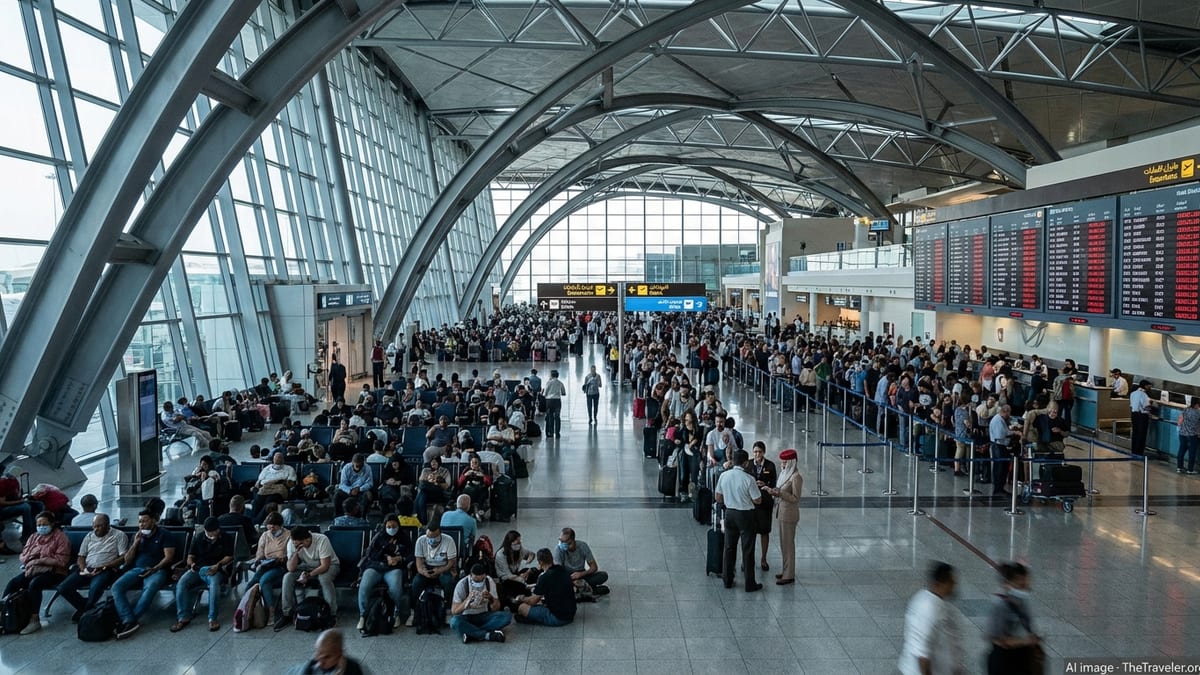
Industry bulletins circulated to corporate clients in early March outline widespread airspace closures and reroutings. These notices describe airspace as closed or partially closed over Iran, Israel, Qatar, Bahrain, Kuwait, Iraq and Syria, and warn of major disruption in Saudi Arabia, Oman, Jordan, Lebanon and Egypt. Airlines have been diverting or suspending some services, lengthening flight times between Europe, Asia and Australasia and complicating itineraries that traditionally relied on Gulf hubs.
Logistics advisories for the maritime sector show a similar pattern of caution. Several carriers have restricted or suspended bookings into parts of the Upper Gulf, the Arabian Gulf and some Red Sea ports, citing security concerns and operational uncertainty. While passenger cruise operations form only a small fraction of movements in these waterways, the same security picture affects port calls and coastal tourism, particularly in areas close to key shipping lanes.
Country‑by‑country risk contrasts
Despite broad regional disruption, risk levels vary sharply between countries. Lebanon remains one of the most restricted destinations, with U.S. advisories set at “Do Not Travel” following cross‑border hostilities and the ordered departure of non‑emergency staff earlier in 2026. Public information notes risks from terrorism, civil unrest, kidnapping and the presence of armed non‑state groups, alongside strained healthcare and infrastructure.
In Israel and the Palestinian territories, advice is more differentiated by region. International summaries point to continued rocket and drone threats, security operations and sudden roadblocks in parts of the West Bank, as well as a blanket prohibition on entry to Gaza mentioned in multiple foreign advisories. At the same time, some urban centers in Israel are subject to fewer movement restrictions but face intermittent air‑raid alerts, making trip planning heavily dependent on local, real‑time updates.
Gulf states such as the UAE, Qatar, Bahrain and Saudi Arabia present a different profile. Before February 2026, they were widely marketed as secure transit and holiday hubs. Since the outbreak of hostilities, they have experienced intermittent missile and drone incidents linked to the wider conflict, including strikes and intercepts in or near major cities and industrial facilities. While core tourism infrastructure in many of these states continues to operate, risk assessments emphasize the possibility of renewed attacks, airspace closures and sudden shifts in diplomatic relations.
Elsewhere, countries like Jordan and Egypt straddle multiple advisory categories. Guidance often distinguishes between relatively stable tourist zones and higher‑risk border regions near Syria, Iraq, Gaza or the Red Sea’s strategic chokepoints. Travelers are urged in published advice to monitor the latest government information for specific provinces or governorates, since risk levels can change quickly with developments on nearby front lines.
Health and documentation requirements evolve
Alongside security concerns, travelers must navigate changing health and entry rules. The U.S. Centers for Disease Control and Prevention maintains traveler health notices for Israel, the West Bank and Gaza that highlight ongoing global measles circulation and renewed concern about poliovirus in several countries, including some in the broader region. Health authorities recommend that visitors ensure routine vaccinations are fully up to date and consider additional immunizations depending on their itinerary and length of stay.
Entry procedures are also shifting. For example, Israel has introduced an electronic travel authorization system, ETA‑IL, which is required for many short‑term visitors for stays of up to 90 days. Public information notes that requirements can differ for dual nationals or those listed in Palestinian population registries, and that separate permissions may apply for movement to and from Gaza. Similar digital pre‑clearance schemes are either in place or under consideration in other states as they strengthen border screening.
Medical capacity is another concern. Official country information pages for multiple destinations in the region advise visitors to purchase comprehensive travel health insurance, warning that local hospitals may expect payment upfront and that evacuation to a third country can be expensive or logistically challenging during crises. In active conflict zones, humanitarian assessments indicate that hospitals and clinics have suffered repeated damage, further constraining the care available to residents and visitors alike.
For travelers transiting through the Middle East rather than staying, health and entry rules still matter. Some countries require advance authorization even for airside connections during heightened security periods, and carriers may deny boarding to passengers who lack the correct paperwork, regardless of whether they plan to enter the country.
Practical planning in an unpredictable environment
Published travel industry guidance now treats the Middle East as a highly dynamic environment in which conditions can change from week to week. Analysts advise that travelers considering trips to the region review not only the advisory from their own government, but also the latest notices from destination states, airlines and insurers. Many recommend flexible tickets, refundable hotel bookings and contingency plans for unexpected route changes or delays.
Risk specialists emphasize that travelers should distinguish between business‑critical and discretionary trips. For tourism in particular, they highlight the possibility that heightened alert levels and visible security measures may significantly alter the experience, even in areas that are statistically less exposed to violence. In high‑risk destinations, some corporates are temporarily suspending non‑essential travel or routing staff through alternative hubs outside the conflict zone.
For those who do proceed with travel, expert commentary points to a series of recurring themes in current guidance: register with consular services where available, maintain regular contact with family or employers, plan for communications outages and carry physical copies of key documents. Travelers are also advised to pay close attention to local instructions during air‑raid alerts or security incidents, and to familiarize themselves with the nearest shelter locations or safe rooms in accommodation and workplaces.
While the outlook for the region remains uncertain, tourism boards and industry groups in some Gulf states continue to signal their intention to reopen and rebuild once conditions allow. For now, however, the combination of active conflict, airspace disruption and elevated political risk means that Middle East travel decisions in 2026 require a level of preparation and caution that goes well beyond pre‑pandemic norms.