


More news on this day
India has entered the global club of hydrogen rail operators with the launch of its first domestically built hydrogen-powered passenger train, flagged off by Prime Minister Narendra Modi on the Jind–Sonipat route in the northern state of Haryana.
Get the latest news straight to your inbox!
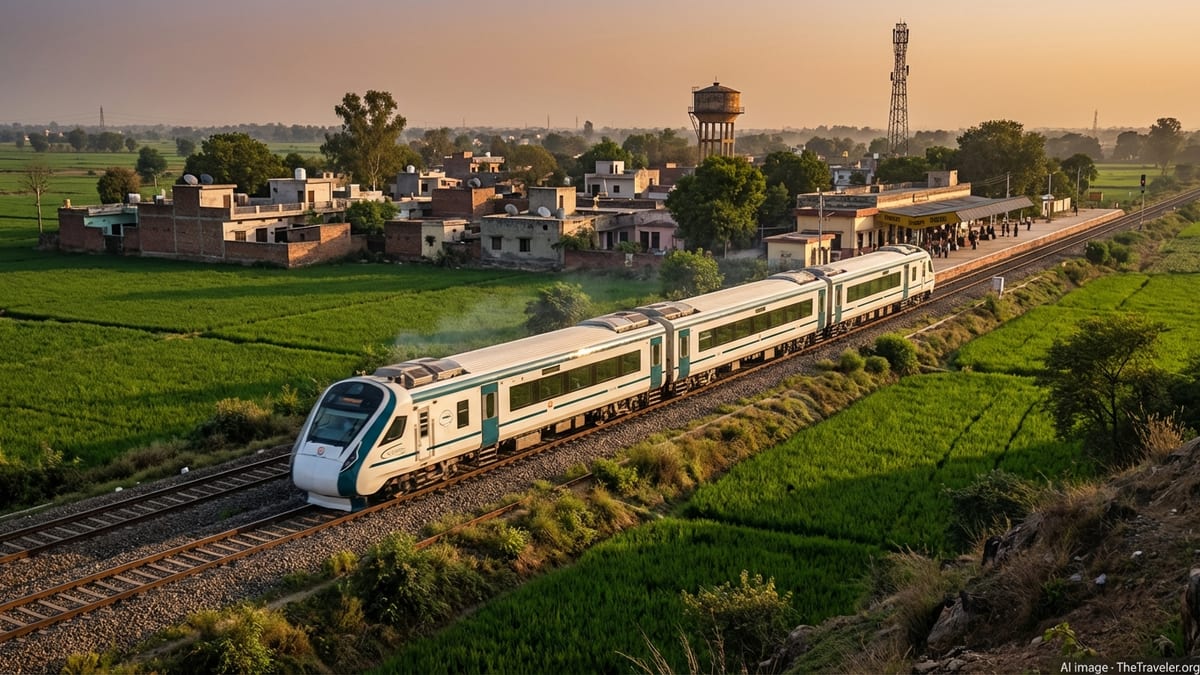
A pilot route in Haryana marks a national milestone
The inaugural service, which began operating between Jind and Sonipat on July 17, is being positioned as both a technology demonstrator and a working commuter link. Reports indicate that the 10 coach train currently runs at moderate speeds on the short section, giving Indian Railways time to observe performance in real world conditions.
Publicly available information from the Ministry of Railways shows that the hydrogen train has been cleared for operations on the Jind–Sonipat corridor after a series of trial runs on nearby stretches in Haryana earlier this year. The route was selected in part because of its relative operational simplicity and proximity to maintenance and refuelling facilities.
Rail analysts note that choosing a limited corridor for the debut allows engineers to refine procedures for hydrogen storage, refuelling, and crew training before any wider deployment. The pilot is also expected to generate data on passenger loads, timetable integration, and cost of operations compared with conventional diesel or electric services.
While the launch service has drawn significant political and public attention, railway planners are framing it as the first step in a longer program rather than a large scale rollout. Decisions on extending hydrogen operations to other parts of the network are expected to depend on the results of this initial phase.
Indigenous design and the ‘world’s longest’ hydrogen train
According to published coverage and official background notes, the new train is a retrofitted Diesel Electric Multiple Unit converted to run on hydrogen fuel cells, with design and integration work carried out in India. The project is being highlighted domestically as an example of “Make in India” manufacturing and engineering capability in advanced rail technology.
The 10 coach configuration is being described in Indian media as the longest hydrogen powered passenger train currently in service worldwide, contrasting with shorter trainsets deployed in parts of Europe. The expanded length allows the train to carry around 2,600 passengers at peak capacity, a scale that reflects typical Indian commuter demand even on secondary routes.
Technical briefings released by Indian Railways outline a propulsion system where hydrogen stored on board feeds fuel cells that generate electricity, which then powers traction motors. The only direct emissions from the process are water vapour and heat, eliminating tailpipe pollutants such as particulate matter and nitrogen oxides that are associated with diesel traction.
Railway engineers involved in the project have emphasized multiple layers of safety, including leak detection sensors, temperature and flame monitoring, and automatic shutdown systems. The train has undergone static and dynamic testing regimes before entering passenger service, in line with standards developed for the new technology.
Hydrogen hubs and the National Green Hydrogen Mission
The hydrogen train’s debut is closely tied to India’s broader green hydrogen ambitions. Government documents describe the service as a flagship component of the National Green Hydrogen Mission, which aims to scale up production and use of hydrogen produced from renewable energy.
To support the new train, Indian Railways has commissioned a dedicated hydrogen refuelling facility at Jind, described in official materials as the largest of its kind on the rail network. The installation includes storage tanks, compression systems, and high pressure dispensers designed specifically for rail applications, reflecting a move from small laboratory pilots to operational infrastructure.
Planners are also exploring additional hydrogen hubs at key junctions if the technology proves viable at scale. These hubs could potentially serve multiple hydrogen powered trains or maintenance vehicles, creating localized ecosystems of production, storage, and consumption aligned with nearby solar or wind power projects.
Policy documents indicate that the rail sector is seen as a strong early market for green hydrogen because of its predictable routes and centralized depots. Lessons from the Jind–Sonipat operation are expected to inform procurement models, fuel supply contracts, and safety codes that could be used across other hydrogen applications in India.
Positioning India within the global hydrogen rail landscape
The launch places India among a small but growing group of countries operating hydrogen powered passenger trains, alongside early adopters such as Germany and China. Internationally, hydrogen trains have generally been introduced on non electrified or lightly used routes where the cost of installing overhead wires is hard to justify.
In India, the picture is more complex. The national rail network is already largely electrified, and electrification remains the main decarbonisation strategy. Analysts writing in specialist rail publications suggest that hydrogen traction may ultimately find its niche on branch lines, low density corridors, and heritage routes where conventional electrification is challenging or visually intrusive.
Published commentary also points out that the Jind–Sonipat project gives India valuable experience in an emerging technology that could later be exported. By developing indigenous capability in hydrogen storage, rolling stock integration, and refuelling systems, domestic manufacturers may seek opportunities in markets where electrification levels are lower and hydrogen rail has clearer economic advantages.
For now, the new train serves primarily as a showcase of engineering ambition and climate aligned innovation. It signals that India intends not only to follow global trends in cleaner transport but to contribute to shaping them, even in niche segments such as hydrogen rail.
What the launch means for travelers and future routes
For passengers on the Jind–Sonipat section, the most noticeable changes are expected to be lower on board noise, smoother acceleration, and a visible rebranding of the train as a next generation service. Reports from early journeys highlight a quieter ride compared with older diesel units that have long served similar routes.
Ticketing and fares on the pilot route are expected to remain broadly in line with existing regional services, as the primary objective is technological validation rather than premium pricing. Indian Railways will be monitoring ridership patterns to understand whether the novelty of hydrogen traction influences demand, or whether convenience and punctuality remain the dominant factors.
Future deployment scenarios discussed in public forums include possible hydrogen services on iconic hill railways and tourism focused lines, where low emissions and a modern image could be strong selling points. However, planners continue to stress that any expansion will be conditioned by cost, safety, and the pace of green hydrogen production within India.
As the train settles into regular operation in the coming months, attention is likely to shift from ceremonial flag offs to operational metrics such as reliability, fuel efficiency, and maintenance requirements. Those results will determine whether India’s first hydrogen powered passenger train remains a high profile one off or becomes the template for a new class of low emission rail services across the country.