


Landing at Montego Bay’s Sangster International Airport is exciting, but the first hour on the ground can be confusing if you are not prepared for local SIM cards, currency, and paying for your taxi. This guide walks you step by step through what to do from the moment you leave the aircraft, so you can get connected, access Jamaican dollars, and pay confidently for transport, tips, and first expenses.
Get the latest updates straight to your inbox!
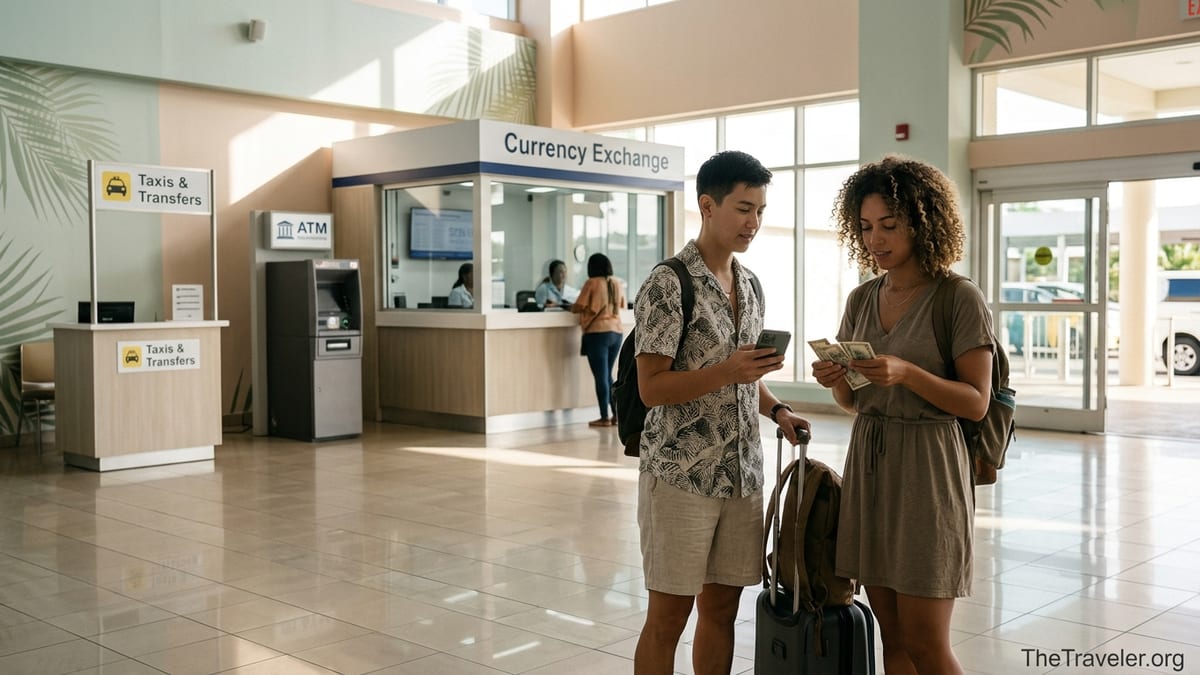
What to Expect on Arrival at Montego Bay’s Sangster International Airport
Sangster International Airport, usually referred to simply as MBJ, is Jamaica’s busiest tourist gateway and sits just a short drive from the resort strip in Montego Bay. After disembarking, you will walk through immigration, baggage claim and customs before you reach the public arrivals hall where you can finally sort out money, data, and transport. The walk is straightforward, and most passengers will clear formalities in 30 to 60 minutes depending on how many flights arrive at the same time.
In the arrivals zone you will see transport company desks, tour operators, a small selection of shops, and access to currency exchange. ATMs are available inside the terminal, and while dedicated mobile network shops are not as prominent as in some major hubs, you can still get connected quickly using eSIMs or by visiting nearby shops once you are in town. Understanding the basic layout before you land will help you avoid wandering around with luggage while trying to figure out where to get cash or data.
Unlike some larger airports where you can spend hours in duty free and shopping malls, MBJ is compact and functional. That means you should not plan on doing major errands here. Think of the airport as a place to get your phone working, pick up enough local currency for immediate needs, and then continue to your hotel where you can make more considered decisions about data top-ups, additional cash, or bank visits.
SIM Cards, eSIMs, and Getting Connected Fast
Jamaica’s mobile market is dominated by two operators, Digicel and Flow, which provide voice and data coverage in Montego Bay and along the north-coast resort corridor. Many short-term visitors now arrive with an international roaming plan already activated on their home carrier, which can be the easiest option for a one-week stay. For example, some North American plans offer low-speed data at no extra cost in Jamaica with the option to pay a small daily fee for higher speeds. Check your carrier’s roaming page before departure and, if the pricing is acceptable, turn on roaming as soon as you land so you have data to handle ride-hailing, maps, and messaging without hunting for a kiosk.
If you prefer a local data package, eSIMs have become a practical solution. Travelers increasingly report buying a Digicel eSIM online before flying, completing the registration with their passport details, and then activating the plan once the aircraft lands. This allows you to bypass any physical SIM hunt in the terminal. App-based eSIM marketplaces also sell Jamaica-compatible plans that connect to the local networks, typically offering bundles such as 3 to 10 GB valid for 7 to 15 days. While exact prices fluctuate, the cost is usually in the range many travelers would pay for a few days of hotel Wi-Fi upgrades.
Physical prepaid SIM cards are more easily purchased once you reach Montego Bay than inside the arrivals hall itself. Visitors have reported buying Digicel starter packs in small convenience stores along the “Hip Strip” on Gloucester Avenue, with examples such as a short-stay package for about one week of data being sold at a fixed price in US dollars for convenience. Official Digicel and Flow stores in town can also set up a SIM, but you should expect to show your passport for registration and allow some waiting time if the store is busy.
Whichever route you choose, download key apps before you travel: WhatsApp for messaging, your airline app for any return changes, and at least one maps app with offline Montego Bay areas saved. If you plan to use a ride-hailing app for part of your stay, set up your profile and payment method in advance so that, once your roaming or eSIM is active, you can request a ride without delay.
ATMs and Currency Exchange at MBJ
Once you are in the public arrivals area you will need Jamaican dollars for taxis, tips, and small expenses. The airport has ATMs operated by major Jamaican banks, such as Scotiabank, which include Sangster International among their ATM locations. These machines typically dispense Jamaican dollars and work with international Visa and Mastercard debit cards, though you may be charged an ATM fee by both the local bank and your home bank. With that in mind, consider withdrawing a single moderate amount rather than several small transactions to reduce fees.
If your card is not working, or you prefer to exchange cash, MBJ hosts currency exchange counters operated by Global Exchange. According to the airport’s passenger services information, these desks are found in several parts of the terminal, including the ground transportation hall, and are open during the airport’s operating hours, which effectively means they cover the main wave of tourist flights. They typically accept major currencies such as US dollars, euros, and British pounds and return Jamaican dollars at a posted rate that includes their commission. Rates at airports are usually less favorable than in town, so a pragmatic strategy is to exchange only what you need for your first day.
As a real-world example, an arriving traveler carrying 300 US dollars in cash might choose to exchange only 80 to 100 dollars at the Global Exchange counter to cover the taxi from the airport, a meal, and initial tips, then use an ATM or a bank branch in Montego Bay for any additional cash at a better rate. Alternatively, you can skip the exchange desk entirely if your debit card works reliably and you are comfortable withdrawing Jamaican dollars from an ATM immediately after arrival.
Remember that most ATMs in Jamaica use chip-and-PIN verification. If your card relies solely on magnetic stripe or if your bank has not enabled international ATM use, you may encounter declines. Before your trip, inform your bank of your travel dates and confirm that your card is cleared for cash withdrawals in Jamaica. Carry a backup debit or credit card stored separately in your hand luggage in case one card fails or is blocked for security reasons.
Cash for Taxis, Airport Transfers, and Tipping
Taxi and transfer payments are where many arrivals feel most pressure around money. At Montego Bay airport you will encounter several types of ground transport. Many visitors prebook a private transfer through their hotel or a local company, which usually allows payment by card online before travel. In that case you only need cash for a tip. For instance, on a 30 US dollar prebooked transfer from MBJ to a Montego Bay resort, it is common to tip the driver the equivalent of 3 to 5 US dollars in either US currency or Jamaican dollars, handed in cash at the end of the ride.
If you are arranging a taxi on arrival, you will see authorized airport taxis parked outside the terminal. Fares to major hotels are often posted at a counter or can be quoted to you in advance. In tourist areas like Montego Bay and Negril, charter taxis commonly quote prices in US dollars, and it is standard to pay in cash at the end of the ride. For example, a family heading from MBJ to a hotel along the main resort strip might be quoted a flat fare in US dollars, while a longer drive to a property outside town would cost more. Because drivers often do not accept cards, you should have small bills ready before you step outside to negotiate or confirm the price.
Across Jamaica, local guidance and official tourism information both emphasize that cash remains the dominant payment method for traditional taxis, and ride-hailing coverage, while present in cities like Montego Bay, is not as extensive as in some other countries. That means even if you hope to use an app-based ride for your hotel transfer, you should still be prepared with enough cash to pay a regular taxi if the app has no drivers available or your data connection is unstable.
For tipping at the airport, modest amounts go a long way. Porters who assist with luggage typically expect a tip per bag or per trolley, usually paid in US dollars or Jamaican dollars. Similarly, if a staff member goes out of their way to assist you with directions or special needs, a small cash tip is appreciated but not mandatory. Keep a mix of US one-dollar bills and low-denomination Jamaican notes in an easily accessible pocket to avoid pulling out large bills in a crowded space.
Using Credit and Debit Cards in Montego Bay
Once you leave the airport and settle into your hotel, you will find that Montego Bay’s tourism infrastructure is generally card-friendly. Major hotels, all-inclusive resorts, and larger restaurants typically accept Visa and Mastercard, and many will also accept American Express. Travelers regularly report paying for hotel extras, restaurant meals, and organized excursions by card without issue. When the card terminal presents the option, choosing to be charged in Jamaican dollars rather than your home currency can help you avoid additional conversion markups from dynamic currency conversion.
That said, you should not rely on cards alone. Smaller shops, local eateries, and market stalls may be cash-only, and even businesses that usually accept cards can experience connectivity issues that temporarily prevent card transactions. In addition, some taxis, smaller tour operators, and roadside vendors simply do not have card terminals. A balanced approach is to carry a primary credit card for larger, predictable spends and maintain a cash float in Jamaican dollars for incidental expenses, street food, and tips.
When using your card, always keep it in sight and decline any offer to take it “to the back” to process, as this is considered best practice worldwide. In taxis or casual settings, be cautious if someone offers to process a card payment via a personal mobile phone instead of an obvious business terminal. If anything feels unclear, ask to pay in cash instead. Before your trip, check whether your credit card charges foreign transaction fees and, if so, consider bringing a secondary card that waives those fees to reduce costs over the course of your stay.
Finally, configure your cards for two-factor authentication that still works when you are abroad. Some banks send one-time codes by SMS, which may not reach you if you switch to a local SIM without keeping your home number active. Using an authentication app or secure email for verification can prevent card declines when booking activities or paying deposits from Jamaica.
What to Arrange Before You Land in Montego Bay
The smoothest arrivals at MBJ are almost always those where a few key decisions have been made before departure. First, decide how you will connect your phone. If you are comfortable with your home carrier’s roaming charges, enable roaming and test that data works as soon as you land. If you want a local data solution, purchase and install an eSIM in advance, or at least research which eSIM provider you will use, so activation takes only a few taps after landing.
Second, confirm your ground transport. Prebooking a hotel transfer with clear payment terms simplifies the money question, especially for families or late-night arrivals. Many Montego Bay resorts and reputable local operators allow you to pay by card online or accept card payment on arrival at the hotel. Print or save the confirmation with the company name and meeting point instructions so you can walk straight past the taxi touts to your driver. If you plan to take an airport taxi instead, research approximate fares to your area and decide whether you will pay in US dollars or Jamaican dollars, then bring appropriate small bills.
Third, prepare your banking. Inform your bank of your Jamaica travel dates, verify daily ATM limits and foreign transaction fees, and ensure at least one debit card and one credit card are ready for international use. If you know your bank charges a high fee per ATM withdrawal, consider bringing a modest amount of US cash as a backup that you can exchange at the airport if needed. Store photocopies or digital scans of your passport and the front of your cards (with numbers obscured) in a secure cloud location in case of loss.
Lastly, download essential offline resources. Save your hotel address in your notes app, including a version that a local driver would recognize, such as the resort name and neighborhood rather than just a street address. Download an offline map centered on MBJ and the Montego Bay area. If you have any special requirements, such as accessibility assistance or traveling with young children, contact your airline and hotel before departure to confirm what help is available so you are not trying to solve these issues in the arrivals hall.
Practical Arrival Scenarios and How to Handle Them
To make this more concrete, imagine a couple arriving on an afternoon flight from New York. Before traveling, they enable low-cost roaming on their US mobile plan and prebook a private transfer from MBJ to their all-inclusive resort, paying by credit card online. On landing, they turn on their phones, confirm that data works, and follow the driver’s meeting instructions in the arrivals hall. They walk past the currency exchange without using it, withdraw Jamaican dollars from an ATM near the exit for small tips and local shopping, and reach their resort without needing to negotiate fares or worry about data plans.
Now consider a solo traveler arriving from Europe who wants to minimize roaming charges. They purchase a Digicel eSIM online a day before departure, register it with their passport details, and schedule activation for arrival day. Once through customs, they enable the eSIM, wait a minute for the network to connect, and then order a ride-hailing car to a guesthouse in town, paying for the ride through the app. At the same time, they withdraw a small amount of Jamaican dollars at the airport ATM to cover tips and street food on the first evening, planning to visit a Digicel or Flow store in Montego Bay later in the week if they need to extend their data package.
A third example is a family landing late at night when some services are quieter. They travel with a mix of cards and 200 US dollars in cash. After finding that the first ATM is temporarily out of service, they walk a short distance inside the terminal to another bank’s machine and successfully withdraw Jamaican dollars. Because they are tired and traveling with kids, they choose an authorized airport taxi and accept a fare quoted in US dollars, paying in cash and tipping in US singles. The next day, once rested, they go into town to top up cash from an ATM and, if needed, buy a local SIM at a convenience store on the main tourist strip.
These scenarios show that there is no single correct method. The key is to arrive with a plan that fits your risk tolerance and budget. Decide in advance whether you want to prioritize convenience (roaming and prebooked transfers) or savings (local SIMs and ATMs in town), and then stick to that plan to avoid making rushed, uncertain decisions in a crowded arrivals hall.
The Takeaway
Arriving at Montego Bay’s Sangster International Airport does not have to be stressful if you approach SIM cards, cash, and card payments with a clear, simple plan. Know in advance whether you will rely on roaming or a local eSIM, bring at least one working debit card for ATM withdrawals and one credit card for larger purchases, and carry a starter supply of small-denomination cash for taxis and tips.
Use the airport’s ATMs or currency exchange counters to obtain only the Jamaican dollars you need for your first day, then reassess once you are settled into your hotel. Be prepared to pay taxis and porters in cash, but expect to use cards comfortably at most hotels, larger restaurants, and tour operators in Montego Bay.
With these basics covered before your flight touches down, you can walk through MBJ focused less on logistics and more on the warm air, sea views, and the start of your time in Jamaica.
FAQ
Q1. Can I buy a physical SIM card inside Montego Bay airport arrivals?
Availability of full-service carrier shops in the arrivals area is limited, so many travelers now rely on roaming or eSIMs and then buy physical SIM cards from Digicel or Flow outlets, or convenience stores, once they are in Montego Bay.
Q2. Is an eSIM reliable for a one-week trip to Montego Bay?
Yes, many visitors use an eSIM from Digicel or international providers for a 7 to 10 day stay, activating it on arrival and topping up online if they need more data.
Q3. Do ATMs at MBJ accept foreign debit cards?
ATMs operated by major Jamaican banks at MBJ generally accept international Visa and Mastercard debit cards, though your home bank may charge a foreign ATM fee.
Q4. Should I bring US dollars or exchange everything into Jamaican dollars?
It is practical to carry some US dollars for emergencies and small tips, but you will usually get better value by withdrawing or exchanging into Jamaican dollars for most day-to-day spending.
Q5. How much cash should I have ready for a taxi from the airport?
For central Montego Bay stays, it is sensible to have the equivalent of at least 40 to 60 US dollars in small bills or Jamaican notes to cover a taxi fare and tips.
Q6. Can I pay my airport taxi by card?
Some transfer companies accept cards, but traditional taxis typically expect cash, so do not assume card payment is possible unless it was clearly offered when you booked.
Q7. Are credit cards widely accepted in Montego Bay?
Yes, major hotels, resorts, and many restaurants accept Visa and Mastercard, but smaller shops, local eateries, and taxis often remain cash-only.
Q8. Is it safe to use ATMs in Montego Bay?
Using ATMs inside the airport, at bank branches, or in busy, well-lit locations is generally considered safer than using isolated machines, especially at night.
Q9. Do I need to tip in cash, or can I add tips to my card bill?
In hotels and larger restaurants you can often add a tip to a card payment, but porters, taxi drivers, and small vendors usually expect tips in cash.
Q10. What should I do if my card is declined at the airport?
If your card is declined, try a second ATM from a different bank, contact your bank using Wi-Fi or roaming to clear any security blocks, and, if needed, exchange a small amount of foreign cash at the airport currency desk to cover immediate expenses.