


Renting a car at Montego Bay’s Sangster International Airport can give you real freedom to explore Jamaica’s beaches, mountains and small towns on your own schedule. It can also be confusing, with unfamiliar insurance rules, sizeable credit card holds and driving conditions that feel very different from home. This guide walks you through how car rental at Montego Bay Airport actually works in 2026, what to expect at the counter, and how to decide if renting is really worth it for your trip.
Get the latest updates straight to your inbox!
Where to Find Rental Desks at Montego Bay Airport
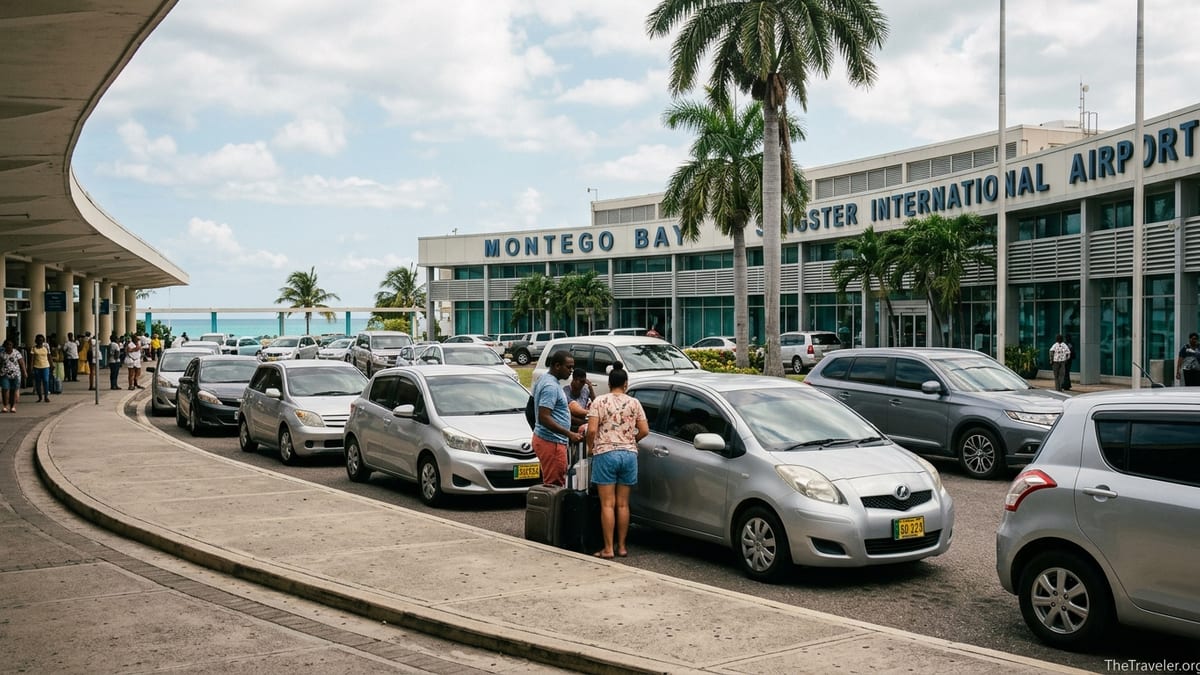
Montego Bay’s Sangster International Airport is compact, so you will reach the car rental area quickly after landing. After you clear immigration and customs, the main rental desks are located in the Ground Transportation and Arrivals Hall area, just outside the customs exit. This is where you will find the big international brands such as Avis, Budget, Hertz, Enterprise, Alamo, National and Sixt alongside well known Jamaican companies like Island Car Rentals and smaller local agencies. Most travelers pick up keys here and are then directed either to the airport parking lot or to a short shuttle for off site lots.
Some companies, especially Jamaican brands and value focused agencies, work slightly differently. For example, several off airport firms provide free shuttles or curbside meet and greet, meaning a representative waits for you in the arrivals hall holding a sign with your name and then walks you to a nearby parking area or minivan shuttle. This is common with companies such as Danjor Car Rentals and Priceless, which operate just a few minutes’ drive from the terminal. The upside is often lower base rates than the international counters inside the building.
At peak arrival times in winter and spring, it is common to see lines at the larger desks, particularly Avis, Budget and Hertz. Plan on 30 to 60 minutes from exiting customs to driving away if you have a reservation with one of the major brands. Off airport operators can sometimes be faster but you may need to wait 10 to 20 minutes for their shuttle or representative to arrive. If you have a tight connection to a pre booked excursion or resort transfer, build in this extra time.
If you prefer a smoother arrival, some travelers book an arrivals lounge service such as Club Mobay to fast track immigration, then head directly to the rental counters. This does not change rental company procedures, but saving half an hour in the immigration line can make the overall pickup process less stressful, especially if you are landing with family or a large group.
Typical Prices, Vehicle Types and Fleet Condition
Rates at Montego Bay Airport fluctuate with season, demand and how far in advance you book, but recent searches show economy and compact cars starting around 30 to 40 US dollars per day in low season and 45 to 60 dollars per day or more in high season before insurance, taxes and fees. Mid size sedans tend to run 10 to 15 dollars per day higher, while compact SUVs and crossovers often start around 60 to 80 dollars per day. Minivans and 7 seater vehicles are in high demand with groups heading to all inclusive resorts and can easily exceed 100 dollars per day.
Most fleets in Montego Bay are made up of familiar models such as Toyota Yaris, Toyota Corolla, Nissan Note, small crossovers like the Nissan X Trail or similar, and minivans such as the Toyota Noah or similar. Manual transmission cars exist but are less common at the airport; if you are not comfortable driving stick, be sure to book automatic specifically. Given the steep hills around places like Montego Bay’s Rose Hall area and the north coast road toward Ocho Rios, many visitors appreciate the extra ground clearance of a small SUV, especially in rainy season when potholes can deepen quickly.
Car condition can vary more than in North American or European airports. Major international brands at Montego Bay Airport usually provide relatively new vehicles with visible pre existing scratches recorded on a check out form. Local agencies may run older cars that show more cosmetic wear, though they can still be mechanically sound. It is common to find small dings, bumper scuffs and interior wear and tear, which reflects both road conditions and the local driving culture. This makes it particularly important to photograph all sides of the vehicle, the wheels and the interior at pickup so you have a clear record of pre existing damage.
Availability can tighten significantly over Christmas, New Year and spring break when flights into Montego Bay are heaviest. Travelers have reported walking up to counters in late December only to find that all reasonably priced cars were sold out or that only premium SUVs and luxury models remained at very high day rates. If you are traveling in peak season and know you want a car, reserving several weeks or months ahead is sensible, especially if you need a minivan or are staying in a villa outside the main resort zones.
Understanding Jamaican Rental Car Insurance at MBJ
Insurance is the most confusing part of renting a car at Montego Bay Airport. In Jamaica, basic third party liability coverage is usually included in the rate, but collision damage waiver (often called CDW) and theft protection are typically required either through the rental company or through proof of valid coverage from a credit card or external policy. For example, Enterprise at Montego Bay notes that you must either purchase their collision and theft package, show written proof of existing coverage valid in Jamaica or accept a large deposit hold, which can be 2,500 US dollars plus the cost of the rental for higher risk categories.
Several brands offer CDW as an optional daily charge, often in the range of 15 to 25 US dollars per day for a standard car, with higher pricing for SUVs and vans. Local companies like Pat’s Car Rental advertise optional CDW starting around 15 US dollars per day, while others package CDW, theft protection and windshield or tire protection into a single daily rate. These waivers usually come with a deductible, meaning that in the event of damage you are still responsible for the first portion of the cost, which can range from around 500 to 1,500 US dollars depending on car class.
Many North American travelers hope to rely on their credit card’s rental car insurance benefits. However, coverage in Jamaica is more restricted than in some other destinations. For instance, some Visa and Mastercard issuers exclude Jamaica altogether or only cover it on premium cards. Individual rental companies at Montego Bay may require written proof from your card issuer that explicitly names Jamaica and details the coverage level. Avis Jamaica, for example, provides documentation explaining that only certain Gold or Platinum Mastercards from specific banks offer primary CDW in Jamaica, and customers are asked to present printed confirmation at the counter. If you cannot produce that letter or if your card simply does not cover Jamaica, you may be required to purchase the rental company’s CDW anyway.
There are also optional add ons such as supplemental liability coverage to increase third party limits, personal accident insurance for you and your passengers, and roadside assistance packages. Given road conditions on some parts of the island, tire and windshield protection is worth considering; pothole related damage is a common complaint among drivers who explore less maintained rural routes. Always ask the agent to explain exactly what is and is not covered, what the deductible is, and how claims are handled in Jamaica. If you plan to rely on your credit card, contact the card issuer before your trip to request a coverage letter that mentions Jamaica specifically and bring a printed copy to present at the desk.
Deposits, Credit Card Holds and Payment Methods
In addition to the rental charge and any insurance, you should be prepared for a substantial credit card hold when collecting your vehicle at Montego Bay Airport. Typical security deposits at airport locations for standard cars often range from around 500 to 1,000 US dollars, and can be higher for SUVs, premium vehicles and minivans. For example, one Montego Bay area agency lists a 1,500 dollar deposit requirement for minivans, while another local company mentions a pre authorization of several hundred dollars above the estimated rental cost. Some travelers have reported holds around 750 to 1,000 dollars on their card for a week long rental when declining the company’s CDW and relying on external coverage.
These deposits are almost always taken as a pre authorization on a major credit card in the main driver’s name. Debit cards are sometimes accepted for prepayment when booking online, but many rental companies in Jamaica will still require a traditional credit card at the counter for the security hold. Europcar Jamaica’s terms, for instance, explicitly state that debit cards and cash are not accepted for deposits and that the credit card holder must be present at pickup. Other firms, such as Economy Rent A Car and several local brands, warn that customers who reserved with a debit card may still be asked for a credit card upon arrival to leave the security deposit.
If you do not have a credit card, your options at Montego Bay Airport narrow considerably. A few smaller agencies might accept a larger cash deposit, but this is not common at the airport counters and can delay pickup while inspections are carried out. Even when debit cards are accepted, the hold amount will come directly out of your available balance and may take days to be released after you return the vehicle. Since deposits at MBJ can easily approach or exceed 1,000 dollars, using a credit card with enough unused limit is usually the most practical approach.
When you return the car, the deposit hold is typically released once the vehicle is checked for damage and fuel level. Some companies at Montego Bay Airport release the hold within 24 to 48 hours, while others can take several business days depending on your bank and card network. It is wise to keep all rental paperwork and the final receipt until you see the hold disappear from your account. If any damage is found, the rental company can charge your card up to the deductible or full repair cost, so detailed photos at both pickup and drop off are important protection.
Driving in Jamaica: Rules, Road Conditions and Safety
Jamaica drives on the left side of the road with right hand drive vehicles, similar to the United Kingdom. For many visitors arriving in Montego Bay from the United States or Canada, this is the first major adjustment. The steering wheel will be on the right, roundabouts circulate clockwise, and the fast lane on multi lane roads is on the right. Speed limits are posted in kilometers per hour. Within Montego Bay and around resort areas, you will encounter a mix of two lane roads, multi lane city arteries and roundabouts that connect the main routes toward Falmouth, Ocho Rios and Negril.
Main highways, such as sections of the North Coast Highway linking Montego Bay with Falmouth, Ocho Rios and beyond, are generally paved and in fair condition, though you should still watch for sudden potholes, uneven shoulders and aggressive overtaking. Travel time from Montego Bay to Negril is typically around two hours in light traffic, but can be longer after heavy rain or storms. In recent years, travelers and locals alike have noted that road conditions in some parts of Jamaica have deteriorated, especially after hurricanes, with more frequent large potholes that can damage wheels and suspension if you hit them at speed.
Driving culture in Jamaica is more assertive than in many parts of North America or Europe. Minibuses and route taxis often overtake on short passing zones, including on hills and sometimes on blind corners. Horns are used frequently as a signal when passing or approaching tight bends. As a visitor, the safest strategy is to keep to a moderate speed, allow faster local drivers to pass and avoid being pressured into driving beyond your comfort level. Night driving outside of major towns is not recommended for first time visitors; many rural and coastal roads lack street lighting, making it hard to see potholes, pedestrians and animals on the roadway.
Police checkpoints appear periodically on main roads, particularly on the approaches to cities and resorts. You should carry your driver’s license, rental contract and passport or a copy whenever you are driving. Roadside breakdown services are limited compared with larger countries, so if your rental company offers branded roadside assistance, note the phone number before leaving the lot. In case of a minor accident, contact your rental firm first and follow their instructions; in Jamaica, leaving the scene without reporting can complicate insurance claims even for minor fender benders.
Resorts, Parking and Day Trips From Montego Bay
Many visitors who rent cars at Montego Bay Airport are staying at the large all inclusive resorts scattered along the north coast, from Ironshore and Rose Hall east of the city all the way toward Falmouth, or west along the coast road to smaller hotels and guesthouses. Most major resorts provide free on site parking for guests, often in open surface lots near the main entrance or behind the buildings. At properties along the Rose Hall strip, for example, guests with rental cars simply collect a parking pass at check in and can come and go through the security gate without extra charges. Smaller boutique hotels and villas may have gated parking areas, but space can be tighter, so it is worth confirming parking arrangements with your host in advance if you plan to drive a larger SUV or minivan.
Having a car can be especially useful if you are staying outside the main resort clusters or in an Airbnb or villa in the hills above Montego Bay. Steep driveways and narrow side roads are common in these residential areas, and surfaces may be worn. If your accommodation is up a hillside road, a compact SUV rather than a low slung sedan can make everyday access easier, particularly in rain. Always ask the property owner whether they recommend a standard car or something with higher clearance for their location.
From Montego Bay, popular self drive day trips include the roughly two hour coastal route to Negril’s Seven Mile Beach and cliffs, visits to Dunn’s River Falls near Ocho Rios, rafting excursions on the Martha Brae River near Falmouth, and drives inland toward Cockpit Country or the south coast. A rental car makes it possible to stop at roadside jerk stands, craft markets and lesser known beaches that scheduled shuttles often bypass. However, be realistic about driving times; for example, a loop that attempts to cover Montego Bay, Ocho Rios and Negril in a single day is not practical once you account for traffic, road conditions and time spent at each stop.
In urban Montego Bay itself, parking in the downtown core can be congested, with a mix of paid lots, informal attendants and tight curbside spaces. Many visitors choose to leave their rental parked at their hotel and use licensed taxis when heading into the city center for shopping or nightlife, returning to their car only for longer intercity trips. This can reduce stress from navigating one way streets and busy intersections, especially after dark.
Is Renting a Car at MBJ Worth It Compared With Taxis and Transfers?
Whether a rental car from Montego Bay Airport is worth it depends on your itinerary, comfort with left side driving and budget. For travelers who plan to stay at a single all inclusive resort in Montego Bay, Negril or Ocho Rios and mainly join organized excursions, a private airport transfer plus occasional taxi rides may be simpler and not dramatically more expensive. A typical private transfer from MBJ to a Montego Bay area resort might cost around 30 to 60 US dollars each way for a couple, while transfers to Negril or Ocho Rios can run 100 to 150 dollars each way depending on vehicle size and booking channel. If you add the rental car’s daily rate, insurance, fuel and parking, you may pay more overall just to have a car sitting idle for much of your stay.
On the other hand, if you enjoy independent exploring and plan multiple day trips, a rental car can quickly become cost effective. Consider a couple staying ten days in Montego Bay who want to visit Negril twice, Ocho Rios once and make a few shorter trips to Falmouth and local attractions. Relying on private drivers for these routes could easily reach several hundred dollars. By contrast, a compact rental at 50 dollars per day plus, say, 20 dollars per day in insurance and an average of 15 to 20 dollars per day in fuel may end up in a similar price range while offering much more flexibility.
Your personal tolerance for stress also matters. Some visitors love the independence of having a car and report no major issues driving between Montego Bay and resort towns, especially in daylight. Others find Jamaican driving intense and prefer to relax in the back of a shuttle. Online discussions among recent visitors show sharply mixed opinions: some travelers rave about the freedom and say they would rent again, while others say the combination of aggressive overtaking, potholes and narrow roads was more than they bargained for. If you are a confident driver, used to urban traffic and willing to take it slowly, you are more likely to see the benefits.
As a middle ground, some travelers choose to rent a car from Montego Bay Airport only for a portion of their stay. For example, you might book a private transfer to your resort, relax for the first few days, then have a car delivered to the hotel for three or four days of exploring before returning it and using a shuttle back to the airport. Several local agencies and some international brands will deliver cars to larger resorts around Montego Bay and Negril for a fee, allowing you to avoid driving immediately after a long flight while still enjoying independent travel later in your trip.
The Takeaway
Car rental at Montego Bay’s Sangster International Airport offers a valuable sense of freedom but comes with unique Jamaican twists that are important to understand before you commit. Insurance requirements are stricter than in many destinations, with collision coverage often mandatory and credit card policies that only sometimes extend to Jamaica. Deposits and credit card holds are typically higher than many travelers expect, frequently in the hundreds or even low thousands of dollars, and debit cards are not a reliable substitute for a traditional credit card.
If you are comfortable driving on the left, patient with assertive local traffic and willing to navigate potholes and occasional rough patches, having your own vehicle can open up beaches, jerk stands, river rafting spots and mountain viewpoints that most tour buses never reach. For resort focused stays or short trips where you mainly shuttle between the airport and a single hotel, however, taxis and private transfers may be simpler and not much more expensive when all rental costs are added up.
Before you land in Montego Bay, decide how much independent exploring you truly plan to do, confirm your credit card’s insurance coverage in writing, and budget realistically for insurance add ons and deposits. With those details sorted out and expectations aligned with Jamaican driving realities, renting a car at Montego Bay Airport can be a rewarding way to experience more of the island on your own terms.
FAQ
Q1. Do I really need to buy rental car insurance in Jamaica if I have a credit card with coverage?
Most rental companies at Montego Bay Airport require proof that your credit card’s coverage explicitly applies in Jamaica, and many cards exclude the country or only cover it on specific premium products. If you cannot provide written confirmation from your card issuer naming Jamaica and outlining the coverage, the rental desk will usually insist that you purchase their collision damage waiver or accept a very large deposit hold. It is wise to contact your card company before your trip, request a coverage letter and bring a printed copy to the counter.
Q2. How big are the typical credit card holds for car rentals at Montego Bay Airport?
Holds vary by company and vehicle type, but many renters report deposits in the 500 to 1,000 US dollar range for standard cars, with higher amounts for SUVs and minivans. Some companies state that if you decline their collision coverage, the hold can increase to well over 1,000 dollars and in certain cases up to around 2,500 dollars plus the estimated rental charges. These amounts are authorized on your card at pickup and released after you return the car without damage.
Q3. Can I rent a car at MBJ with a debit card instead of a credit card?
Some companies accept debit cards for online prepayment, but a traditional credit card in the main driver’s name is usually required at the counter for the security deposit. Several Montego Bay rental firms say explicitly that debit cards and cash are not accepted for deposit holds. Even where debit cards are allowed, the hold is taken directly from your available balance and may take days to be released, so using a credit card with sufficient limit is strongly recommended.
Q4. Is it safe to drive from Montego Bay to Negril or Ocho Rios on my own?
The main coastal routes between Montego Bay, Negril and Ocho Rios are commonly driven by visitors and are generally considered acceptable for daytime travel, though conditions can change after heavy rain or storms. You should expect uneven pavement, potholes and assertive local drivers who overtake frequently. Most first time visitors are advised to avoid driving these routes after dark because many sections lack street lighting and it can be hard to see road hazards and pedestrians.
Q5. Do Montego Bay and north coast resorts charge for parking rental cars?
Large all inclusive resorts and major hotels around Montego Bay, Rose Hall, Negril and Ocho Rios typically offer free on site parking for guests, often in open lots near the entrance. You may be given a parking pass or dashboard tag at check in. Smaller boutique hotels, villas and guesthouses can have more limited parking and tighter spaces, so it is worth confirming arrangements in advance, especially if you plan to rent a larger SUV or minivan.
Q6. What kind of car is best for driving in Jamaica?
For most visitors renting at Montego Bay Airport, a compact or mid size automatic is adequate for driving between major resort towns and along the north coast. However, a small SUV or crossover with higher ground clearance can be more comfortable on rougher roads, steep villa driveways and in rural areas where potholes and uneven shoulders are common. Manual transmission cars exist but are less prevalent, and most travelers are more relaxed with an automatic when adjusting to left side driving.
Q7. Will my US or Canadian driver’s license work in Jamaica?
For typical tourist stays, a valid driver’s license from the United States, Canada, the United Kingdom and many other countries is generally accepted by rental companies at Montego Bay Airport. You do not usually need an International Driving Permit for short visits, although some agencies may request one from travelers whose licenses are not in English or who come from countries with very different documentation. Always check the specific requirements in your rental confirmation.
Q8. How long does it take to pick up a rental car at Montego Bay Airport?
At quieter times, you may be on the road within 30 minutes of exiting customs, but in peak winter and spring seasons it can easily take 45 to 60 minutes or more. Time is spent waiting in line at the desk, completing paperwork, reviewing insurance options and then either walking to the nearby lot or taking a short shuttle to an off site location. If you are landing with a large flight from North America or Europe, build in extra time before any scheduled activities.
Q9. Is fuel expensive and are gas stations easy to find near Montego Bay?
Fuel prices in Jamaica are generally higher than in much of the United States and closer to what many travelers expect in parts of Europe, though they fluctuate with global oil markets. Several branded service stations line the main roads in and around Montego Bay, and there are stations along the north coast highway toward Negril and Ocho Rios. It is sensible to top up before long drives, especially if you plan to explore more rural interior areas where stations are less frequent.
Q10. Should a first time visitor to Jamaica rent a car or rely on shuttles and taxis?
For a first trip where you plan to stay primarily at one resort and take a few organized excursions, many visitors find that private transfers and licensed taxis are less stressful than renting a car. You avoid driving on the left, dealing with assertive local traffic and worrying about navigation or road conditions. If you are a confident driver, enjoy independence and plan several day trips, a rental car can be worthwhile, but it is important to understand the insurance rules, deposit requirements and driving culture before deciding.