


Montego Bay’s Sangster International Airport is built around tourists, but its public transport is built around locals. That gap can surprise budget travelers who arrive expecting city-style airport buses or metro lines. Instead, you step out into a world of licensed taxis, informal route cabs, long-distance coaches and very limited true public bus options. This guide explains what really works for visitors, what is mostly for locals, and when saving a few dollars is not worth the hassle or risk.
Get the latest updates straight to your inbox!
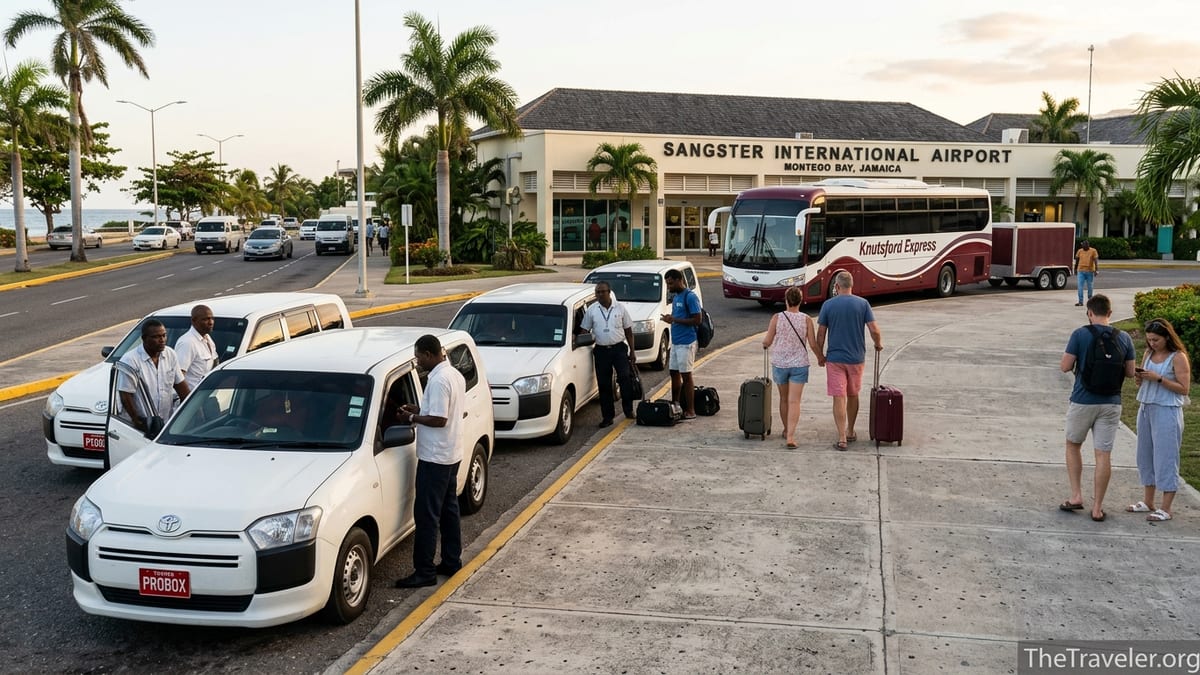
Understanding the Layout: Airport, Hip Strip and Downtown
Sangster International Airport sits right on the coast at the northern edge of Montego Bay. The main resort area, including Doctor’s Cave Beach, the Hip Strip on Gloucester Avenue and hotels like S Hotel, Deja Resort and SeaGarden, runs along the shoreline to the south of the runway. Central Montego Bay and the busy transport hubs, including the downtown bus park and taxi stands used by locals, are a short drive inland but a world away in how they feel and operate.
Walking out of the terminal, you first see the official taxi dispatch area and desks for resort shuttles. There is no city bus stop built into the terminal, no rail connection, and no tram or metro. Any public or semi-public transport option you use will either depart from the curbside taxi area, from the road just outside the airport perimeter, or from the downtown transport centers several kilometers away.
For context, a licensed airport taxi to a hotel on the Hip Strip might cost in the region of 20 to 30 US dollars for up to two passengers, depending on the exact property and whether you pay in US dollars or Jamaican dollars. That same distance by local route taxi, if you were already in town, might cost just a few US dollars equivalent. The catch is that route taxis rarely come inside the airport grounds, and getting to them involves walking out on foot and knowing exactly where you are going.
This split layout matters because almost every truly budget transport option to or from the airport involves, at minimum, one extra leg by taxi or on foot to reach the local bus or coach departure point. If you are landing late, have children, bulky luggage or are heading straight to a coastal resort, many of those options quickly stop making sense in real life.
Local Buses and Route Taxis: The Reality for Visitors
In Montego Bay, the closest thing to public buses are services operated by Montego Bay Metro and various private minibuses that move workers and students between suburbs and the city. These do not run into the airport. They tend to start and finish at the downtown bus park or along main roads like Barnett Street and Howard Cooke Boulevard. Fares are low compared with tourist taxis, roughly in line with what a local commuter might pay, but you need Jamaican dollars, patience and a good sense of where you are getting off.
Even more common than buses for local trips are “route taxis,” usually Toyota sedans or small minivans with red license plates that run fixed routes and pick up and drop off multiple passengers along the way. For example, a route taxi might shuttle constantly between the downtown taxi stand and the Ironshore or Rose Hall area, stopping wherever people flag it down. Locals squeeze in, four across the back seat and sometimes two in the front passenger seat, and pay a small fixed fare that is closer to a bus ticket than a private cab.
For a visitor, the appeal is obvious: a ride that might cost 30 US dollars as a private airport taxi can be done as a series of shared hops for a fraction of that. The problem is that route taxis are not designed around tourists. They do not have luggage space, drivers expect you to know local landmarks and road junctions, and they will stop often to pick up and drop off others. If you have a large suitcase and a carry-on, trying to wedge them into a full route taxi will not be popular and sometimes not even possible.
There is also an insurance and licensing issue. Many route taxis are legally licensed to carry locals on specific routes but are not properly insured to transport tourists on point-to-point trips far from their core area. It is common to see advice aimed at visitors recommending that tourists stick to operators who are authorized by the Jamaica Tourist Board or clearly branded as JUTA or JCAL taxis. Those official vehicles also carry red plates but usually have logos and operate more like private cabs, with prices that reflect that extra formality and coverage.
Intercity Coaches: Knutsford Express and Long-Distance Links
If you are traveling beyond Montego Bay, the most useful quasi-public transport service for visitors is the intercity coach network, especially Knutsford Express. Knutsford runs air-conditioned buses linking Montego Bay with Negril, Ocho Rios, Kingston, Mandeville and other towns. The company has a terminal located next to Sangster International Airport, meaning you can technically walk or take a short taxi hop from the arrivals curb to the coach office to continue by bus.
In practice, many travelers use Knutsford Express to cut the cost of longer journeys that would be very expensive by private taxi. For example, a private transfer from Montego Bay Airport to Kingston can cost well into the low hundreds of US dollars one-way, especially if arranged through a resort or international tour operator. The coach fare on Knutsford Express for the same corridor is typically in the range of tens of US dollars per person rather than hundreds, though you still need to pay for a short taxi ride from the airport to the coach terminal and from the destination terminal to your hotel.
Schedules change seasonally, but across the network there are usually several departures per day on main routes like Montego Bay to Kingston or Negril. Buses are generally reliable and used by both locals and tourists who prefer a more controlled environment than a patchwork of route taxis. Luggage is stowed in the underfloor compartment, which is a major advantage if you are carrying large suitcases or sports gear. Compared with wrestling those bags into a minibus or shared taxi, the coach is much more comfortable.
The limitation is that Knutsford Express and similar coach services are designed for intercity travel, not for short hops within the resort zone. If you are staying in Rose Hall, Ironshore or on the Hip Strip, a coach does not replace a taxi for the final 5 to 15 kilometers. As a budget-conscious traveler, it is realistic to combine one well-timed coach leg with small taxi segments at each end, but trying to use the coach as your daily shuttle to beaches or restaurants is neither practical nor allowed.
Luggage, Comfort and the Hidden Costs of “Cheap” Transport
The single biggest reason public transport around Montego Bay Airport is awkward for visitors is luggage. Local buses and route taxis are optimized for commuters carrying a backpack or a shopping bag, not couples arriving with two checked suitcases, a stroller and a surfboard bag. Even if you can physically fit your bags inside, you will stand out, slow boarding and may be charged extra or refused if the vehicle is already full.
Consider a common budget strategy: walk out of the airport grounds, catch a route taxi to the downtown bus park, then another shared taxi toward a resort area like Ironshore or the Freeport cruise pier. On paper, that might save 15 to 20 US dollars compared with a direct authorized taxi. In reality, you could end up standing on a hot roadside with your bags, negotiating fares in a new currency, while tired after a long flight. If your suitcase blocks someone from sliding across the seat, expect frustration and pressure to move quickly.
Coaches like Knutsford Express handle luggage far better, with tagged bags in a separate compartment and soft seats inside. However, if you land at lunchtime and the next coach is not until late afternoon, the hours you spend waiting at the terminal have a cost too. You might need to buy food, pay for short trips to stash bags at a guesthouse, or burn daylight you had hoped to spend on the beach. What looks cheap in raw fare numbers can be expensive in terms of lost time and energy.
Even official airport taxis have luggage considerations. Most are standard sedans, not minivans. If three friends arrive together with large hard-shell cases, the driver may need to fold down seats and Tetris everything into the trunk and footwells. This is usually manageable, but if you are traveling with golf clubs, dive gear or multiple kids’ suitcases, it is worth asking your hotel or transfer company in advance for a larger vehicle. Paying a slightly higher fixed rate for a van can work out better than trying to improvise at the curb.
Resort-Area Limitations and Where Public Transport Breaks Down
The further your hotel is from Montego Bay’s urban core, the less realistic it becomes to rely on local public transport. Properties along the main strip between the airport and the downtown area, such as SeaGarden, S Hotel, Deja Resort and some smaller guesthouses, sit on a corridor where taxis and route cabs pass frequently. In theory you could walk out to the main road and flag a shared vehicle back toward town or onward to the supermarket. In practice, you will be doing that without a sidewalk in parts, under hot sun, and without posted stops or timetables.
By contrast, large all-inclusive resorts east of Montego Bay such as those in the Rose Hall area, and west toward Hopewell and the Lucea corridor, are designed as self-contained bubbles. They often sit behind security gates off the highway. Local buses and route taxis run along the main road, not into resort driveways. To use them, you would need to walk or arrange a short paid ride from your lobby to the highway, then wait at the roadside. Returning at night raises issues of lighting, traffic and personal security beside a fast-moving coastal road.
Along the north coast toward Negril or Ocho Rios, distances grow larger and settlements thin out. Some independent travelers piece together a journey by taking a local taxi from the airport to the downtown Montego Bay bus park, then a minibus or shared taxi to intermediate towns like Lucea, Savanna-la-Mar or Falmouth, then onward again. That approach is cheap and widely used by Jamaicans, but it assumes you can travel light, speak up about where you are getting off, and handle your bags quickly in crowded vehicles.
For tourists on short stays, the cost of a missed hotel check-in, a lost evening, or the stress of finding transport after dark can outweigh the savings. Public transport in these resort corridors is real and active, but it is organized around local commuting and shopping patterns, not the door-to-door convenience most visitors expect when landing at an international airport.
Safety, Scams and Sensible Caution
Jamaica’s public transport culture is lively and can be good-humored, but it is also fast-paced, crowded at peak hours and not especially gentle with newcomers. At Montego Bay Airport specifically, the most important safety principle is to use clearly identified, authorized vehicles. Official airport taxis operate from a marked dispatch area, quote fixed or posted rates to common hotel zones, and provide receipts on request. Many drivers are part of long-established groups such as JUTA or JCAL, and their cars carry red plates and sometimes company branding.
Avoid individuals who approach you aggressively inside the terminal building or in the parking lot offering unofficial rides. While some may simply be freelance drivers, others may quote a low price and then add charges for luggage, tolls or extra passengers once you are underway. If a deal sounds dramatically cheaper than what hotel staff or the airport information desk mention, verify it carefully or decline.
On local buses and route taxis, the main risks are petty theft, confusion about where to get off, and ending up stranded somewhere unfamiliar if operations slow down in the evening. Keep valuables out of sight, avoid flashing phones and wallets, and distribute cash in more than one pocket so you can pay small fares without revealing a large roll of bills. If a vehicle feels overcrowded beyond your comfort level, it is acceptable to wait for the next one, though at busy urban stops that may not be much better.
Many seasoned visitors make use of one or two trusted drivers for most of their stay, arranging airport pickup and then using the same person for excursions to places like Dunn’s River Falls, Martha Brae rafting or local jerk spots. This is not as cheap as public buses, but it does give you a known contact and reduces the need to negotiate rides repeatedly in unfamiliar conditions. Over a week, the peace of mind and saved time can be worth more than what you shave off the budget by piecing together ad hoc rides.
When Public Transport Is Not Practical for Tourists
There are several scenarios where, from a practical standpoint, public or semi-public transport options around Montego Bay Airport are a poor fit for tourists. The first is late-night or very early morning arrivals and departures. Local buses and many route taxis thin out significantly after dark, especially on suburban and resort stretches of the coast. If your flight lands close to midnight or departs at dawn, you do not want to depend on finding a shared taxi at the roadside or navigating an unfamiliar downtown bus park with luggage.
Travelers with mobility issues, small children or a lot of luggage also generally find that official taxis, pre-booked airport transfers or hotel shuttles are the only sensible options. Pushing a stroller across uneven sidewalks, lifting suitcases up into packed minibuses, or walking 10 to 15 minutes out of the airport with heavy bags in tropical heat is neither comfortable nor safe. In these cases, it is more realistic to focus your budget strategies on choosing midrange accommodation or eating where locals eat, rather than shaving a few dollars off the airport transfer.
Another situation where public transport becomes impractical is when you are staying at remote villas, hilltop guesthouses or properties down narrow country lanes. Even if you take a coach or route taxi to the nearest town, the last couple of kilometers into the hills will usually require a chartered vehicle that knows exactly where your destination is. Owners of such accommodations often have preferred local drivers; arranging with them in advance tends to work far better than trying to improvise upon arrival.
Finally, if you are on a tight schedule with multiple connections, such as landing in Montego Bay and needing to reach Kingston in time for an evening meeting, your tolerance for delays should guide your choice. A direct transfer in a private car or a well-timed coach is sensible. Attempting a patchwork of local buses to save the equivalent of a few fast-food meals can easily unravel if one leg runs late or fills up before you can board.
Making Budget-Friendly Choices That Still Work
Budget travel in and out of Montego Bay Airport works best when you mix realistic thrift with an honest view of your own comfort level. One workable strategy is to spend on convenience for the arrival leg, then economize later when you know your bearings. For example, you might take an authorized taxi from the airport to your hotel on day one, then, once you have rested and gotten used to local prices, use route taxis or local buses for short daytime trips between downtown, the Hip Strip and shopping areas.
For longer journeys, combining an authorized taxi with an intercity coach can offer a good middle ground. A short taxi hop from Sangster Airport to the Knutsford Express terminal, followed by a several-hour coach ride in air-conditioned comfort, and then another small taxi ride at the far end still costs significantly less than a door-to-door private transfer spanning the entire route. This pattern also gives you two fixed points to plan around: the coach departure and arrival times, which you can build the rest of your day around.
Sharing rides is another way to cut costs without sliding into the least comfortable public options. Many airport taxis are happy to carry two or three couples going to similar areas, as long as everyone agrees on a price beforehand. If you meet fellow travelers on the flight or at baggage claim heading to resorts in the same direction, you can ask whether they want to split a cab, making a door-to-door ride roughly comparable in cost per person to a coach plus local transfers.
Above all, avoid making your entire trip hinge on catching a specific local bus or finding a route taxi that may or may not appear on time. Montego Bay’s airport and resort zone remain fundamentally car and taxi oriented. Public and semi-public transport is a useful tool if you understand its limits and are flexible, but it is not a replacement for all the ground movement a typical beach holiday or multi-stop Jamaican itinerary requires.
FAQ
Q1. Is there a public bus from Montego Bay Airport into downtown Montego Bay?
There is no dedicated city bus that runs directly from the arrivals curb into downtown. To use local buses, you generally need to reach the downtown bus park or main roads first, usually by taking a taxi or walking out of the airport area.
Q2. How much does a licensed taxi from Montego Bay Airport to the Hip Strip usually cost?
Prices vary by operator and currency, but a licensed airport taxi to hotels on the Hip Strip typically costs in the region of 20 to 30 US dollars for up to two passengers, with small additional amounts for extra people or late-night service.
Q3. Can tourists safely use route taxis around Montego Bay?
Many visitors do use route taxis, especially for short daytime hops, but they are crowded, informal and not focused on tourist comfort. It is safer to choose clearly licensed red-plate taxis that are authorized to carry visitors, keep valuables out of sight and avoid using these services late at night or with heavy luggage.
Q4. Is Knutsford Express a good option from Montego Bay Airport to other parts of Jamaica?
Yes. Knutsford Express is a popular intercity coach service with a terminal near the airport. It can be a cost-effective and comfortable way to reach places like Kingston, Negril or Ocho Rios, especially if you combine it with short taxi rides at each end of the journey.
Q5. What is the cheapest way to get from Montego Bay Airport to Negril?
The absolute cheapest method is usually a chain of route taxis and local buses via downtown Montego Bay and intermediate towns, but it is slow, crowded and awkward with luggage. For most tourists, a coach like Knutsford Express or a shared shuttle offers a more practical balance of cost, comfort and reliability.
Q6. Are there luggage limits on local buses and route taxis?
Local buses and route taxis are designed for people with small bags, so large suitcases and sports equipment are difficult to accommodate. Drivers may refuse very bulky luggage or ask you to pay extra if your bags take up seats that could be used by other passengers.
Q7. Do Montego Bay resorts provide their own airport shuttles?
Many large resorts and some midrange hotels either include airport transfers in their room rates or can arrange them for a fixed fee. This is especially common at all-inclusive properties along the north coast, and it often ends up being the simplest and safest choice if you are staying in a resort corridor.
Q8. Is it worth walking out of the airport to find a cheaper taxi on the main road?
Some travelers do walk out to the main road to try to flag cheaper route taxis, but it involves navigating traffic, heat, and uncertainty with luggage. The savings are rarely large enough to justify the hassle for most visitors, especially after a long flight or when traveling with family.
Q9. How can I avoid being overcharged for airport taxis in Montego Bay?
Use the official taxi desk or clearly marked licensed taxis, ask for the fare to your hotel before getting in, and confirm whether the price is per car or per person. Having a rough idea of typical fares, carrying small bills, and being ready to walk away from unclear deals also helps prevent overcharging.
Q10. When is public transport around Montego Bay Airport simply not a good idea?
Public and semi-public transport is usually not advisable for very late or very early flights, for travelers with mobility issues or lots of luggage, or for those heading to remote villas or hilltop properties. In these cases, a pre-booked transfer, hotel shuttle or licensed taxi is the more realistic and safer choice.