


Landing at Montréal–Trudeau International Airport (YUL) is the easy part. The real question for most visitors is how to get from the terminal to downtown quickly, comfortably and without overpaying. With a dedicated airport bus, a fixed-fare taxi zone, app-based rides, private transfers and car rentals, the challenge is not a lack of options but choosing the one that actually fits your budget, luggage and hotel location. This practical guide breaks down each choice with current prices, journey times and concrete examples so you can decide your best route into the city.
Get the latest updates straight to your inbox!
Orientation: Distances, Travel Times and Key Downtown Areas
Montréal–Trudeau International Airport sits roughly 14 kilometres west of downtown Montreal. In light traffic, a direct drive to central hotels around Peel, McGill, or Place Ville-Marie typically takes about 20 to 30 minutes. In rush hour or during construction, that can easily stretch closer to 45 minutes or more, which is important when comparing bus and car-based options.
Most visitors stay in a few main areas: the central downtown business district around René-Lévesque Boulevard and Sainte-Catherine Street, Old Montreal near Place d’Armes and the Old Port, and the Plateau and Mile End neighbourhoods a bit further north. The 747 airport bus focuses on downtown and Berri-UQAM, which is ideal if your hotel is near a metro station. Taxis, Uber and private transfers are better if you are staying in Old Montreal’s cobblestone streets or in neighbourhood hotels a bit away from major transit hubs.
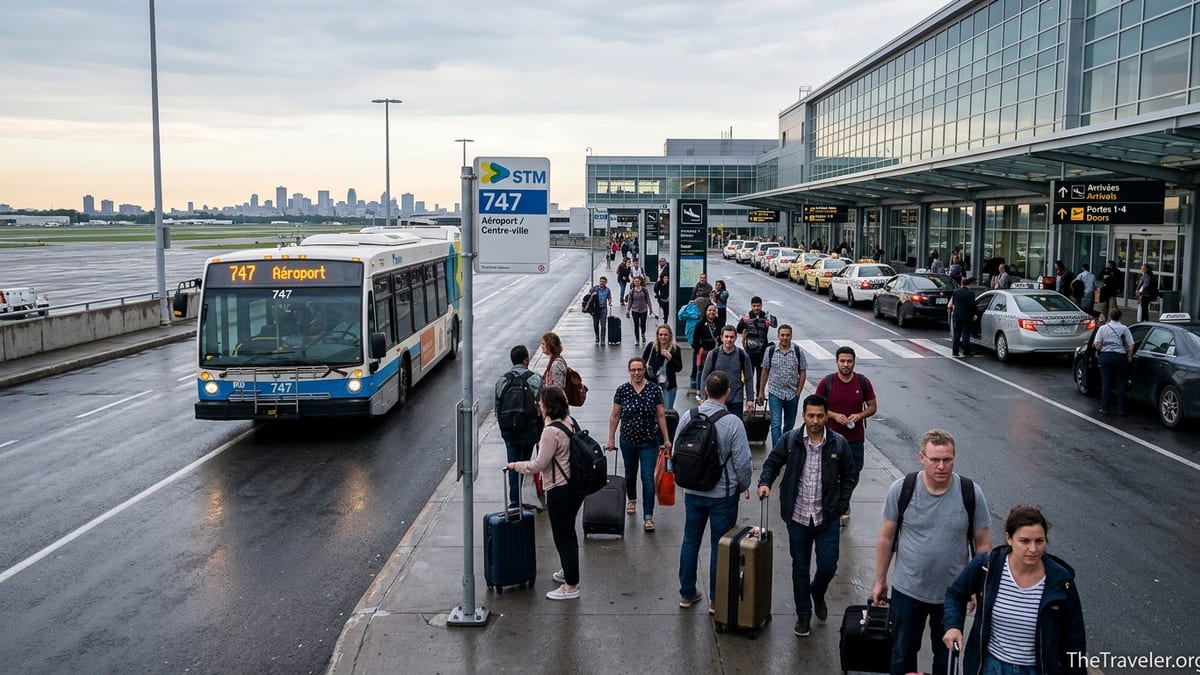
The airport has one main terminal. Arrivals are on the ground level, where you will follow signs for buses, taxis and app-based rides. The 747 stop is a short walk from the international arrivals exit, while the taxi queue sits directly outside the main doors. App-based rides have their own signed pickup zone, which can change as construction around the terminal evolves, so always check the latest instructions in your app when you land.
Because traffic conditions and construction around YUL are currently quite dynamic, travelers should allow some flexibility in their plans. It is wise to build at least a 60-minute buffer between airport arrival and any time-sensitive downtown commitments, especially if you plan to travel during weekday rush hours or overnight when service frequencies can change.
747 Airport Bus: Cheapest All-in-One Transit Option
The 747 YUL Aéroport Montréal-Trudeau / Centre-ville express bus is the official airport shuttle operated by the city transit agency. It runs 24 hours a day and connects the airport with key downtown points including Lionel-Groulx metro, central downtown segments of René-Lévesque Boulevard, and Berri-UQAM near the main intercity bus terminal. Typical journey time is about 45 to 60 minutes depending on traffic and where you get off.
The 747 requires a special fare. As of mid-2026, a cash ticket for the 747 costs approximately 11.25 Canadian dollars per person and is valid as an unlimited 24-hour pass on buses, the metro and other local transit services in Zone A, which covers central Montreal. That means your airport transfer and the rest of your first day’s transit rides are included in a single ticket. You can buy this fare at machines inside the terminal near the bus stop or pay directly in some cases using contactless methods, but it is wise to purchase at the vending machines to avoid confusion with drivers.
For many independent travelers, the 747 is the best value. A solo traveler landing in the afternoon who is staying near Berri-UQAM or along the Green or Orange metro lines can ride the bus to the nearest stop, walk to their hotel and then use the same ticket to take the metro up to the Plateau in the evening. A couple visiting on a budget can spend roughly 22.50 dollars in total for airport transfers plus unlimited transit for their entire first day rather than 50 dollars or more for a taxi that only covers the first ride.
The main downsides are crowding and luggage management. At busy times, especially during summer or major events, the 747 can be packed with travelers and suitcases, and there is no guarantee of a seat. If you are carrying multiple large bags or traveling with small children or mobility issues, standing for up to an hour on a bus after a long flight is not ideal. In those cases, even budget-conscious travelers might prefer to share a taxi or rideshare to save time and stress.
Taxi: Predictable Fixed Fare and Door-to-Door Simplicity
For many visitors, the simplest option is a taxi from the official airport rank. Montreal has a fixed-fare zone between the airport and downtown. As of 2026, a trip from YUL to the defined downtown area costs around 49.45 Canadian dollars between 5 a.m. and 11 p.m., and about 56.70 dollars between 11 p.m. and 5 a.m., before tip. The fare is per car, not per person, so a family of four going to a hotel on Boulevard René-Lévesque or near the Bell Centre is effectively paying about 12 to 15 dollars each for a direct, door-to-door ride.
The fixed-fare zone covers central downtown hotels such as Fairmont The Queen Elizabeth, Le Centre Sheraton, the Marriott Château Champlain, and many properties along Sherbrooke Street and Peel Street. If you are staying slightly outside the official zone, for example in parts of the Plateau or west of Atwater, the meter rate will usually apply instead of the fixed fare, but the total rarely goes far beyond 60 to 70 dollars unless traffic is unusually heavy.
A key advantage of taking a taxi at YUL is speed of boarding compared with app-based rides. The taxi queue is visible as soon as you exit the terminal, and during busy periods the line generally moves steadily because a dispatcher is present. Unlike with some ride-hailing pickups where cars may circle in traffic or cancel, you usually get into a taxi within minutes. For business travelers arriving just before a meeting, this predictability often outweighs the slightly higher cost compared with a discounted rideshare.
Travelers should still pay attention to a few practical points. The flat fare applies only between the defined downtown zone and the airport, so confirm with the driver before departure that your destination qualifies. Tipping around 10 to 15 percent is customary in Montreal. Finally, it is wise to have your hotel address written down or pulled up on your phone to avoid any confusion, especially if your French pronunciation differs from what the driver expects.
Uber and Lyft: Flexible but Variable in Price and Wait Time
Uber and Lyft operate at Montréal–Trudeau, and for many local residents they are the preferred alternative to taxis. For visitors, app-based rides can offer savings and more predictable digital receipts, but recent experiences suggest they can involve longer waits and some price volatility, especially during peak travel times or heavy construction around the terminal.
On a typical afternoon with moderate demand, an UberX from the airport to a downtown hotel near Square Victoria or Place Bonaventure might cost somewhere in the range of 35 to 50 Canadian dollars, depending on surge pricing. At quieter times, such as early morning or late at night on a weekday, some riders report prices under 40 dollars for the same route, which is notably cheaper than the fixed taxi fare. On the other hand, during busy summer weekends or when there are major events, fares can spike closer to or even above taxi prices.
Rideshare pickup at YUL is organized in a designated zone that is different from the taxi queue. You typically receive exact pickup instructions in the app, such as going to a numbered door or specific curbside area. At times, especially when roadworks are underway outside the terminal, drivers can struggle to navigate, leading to waits of 20 to 30 minutes or more. Some recent travelers have described very slow pickup experiences and even driver requests for extra cash tips, which are not official policy and can be declined.
For small groups with light luggage who are comfortable using their phones and do not mind potential waits, rideshares can be a smart middle ground between the 747 and a taxi. A couple arriving mid-day and heading to Old Montreal might watch prices for a few minutes in the app and book the first reasonably priced ride, shaving 10 to 15 dollars off the taxi fare. However, families with tired children arriving around midnight often report that paying the fixed taxi fare at the curb is worth the reduced complication.
Private Transfers and Car Rental: When Comfort or Flexibility Matter Most
Pre-booked private transfers are another option, especially attractive for those who want a meet-and-greet service. Various local car services and international transfer companies offer sedans, minivans and even larger vehicles for groups. Prices vary widely but are generally higher than a taxi, often starting somewhere around 80 to 120 Canadian dollars for a private car to central Montreal. For that premium, you typically receive a driver waiting in arrivals with your name, help with luggage and a guaranteed vehicle sized for your group.
Private transfers can make sense in certain scenarios. A conference organizer flying in a group of colleagues might book a van to take everyone directly from YUL to a downtown convention hotel, eliminating the need to shepherd people through the bus system. A family arriving late at night with young children and multiple large suitcases may appreciate having a pre-arranged vehicle and car seats ready rather than negotiating at the taxi rank.
Car rental is available from all major brands at Montréal–Trudeau, but it usually is not the most convenient way to reach downtown for short stays. Daily rental rates might start anywhere from 60 dollars per day before insurance, taxes and parking, and many downtown hotels charge 30 to 40 dollars per night for parking. Combined with Montreal’s one-way streets, construction detours and sometimes limited parking around attractions in Old Montreal and the Plateau, most visitors find that a rental car is more hassle than help.
Where car rentals shine is for itineraries that extend beyond the city. If your plan is to spend a day or two downtown and then continue to the Laurentians, Eastern Townships or Quebec City, picking up a rental at the airport on arrival can be reasonable. In that case, you accept that your first drive into town may be slower but avoid doubling back to the airport or a suburban rental depot later in your trip.
Costs, Luggage and Hotel Locations: Matching Options to Real Itineraries
When evaluating airport transfers, consider both cost per person and how well the option fits your luggage and hotel location. A solo backpacker landing at 3 p.m. and staying near the Berri-UQAM metro station pays about 11.25 dollars on the 747, walks a few blocks and is effectively done. The same traveler taking a taxi would be spending roughly 50 dollars for a ride of similar duration once traffic and lights are considered.
A couple with two large suitcases staying in Old Montreal near Place d’Armes has a more nuanced choice. The 747 can get them to Berri-UQAM on its eastern end, from where they need either a short metro ride or a taxi to the Old Port. With heavy luggage and possibly snow or slush on the streets in winter, dragging suitcases through station stairs is less appealing. For them, a taxi directly from the airport to their hotel lobby for roughly 50 to 60 dollars, plus tip, may feel like good value after a long international flight.
Families and groups see the biggest per-person savings with direct car options. A family of four staying near the Bell Centre might weigh a 747 total of about 45 dollars versus a fixed-fare taxi at around 50 dollars. With children, strollers and bags, adding only a few dollars to avoid a crowded bus becomes an easy decision. Conversely, a group of three friends staying in hostel-style accommodation near Lionel-Groulx may find that each paying 11.25 dollars for the 747 and walking from the stop keeps more of their budget free for meals and nightlife.
Season also matters. In July, walking a few blocks from a bus stop or metro station is generally pleasant. In January, sidewalks can be icy and temperatures well below freezing. A traveler arriving on a winter evening to a hotel a 10-minute walk from the nearest metro may find that saving 20 dollars by taking the bus is quickly outweighed by the discomfort of managing luggage in snow and wind. Factoring local weather into your transfer choice is just as important as the sticker price.
Best Transfer by Traveler Type
Budget backpackers and independent travelers usually get the most value from the 747 bus, particularly if they are comfortable with transit and staying near a metro station. For example, a solo traveler heading to a budget hotel near Lionel-Groulx can ride the 747 to that stop, walk to their accommodation and then use the included 24-hour pass to explore the city by metro for the rest of the day. Over a week-long trip with a return flight, choosing the 747 both ways can save well over 70 or 80 dollars compared with taxis.
Business travelers with meetings downtown often prioritize time and predictability over absolute cost savings. For someone landing at 8 a.m. on a weekday with a 10 a.m. meeting near Place Ville-Marie, a taxi is usually the most sensible option: walk out, join the managed queue, show the driver the office address and enjoy a direct ride for the fixed fare without worrying about bus schedules or transfers. If their company reimburses expenses, the modest extra cost relative to the 747 is usually not a concern.
Families and older travelers frequently benefit from taxis or private transfers. A family of four arriving after a transatlantic flight might find that the combination of tired children, strollers and jet lag makes even a modestly crowded 747 feel daunting. For them, being able to buckle everyone into a single vehicle and drive directly to a suite hotel in Old Montreal is worth the 50 to 60 dollar fare. Older travelers or anyone with mobility challenges likewise tend to appreciate the absence of stairs and transfers.
Short-stay visitors who care about convenience but also track their budget, such as couples on a weekend trip, may find Uber or Lyft attractive when prices are favourable. If the app quotes around 35 to 40 dollars to a downtown boutique hotel and the weather is good, that can be a pleasant, cost-effective ride. However, they should be prepared with a fallback plan if demand surges or pickup delays become excessive, whether that means switching to the taxi rank or heading for the 747.
The Takeaway
There is no single best way to get from Montréal–Trudeau Airport to downtown. Instead, the right choice depends on how many people you are traveling with, how much luggage you have, when you arrive and where exactly you are staying. The 747 bus is hard to beat for solo travelers and budget-conscious visitors staying near the metro, especially since the fare doubles as a 24-hour city transit pass. Taxis provide predictable fixed fares and straightforward door-to-door service that works especially well for families, business travelers and winter arrivals.
Uber and Lyft sit in the middle, potentially cheaper than taxis but currently more vulnerable to delays and price swings, particularly when the airport road system is under strain from construction. Private transfers and rental cars occupy more specialized niches, either for those who value meet-and-greet comfort or for itineraries that continue beyond Montreal’s urban core. By weighing your own priorities against the options described here, you can step off the plane at YUL confident that you know exactly how you will reach your Montreal base.
FAQ
Q1. How long does it usually take to get from Montreal Trudeau Airport to downtown?
In normal traffic, most car journeys take around 20 to 30 minutes. During rush hour or heavy construction, plan for closer to 45 minutes, and the 747 bus can take up to about an hour.
Q2. Is the 747 airport bus really the cheapest way into the city?
For solo travelers and many couples, yes. The 747 fare is roughly 11 dollars per person and includes unlimited transit for 24 hours, which usually undercuts taxis and rideshares to central hotels.
Q3. Where does the 747 bus drop off in downtown Montreal?
The 747 serves several stops along key downtown arteries and typically connects with stations such as Lionel-Groulx and Berri-UQAM, making it convenient for hotels near metro lines and the main bus terminal.
Q4. How much is a taxi from Montreal Trudeau Airport to downtown hotels?
There is a fixed fare zone between the airport and downtown. As of 2026, it is roughly 49 to 50 dollars during the day and a bit more overnight, plus tip, per taxi.
Q5. Are Uber and Lyft allowed to pick up passengers at the airport?
Yes, both services operate at YUL, using a signed pickup area separate from the taxi queue. Prices vary with demand, so sometimes they are cheaper than taxis and sometimes similar or higher.
Q6. What is the best option if I arrive late at night with a lot of luggage?
For late-night arrivals with several bags or children, most travelers find a taxi or pre-booked private transfer easiest, avoiding crowded buses and long walks to hotels in the cold.
Q7. Should I rent a car at the airport just to reach downtown?
Usually not. Parking in central Montreal can be expensive and driving can be stressful for first-time visitors. Car rental is more sensible if your plans include trips outside the city.
Q8. Can I use the 747 ticket for the metro and other buses after I arrive?
Yes. The 747 fare functions as a 24-hour transit pass for central Montreal, so you can ride the metro and local buses for the rest of the day at no extra cost.
Q9. Which option is best for a business traveler on a tight schedule?
Most business travelers prefer taxis due to the fixed fare, direct drop-off at downtown offices or hotels, and the ability to avoid potential waits or crowds associated with buses and rideshares.
Q10. What if my hotel is in Old Montreal or the Plateau instead of the central business district?
If you are staying in Old Montreal or neighbourhoods like the Plateau, taxis and rideshares are usually more convenient, providing direct service to smaller streets, while the 747 works best when combined with a short metro ride and manageable luggage.