


Landing at Montreal Trudeau Airport and heading straight for a rental car can be a smart move, especially if you are planning day trips beyond the city or a winter road trip through Quebec. Montreal’s main airport has recently centralized most rental operations in its new P4 parking structure, and local rules on insurance, winter tires, and driving conditions can surprise visitors. This guide walks you through exactly how car rental works at YUL, what to expect at the P4 counters and shuttles, how much deposits and insurance typically cost, and whether you even need a car for your trip.
Get the latest updates straight to your inbox!
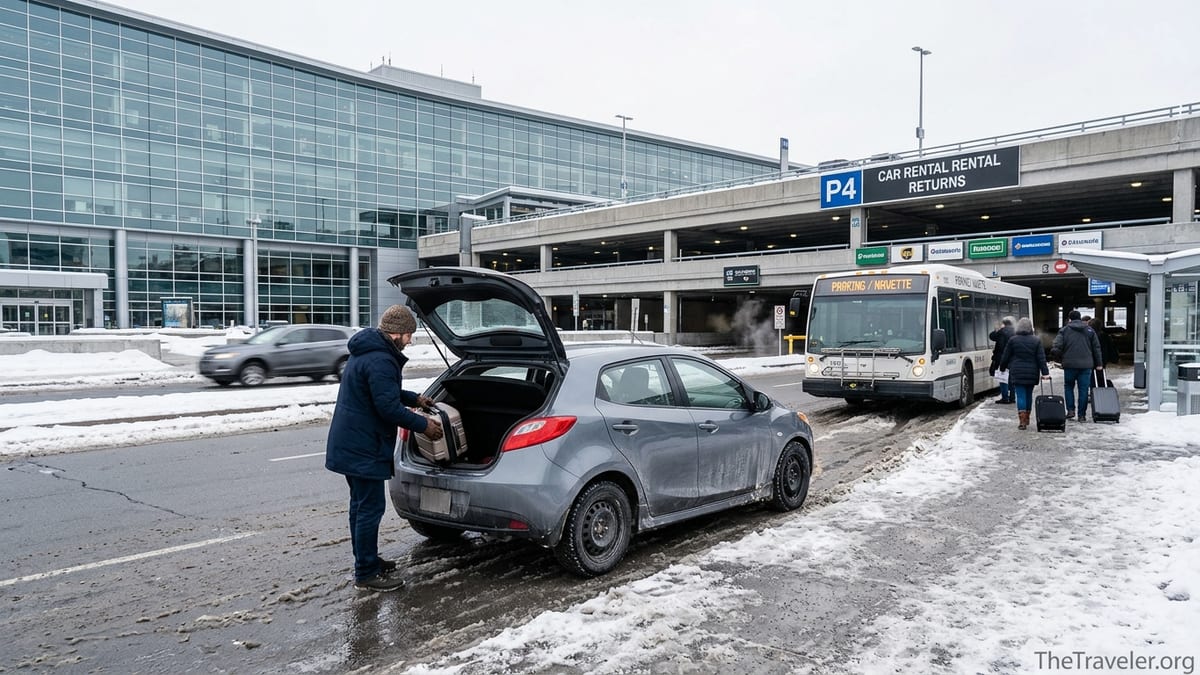
How Car Rental Works at Montreal Trudeau Airport (YUL)
Montreal Pierre Elliott Trudeau International Airport (YUL) concentrates its on-airport car rental companies in the P4 parking structure, a multilevel garage a short shuttle ride from the terminal. Airport information confirms that rental counters in P4 are open daily from early morning to after midnight, typically around 7 a.m. to 1 a.m., covering the bulk of arriving flights. If you land later at night, you may find reduced staffing, so always check your agency’s specific hours on your confirmation email.
From the arrivals level in the main terminal, passengers follow signs for shuttles and parking and exit near the designated doors for the P4 shuttle. The airport operates a free, loop-style shuttle that runs between the terminal and P4; the ride usually takes about 5 to 10 minutes, depending on traffic inside the airport complex. Travelers report that the new layout can involve a bit of walking inside the terminal before you reach the shuttle stop, so factor that in if you are tired or carrying a lot of luggage.
At P4 you step off the shuttle into a large parking structure where rental counters, key pick-up points, and the majority of vehicles are now located on dedicated levels. Signage inside P4 clearly indicates car rental brands and parking bays, but it can still feel like a maze if you arrive during a busy period. Give yourself an extra 15 to 20 minutes between shuttle, paperwork, and locating your car before any onward reservations, such as a train from nearby Dorval station or a timed hotel check-in.
Most travelers find that picking up at the airport is more expensive than renting in the city, but it can save a lot of time if you are heading straight to regions like the Eastern Townships, the Laurentians, or Quebec City. For a weekend in downtown Montreal, however, the car may sit unused in a garage, so consider whether the convenience at YUL outweighs urban parking and traffic once you arrive.
P4 Rental Counters and Off-site Shuttles: Who Is Where
The new P4 parking structure houses the main international rental brands most visitors will recognize. Companies such as Avis, Budget, Hertz, Dollar, Thrifty, National, Alamo, and Enterprise typically operate desks and on-site fleets here, so you pick up your keys and car in the same general area. For example, Avis directs renters to return vehicles to the P4 garage, where the company’s designated rows are clearly marked with signage and staff often circulate during peak hours to guide returns.
Some lower-cost or local brands may not have a full desk inside P4, instead relying on off-site locations and dedicated shuttles that pick up from the airport. In those cases, your confirmation email usually specifies “shuttle to off-airport location” and explains where the courtesy van will collect you, often at a clearly marked shuttle zone near arrivals. These off-airport locations may offer slightly lower base rates but can add time and complexity, especially in bad weather or late at night.
The P4 structure has also become a hub for rideshares and some hotel shuttles, which means the area can be busy with buses, courtesy vans, and passengers moving in several directions. Travelers using Uber or Lyft from YUL often report that pick-up points are on the far side or back of P4, accessed either by the same shuttle used by car renters or by walking through parts of the garage. If you are arriving with children, large ski bags, or winter luggage, staying with an on-airport rental brand based directly at P4 minimizes transfers.
One practical implication is how much time to allow when returning your car. Because you must drive into the P4 complex, find the right rental level, complete your return inspection, and then either walk or take the shuttle back to the terminal, it is smart to arrive 30 to 45 minutes before you would normally show up for check-in. In winter, when snow banks and slower traffic can delay entry to the airport roads, giving yourself an extra buffer is even more important.
Deposits, Credit Cards, and Practical Costs at YUL
Car rental companies operating at Montreal Trudeau almost always require a credit card in the driver’s name and a security deposit placed as a hold. For a typical compact or mid-size car, the hold often includes the estimated cost of the rental plus an extra amount, frequently somewhere in the region of 200 to 500 Canadian dollars. For higher-value vehicles such as premium SUVs or luxury models, holds can reach several hundred more, and at some North American airports these can rise to close to four figures for high-risk rentals. The exact amount varies by company, vehicle class, and your own customer profile.
Debit cards are less widely accepted, especially at airport locations. Some companies allow debit card rentals only for certain categories and may require proof of return travel and a larger deposit, sometimes in the range of a few hundred dollars beyond the rental cost. In Quebec, as elsewhere in Canada, the rental location may run a credit check if you insist on using a debit card or if your card is from a lesser-known issuer, so be prepared for possible delays while staff complete this step.
Fuel policies at YUL generally mirror those in the rest of North America. The most common arrangement is “full to full”: you receive the car with a full tank and must return it full, or pay a per-litre refuelling rate that is usually higher than nearby gas stations. Many counters in P4 will also offer a prepaid fuel option, where you pay upfront for a full tank at a set rate and return the car at any level. This can be convenient if you know you will be rushing to the airport, but it is rarely economical for city-only driving because you pay for a full tank even if you use only half.
Other typical add-ons include GPS units, child seats, and additional driver fees. For example, adding a second driver without elite status or a corporate contract can easily add a daily surcharge that may equal or exceed the price of a basic insurance upgrade. Montreal’s layout is straightforward with smartphone navigation, so most visitors skip the GPS unless they plan to drive into remote areas where mobile coverage is less reliable.
Understanding Insurance for Quebec Rental Cars
Insurance terminology in Quebec can be confusing for visitors from the United States or Europe because the legal framework and typical coverages differ. Quebec operates a public no-fault system for bodily injury, but property damage liability and coverage for the rental car itself are handled through private insurance and rental contracts. As a renter, you usually see several main products: liability coverage to protect you if you damage others’ property, collision and loss damage waivers that deal with the rental vehicle itself, and optional extras related to personal effects or roadside assistance.
Most Canadian rental companies include a basic level of third-party liability coverage in the base rate, often around a few hundred thousand Canadian dollars. Many travelers, however, prefer to have higher limits, such as one or two million dollars of liability, especially when driving on highways or in winter conditions. Some agencies at P4 will offer an upgrade to higher liability for a daily fee, though availability can vary. Others may suggest that you obtain additional coverage through your own auto policy or travel insurance sold by a Canadian insurer, which often emphasizes checking your contract carefully for rental car clauses and maximum vehicle values.
Collision Damage Waiver or Loss Damage Waiver, often called CDW or LDW, is where your credit card may come in. Many premium Canadian and international credit cards include rental car damage coverage if you pay for the rental with that card and decline the rental company’s CDW. There are important limits, such as maximum vehicle value caps that often sit below the price of luxury vehicles, exclusions for certain car types, and strict rules about the length of rental. Credit card coverage typically does not replace liability insurance, so even if you rely on your card for damage to the rental vehicle, you still need liability coverage from the rental company, your own auto policy, or a separate travel insurance product.
Because Quebec law requires certain minimum coverages, it is worth reading the fine print before you sign at the P4 counter. A common practical strategy for visitors is to arrive with a clear plan: know whether your credit card provides CDW for Canadian rentals, understand the liability limit in your home auto insurance or travel policy, and decide in advance whether you are comfortable declining extras at the desk. This reduces the pressure from upselling and shortens the time you spend at the counter after a long flight.
Quebec’s Winter Tire Rules and Real Winter Driving Conditions
If you are renting a car any time between early December and mid-March, Quebec’s winter tire regulations are central to your planning. Provincial rules state that from December 1 to March 15, most passenger vehicles registered in Quebec, including rental cars, must be equipped with tires specifically designed for winter driving, identified by the mountain and snowflake symbol. The requirement does not apply to vehicles registered outside Quebec, but almost all cars rented at Montreal Trudeau by major chains are Quebec-registered fleets and therefore must comply.
In practice, this means that if you pick up a car at YUL from a mainstream company during the regulated period, it should already be on proper winter tires. The government has confirmed that the obligation applies specifically to vehicles offered for rental, and fines for non-compliance are significant enough that the major brands treat winter tires as standard on their Quebec fleets. You should still visually inspect the tires for the snowflake symbol on the sidewall and adequate tread depth, especially if you plan to drive to mountainous or rural areas where conditions can be harsh.
Winter driving itself can be a shock for visitors. Montreal experiences snow, freezing rain, and rapidly changing temperatures, and highways leading toward Quebec City, the Laurentians, or the Saguenay region can shift from wet to compact snow to glare ice within the span of an hour. Local road safety guidance emphasizes slowing down, increasing following distances, and signalling early in cold weather because tire grip is reduced and stopping distances increase. Snow plows and salt trucks operate intensively, but you may still encounter partially cleared lanes and snow banks narrowing exits around the airport and on approach roads.
Before starting a winter rental at P4, allocate time in the garage to familiarize yourself with the car’s controls. Locate the rear window defroster, front defogger, and, if available, heated mirrors. Keep a snow brush and ice scraper in the trunk; most Quebec rental vehicles include one, but if not, you can purchase an inexpensive set at a gas station near the airport. Clearing all windows, lights, and the roof of snow is not only safer but also expected by local authorities, who can fine drivers for operating vehicles with dangerously obstructed visibility.
Is a Rental Car Worth It in Montreal?
Whether you should rent a car at Montreal Trudeau largely depends on how much of your trip will be spent in the city versus the wider region. For a downtown-only visit of two or three days, the combination of the airport bus, metro, commuter trains, and taxis or rideshares is usually more efficient and less stressful than navigating Montreal’s one-way streets and construction zones. Parking at central hotels routinely adds a nightly fee that can rival an extra night’s accommodation in a smaller town, and winter snow removal operations often limit curbside parking.
On the other hand, a rental car becomes very useful if your itinerary includes ski resorts, rural inns, or small towns where public transport is infrequent. For example, a family flying into YUL on a Friday afternoon and driving straight to Mont-Tremblant for a long ski weekend will find an on-airport rental extremely convenient, especially when loaded with gear. Similarly, travelers planning to explore the Eastern Townships wineries, visit relatives in outlying suburbs, or tour winter festivals in Quebec City benefit from the flexibility of their own vehicle despite higher fuel and toll costs.
Season also matters. In July, when Montreal hosts festivals and outdoor dining is in full swing, downtown streets are busy but mainly dry, and a rental car works well for day trips to lakes and national parks. In January, however, visitors not accustomed to snow may find that relying on trains and buses for city-to-city travel is more relaxing, reserving car rental for specific countryside segments with confident drivers behind the wheel. Some travelers compromise by scheduling the car only for part of the trip, picking it up from a downtown location after city sightseeing or dropping it off before their final days in Montreal to avoid parking costs.
If you have a long layover and want a quick side trip, such as a drive along the St. Lawrence or a winter visit to a nearby spa, a same-day rental from P4 can still be worthwhile. Just remember to build in time for shuttle transfers, paperwork, and vehicle checks so you do not cut it too close to your onward flight.
Practical Tips for Driving in Montreal and Across Quebec
Driving from YUL into Montreal follows a network of busy highways, particularly Autoroute 20 and Autoroute 13, before feeding into city streets. Signage is mostly in French, with key indications such as “sortie” for exit and “centre-ville” for downtown. Speed limits are in kilometres per hour, and automated speed cameras operate on some corridors. Staying in the right or middle lanes on your first drive and allowing locals to pass on the left can reduce stress while you adapt.
Once in the city, you will encounter a mix of one-way streets, dedicated bus lanes, and bike paths, some of which change configuration between seasons. In winter, snow banks can narrow streets and hide curbs, and parking signs may be temporarily covered or replaced during snow removal operations. Keeping a close eye on street-cleaning schedules displayed on poles and taking advantage of hotel or underground parking avoids tickets and towing. Many garages accept credit cards and clearly display daily maximums, which, in popular downtown neighborhoods, can rival the cost of a budget hotel room in a smaller town.
For longer road trips, Quebec’s provincial network is generally well maintained, with rest areas and service stations at regular intervals along major highways. It remains important, however, to check road conditions before departure, especially in winter. The provincial government promotes online and app-based tools that show closures, snow removal operations, and travel advisories, and local radio provides frequent updates during storms. If you are heading to remote regions where mobile coverage may be weaker, download maps for offline use and keep your fuel tank above half, as gas stations can be farther apart than around Montreal.
Language rarely presents a major barrier for drivers. While most road signage is in French, pictograms are standard, and staff at major rental counters and highway service stations near Montreal almost always speak both French and English. Still, it helps to recognize a few key terms such as “ralentir” for slow down, “verglas” for black ice, and “fermé” for closed, which you may see flashing on overhead highway message boards during bad weather.
FAQ
Q1. Where exactly are the car rental counters at Montreal Trudeau Airport?
The main rental counters are in the P4 multilevel parking structure, reached by a free shuttle from the terminal’s arrivals level, where most big-name brands have desks and vehicles.
Q2. How long does it take to get from the terminal to my rental car at P4?
Plan about 20 to 30 minutes from exiting customs to sitting in your car, including walking to the shuttle stop, a 5 to 10 minute shuttle ride, check-in at the counter, and finding your vehicle.
Q3. Do Montreal airport rental cars come with winter tires?
During the regulated period from December 1 to March 15, Quebec-registered rental vehicles are required to have winter tires, so cars picked up at YUL from major agencies should already be equipped.
Q4. What kind of deposit should I expect when renting at YUL?
For a standard car, companies commonly place a hold that includes the estimated rental cost plus a few hundred Canadian dollars, with larger or luxury vehicles attracting higher deposits.
Q5. Can I use a debit card to rent a car at Montreal Trudeau?
Some agencies allow debit cards with conditions such as proof of return travel, larger deposits, and possible credit checks, but a major credit card in the driver’s name is more widely accepted.
Q6. Is it better to rent on-airport at P4 or use an off-site rental company?
On-airport rentals at P4 are more convenient, especially in winter or late at night, while off-site locations reached by shuttle may be slightly cheaper but add time and complexity.
Q7. Do I need to buy the rental company’s insurance if my credit card has coverage?
Credit cards often cover damage to the rental vehicle if you pay with that card and decline the company’s collision waiver, but you still need adequate liability coverage from the rental, your own auto policy, or travel insurance.
Q8. Is a rental car necessary for visiting Montreal itself?
For a trip limited to downtown and nearby neighborhoods, public transport, taxis, and rideshares are usually easier, while a rental car is more useful for regional trips to ski hills, small towns, or national parks.
Q9. How difficult is winter driving around Montreal for someone used to milder climates?
Conditions can be challenging, with snow, ice, and reduced visibility, so drivers must slow down, increase following distances, and rely on winter tires and careful vehicle control, especially on highways.
Q10. How early should I return my rental car before my flight from YUL?
Arrive at P4 at least 30 to 45 minutes before the time you would normally reach the terminal, to allow for finding the return area, inspection, and catching the shuttle back to check-in.
The Takeaway
Renting a car at Montreal Trudeau Airport can be straightforward and highly practical if you understand how the P4 car rental hub works, what deposits and insurance you are likely to face, and how Quebec’s winter rules shape driving conditions. For visitors who plan to explore beyond the city or travel in the colder months, an on-airport rental at YUL offers flexibility and access to snow-covered landscapes that are hard to reach by public transport alone.
Balancing that convenience against Montreal’s urban parking costs and winter traffic is key. By arriving with a clear insurance strategy, sufficient credit card capacity for deposits, and realistic expectations about winter road conditions, you can make an informed decision about whether a rental car is worth it for your trip. With the right preparation, driving out of P4 can be the start of a memorable journey through Quebec’s cities, villages, mountains, and rivers, in any season.