


For many travelers flying from Montreal to the United States, the most confusing part of the journey happens before they ever set foot on American soil. Montreal Trudeau International Airport (YUL) is one of a handful of airports where you clear U.S. Customs and Border Protection (CBP) before boarding. Done right, U.S. preclearance can make your trip smoother and your U.S. connection far less stressful. Done poorly, it is one of the easiest places to miss a flight. This guide walks you through exactly how preclearance at YUL works in 2026, how much time you really need, which documents to bring, how Checkpoint C and Mobile Passport Control fit together, and the connection pitfalls to avoid.
Get the latest updates straight to your inbox!
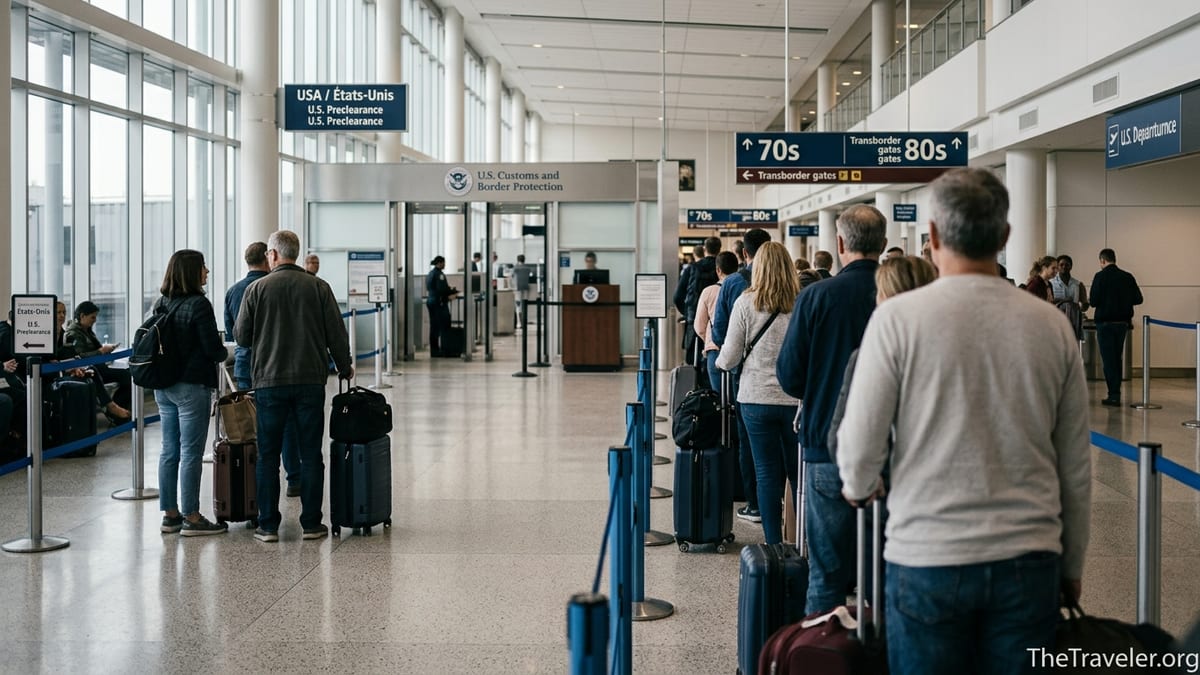
How U.S. Preclearance at Montreal Trudeau Works
Montreal Trudeau is one of nine Canadian airports with full U.S. border preclearance facilities. That means all nonstop flights from YUL to the United States depart from a dedicated transborder area and passengers are processed by U.S. CBP officers in Montreal before boarding. When your flight lands in the United States, it arrives as a domestic flight. In most cases you walk directly to your onward connection or exit, without visiting immigration or baggage claim again.
In practical terms, your departure day in Montreal includes three main steps: airline check in and bag drop in the main terminal, security screening at Checkpoint C, and then U.S. CBP inspection in the preclearance hall just beyond that checkpoint. Only after clearing both security and CBP can you reach the transborder gates, which are clustered around the 70s and 80s gate range used by carriers like Air Canada, United, American, and Delta for U.S. routes.
Because CBP operates under U.S. rules inside a Canadian airport, the encounter you have at Montreal will feel almost identical to arriving at an immigration hall at Chicago O’Hare or Newark. Officers will ask about your trip, verify your documents and, for many travelers, collect biometrics. The difference is timing: you do it before boarding, not after landing, which is why your schedule in Montreal matters so much.
How Early to Arrive: Realistic Timing for YUL Preclearance
Montreal’s tourism office and airport officially advise U.S.-bound passengers to arrive at least three hours before scheduled departure, particularly in the morning and early afternoon peaks when large banks of flights depart to hubs like New York, Chicago, Washington, and Atlanta. That recommendation reflects real bottlenecks: security queues at Checkpoint C, surges at CBP when several narrow‑body flights leave within an hour, and the additional time needed if you are checking bags, dealing with an ESTA or visa, or traveling with children.
In practice, frequent flyers often aim for 2.5 to 3 hours before departure if they already have boarding passes and no bags to check. For example, a traveler on a 17:00 Air Canada flight to Newark who arrives curbside at 14:00 with only carry‑on luggage usually has a comfortable margin, even if security takes 20 minutes and CBP another 20 to 30 minutes. By contrast, a family of four on a 07:15 departure to Orlando during school holidays that shows up at 05:45 with checked bags can easily face combined queues of 60 to 90 minutes and end up sprinting to the gate.
Connection times inside YUL can be tight if you are arriving from another Canadian or international city and then flying on to the U.S. Standard minimum connection times published for many itineraries are often in the 60 to 90 minute range, but those values assume a smooth path and modest queues. If you are booking separate tickets, or choosing between options, aim for at least 2 hours from scheduled arrival to U.S. departure, and 2.5 hours if your inbound flight is on a smaller regional airline or from Europe in winter when delays are common.
Navigating Checkpoint C and the Transborder Concourse
All U.S. flights from Montreal depart from the transborder jetty, which is reached through Checkpoint C on the departures level. Unlike Checkpoint A, which handles both domestic and international departures, Checkpoint C is reserved for U.S.-bound passengers because it feeds directly into the U.S. preclearance zone. To reach it, you follow the “USA / États‑Unis” signs after check‑in; you will pass signage reminding you that you must clear U.S. border control before boarding.
Checkpoint C functions like a standard airport security checkpoint. You show your boarding pass, pass through screening, and collect your belongings. Wait times fluctuate during the day, but early morning (around 05:00 to 08:00) and mid‑afternoon (roughly 14:00 to 17:00) typically see the heaviest traffic due to departure banks to major U.S. hubs. For instance, when Air Canada has clustered flights to New York LaGuardia, Newark, Washington National, Chicago, and Boston within a 90‑minute window, the security line can swell quickly, even if individual screening lanes move efficiently.
Once you exit security, you are funneled almost immediately into the CBP preclearance hall. There is no way to go directly to your gate without passing through U.S. border inspection. This design catches some passengers off‑guard: they assume that “customs” will happen after landing in the U.S., only to realize in Montreal that they have two major bottlenecks to clear in sequence. The safest approach is to treat clearing Checkpoint C and CBP as a single combined process that can easily occupy 45 minutes in busy periods.
Documents and Eligibility: What You Must Carry
Because you are dealing with U.S. CBP rather than only Canadian airport security, you must have all documentation ready just as if you were landing in the United States. At a minimum, that means a valid passport for every traveler, including infants. U.S. citizens may travel on a U.S. passport, and Canadian citizens generally on a Canadian passport; dual citizens should carry the passport they intend to use to enter the United States. Government‑issued photo ID plus a birth certificate is not sufficient for air travel between Canada and the U.S.
Non‑U.S. citizens and non‑Canadians must also have an appropriate visa or authorization where required. Many travelers from visa waiver program countries will already have ESTA approval associated with their passport. CBP officers at Montreal can see this electronically, but they may still ask about the details of your trip, where you are staying, and whether you have a return ticket. Others, such as business travelers on B1/B2 visas or students on F‑1 visas, need to carry their visa‑bearing passport and any supporting documents they would present on arrival at a U.S. airport, such as an I‑20 for students or evidence of employment for work visas.
Trusted traveler program members enjoy some advantages. Global Entry and NEXUS kiosks are present in many Canadian preclearance facilities, including Montreal. NEXUS members who are U.S. or Canadian citizens or permanent residents can often process at dedicated kiosks and then use fast‑track lanes to see an officer, while Global Entry members arriving on certain itineraries can benefit from shortened processing. In practice, the exact lane configuration can change with staffing and time of day, so even trusted travelers should be prepared to follow signage and staff direction rather than assuming an automatic fast track.
Using Mobile Passport Control at Montreal
Montreal Trudeau is one of the preclearance airports where U.S. CBP has rolled out Mobile Passport Control, the official smartphone application that allows eligible travelers to submit their passport and declaration information digitally before speaking with an officer. The app is free, available on major app stores, and supported at more than 30 U.S. airports along with several Canadian preclearance locations, including YUL.
In day‑to‑day use, Mobile Passport Control at Montreal works as follows. After checking in and clearing security, you open the app, create a “trip,” and scan the passports of everyone traveling in your group who is eligible for MPC. You answer the standard customs declaration questions in the app and submit them electronically. The app generates a digital receipt, often in the form of a QR code or confirmation screen, which you present in the designated MPC line in the preclearance hall. In quieter periods, this might only save a few minutes, but when conventional lines are full, the MPC queue can move noticeably faster.
Eligibility rules are specific. At the time of writing, MPC is generally available to U.S. citizens, U.S. lawful permanent residents, and some Canadian citizens on selected itineraries, among others, but not all visa categories are supported and rules can evolve. Some travelers in Montreal report being redirected to regular lines when using MPC despite signage suggesting broader eligibility, often because of local staffing or changing CBP instructions. To avoid surprises, treat MPC as a “nice speed boost” rather than as a guarantee, and always allow enough time as though you might have to use the standard line.
Interview Expectations and CBP Red Flags
The actual CBP interaction in Montreal usually takes only a few minutes per traveler when documents and declarations are in order. Officers will typically verify your identity, scan your fingerprints or photograph your face where required, and ask a short series of questions such as where you are going, how long you intend to stay, and what you do for work. Families are often processed together, particularly when traveling on U.S. or Canadian passports, while some non‑citizens or complex cases may be separated for additional questioning in a secondary inspection area.
Problems arise when your answers conflict with your documents, you lack required paperwork, or your travel pattern triggers automated flags. For example, a traveler on a B1/B2 visa who has spent most of the past year shuttling between Montreal and Florida on extended stays may be asked detailed questions about ties to Canada, employment, and whether they are effectively living in the United States without a proper status. Likewise, a visitor who arrives at CBP with no accommodation booked for a supposed three‑week stay, limited funds, and an unclear itinerary may face extra scrutiny, whether they are clearing at Montreal or at an airport in the United States.
If you are traveling on an immigrant‑intent visa category, such as a CR1 spousal visa or a K‑1 fiancé(e) visa, preclearance is where your initial entry processing will occur. Real‑world reports from Montreal suggest that such travelers are often directed to secondary inspection, where officers review sealed visa packets, confirm admissibility, and endorse paperwork. This can take 30 minutes or more, which makes extra buffer time essential. In one commonly cited example, a traveler on an early‑afternoon Air Canada flight to Chicago for onward travel to Milwaukee was advised by a CBP officer in Montreal to be in the check‑in queue a full 4 hours before departure to ensure enough time for both primary and potential secondary processing.
Connection Risks in Montreal and Beyond
One of the main selling points of preclearance is smoother domestic connections in the United States. If everything goes well, landing in a hub like Newark, Chicago, or Denver from Montreal feels like a domestic arrival: you step off the plane, walk down the jet bridge, and head straight to your next gate. You do not collect and recheck bags, and you do not pass through a second security checkpoint unless you voluntarily exit the secure area. This opens up shorter connections that might be risky if you were arriving internationally without preclearance.
The trade‑off is that the risk shifts back to Montreal. If your inbound flight to YUL arrives late or if queues at Checkpoint C and CBP are longer than expected, there is no “make it up later” safety net. Airlines routinely close boarding for U.S. flights 15 to 30 minutes before departure, and if you are still in the CBP queue at that point, you are unlikely to be boarded. Passengers traveling on a single ticket with a protected connection can usually be rebooked, but options later in the day may be limited, especially on smaller routes like Montreal to Charlotte or to some Midwestern cities served by regional jets.
Connections entirely within Montreal also present traps. If you are arriving from another Canadian city such as Halifax or Vancouver and continuing to the United States, you typically follow transfer signs that funnel you toward security and then U.S. preclearance without exiting to the public check‑in hall. That can save time, but only if your inbound flight is on schedule. Booking a 65‑minute connection from Toronto to Montreal and then onward to Boston on the same airline may technically meet minimum standards, yet in winter weather that margin can evaporate quickly. Where possible, opt for 2 hours or more, particularly for critical trips such as cruise departures or same‑day business meetings.
Practical Day‑Of Tips for a Smooth Experience
A few habits make preclearance at Montreal significantly less stressful. First, complete as much as possible before arriving at the airport: check in online, confirm that your ESTA or visa is valid, and ensure your passport has sufficient validity for U.S. entry. If you are using Mobile Passport Control, download and set up the app at home so you are not wrestling with slow Wi‑Fi at the airport.
Second, control what you can about timing. For morning departures to busy hubs like New York, Boston, Washington, and Chicago, consider staying near the airport the night before to make an early arrival easier. For example, a traveler with a 06:30 flight to LaGuardia who stays downtown and relies on rush‑hour traffic has a higher risk of arriving at 05:15 and encountering a long Checkpoint C line, whereas someone who sleeps at an airport‑area hotel can comfortably be in the terminal by 03:30 or 04:00, when lines are shorter and staff are still ramping up.
Finally, treat Montreal preclearance as the real border that it is. Answer questions directly and calmly, avoid jokes about prohibited items or immigration, and keep your phone and earbuds put away when you step up to the officer. If you are selected for secondary inspection, stay focused on the fact that your primary flight risk is the clock. Whenever you can do so politely, mention your departure time, especially if it is within the next hour. Officers cannot guarantee you will make your flight, but in many documented cases at YUL, they have coordinated with airlines or expedited processing when a genuine time crunch is evident.
The Takeaway
U.S. preclearance at Montreal Trudeau can either be a major advantage or a major stressor, depending on how you plan for it. Arriving early, understanding the sequence from check‑in to Checkpoint C to CBP, and having your documents in order gives you a strong foundation. Using tools like Mobile Passport Control and trusted traveler programs can shave precious minutes off the process, but they are supplements, not substitutes, for a solid time buffer.
For most travelers, treating a U.S. departure from Montreal like any other long‑haul international flight, with a three‑hour airport arrival and at least a two‑hour protected connection, offers the best balance of safety and convenience. In return, you get to land in the United States as a domestic passenger, clearing the most bureaucratic part of your trip on Canadian soil and stepping off the plane already admitted and ready to move.
FAQ
Q1. Do I clear U.S. immigration in Montreal or when I land in the United States?
In Montreal. All nonstop flights from YUL to the U.S. use the preclearance facility, so you complete U.S. immigration and customs before boarding and arrive in the U.S. as a domestic passenger.
Q2. How early should I arrive at Montreal Trudeau for a U.S. flight?
Plan to be at the airport around three hours before departure, especially in the morning and mid‑afternoon peaks or if you have checked bags, children, or a visa that could require extra questioning.
Q3. Where is Checkpoint C and do I still need to go through regular security?
Checkpoint C is the dedicated security checkpoint for U.S.‑bound flights at YUL. You must clear this security screening before entering the U.S. preclearance hall and reaching your gate.
Q4. Can I use Mobile Passport Control at Montreal and will it really save time?
Yes, Mobile Passport Control is supported at Montreal’s preclearance facility and can shorten your time in line, especially during busy periods. However, eligibility rules and local lane management mean you should still allow enough time in case you are directed to a standard line.
Q5. What documents do I need for U.S. preclearance at YUL?
You need a valid passport for every traveler plus any required U.S. visa or ESTA authorization. Trusted traveler cards like NEXUS can be useful but do not replace the need for a passport on most air itineraries.
Q6. Is my baggage checked through, or do I handle it again after landing in the U.S.?
If your bags are tagged through to your final U.S. destination on a single ticket, you usually do not see them again until your final stop. They are screened and inspected behind the scenes during preclearance in Montreal.
Q7. How much connection time do I need in Montreal between a Canadian flight and a U.S. flight?
Although airline minimums can be around 60 to 90 minutes, aiming for at least two hours is safer, and 2.5 hours is wise in winter or if you hold a visa that might trigger additional CBP questions.
Q8. What happens if I am sent to secondary inspection by CBP in Montreal?
You will be directed to a separate area where officers conduct more detailed checks or process visas. This can add 30 minutes or more, so extra buffer time is essential, especially for immigrant‑intent visa holders.
Q9. Does preclearance at Montreal change anything for my connection in the U.S.?
Yes. You arrive as a domestic passenger, so you normally do not clear immigration or customs again, nor do you recheck bags. This often allows for shorter, less stressful U.S. connections.
Q10. What if long lines at preclearance cause me to miss my U.S. flight?
If your itinerary is on a single ticket, your airline will typically rebook you on the next available flight, subject to space. On separate tickets, you may have to buy a new onward ticket, which is why generous connection buffers are important.