


The 747 bus between Montréal–Trudeau International Airport (YUL) and downtown remains one of the most useful bargains in the city for 2026 travelers. For a single fixed fare you get a direct airport link plus 24 hours of unlimited public transit in central Montreal. Yet many visitors still end up in the wrong place, buy the wrong ticket, or stand in long lines they could have skipped. This guide walks you step by step through tickets, stops, recent changes around Gare d’autocars and Berri‑UQAM, travel times, luggage tips, and the classic mistakes to avoid, so you can step off the plane and ride with confidence at any hour of the day or night.
Get the latest updates straight to your inbox!
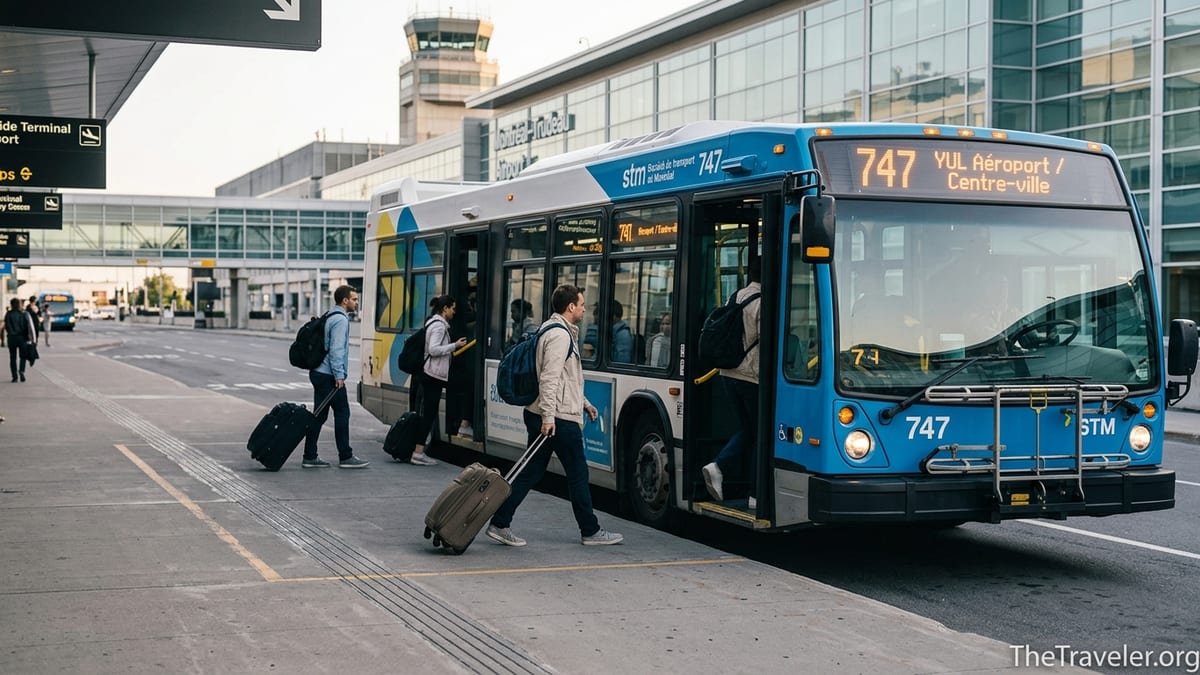
How the 747 Airport Bus Works in 2026
The 747 is an STM (Société de transport de Montréal) bus line connecting Montréal–Trudeau Airport to downtown Montreal 24 hours a day, 7 days a week. It is a regular public bus, not a private shuttle, but it is designed with airport passengers in mind: more luggage space than standard city buses, simple routing, and a special fare that doubles as a 24‑hour public transit pass in central Montreal. In 2026, this makes it one of the most cost‑effective ways to reach downtown if you are not traveling with a large group or excessive luggage.
The route links YUL to downtown along Boulevard René‑Lévesque with key stops at Lionel‑Groulx metro station and several major hotel areas before reaching the Berri‑UQAM sector near Montreal’s main intercity bus terminal (Gare d’autocars). Official material describes the fare as providing a 24‑hour all‑modes Zone A pass, which means that once you pay for the 747, you can ride the Montreal metro and most city buses as much as you like within central Montreal for the next 24 hours. This is particularly convenient for visitors staying near stations such as Peel, McGill, Berri‑UQAM or Lionel‑Groulx.
Service is frequent, with multiple departures per hour during the day and regular departures through the night. At peak times, travelers often see two or three buses lined up at the airport stop, with staff helping to organize boarding. While schedules can fluctuate with traffic on Autoroute 20 and local downtown streets, headways are typically short enough that you rarely wait more than 15 to 20 minutes during the day. Overnight service is slightly less frequent but still continuous.
Travel time varies depending on traffic and where you get off. In moderate conditions, expect around 20 to 30 minutes between YUL and Lionel‑Groulx metro, and about 40 minutes total to reach the Berri‑UQAM area. In heavy rush‑hour or during construction, the same ride can stretch closer to an hour. Travelers arriving late in the evening often report smoother flows and faster trips, while early weekday rush hours can be noticeably slower heading into downtown.
Fares, Tickets and What Your 747 Pass Actually Includes
In 2026, the standard cash fare for the 747 is 11.25 Canadian dollars. This is higher than a regular STM bus ticket, but that is because it is not only a single ride: it functions as a 24‑hour unlimited transit pass in Zone A. In practical terms, that covers the entire Montreal metro network and almost all STM buses on the island’s urban core. Many visiting fans for recent sporting events or conferences plan their arrival so that this 24‑hour window covers both airport transfer and an evening or full day of sightseeing by metro.
The same fare amount applies whether you pay cash on the bus, buy a specific “YUL Aéroport Montréal‑Trudeau” product on a ticket machine, or load an equivalent 24‑hour pass compatible with the 747 onto an OPUS card or occasional smart card. Travelers using conference guides in 2026, for example, are often advised that paying 11.25 dollars at the airport gives them a day of unlimited rides on bus, metro and some exo trains in Zone A. That means you can go from the airport to downtown, then continue by metro to a neighbourhood like Plateau‑Mont‑Royal or Old Montreal, all under the same ticket.
One common source of confusion is the difference between regular single‑ride bus or metro tickets and those that are valid for the 747. A basic one‑trip metro ticket bought in town is not valid for boarding the 747 at the airport. To ride the 747 you must either carry a 24‑hour pass that explicitly covers the airport line or purchase the dedicated airport fare. Tourists sometimes buy a regular single ticket at a downtown metro station, then discover they cannot use it to go back to YUL on the 747 and must buy the airport fare separately.
For families, it is worth checking the latest rules about children traveling free with an adult, as these policies can change. Typically, younger children ride free when accompanied by a paying adult with a valid fare, but older children in the 6 to 11 range may require specific reduced fares or must ride with an adult who holds the appropriate pass. Because the 747 fare itself is a premium product, families with several older children may find day passes or multi‑day passes more economical than buying separate airport tickets for everyone.
Where and How to Buy Your 747 Ticket
At Montréal–Trudeau Airport, you can purchase a 747 ticket in several ways. Official airport guidance in 2026 lists ticket machines located in the arrivals area, where you can buy either an airport‑specific ticket or load a pass onto an OPUS card. These machines accept major bank cards and allow you to choose English or French on the screen. For many travelers, buying at the machine before stepping outside is the most comfortable option, because it avoids dealing with cash and ensures you board with a valid ticket in hand.
You can also pay directly on the bus with exact coins. The driver does not give change and paper notes are not accepted, so you would need to have 11.25 dollars in coins ready. This is typically inconvenient for international visitors who land with cards and banknotes but no coins, so it is usually recommended only if you already have Canadian currency or are coming from elsewhere in the city with change in your pocket. Some downtown parking pay stations near 747 stops also sell airport fares for trips to YUL, which is useful for locals who decide last minute to take the bus to the airport rather than drive.
In addition, you can buy a digital airport fare via the Chrono mobile app, which is the official regional transit application. As of 2026, the regional authority has phased out airport ticket sales through the Transit app and promotes Chrono instead. With Chrono, a traveler aged 14 or over can purchase a “YUL Aéroport Montréal‑Trudeau” digital fare on their phone, activate it when they are ready to board, and then simply show the screen to the driver. The app requires an internet connection to purchase and load fares, so you should ensure you have Wi‑Fi at the airport or mobile data available before relying on this option.
For regular visitors and long‑stay travelers, an OPUS smart card loaded with an appropriate 24‑hour pass or multi‑day pass that includes the 747 can be the best solution. You can buy an OPUS card at some airport ticket machines or downtown STM service points, then add airport‑compatible fares as needed. For example, a business traveler staying a full week might arrive on the 747 using a 24‑hour pass and later buy a weekly pass on the same OPUS card for commuting. The key is to verify on the screen that the fare product you select is explicitly valid on the 747 line, not just a basic bus ticket.
Key 747 Stops, Downtown Routing and Gare d’autocars Changes
The 747 route connects several strategic points between YUL and downtown. Leaving the airport, eastbound buses often run non‑stop to Lionel‑Groulx metro station, a major interchange where the green and orange metro lines cross. This is an excellent transfer point if you are staying near stations like Place‑des‑Arts, Laurier, or Snowdon, because you can switch to the metro and avoid slower surface traffic through downtown streets. From Lionel‑Groulx, the bus proceeds along the Ville‑Marie corridor before joining René‑Lévesque.
Along Boulevard René‑Lévesque, the 747 serves multiple downtown stops at intersections such as Guy, Drummond, Peel, Mansfield, Union, Jeanne‑Mance, Saint‑Laurent and Hôtel‑de‑Ville. These stops are particularly useful if your hotel is on or near René‑Lévesque, Sherbrooke, or in the Quartier des spectacles. For example, a traveler staying at a large chain hotel near Peel and René‑Lévesque can simply get off at the Peel stop and walk a short block rather than riding all the way to Berri‑UQAM. Similarly, visitors renting apartments near Saint‑Laurent Boulevard will find it convenient to disembark at the Saint‑Laurent stop and walk north.
At the eastern end of the line, the 747 historically terminated at the Gare d’autocars de Montréal, located near the Berri‑UQAM metro complex. Over time, construction and downtown road changes have shifted the exact boarding areas. In 2026, official tourism information highlights that the downtown terminus is on Boulevard René‑Lévesque near the corner of rue Berri. The intercity bus terminal itself sits just south of this intersection, linked to Berri‑UQAM metro by underground passages and sidewalks. For travelers heading onward by intercity bus to Quebec City, Ottawa, or the Eastern Townships, the short walk from the 747 stop to Gare d’autocars remains straightforward.
Because Berri‑UQAM is both a metro hub and the connection point for the intercity bus terminal, it can feel busy and slightly confusing, especially after a long flight. A practical tactic is to decide in advance whether you actually need to go as far as Berri‑UQAM. Many hotels and hostels in central Montreal are closer to intermediate stops, and staying onboard until the terminus just to backtrack can add 20 minutes to your journey. For example, visitors staying in Old Montreal near Place‑d’Armes station often disembark at the Hôtel‑de‑Ville stop on René‑Lévesque and walk south through the historic streets rather than continuing to Berri‑UQAM.
Travel Time, Frequency and 24/7 Service Tips
The 747 runs around the clock, but the experience changes depending on the time of day. During daytime and early evening hours, buses are frequent and can be quite busy, especially when several large flights land within a short window. It is not unusual to see a queue forming at the YUL stop, but STM often sends multiple buses in quick succession so that the line clears rapidly. Travelers arriving mid‑afternoon on a busy summer weekend, for example, might see three buses arrive within about 10 minutes, making boarding less stressful even with luggage.
At night, frequencies are lower but service remains continuous. After midnight, expect somewhat longer waits, but you can still count on being able to reach downtown by bus without turning to taxis or ride‑hailing. Many locals working late shifts at the airport still choose the 747 as their primary mode of transport, which can be reassuring for visitors unsure about riding public transit overnight. Buses are usually quieter at these hours, and travel times can actually be shorter because of reduced road congestion.
Typical scheduled travel time between YUL and the downtown terminus is around 40 minutes in one direction, but that assumes reasonably smooth traffic. Real‑world experiences reported by recent riders show a wide range: some complete the Berri‑UQAM to airport leg in just over 30 minutes by using the metro to Lionel‑Groulx first, then transferring to the 747 for a mostly non‑stop run. Others, stuck in construction zones or heavy rush‑hour traffic, have taken close to an hour from downtown to the airport. Because of this variability, it is wise to allow at least 60 to 75 minutes from central Montreal to YUL when catching a flight, especially at peak times.
One of the smartest strategies for minimizing travel time is to use the metro for the dense downtown section and the bus for the airport segment. For example, instead of boarding the 747 at Berri‑UQAM and riding all the way on surface streets, you can take the orange or green metro line to Lionel‑Groulx, then transfer to the 747 there. Many Montreal residents recommend this pattern, as the bus ride from Lionel‑Groulx to YUL skips most inner‑city traffic. This is especially relevant during weekday morning or late afternoon peaks, when René‑Lévesque and surrounding streets are congested.
Luggage, Accessibility and Onboard Experience
The 747 buses are designed to accommodate airport passengers, but they are still public city buses rather than dedicated coaches. Inside, you will find luggage racks near the front as well as open standing space that can be used for suitcases when the bus is crowded. Soft‑sided bags and carry‑ons generally fit well on the racks. Large checked suitcases can be stored upright in the open areas, but you should keep them close at hand and ensure they do not block doors or aisles. During busy periods, drivers sometimes ask passengers to move further inside to make space for others boarding with bags.
There is no separate under‑floor luggage hold and no assigned seating. You simply board through the front door, present your ticket or mobile pass to the driver, and move inside. Seats are first‑come, first‑served, and some passengers may stand during portions of the journey. For that reason, it is helpful to pack so you can hold or brace your bag if you do not get a seat. Travelers with very bulky sports equipment or multiple large suitcases sometimes find it more comfortable to share a taxi or private shuttle, particularly during the busiest summer vacation weeks.
From an accessibility perspective, 747 buses are low‑floor vehicles capable of kneeling and deploying ramps, similar to other modern STM buses. Wheelchair users and passengers with mobility challenges can typically board using the front ramp and find designated spaces inside. It is still worth allowing extra time in case the first bus that arrives is crowded and you prefer to wait for the next one. If you use mobility aids, consider sitting or standing near the front where you are close to the driver and have easier access to the exit ramp.
Onboard comfort is basic but adequate. There are overhead grab bars and poles, interior lighting, and normal city‑bus seating. Air‑conditioning usually operates during the summer, but as with any city bus, it can feel warm on very hot days when the vehicle is full. There are no onboard toilets or Wi‑Fi. Many passengers use the ride to quickly check maps, confirm hotel addresses, or purchase metro tickets in their phone apps before arrival, but you should not rely on a stable data connection while the bus is moving through tunnels and dense high‑rise areas.
Classic Tourist Mistakes and How to Avoid Them
Despite its simplicity, the 747 still catches many visitors out. One of the most common mistakes is buying the wrong ticket type. Tourists sometimes purchase a basic two‑ride magnetic ticket from a downtown metro station, assuming it will cover a return to the airport. They later discover that the 747 requires the special airport fare or an equivalent 24‑hour or multi‑day pass that explicitly includes the airport line. To avoid this, always verify at the machine or with staff that your ticket is valid on the 747 before you head for your return flight.
Another frequent error is staying on the bus too long instead of getting off at the most convenient stop. For example, a visitor whose hotel is near the Guy‑Concordia area might ride all the way from YUL to Berri‑UQAM, then take the metro back west, doubling travel time unnecessarily. In reality, the 747 stops at Guy and several other key downtown intersections. Checking the list of René‑Lévesque stops before boarding can save you a frustrating back‑track with luggage. Hotels in the central business district, the Quartier des spectacles, and even parts of Old Montreal are often closer to intermediate stops than to the eastern terminus.
A third pitfall is underestimating travel time to the airport, particularly during construction or bad weather. Montreal is known for extensive roadwork, and routes to YUL are no exception. Some travelers leaving from Berri‑UQAM calculate only 40 minutes for the ride, then are surprised when a traffic jam stretches the journey past an hour, putting a tight squeeze on check‑in and security. A safer plan is to treat 60 to 75 minutes as your default window from downtown, especially if you are unfamiliar with local conditions or traveling at a traditionally busy time, such as Friday late afternoon.
Finally, it is easy to forget that the 747 is a regular city bus where normal precautions with valuables apply. Phones, passports and wallets can be left on seats or fall between cushions when passengers hurry off with luggage. Locals occasionally report lost phones on the 747 that later turn up at STM lost‑and‑found. To avoid this, keep your documents and electronics in a single small bag that you always carry on your body, separate from checked suitcases, and do a quick visual sweep of your seat and floor area before getting off at your stop.
FAQ
Q1. How much does the 747 bus cost from Montreal airport to downtown in 2026?
The 747 fare is about 11.25 Canadian dollars and includes a 24‑hour transit pass in Zone A, covering most buses and the entire Montreal metro network.
Q2. Is the 747 bus really running 24 hours a day?
Yes. The 747 operates 24 hours a day, 7 days a week. Frequencies are higher during daytime and evening, with slightly longer waits overnight, but there is continuous service.
Q3. Where does the 747 stop in downtown Montreal?
The 747 serves a series of stops along Boulevard René‑Lévesque, including Guy, Peel, Mansfield, Jeanne‑Mance, Saint‑Laurent and Hôtel‑de‑Ville, and it terminates near Berri‑UQAM and the Gare d’autocars area.
Q4. Can I pay for the 747 with a credit card on the bus?
Onboard payment is cash only with exact coins. If you want to use a credit or debit card, buy your ticket at an airport machine, downtown fare machine, or through the Chrono mobile app before boarding.
Q5. Is my regular metro ticket valid on the 747?
No, a basic single‑ride metro or bus ticket is not valid. You need either the specific airport fare or a 24‑hour or multi‑day pass that explicitly includes the 747 line.
Q6. How long does the 747 take between the airport and downtown?
In typical conditions, plan roughly 40 minutes between YUL and central downtown. At busy times or during roadworks, the trip can stretch closer to an hour, so allow extra time.
Q7. What is the best stop if my hotel is near the city center?
If your hotel is along or near René‑Lévesque, get off at the nearest cross‑street such as Peel, Mansfield or Jeanne‑Mance. Otherwise, Lionel‑Groulx is an excellent transfer point to reach other neighbourhoods by metro.
Q8. Can I bring large luggage or sports equipment on the 747?
Yes, but space is limited. The 747 has luggage racks and standing areas, yet very large or multiple suitcases can be awkward at busy times. In that case, a taxi or private shuttle might be more comfortable.
Q9. Is the 747 safe to use late at night?
Many local workers and travelers use the 747 overnight, and it is generally considered a normal, safe option. As with any public transit, keep an eye on your belongings and sit where you feel comfortable.
Q10. Should I ride the 747 all the way from Berri‑UQAM to the airport?
You can, but it is often faster to take the metro to Lionel‑Groulx and board the 747 there, especially during rush hour, because that segment skips most downtown surface traffic.