


For many UK and European travellers, Monzo has quietly become the bright coral card that shows up in almost every hostel common room and airport coffee queue. With fee-free card payments abroad and slick budgeting tools, it looks tailor-made for trips. But once you dig into ATM limits, subscriptions and alternatives like Wise and Revolut, the picture gets more nuanced. If you are planning a city break in Paris, a month in Thailand or a multi-country gap year, it is worth understanding exactly how Monzo works for travel spending before you rely on it as your main card.
Get the latest updates straight to your inbox!
How Monzo Works When You Travel
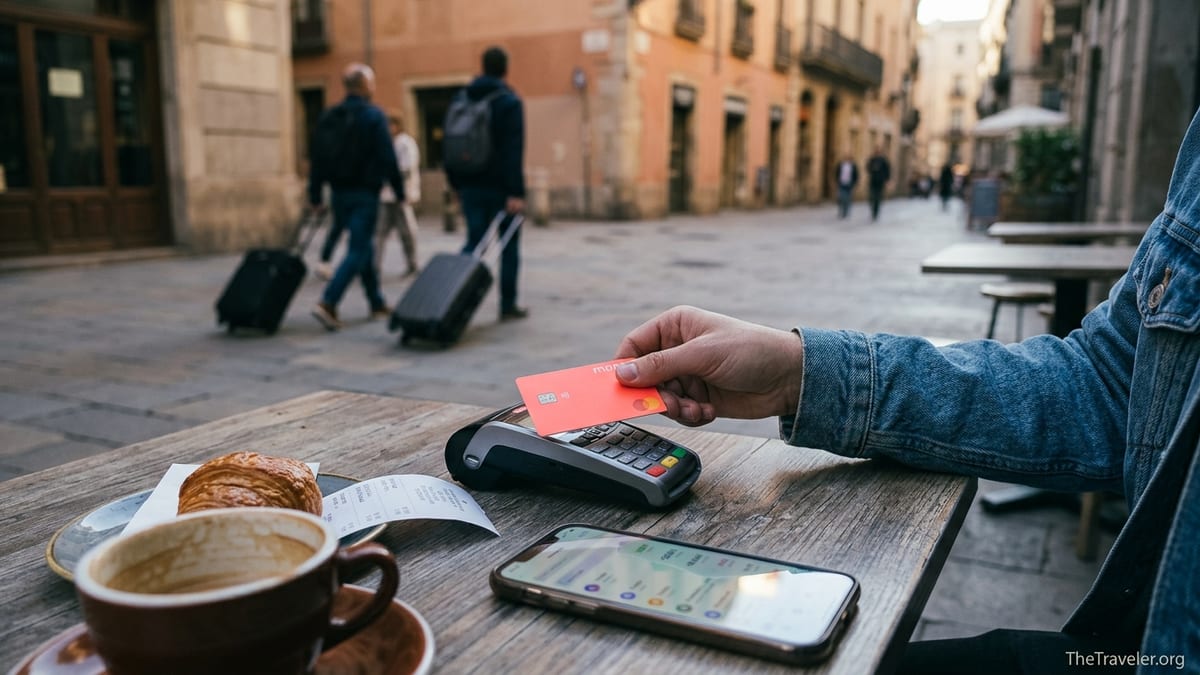
Monzo is a UK-based digital bank that runs almost entirely through its mobile app. You get a Mastercard debit card that works almost anywhere you can pay by card worldwide. When you are abroad, you simply tap or insert your Monzo card in the local currency and the transaction is converted using Mastercard’s rate, with no foreign transaction fee added by Monzo for purchases. In practice, that means you can pay for a 4 euro espresso in Rome or a 1500 baht diving trip in Koh Tao and Monzo will convert it back to pounds at roughly the market rate on the day.
For most short trips, day-to-day spending is straightforward. Imagine a long weekend in Barcelona: you book a 280 euro hotel, spend around 120 euros on food and tapas, 40 euros on public transport and museum tickets, and 60 euros on shopping. Paying all of that by Monzo card would mean no extra foreign usage fee from Monzo, and the app would immediately show how much you’ve spent in both euros and pounds, broken down into categories like “Eating Out” and “Transport”.
The big caveat is cash. While many European cities are now card-first, cash is still important in destinations like rural Vietnam, small family-run guesthouses in Morocco or street food markets in Mexico. Monzo lets you withdraw cash for free up to certain limits every 30 days, and then charges 3 percent on withdrawals above those limits. How quickly you hit those limits depends on whether Monzo is your main bank account and which region you are in.
Because Monzo works best as your everyday account, many frequent travellers use it not as a separate “travel card” but as their main current account at home. Their salary is paid into Monzo, bills go out from it, and the same card simply works when they land abroad. If you prefer to ring-fence your travel money, you can transfer a set amount into Monzo just before your trip and use it purely as a spending wallet.
Fees, Limits and Real-World Costs Abroad
Monzo’s headline promise is that card payments abroad are fee-free and use the Mastercard exchange rate. For a practical example, if you tap your Monzo card to pay a 50 dollar restaurant bill in New York, Monzo will convert that at roughly the live Mastercard rate at the time. You avoid the 3 percent foreign transaction fee that many high-street UK banks still charge on top of an often worse exchange rate. Over a week-long trip where you spend the equivalent of 800 pounds, that can easily save you 20 to 30 pounds versus a traditional bank card.
ATM withdrawals are where you need to pay attention. Monzo groups the UK and the European Economic Area together for fee purposes. If you use Monzo as your main bank account, you can withdraw cash in the EEA without a Monzo fee, and up to 200 pounds every 30 days outside the EEA before a 3 percent charge kicks in. If you do not use Monzo as your main account, your allowance is lower: typically 400 pounds fee-free every 30 days in the UK and EEA, and 200 pounds outside the EEA, after which the same 3 percent fee applies. The app shows your remaining allowance so you can check before another withdrawal.
Consider two different trips. In Paris, you might withdraw 60 euros once for small purchases but mostly pay by card for metro tickets, bistro meals and museum entrances. You are unlikely to hit Monzo’s EEA cash limits on a short city break. In contrast, take a month in Bali where many homestays and scooter rentals prefer cash. If you withdraw the equivalent of 500 pounds over several ATM visits, only the first 200 pounds will be fee-free under the typical fair use policy, and the remaining 300 pounds of withdrawals would incur around 9 pounds in Monzo fees. On top of that, Indonesian ATMs may add their own local fee, which is outside Monzo’s control.
Monzo’s newer paid plans, such as Extra, Perks and Max, are not primarily travel products but they can influence your overall costs. The plans come with monthly fees, but card payments abroad remain fee-free and the core ATM structure stays similar. For most casual travellers, the free account is sufficient. Paid tiers tend to appeal more to people who want additional features such as higher interest on savings, bundled insurance or premium support, rather than lower foreign spending costs alone.
Where Monzo Shines for Travellers
The strongest reason to use Monzo on the road is that card spending abroad feels almost identical to spending at home. You open the app and immediately see the transaction in local currency and pounds, alongside a merchant name and often a logo. If you tap to pay for a 1200 yen ramen lunch in Tokyo, Monzo will show a card payment to the restaurant, convert the cost into pounds, and automatically categorise it under “Eating Out”. This instant clarity makes it much easier to keep track of your budget compared with traditional banks where you might only see pending charges and unclear merchant names for days.
Budgeting tools are another big win. You can set a monthly spending budget in Monzo before you travel, for example 1,000 pounds for a two-week trip to Thailand, then watch as each hotel stay, Grab ride and café bill nudges your total closer to that figure. When you tap to pay 600 baht for a beachside dinner, the app shows how much of your Eating Out category remains. If you are travelling as a couple or in a group, shared tabs and bill splitting make it easy to track who paid for what. One person can put the 250 euro Airbnb booking in Lisbon on their Monzo card, then use a shared tab so the app calculates that each friend owes 125 euros.
Monzo also handles card security abroad in a way that suits travel. You can freeze and unfreeze your card instantly in the app if it goes missing in a hostel locker or night train. You can also generate virtual cards for online bookings, which helps when paying unfamiliar airlines, guesthouses or regional rail companies that you do not fully trust. If a dubious hotel website in Southeast Asia later suffers a data breach, you can simply delete that virtual card instead of cancelling your physical one while you are mid-trip.
For longer itineraries across multiple countries, Monzo’s travel reports give a clear sense of what a trip actually cost. When you return from, say, a three-week route through Mexico, Guatemala and Belize, the app can show that you spent 420 pounds on accommodation, 360 pounds on food and drink, 210 pounds on transport and 110 pounds on “fun” such as cenote entrance fees and snorkelling tours. Having those figures in one place is useful not just for memories but also when planning your budget for the next trip.
The Weak Spots: Cash, Multi-Currency and Insurance
Monzo’s philosophy is that most spending should happen on card, and in many regions that aligns with reality. However, if your travel style or destination is still heavily cash-based, the cash withdrawal limits can be restrictive. Imagine a two-month overland backpacking trip from Laos to Cambodia, where guesthouses, buses and street food stalls are routinely cash-only. It would be realistic to withdraw the equivalent of 800 to 1,000 pounds in local currencies over that period. With a 200 pound fee-free allowance every 30 days outside the EEA on the standard usage pattern, you would pay a 3 percent fee on a large portion of those withdrawals. That could translate to 18 to 24 pounds in Monzo fees on top of local ATM charges, enough to cover a couple of extra nights in a hostel.
Another limitation is that Monzo does not let you hold and manage multiple currencies in the same way as some specialist competitors. With Wise or Revolut, you can pre-convert money into dollars, euros or other currencies and leave it in a dedicated balance, which is helpful if you are paid in foreign currency or want to lock in a rate. Monzo keeps everything denominated in pounds. For a straightforward holiday where your income is in pounds and you just need to spend abroad, that simplicity can be a plus. But if you are a digital nomad paid in dollars or euros, or you want to keep a long-term euro balance for repeated trips to the eurozone, Monzo is less flexible than a multi-currency account.
Travel insurance is another area where Monzo is no longer trying to compete head-on with premium travel products. Earlier, Monzo offered Premium and Plus plans that included worldwide travel insurance, but the bank has since shifted to new subscription bundles focused more on everyday banking and savings. That means many travellers now combine Monzo with separate standalone travel insurance from providers or rely on packaged accounts from traditional banks for cover. If you are heading to Canada for skiing, for example, you might still use Monzo for on-the-ground spending but depend on a dedicated winter sports policy elsewhere to cover medical emergencies and lost equipment.
Monzo’s focus on the UK market can also be a drawback if you relocate long-term. The account is designed for UK residents and the card is denominated in pounds. If you move to Spain or Germany for several years, you might find that maintaining a local euro account plus a multi-currency travel card like Wise or Revolut is more convenient than keeping Monzo at the centre of your finances, though Monzo can still work as an ancillary card for trips back to the UK or further afield.
Monzo vs Wise vs Revolut: Which Is Better for Travel Spending?
When you compare Monzo to Wise and Revolut, it helps to remember that they started with different priorities. Monzo is first and foremost a UK current account with strong budgeting tools that happens to work very well abroad. Wise began as an international money transfer service and excels at moving money between currencies at low cost, while Revolut was built as an app-first spending card with multi-currency balances and tiered travel-focused perks.
For a typical UK traveller taking one or two holidays a year, Monzo’s combination of fee-free card spending abroad and simple budgeting is usually enough. Picture a one-week family trip to the Algarve: flights and accommodation are prepaid, and on the ground you mostly tap to pay for supermarket shops, restaurant meals and car fuel. You may take out 100 to 150 euros in cash for beach bars that still prefer notes. Monzo handles that pattern almost perfectly, with minimal risk of hitting the fee-free cash limit and excellent clarity on how much you are spending each day.
Wise becomes more compelling if you are frequently receiving, holding or sending foreign currency. A freelancer based in London but invoicing clients in the United States and the eurozone might find Wise’s ability to hold dollar and euro balances and convert them selectively at mid-market rates very appealing. They could then transfer money into Monzo for domestic bills while using the Wise card to spend dollars directly during a month working remotely in New York. Revolut, on the other hand, targets travellers who value a single app with multi-currency balances, higher ATM limits on paid tiers and lifestyle extras such as airport lounge discounts. A digital nomad bouncing between Lisbon, Tbilisi and Bangkok might find Revolut’s paid plans worthwhile if they rely heavily on ATM cash and enjoy bundled perks.
In informal comparisons by travel and money blogs, Monzo tends to win as a primary UK current account with decent travel performance, while Wise or Revolut are often recommended as dedicated travel wallets. A practical strategy many experienced travellers use is to pair them: Monzo for day-to-day life and general travel spending, plus Wise for large international transfers or holding non-sterling balances, or Revolut for trips where higher ATM limits and on-app currency exchange matter most.
Making Monzo Work Harder for Your Next Trip
If you decide to rely on Monzo for an upcoming trip, a bit of preparation can make a noticeable difference. First, check your cash withdrawal allowance in the app before you go. If you are heading somewhere card-friendly like Copenhagen, Amsterdam or Singapore, you may barely touch cash and will sit comfortably within the fee-free limit. If your destination is more cash-oriented, such as rural Turkey or parts of Central America, consider combining Monzo with a second card that offers more generous international ATM terms to cover heavy cash days, while still using Monzo for card payments.
Second, take advantage of Monzo’s budgeting features. Before a two-week trip to Japan, you might move 1,500 pounds into a dedicated pot labelled “Japan 2026” and set a 100 pounds per day budget. Each time you pay for a Shinkansen ticket, buy convenience-store snacks or book a ryokan, you can see how close you are to your daily and overall limits. Many travellers find that simply seeing a running total in the app naturally curbs impulse purchases, like a third round of cocktails on a rooftop bar in Osaka.
Third, learn to spot and decline dynamic currency conversion when merchants abroad offer it. In many countries, card machines will ask if you want to pay in pounds rather than the local currency. Always choose the local currency: Monzo’s conversion at the Mastercard rate is almost always better than the rate baked into the terminal’s conversion, which can quietly add several percent to the bill. For instance, a 100 euro restaurant bill in Madrid might cost you around 100 pounds at Monzo’s live rate, but 104 to 106 pounds if you accept the terminal’s own conversion into pounds.
Finally, keep Monzo as part of a wider safety net. Travel with at least one backup card from a different provider kept separately, such as a Wise debit card, a Revolut card or a traditional bank debit or credit card. If a specific merchant or ATM network has an issue with Monzo’s cards in a country you are visiting, you will not be stranded. Many travellers also store digital versions of their cards in Apple Pay or Google Pay so that if a physical wallet is lost on a beach or night out, they can still pay with their phone after freezing the physical card.
The Takeaway
For most UK-based travellers, Monzo is a very solid choice for everyday travel spending. It offers fee-free card payments abroad at near-market exchange rates, a clean and intuitive app and powerful budgeting features that translate well to trips, whether you are navigating Berlin’s U-Bahn, bar-hopping in Budapest or ordering delivery to a co-working space in Mexico City. Used smartly, it can save you a meaningful amount compared with traditional high-street bank cards that still add foreign transaction fees and obscure markups.
Monzo is not perfect, particularly if you rely heavily on cash or need to manage money across several currencies. The ATM limits outside the EEA and the lack of true multi-currency balances mean that heavy cash users and long-term nomads may be better served by pairing Monzo with Wise or Revolut. Likewise, if bundled travel insurance and lounge access are top priorities, a premium travel credit card or a paid Revolut plan might deliver more value than Monzo’s subscription bundles.
Ultimately the question is not whether Monzo is the single best travel product on the market, but whether it suits the way you travel. If you mostly tap to pay, like seeing your spending categorised in real time and want one main bank account that works seamlessly when you leave the UK, Monzo is absolutely worth having in your wallet. If your trips are cash-heavy, multi-currency or insurance-focused, treat Monzo as part of a toolkit: excellent for card payments and clarity, complemented by other accounts that fill in the gaps.
FAQ
Q1. Does Monzo charge fees for card payments abroad?
Monzo does not add its own foreign transaction fee to card payments abroad. Purchases are converted using the Mastercard exchange rate, which is usually close to the live market rate, so you typically just pay what you spend in the local currency converted back to pounds.
Q2. How much cash can I withdraw abroad with Monzo before paying extra?
Monzo operates fair use limits that vary depending on whether it is your main account and where you are withdrawing. Broadly, you can withdraw a few hundred pounds equivalent fee-free every 30 days, with a 3 percent fee on withdrawals above that. The app shows your personal allowance and remaining limit, so check it before making large cash withdrawals.
Q3. Is Monzo better than Wise or Revolut for travel?
Monzo is often better if you want a full UK current account that also works smoothly abroad. Wise tends to win for low-cost international transfers and holding multiple currencies, while Revolut can be more attractive for higher ATM limits and bundled travel perks on paid plans. Many travellers use Monzo alongside one of these rather than trying to choose just one.
Q4. Can I use Monzo for long-term travel or digital nomad life?
Yes, many digital nomads use Monzo, but it works best as part of a mix. It is excellent for everyday card spending and budgeting, but if you often need cash in non-EEA countries or want to hold balances in dollars or euros, you may want to add a multi-currency account such as Wise or Revolut for more flexibility.
Q5. Does Monzo include travel insurance?
Monzo’s current focus is on banking and budgeting features rather than bundled travel insurance. Some of its subscription tiers have previously included insurance, but many travellers now pair Monzo with standalone travel insurance from specialist providers or packaged accounts from traditional banks to get comprehensive cover.
Q6. Is Monzo safe to use as my main card when abroad?
Monzo is regulated as a UK bank and protects your eligible deposits under the Financial Services Compensation Scheme up to the standard limit for UK banks. In daily use, features like instant transaction alerts, in-app card freezing and virtual cards help reduce fraud risk when you are paying unfamiliar merchants or using shared accommodation.
Q7. Will Monzo work everywhere, or should I carry a backup card?
Monzo works anywhere that accepts Mastercard, which covers most countries, but it is still wise to carry at least one backup card from another provider. Occasional technical issues, local network quirks or individual merchants refusing foreign cards can happen, so having a second option avoids being stuck without access to funds.
Q8. Can I use Monzo to pay in the local currency when I book hotels and flights online?
Yes, you can use your Monzo card or a Monzo virtual card to book hotels, flights and trains online in the local currency. It is generally best to pay in the currency of the hotel or airline, letting Monzo handle the conversion at the Mastercard rate, rather than letting the website convert the amount to pounds at its own rate.
Q9. What happens if I lose my Monzo card while travelling?
If your Monzo card is lost or stolen, you can freeze it instantly from the app, which blocks new transactions. You can then order a replacement card, which Monzo will post to you, and in many cases you can keep paying using Apple Pay or Google Pay on your phone if the digital wallet is still active.
Q10. Is Monzo available to travellers who are not UK residents?
Monzo is primarily designed for UK residents and typically requires a UK address to open an account. If you are visiting from abroad and do not live in the UK, you may find it easier to use travel-friendly cards from providers in your home country, and treat Monzo as an option mainly for people who bank in the UK.