


Some people arrive in New Jersey’s Pine Barrens with night-vision cameras and ghost stories, determined to track the legendary Jersey Devil. What they usually find instead is something far more unexpected in the nation’s most densely populated state: a million acres of pitch pine forest, blackwater rivers, cranberry bogs, and star-filled skies that feel worlds away from the casino lights of Atlantic City and the traffic of the Turnpike. Most visitors come for the myth, but they stay for the wilderness.
Get the latest updates straight to your inbox!
The Myth That Put the Pine Barrens on the Map
The Pine Barrens might be one of the few American wilderness areas whose brand is built as much on folklore as on its forests. The region’s best-known resident is the Jersey Devil, said to have been born in 1735 to a woman known as Mother Leeds before fleeing into the woods to haunt the swamps and cedar stands of what is now South Jersey. Over the next three centuries, stories spread of a winged, hoofed creature screeching through the night, scaring farmers, stagecoach drivers, and later, late-shift workers driving home on lonely county roads.
Today, that legend still sells T-shirts in shore-town gift shops and inspires ghost tours and Halloween specials on regional TV. Leeds Point, near Great Bay, remains a focal point for believers, and you will still hear barstool stories in towns like Galloway and Egg Harbor City about strange cries in the pitch-black woods. For many first-time visitors, especially those coming from Philadelphia or New York, the myth is the hook that finally pulls them off the interstate and into the pines.
Spend even a single evening here, though, and folklore quickly blurs into the far more tangible reality of the landscape itself. When the sun goes down and the forest turns to silhouettes, it is the rustle of wind in the needles, the chorus of tree frogs, and the crunch of sandy soil underfoot that dominate your senses. The Jersey Devil might be the excuse, but the true sensation is standing in a vast, dark forest that feels surprisingly wild for a place only an hour or so from major cities.
For travelers, the legend serves a practical purpose: it concentrates curiosity on a single place name, the Pine Barrens, that might otherwise be lost among the shore, the suburbs, and the state highways. Once people start looking, they discover that this spooky backdrop is also one of the East Coast’s most significant protected landscapes.
A Million Acres of East Coast Wilderness
Officially known as the Pinelands National Reserve, the Pine Barrens cover roughly 1.1 million acres, spanning portions of seven South Jersey counties and about 22 percent of the state’s land area. Inside this patchwork of public and private land lie state forests, wildlife management areas, historic villages, and quiet backroads that make it feel less like a single park and more like a rural region with its own identity. It is designated both as a National Reserve and a UNESCO biosphere reserve, underscoring its global ecological importance.
For visitors, the scale is immediately striking. Drive Route 206 between Hammonton and Tabernacle or Route 563 between Green Bank and Egg Harbor City, and you will travel for long stretches with nothing but pine forest in every direction. In a state better known for shore houses and toll plazas, this uninterrupted sweep of green feels improbable. On summer weekends, you might share the road with pickups carrying kayaks to launch sites on the Mullica or Batsto rivers, or with Scouts heading to remote camps that require a hike or paddle to reach.
Much of the best public access is in large state forests like Wharton, Brendan T. Byrne, Bass River, and Belleplain. Wharton State Forest alone covers more than 120,000 acres, making it New Jersey’s largest state forest and a primary gateway for day-trippers and overnight visitors. Its Atsion Recreation Area, off Route 206, has a popular swimming lake, picnic grounds, and a launch for paddling trips, all set among classic pitch pine and scrub oak. For travelers testing the waters of the Pine Barrens for the first time, it is an easy, clearly signed entry point that still offers an immediate sense of being out in the woods.
The scale and relative emptiness can feel startling if you are used to more tightly managed parks. Cell service drops out in patches, sandy forest roads spiderweb into the trees, and navigational mistakes can add real time to a drive. This is a landscape that rewards preparation, paper maps, and attention to where you are, and that is precisely what gives it an authentic wilderness feel so close to major metro areas.
Where Folklore Meets Real Places
Although the Jersey Devil story is firmly in the realm of folklore, it is anchored to real geography, and visiting those places adds a satisfying physical dimension to the myth. Leeds Point, often cited as the creature’s home turf, sits near the marshes along the Great Bay, where the pine forest gives way to tidal creeks and spartina grass. Driving there at dusk from the inland pines, you pass old farmsteads, weathered signs, and stretches of seemingly empty road that seem ready-made for campfire tales.
Deeper inland, Wharton State Forest and its historic Batsto Village provide another kind of myth-meets-reality experience. Batsto is a preserved 19th-century iron-making and glassmaking village on the banks of Batsto Lake, with a mansion, workers’ cottages, and a restored general store. On busy autumn weekends, its parking lot fills with visitors attending craft fairs or walking the interpretive trails, yet step a few hundred yards away onto the Batsto Red or Blue trail and the hum of the event fades into the whisper of pines.
At Atsion, just north of Batsto, the brick remains of the old iron furnace and the historic mansion quietly watch over the man-made lake that now anchors the recreation area. It is easy to imagine workers two centuries ago looking nervously toward the dark trees and telling each other tales about strange cries in the night. While today’s visitors are more likely to worry about mosquitoes than monsters, the sense of history and isolation still adds a charged quality to twilight walks and late-night campfires.
For travelers curious about the region’s other legends and ghost stories, local outfitters and visitor centers sometimes share pamphlets or informal advice about roadside cemeteries, old tavern sites, and rumored haunted bridges. None of this is essential to enjoying the Pine Barrens, but for many visitors, it adds an extra layer of narrative that complements the very real pleasures of hiking, paddling, and birding in the area.
Exploring the Rivers, Trails, and Lakes
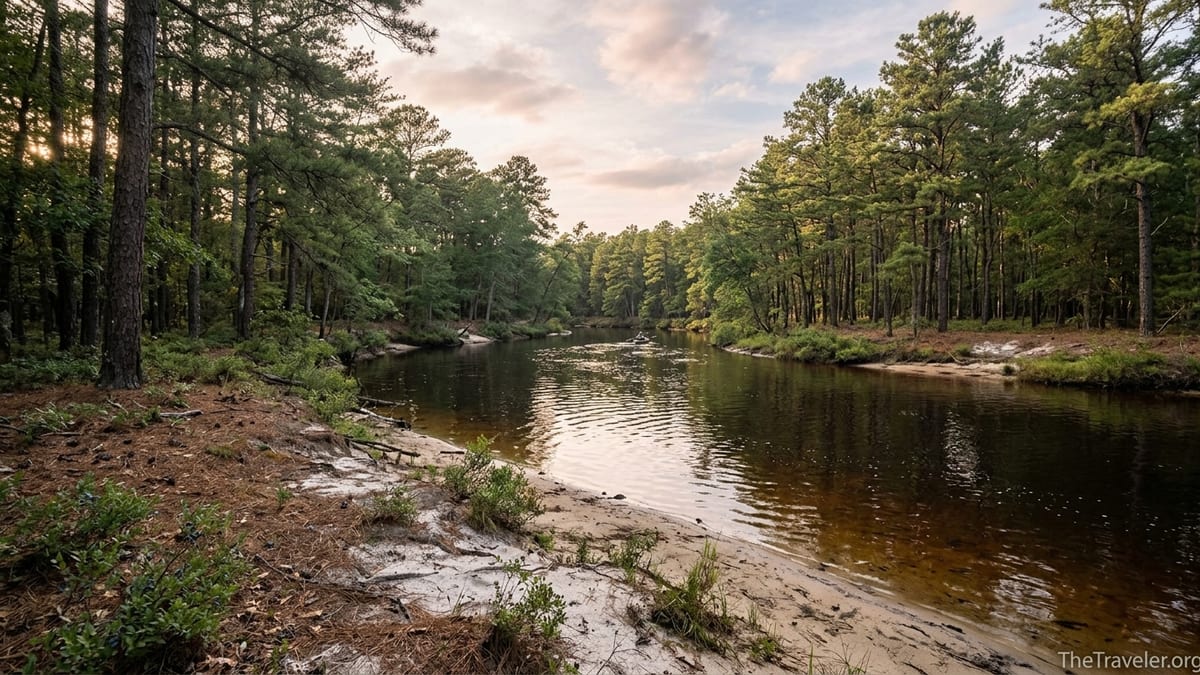
Once the initial curiosity about the Jersey Devil fades, most visitors find themselves drawn to the Pinelands’ rivers and trails. One of the most classic Pine Barrens experiences is a paddle trip on a narrow blackwater river like the Mullica, Batsto, Wading, or Oswego. These streams run tea-colored from the natural tannins leached from cedar roots and pine needles, giving the water a dark, reflective surface that mirrors the sky and tree canopy above.
On a typical summer day, you might rent a canoe or sit-on-top kayak near Atsion or Batsto for a half-day trip that costs roughly what you would pay for a shore-town bike rental. Outfitters shuttle you upstream and let you float back to your car, navigating gentle currents, tight bends, and the occasional downed tree. Campsites like Mullica River Campground and Lower Forge are accessible only by boat or on foot, creating overnight trips where you carry in everything you need, from drinking water to a compact camp stove, and wake up to mist rising off the river instead of the buzz of traffic.
Hikers have their own signature route: the Batona Trail. Stretching about 50 miles, it links Bass River, Wharton, and Brendan T. Byrne state forests, crossing sandy ridges, boardwalked wetlands, and sections of quiet forest road. You do not have to backpack the whole route to enjoy it; many visitors sample a few miles from trailheads near Carranza Memorial, Batsto, or Route 563. Day hikes of 5 to 10 miles give a taste of classic pine barrens scenery: low, wind-sculpted pines, blueberry and huckleberry underbrush, sphagnum bogs, and occasional views across old cranberry reservoirs.
For families and first-time visitors, Atsion Lake and other designated swim areas provide a gentler introduction. During peak season, a guarded beach, changing rooms, and picnic tables make it feel more like a retro summer lake resort than a deep forest outing. Yet even here, a short walk along a side trail quickly puts you in quiet woods where you can hear pine warblers, spot sundews and pitcher plants in wet sand, and see the region’s namesake barren, nutrient-poor soils up close.
Wildlife, Ecology, and the Quiet Details
Beyond its folklore, the Pine Barrens is an ecological outlier. The sandy, acidic soil that early farmers dismissed as barren supports a specialized community of plants and animals, many of them rare or threatened. Pitch pine and scrub oak dominate the uplands, often in stunted, twisted forms sculpted by fire and wind. Underneath, shrubs like highbush blueberry, huckleberry, and sheep laurel form a dense understory that bursts into color in late spring and early summer.
In wetter pockets, Atlantic white cedar swamps offer a very different mood: cool, dim, and hushed, with mossy hummocks and slow-moving tea-colored streams threading through the trees. Here, visitors may catch glimpses of dragonflies, turtles sunning on logs, and, with luck, barred owls or great blue herons. The region’s wetlands and ponds are home to carnivorous plants like pitcher plants and sundews, which have evolved to supplement their diet with insects in these nutrient-poor environments. Spotting a cluster of bright red sundews clinging to wet sand near a boardwalk can be a highlight for kids and botany-minded travelers alike.
Wildlife sightings are seldom dramatic in the safari sense, but they are steady and rewarding for patient observers. White-tailed deer, wild turkeys, and box turtles are common. Birders come looking for species like pine warblers, rufous-sided towhees, and, in some seasons, migrating raptors. At night, the soundscape shifts to owls, insects, and the occasional splash of something unseen in a nearby stream. On clear nights far from town centers, the lack of artificial light makes for good stargazing by East Coast standards, an unexpected perk for visitors who usually associate New Jersey with bright skies.
For many travelers, it is the small details that stick: the resinous scent of warmed pine needles underfoot, the feel of sugar sand that squeaks under boots, the way tannin-dark rivers turn coppery in late afternoon light. These quiet sensory impressions are what make people fall in love with the Pine Barrens, long after the novelty of cryptid lore has worn off.
Planning Your Own Pine Barrens Adventure
Because the Pine Barrens is a dispersed region rather than a single, signed national park entrance, planning a visit benefits from a bit of advance research. Many travelers use Wharton State Forest as their hub, especially the Atsion and Batsto areas, which offer ranger stations, maps, and clear trailheads. From Philadelphia, it is roughly an hour’s drive to Atsion; from New York City, around two to two and a half hours, depending on traffic and your exact starting point.
Paddling trips are among the easiest ways for first-timers to experience the landscape. Seasonal outfitters near Atsion and Batsto rent canoes and kayaks and offer shuttle services on the Mullica and Batsto rivers, with options ranging from two-hour floats to full-day adventures. Prices are typically comparable to a day’s bicycle rental at the shore, and reservations are strongly recommended on spring and fall weekends when weather is pleasant and water levels are favorable.
Camping options range from drive-in campgrounds with basic amenities to primitive riverside sites accessible only on foot or by boat. Popular primitive spots like Mullica River and Lower Forge require advance reservations and adherence to pack-in, pack-out rules, including bringing your own drinking water and carefully managing campfires according to current regulations. For travelers who want a roof without sacrificing the pine barrens experience, private campgrounds and glamping sites on the region’s periphery offer cabins, yurts, and tent platforms within a short drive of trails and rivers.
Day visitors can easily structure a loop that combines history, hiking, and a swim. A common pattern is to start the morning at Batsto Village, walking the historic site and visitor paths, then hike a few miles on the Batsto Red or Blue trails, followed by an afternoon at Atsion Lake or a short paddle on a nearby river. Even in peak season, it is possible to find quiet corners by heading out early or lingering into the late afternoon after most beachgoers have packed up.
Respecting a Fragile and Sometimes Tricky Landscape
The Pine Barrens’ wild feel is part of its appeal, but it also demands a measure of respect. Sandy forest roads, often labeled only with small markers or none at all, can quickly confuse drivers unfamiliar with the area. GPS navigation sometimes misjudges road conditions, leading unwary visitors into deep sand where standard cars can get stuck. Unless you know the roads and have appropriate clearance and tires, it is wise to stick to paved routes and clearly maintained access points like those at Atsion, Batsto, and Bass River State Forest.
Ticks are a persistent reality, especially in warm months, so long pants, repellent, and careful post-hike checks are part of any responsible visit. The same nutrient-poor soils that support specialized plants also make the ecosystem sensitive to disturbance, meaning off-trail hiking, illegal off-road vehicle use, and careless campfires can have outsized impacts. Visitors are strongly encouraged to stay on designated trails, use established fire rings where allowed, and pack out all trash, even small items like food wrappers and bottle caps.
Water conditions can also vary. The region’s blackwater rivers are generally gentle, but water levels change with rainfall, and strainers like downed trees can create hazards, particularly for inexperienced paddlers. Outfitters and rangers are good sources of current information on which sections are best suited to beginners, families, or experienced boaters at any given time. Wearing a properly fitted life jacket, even in seemingly calm water, is standard practice here.
Finally, the very remoteness that makes the Pine Barrens feel magical can also be disorienting. It is not unusual for cell coverage to drop along backroads and trails, so carrying paper maps, telling someone your plans, and keeping an eye on daylight are practical safety measures. Travelers used to busy urban and suburban environments may find the deep quiet either soothing or unsettling, especially at night. Lean into that feeling, but do so with good preparation and a healthy respect for the environment.
The Takeaway
In the end, the Jersey Devil is the Pine Barrens’ most effective travel ambassador. It sparks curiosity, draws clicks, and convinces road-trippers to veer off the highway into a part of New Jersey many never realized existed. Yet almost everyone who spends real time here comes away talking about something else entirely: the stillness of a cedar swamp, the slow bend of a blackwater river, the silhouettes of pines against a starry sky.
For travelers, that is the real story. The Pine Barrens offer an accessible but genuinely wild experience on the crowded Eastern Seaboard, with enough infrastructure for comfort but enough empty space to feel like an escape. You can come for the ghost stories, but you are likely to leave with muddy boots, sun-warmed shoulders, and a new appreciation for how much true wilderness still hides in plain sight between the big cities of the Mid-Atlantic.
If you plan a visit, bring your curiosity about the region’s legends, but also bring a map, sturdy shoes, and time to wander slowly. Listen for owls as much as for folklore, watch for dragonflies and pitcher plants as much as for mythical creatures. In the Pine Barrens, the myth is the doorway; the wilderness is what keeps you coming back.
FAQ
Q1. Is it safe to camp in the Pine Barrens given all the Jersey Devil stories?
Yes. The Jersey Devil is folklore, and thousands of people camp safely here each year. Real concerns are ticks, navigation, and weather, so focus on preparation and park rules.
Q2. Where is the best place for a first-time visitor to start?
Wharton State Forest’s Atsion or Batsto areas are ideal. They offer ranger presence, clear signage, maintained trails, canoe and kayak access, and easy parking close to major highways.
Q3. Do I need a four-wheel-drive vehicle to explore the Pine Barrens?
No. You can see and do a lot using only paved roads and main park entrances. Avoid unmarked sandy forest roads unless you have appropriate experience and a vehicle suited to deep sand.
Q4. Can I visit the places associated with the Jersey Devil legend?
Yes. Travelers often explore Leeds Point near Great Bay and the inland forests around Wharton State Forest. These are ordinary communities and public lands, so be respectful and follow local regulations.
Q5. Are there guided tours or outfitters for paddling and hiking?
Yes. Seasonal outfitters near Atsion and Batsto rent canoes and kayaks, run shuttles on rivers like the Mullica and Batsto, and sometimes offer guided trips or instruction for beginners.
Q6. What time of year is best to visit the Pine Barrens?
Late spring and fall are especially pleasant, with mild temperatures and fewer insects. Summer offers swimming and long paddling days, while winter can be quiet and starkly beautiful.
Q7. Is swimming allowed in Pine Barrens lakes and rivers?
Swimming is allowed only in designated areas like guarded beaches at Atsion Lake during the operating season. Rivers are primarily used for paddling; always check current regulations and safety notices.
Q8. Can I see wildlife easily, or do I need special gear?
You do not need special gear. Deer, turkeys, turtles, and many birds are commonly seen from trails and riverbanks. Binoculars enhance birdwatching, but patience and quiet are more important than equipment.
Q9. Are there family-friendly activities if we are not experienced campers?
Yes. Short hikes near Batsto Village, a day at Atsion Lake’s beach, easy paddle trips with outfitters, and picnics at signed recreation areas all work well for families and beginners.
Q10. How long should I plan to stay to get a real feel for the Pine Barrens?
A single day offers a good introduction, but a weekend allows time for a paddle trip, a hike, and an evening around a campfire. Many travelers return for longer stays once they have sampled the region.