


More news on this day
Traffic on Interstate 64 near Norfolk International Airport was heavily backed up after a multi-vehicle crash involving an overturned car brought westbound lanes to a crawl, according to early reports from the scene.
Get the latest news straight to your inbox!
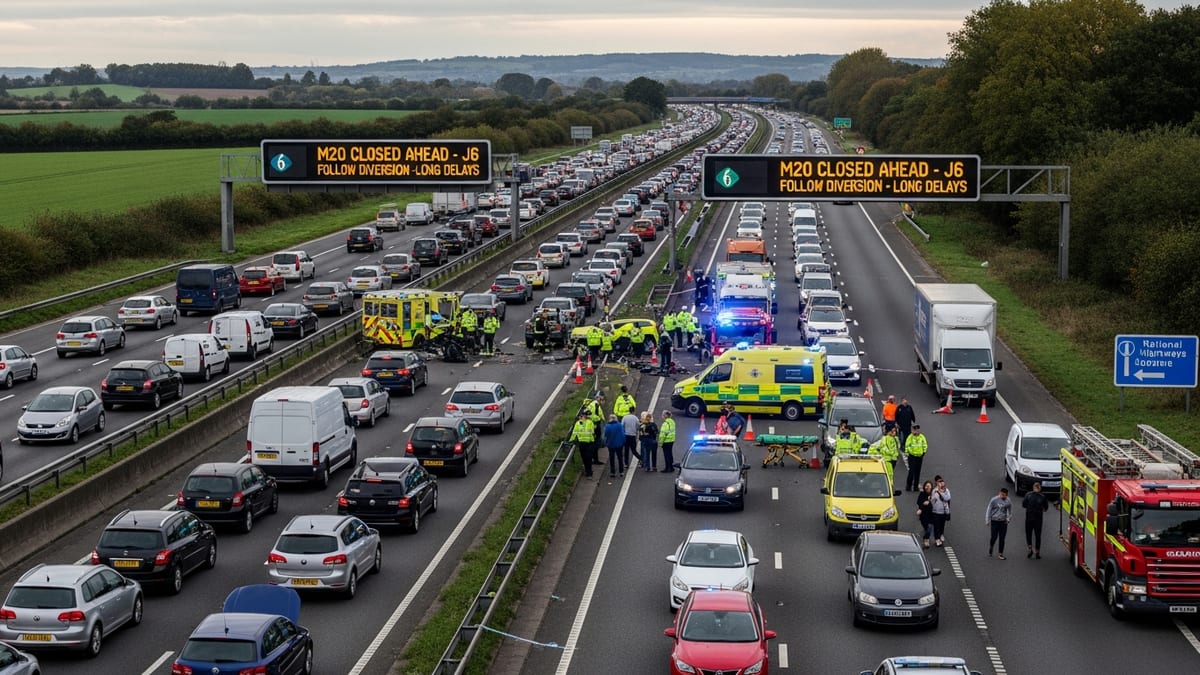
Crash near airport interchange triggers severe backups
Initial information from traffic monitoring services and regional coverage indicates that the collision occurred on I-64 in the vicinity of the exits serving Norfolk International Airport, at a busy stretch where local and airport-bound traffic routinely converge. The crash involved multiple vehicles, including at least one that overturned, prompting an extended response and lane closures.
Publicly available reports describe a chaotic scene in the immediate aftermath, with damaged vehicles blocking travel lanes and debris scattered across the roadway. The overturned car is reported to have come to rest in a travel lane, significantly limiting movement and contributing to the rapid buildup of congestion in both directions as drivers slowed near the crash site.
Traffic cameras and commuter accounts cited in local updates show vehicles at a standstill for long stretches as emergency responders and tow trucks worked to access the crash area. The combination of peak-period traffic and the strategic location of the incident near the airport interchange magnified the impact on regional movement.
Live traffic maps captured an extended red zone along I-64, with delays spilling back toward other Hampton Roads corridors often used by travelers heading to and from the airport. Drivers reported delays of well over 30 minutes in some cases, with many attempting last-minute detours onto parallel local routes.
Limited early details on injuries and vehicle count
As of the latest publicly available information, the exact number of vehicles involved in the I-64 crash near Norfolk International Airport has not been fully detailed. Early descriptions refer to a multi-vehicle situation, indicating that several cars and possibly larger vehicles were part of the chain of collisions that culminated in one car overturning.
Reports circulating through regional traffic alerts and local news summaries have not yet provided a comprehensive accounting of injuries. Some accounts reference medical personnel on site, but publicly accessible sources did not immediately specify how many people were transported from the scene or the severity of any injuries.
In many similar interstate crashes, investigators typically work to determine whether speed, lane changes, following distance, or sudden braking in congested conditions contributed to vehicles colliding. Published research on comparable I-64 incidents across Virginia notes that abrupt slowdowns near interchanges and work zones can quickly trigger chain reactions when traffic volumes are high.
Additional updates on the condition of those involved are expected to emerge as hospital and incident data are compiled and summarized in official crash reports. Until those documents are released, information about injuries remains preliminary and subject to revision.
Travelers to Norfolk International Airport face missed flights and diversions
The crash’s location near the primary access routes for Norfolk International Airport created particular challenges for air travelers. Drivers heading to the airport via I-64 encountered extended slowdowns and intermittent standstills, raising the risk of missed flight departures and last-minute itinerary changes.
According to publicly available airport guidance and prior traffic advisories, I-64 is a principal artery feeding the roadway network surrounding the terminals. When conditions on the interstate deteriorate, nearby surface streets often become overloaded as motorists attempt to divert around congestion, further compounding delays for airport-bound traffic.
Travel-related commentary posted by local commuters indicates that some drivers tried to exit the interstate early and reach the airport through neighborhood routes and secondary arterials, adding to backups on roads normally used for local access. Others chose to remain on I-64 despite slow speeds, calculating that detours might not provide a significant time advantage.
Transportation planners have previously highlighted the sensitivity of the airport corridor to incidents on I-64, noting that even relatively brief lane closures can have an outsized effect on travelers and on-time performance at the terminals during busy periods.
Authorities work to clear lanes and restore normal flow
Incident response teams moved to secure the crash scene, assist anyone injured, and begin the complex task of removing damaged vehicles from the roadway. A crash that includes an overturned car typically requires specialized equipment, which can prolong lane closures while responders stabilize and then upright the vehicle.
According to publicly available traffic system data from prior major incidents on I-64, the process of documenting a multi-vehicle crash, moving wreckage to the shoulders, and conducting roadway cleanup often proceeds in carefully staged steps. Even once one or two lanes reopen, residual backups can continue for an hour or more as traffic volumes normalize.
Regional traffic feeds indicated that congestion gradually began to improve after crews were able to clear at least one lane past the scene. However, heavy delays persisted in the immediate area as drivers moved slowly through the residual bottleneck and past the remaining activity on the shoulder.
Transportation agencies generally review serious crashes like this one to evaluate whether additional signage, variable speed advisories, or modifications to ramp and merge patterns could reduce the risk of similar incidents at busy interchanges serving airports and other critical destinations.
Continuing delays highlight ongoing safety concerns on I-64
The latest multi-vehicle crash near Norfolk International Airport adds to a pattern of serious incidents that periodically disrupt I-64 through the Hampton Roads region. Previous collisions in this corridor have drawn attention to the challenges of managing high traffic volumes, frequent lane changes, and complex interchange layouts.
Published analyses of interstate safety in Virginia describe I-64 as a vital east-west spine that carries a mix of daily commuters, freight traffic, and travelers headed to key hubs such as military installations, port facilities, and airports. That combination can leave little margin for error during peak hours, when any sudden slowdown or unexpected lane blockage can cascade into a major disruption.
Transportation and safety studies focused on prior I-64 crashes have also underscored the importance of driver behavior. Maintaining safe following distances, avoiding abrupt lane changes near ramps, and reducing speed when traffic begins to tighten are all cited as measures that can help reduce the likelihood of multi-vehicle collisions and rollovers.
For travelers in the Norfolk area, the incident serves as a reminder to build extra time into airport trips, monitor live traffic conditions, and remain prepared to adjust routes when serious crashes occur along I-64. Future infrastructure upgrades and ongoing safety campaigns are expected to remain central to efforts to improve reliability along this critical corridor.