


Adolfo Suárez Madrid Barajas Airport is one of Europe’s busiest hubs, and at peak times its security lanes and passport control points can feel stretched to the limit. For travelers, the difference between a smooth experience and a stressful one usually comes down to knowing what to expect: where the bottlenecks are, how Fast Track works, what the new Entry/Exit System means in practice, and how long you realistically need for connections. This guide walks you through security and immigration at Madrid Barajas in 2026, with practical, real-world examples drawn from recent traveler experiences.
Get the latest updates straight to your inbox!
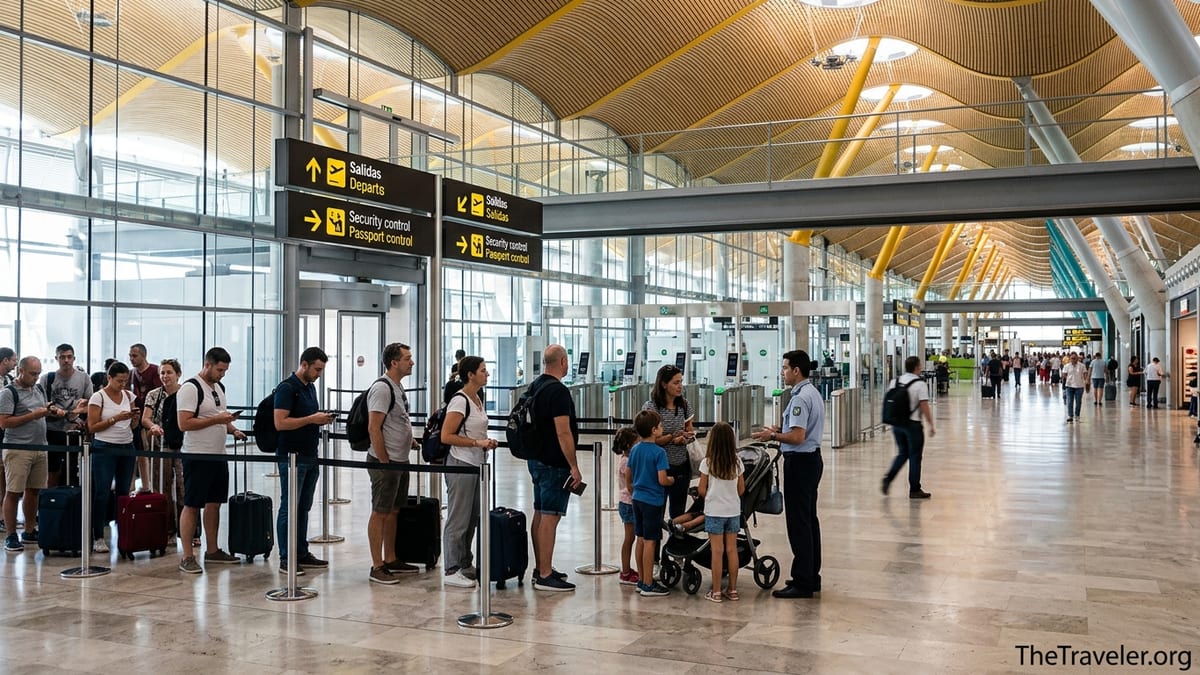
How Madrid Barajas Is Laid Out and Why It Matters for Controls
Madrid Barajas (airport code MAD) is spread across four main passenger terminals: T1, T2, T3 and the newer T4, plus the satellite building T4S. Non-Schengen long-haul flights often use T1 and T4/T4S, while many European Schengen flights operate from T2 and T4. This layout is important because security checkpoints and passport control are not identical in each building, and your path through the airport will differ depending on where you depart or arrive.
For example, a traveler flying from New York to Madrid on Iberia and then connecting to Valencia will typically arrive into T4S, clear passport control there, take the underground train to T4, and then walk through the Schengen departures area without another immigration check. A passenger arriving from London into T1 and connecting to a domestic flight in T4, on the other hand, will clear passport control and customs in T1, then transfer by the free shuttle bus to T4 and pass through security again before boarding.
The airport handled more than 68 million passengers recently, very close to its official capacity, and the Spanish airport operator Aena has publicly signaled that slot growth will be limited from summer 2027 to avoid congestion. In practice, this means that peak-time crowding at security and immigration will remain a feature travelers must plan around, especially in summer and on Sunday afternoons when many long-haul flights converge.
Because the terminals sit in separate buildings, walking distances can feel long. Online forums are full of comments from passengers surprised at how long it takes just to deplane, walk to passport control, and then reach the metro or inter-terminal shuttle. Factoring in these internal transfers is as important as estimating the lines themselves.
Security Screening at Madrid Barajas: Process and Wait Times
Security screening at Madrid Barajas is similar to other large European airports, but recent technology upgrades have changed the rules in some lanes. Standard checkpoints still generally require you to remove laptops and other electronics from your bag and separate liquids into 100 ml containers in a clear plastic bag. At some Fast Track lanes in T2 and T4, however, Aena has installed newer scanners that allow passengers to leave both electronics and liquids inside their cabin luggage, which speeds up the process noticeably.
Wait times vary widely by terminal, time of day, and season. Recent queue-monitoring services report average standard security waits of around 20 to 30 minutes in busy periods, with much shorter lines early in the morning and mid-afternoon on weekdays. On a typical busy summer Saturday, a family departing to Latin America from T1 around 10:00 might face a line that snakes back to the check-in area and takes 35 minutes to clear, while a solo traveler with only hand luggage using T4 Fast Track for a 21:00 departure might be through in under 5 minutes.
Traveler reports from 2025 and 2026 describe a “lottery” element: some days, especially in T4 before transatlantic departures, it is possible to go from curb to gate in 30–40 minutes; on others the security queue alone can push past half an hour even before passport control. Third-party tools and airport apps that forecast queue levels for MAD, using live flight data, now commonly label peak morning and late-afternoon banks of flights as “very busy,” reflecting this inconsistency.
The key takeaway is that Madrid Barajas security is generally efficient but volatile. For most non-peak departures within Europe, arriving 2 hours before your flight is often enough. For long-haul flights, especially to the United States where extra checks sometimes apply at the gate, 3 hours is more prudent, and 3.5–4 hours is advisable at heavy travel times like Easter, August weekends, or around Christmas.
Fast Track and Airline Priority: Who Can Skip the Main Line
Madrid Barajas offers a paid Fast Track service operated by Aena in several terminals, alongside priority security lanes provided by airlines for their premium and elite-status customers. These lanes are physically separate from the regular security line and usually much shorter. In Terminal 4, airlines such as Iberia, American Airlines and British Airways direct business-class passengers and oneworld elites to dedicated Fast Lane or Fast Track entrances, while in Terminals 1 and 2 a mix of airline-branded and Aena-branded priority lanes are used.
Passengers can usually buy Fast Track access in advance via Aena’s VIP services portal or through membership programs like DragonPass and various premium credit cards. As an example, a traveler flying economy from Madrid to Paris in August might purchase a one-off Fast Track pass to use the dedicated lane in T2, walking past a 30-minute standard queue and clearing security in roughly 5 minutes. Other travelers have described buying access on the spot via their phone after seeing the length of the regular line, then walking over to the priority entrance and entering without delay.
There are some caveats. Airline Fast Track eligibility rules vary, and codeshare passengers sometimes discover they are not listed as priority at the checkpoint even though they hold a business-class ticket on a partner airline. Renovation work has occasionally closed or rerouted priority lanes, particularly in T4, so during certain months signs may direct even Fast Track travelers through a shared pre-queue before the lanes split again. And while Fast Track generally reduces waiting time, it does not exempt anyone from security rules: you still must go through the scanner and occasional manual checks like everyone else.
In recent traveler accounts, the consensus is that Fast Track at Madrid is worth it when you are traveling in peak hours with only carry-on luggage, or if you have a tight self-connection and want to minimize risk. For off-peak departures, many passengers report getting through standard security quickly enough that paying extra would not have made a substantial difference.
Passport Control: Schengen, Non-Schengen and the New Entry/Exit System
Madrid Barajas handles both Schengen and non-Schengen flights, so whether you face passport control depends on your route. Travelers moving between Spain and other Schengen countries such as France, Italy or Germany usually do not pass immigration at all, only security. Those arriving from or departing to non-Schengen destinations like the United Kingdom, the United States, Latin America, or Morocco must clear passport control when entering or leaving the Schengen Area.
Since 2025, Spain has been rolling out the EU’s new Entry/Exit System (EES), which digitally records the time and place that non-EU nationals enter and leave the Schengen zone. At Madrid Barajas this means that many third-country travelers now first stop at self-service kiosks or automated gates to have their fingerprints and facial image captured before they proceed to an officer or eGate. One traveler entering Spain in spring 2026 via T4S described rows of EES machines with staff directing passengers: EU passports in one line, non-EU in another, with families and infants sent to specific staffed booths to speed things up.
This new system has added an extra step for first-time or infrequent visitors, and early phases in other EU airports produced notable queues. At Madrid, recent accounts suggest that EES implementation has gone relatively smoothly compared with some northern European hubs, but delays can still occur when multiple wide-body flights arrive close together. A Canadian tourist arriving from Montreal at 07:30 in July might find a 40-minute line at the EES kiosks followed by a short wait to see a border officer, while a business traveler from São Paulo arriving mid-morning in October could be through in under 20 minutes if most passengers are returning visitors whose biometric data is already on file.
Outbound passport control can also build up at busy times, especially in T4S before mid-day and mid-afternoon long-haul departures. U.S.-bound travelers report that the combined effect of security, train transfer to T4S, passport control and occasional extra questioning at the gate sometimes totals an hour or more. For that reason, frequent flyers to the United States out of Madrid commonly aim to arrive at the airport 3.5–4 hours before departure to build in a buffer for these variable waits.
Using eGates and Biometrics: Who Qualifies and What to Expect
Madrid Barajas has long used automated passport control eGates for eligible travelers, and in recent years these have been integrated with or sit alongside the newer EES kiosks. Holders of biometric passports from EU and Schengen countries are generally the primary users of eGates on arrival, but some non-EU nationalities, such as citizens of the United Kingdom or certain visa-exempt countries, may also find eGates available to them depending on current Spanish border policies.
In practice, the experience can vary. A German passenger arriving from Frankfurt may walk directly to a bank of eGates, scan their passport, look into the camera and be through in under 2 minutes. A British holidaymaker arriving from London might be directed first to an EES kiosk to record their entry, then to an automated gate to confirm identity. Meanwhile, an American traveler whose fingerprints are not yet in the EES database may be guided to a staffed booth instead, particularly if traveling with children too young to use the machines.
The airport has also experimented with biometric programs in cooperation with airlines, using facial recognition at boarding or at some security points to speed up processing for enrolled passengers. These initiatives have faced regulatory scrutiny in Spain around data protection; national authorities have levied fines on operators over concerns about how biometric data is stored and used, and legal challenges are ongoing. For travelers, this means systems may appear, disappear, or operate only for limited passenger groups while policies are refined.
For now, the safest expectation is that if you hold an EU or Schengen-state passport with a biometric chip, you will usually be able to use at least some eGates at Madrid on arrival and possibly on departure. If you are a non-EU traveler, especially from visa-exempt countries like the United States or Canada, you should be prepared for either automated or manual processing and follow airport staff instructions. Having your passport ready and removing hats or sunglasses in advance will help keep both lines moving.
Realistic Transfer Times and Example Itineraries
Because of the size and layout of Madrid Barajas, connection times are a frequent concern. Online travel communities regularly feature questions from passengers with 2–3 hour layovers wondering if they can make their next flight or even nip into the city. The honest answer depends on terminal combinations, whether you are changing airlines on separate tickets, and whether you must clear passport control and security again.
A commonly cited example is a 3-hour self-transfer from a non-Schengen arrival in T1 to a Schengen departure in T4. Travelers who have done this in 2025 and 2026 report that, if the inbound flight is on time, it typically takes around 15–20 minutes to deplane and reach passport control, 10–30 minutes to clear immigration, another 10–20 minutes to collect checked luggage, 10–15 minutes to catch the free inter-terminal shuttle bus to T4, and finally 15–20 minutes to re-check bags, pass security and walk to the gate. In total, this can easily reach 75–90 minutes on a normal day, leaving some margin within a 3-hour window but not much room for significant delay.
Within the same terminal complex, transfers are easier. A passenger arriving into T4 from Bilbao and connecting to a long-haul Iberia flight from T4S to Mexico City often remains airside. They walk from their arrival gate in the Schengen zone to the security check for non-Schengen departures, ride the underground train to T4S, and then clear outbound passport control before boarding. Frequent flyers who know the layout and travel with hand luggage report completing this sequence in as little as 30–40 minutes when queues are light, but budgets of 60–90 minutes are recommended, especially for first-time visitors.
For very short connections booked on a single ticket, airlines at Madrid generally have procedures to fast-track misconnecting passengers through security and passport control. However, if you are on separate bookings, that safety net does not apply. In that case, a conservative approach is best: allow at least 2.5–3 hours between flights that involve changing terminals and rechecking bags, and more in summer.
As for leaving the airport during a layover, real-world experience suggests that only layovers of 6 hours or more are genuinely comfortable if you want to reach central Madrid, have a meal, and return through security and passport control without rushing. The airport’s own transport links into the city are efficient, but the time spent walking long corridors, waiting at immigration and queuing at security can easily eat an hour or two each way.
Special Considerations: Families, Mobility Needs and U.S.-Bound Flights
Certain groups of travelers face distinct challenges at Madrid Barajas security and passport control. Families with young children, for example, may be directed to special lanes at EES kiosks or passport control desks. One traveler in 2026 described being waved away from the general queue at T4S and told to go directly to counters reserved for families, which reduced their wait significantly. That said, strollers still need to be folded for security screening, and liquids rules for baby food and formula apply as elsewhere in Europe, so allowing extra time remains wise.
Passengers with reduced mobility or hidden disabilities can request assistance through their airline or Aena in advance. Staff can then accompany them through security and passport control using accessible routes, lifting some of the stress of navigating long walks and crowded queues. In busy summer periods, early booking of assistance is especially important because resources are stretched across the airport’s four terminals.
Flights to the United States deserve special mention. Although Madrid Barajas does not host U.S. preclearance facilities, airlines and security staff often perform additional document and security checks at the gate or a dedicated pre-boarding area. Travelers have reported being selected for Secondary Security Screening (sometimes marked as “SSSS” on the boarding pass), which can involve extra bag searches and questioning. Combined with standard security and passport control, this means U.S.-bound passengers should treat the airline’s recommended check-in time as a minimum and aim for the earlier side of any suggested window.
Travelers connecting from Schengen flights onto U.S. departures in T4S also need to remember that once they ride the train from T4 to T4S, they must still pass outbound passport control before reaching their gate. On busy Sundays or during holiday periods, this passport control line alone can reach 30–45 minutes. Many frequent transatlantic flyers from Madrid say they have adopted a strict rule: arrive at the airport at least 3 hours before departure in shoulder season and 4 hours ahead in July, August and late December.
The Takeaway
Madrid Barajas is an efficient but heavily used hub where security and passport control can swing from painless to frustrating depending on the day. Technological improvements such as advanced scanners in some Fast Track lanes and the gradual stabilization of the EU’s Entry/Exit System are helping, but peak traffic and the airport’s near-capacity passenger volumes mean bottlenecks will remain a reality in 2026 and the years leading up to the next round of expansions.
The most effective strategies are straightforward. Know which terminal you use and whether your itinerary involves Schengen or non-Schengen segments. Build realistic time buffers into your plans, especially for self-transfers and U.S.-bound flights. Consider purchasing Fast Track in peak hours or if you are traveling with only carry-on luggage. And keep your documents, liquids and electronics organized in advance so that when your turn at the scanner or EES kiosk comes, you move quickly.
Travelers who arrive early, understand the layout and follow staff directions usually find that Madrid Barajas works smoothly, even if it requires a lot of walking. Those who underestimate how long it takes to clear lines and change terminals are the ones most likely to end up sprinting for a gate. With a bit of preparation, you can let one of Europe’s busiest airports be a gateway to Spain and beyond rather than a source of last-minute stress.
FAQ
Q1. How early should I arrive at Madrid Barajas for an international flight?
For non-Schengen long-haul flights, especially to North America or Latin America, aim to arrive 3 hours before departure in regular seasons and up to 3.5–4 hours before during peak summer or major holidays. This allows for check-in, potentially long security lines, passport control and walking time to your gate.
Q2. Is Fast Track at Madrid Barajas worth paying for?
Fast Track is most valuable in peak hours or when you have a tight connection and are traveling with hand luggage. Travelers frequently report clearing security in under 5–10 minutes via Fast Track when standard lines are 20–30 minutes or longer. At quiet times, the benefit can be minimal.
Q3. Do I always have to go through passport control at Madrid Barajas?
No. If you are flying entirely within the Schengen Area, you usually only pass through security. You will go through passport control when entering or leaving Schengen, for example when traveling between Madrid and the United Kingdom, the United States, Latin America, or other non-Schengen countries.
Q4. How long does passport control usually take on arrival?
Recent traveler reports suggest a wide range. At quiet times, eGate users can clear in under 10 minutes. When several long-haul flights arrive together, non-EU passengers using the Entry/Exit System may face 30–45 minutes or more. Families and those directed to special counters sometimes move faster than the main queue.
Q5. Can I use eGates at Madrid Barajas with a UK or US passport?
EU and Schengen-state biometric passports are the primary users of eGates. Some non-EU travelers, such as UK citizens and certain other visa-exempt nationalities, may have access depending on current Spanish border policies, but U.S. citizens should generally expect manual processing or mixed automated and manual steps.
Q6. Is a 2-hour layover enough to connect at Madrid Barajas?
A 2-hour layover can be sufficient for a same-terminal Schengen to Schengen connection without checked bags, but it is tight for transfers involving different terminals, baggage reclaim, or passport control. For self-transfers or non-Schengen segments, 2.5–3 hours is a safer minimum.
Q7. What should families with young children expect at security and passport control?
Families must still follow standard security rules, including folding strollers and screening baby items, but passport control often has dedicated counters for families. Staff may direct parents with infants and small children to shorter lines, especially at T4S, though you should still allow additional time.
Q8. Are liquids and laptops allowed to stay in my bag at security in Madrid?
In most standard security lanes you must still remove laptops and place liquids of up to 100 ml each in a clear plastic bag. However, some Fast Track checkpoints in T2 and T4 use newer scanners that allow you to keep electronics and liquids in your cabin bag, which speeds the process.
Q9. Does Madrid Barajas have TSA PreCheck or Global Entry-style lanes?
No. U.S. programs like TSA PreCheck and Global Entry do not apply at Madrid Barajas. Instead, the airport offers its own Fast Track and airline priority lanes for security, and Spanish border police manage passport control using a mix of eGates, EES kiosks and staffed booths.
Q10. Can I realistically go into Madrid city during a long layover?
It is possible if you have at least 6 hours between flights and your immigration status allows entry into Spain. You must budget time to clear passport control on arrival, travel into the city, return to the airport, and then pass security and outbound passport control again, so shorter layovers are usually better spent airside.