


Landing in Mumbai can feel intense, especially if you are heading all the way from Chhatrapati Shivaji Maharaj International Airport in Andheri to South Mumbai districts such as Colaba, Fort, Nariman Point or Marine Drive. The distance is only around 25 to 30 kilometres, but heavy traffic, jet lag and luggage can turn the transfer into the most stressful part of the trip. This guide breaks down the real-world options in 2026, with typical costs, journey times and practical tips so you can walk out of the terminal knowing exactly what to do.
Get the latest updates straight to your inbox!
Understanding the Route from the Airport to South Mumbai
Mumbai’s main airport is in the northern suburb of Andheri, while South Mumbai sits at the city’s southern tip around the Gateway of India, Colaba and Cuffe Parade. In smooth, late-night traffic the drive can take 35 to 45 minutes. In daytime or evening peak, the same journey can stretch to 75 minutes or more as cars crawl along the Western Express Highway and the north-south arterial roads through Bandra, Dadar and Worli.
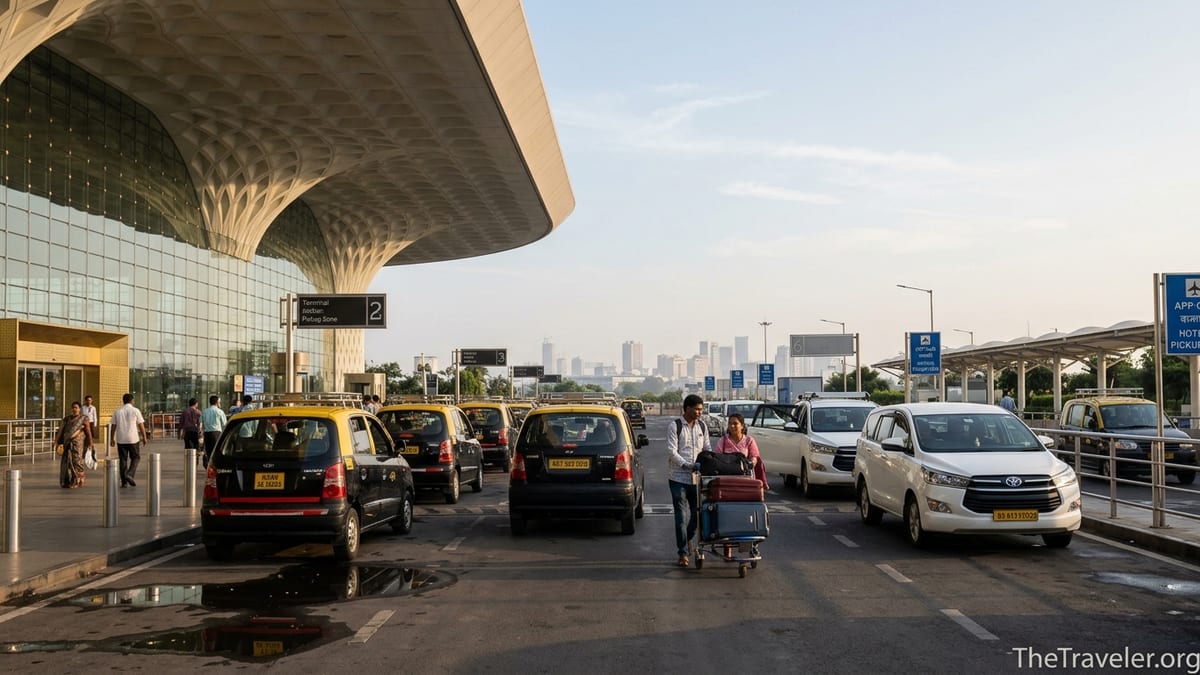
Most international flights arrive at Terminal 2, a large, modern terminal where you will find official taxi counters, ride-hailing pickup points and the closest public transport options. Many domestic flights for low-cost carriers still operate from Terminal 1 in Santacruz, a short drive away, linked by a free shuttle bus. Knowing which terminal you land at is important, because the exact pickup points for Uber or Ola and the nearest bus stops are different.
For a typical visitor staying in South Mumbai, common hotel areas include Colaba (close to the Taj Mahal Palace and backpacker hostels behind Colaba Causeway), Fort and Churchgate (business hotels and older colonial buildings), and Nariman Point and Marine Drive (large waterfront hotels like the Trident and Oberoi). When booking or negotiating a ride, it helps to say your area clearly, for example “Colaba near Regal Cinema” or “Nariman Point, Trident hotel,” as many drivers think in landmarks rather than full street addresses.
At 2026 prices, a one-way car transfer from the airport to these areas usually falls somewhere between roughly ₹550 and ₹1,200 depending on the time of day, whether you take Uber or Ola, a pre-paid taxi, or a private car, and how severe the traffic is. Budget public transport using a combination of metro, suburban trains and buses can bring that down to under ₹150 per person, but with significantly more effort and less comfort if you are carrying luggage.
Uber and Ola: App Cabs from the Terminal
For many international travellers, Uber and its Indian rival Ola offer the most familiar option. Both apps operate at Mumbai Airport, and in 2026 a standard UberGo or Ola Mini from Terminal 2 to Colaba, Fort or Nariman Point often quotes somewhere in the ₹500 to ₹900 range in off-peak hours, and can spike above ₹1,000 during rush hour or heavy rain. The exact figure varies with live demand, but the benefit is that you see an estimated fare before you commit.
At Terminal 2, you must follow the “app cabs / Ola / Uber” signs from arrivals, typically via elevators down to a dedicated multi-level car park (P4 or a similar level) where drivers wait. Plan on a 5 to 10 minute walk using lifts and ramps with your luggage. Terminal 1 has its own separate pickup areas, usually across the access road near the car park. It is important to meet the driver at the precise zone indicated in the app; if you wander outside the airport gates, touts will approach you offering “Uber” or “Ola” but these are usually unmetered private cars trying to negotiate cash fares.
The main advantage of Uber and Ola is transparency and the ability to pay by card in many cases. You avoid haggling and can see the route on your phone. For example, a mid-morning Uber from T2 to a hotel near the Taj Mahal Palace in Colaba might show ₹650 with an estimated arrival in 55 minutes. A similar trip at 8 pm on a rainy weekday can surge to over ₹1,200 and take 90 minutes, according to recent rider reports.
The downside is that cars may be scarce at peak times. Travellers arriving late at night sometimes complain of waiting 20 to 30 minutes for a driver to accept the ride, and there are frequent stories of drivers asking to cancel the app booking and pay cash at a higher price. If that happens, you can refuse politely, insist on staying within the app, or simply cancel and rebook. It is usually safest to stick to the quoted app fare, particularly if you are unfamiliar with local prices.
Prepaid and Metered Taxis: Kaali Peeli, Cool Cabs and Counters
Prepaid taxis remain a straightforward, old-fashioned way to get into the city, especially if you do not want to rely on mobile data or ride-hailing apps. Inside both terminals, just after customs and baggage claim, you will find official pre-paid taxi counters run in coordination with the transport authorities and airport operator. You tell the clerk your destination, for example “Colaba, near Regal Cinema,” they consult a distance slab, and you pay a fixed amount upfront in cash or card. You then receive a printed slip to hand to the driver outside.
Recent fare revisions have pushed up prepaid prices slightly, but they are still reasonable by global standards. From Terminal 2 to South Mumbai the prepaid fare for a basic black-and-yellow “kaali peeli” taxi usually falls somewhere in the ₹700 to ₹900 band depending on distance and the exact fare table in use. That is often a little higher than an off-peak Uber, but competitive during surge pricing. An air conditioned blue-and-silver “cool cab” is typically 20 to 25 percent more than a regular taxi for the same route.
Once outside, you will see lines of black-and-yellow taxis waiting in marked bays. Staff at the counter or marshals near the curb will direct you to the correct vehicle. The driver has already been paid, so there is no need for negotiation. You do not pay anything extra unless you choose to tip, which is optional. If the driver asks for additional money beyond what is printed on your slip, you can firmly say that you have already paid at the counter and show the receipt.
It is also possible to walk a short distance beyond the terminal area and hail regular metered taxis on the access roads. That can save a little money, because they run on the official meter instead of a higher prepaid slab, but this is not recommended for first-time visitors with luggage. Outside the controlled airport zone, informal drivers and touts often approach arriving passengers, quoting inflated flat fares such as ₹1,500 or more for South Mumbai. For safety and simplicity, sticking to the official prepaid counters or app cabs inside the terminal is usually the better choice.
Airport Buses: BEST and Private Airport Shuttles
Mumbai’s red BEST buses and newer air conditioned services link the airport area with many parts of the city, including South Mumbai. For budget-conscious travellers without heavy luggage, these buses can be excellent value. Non-air conditioned BEST routes from stops near the domestic terminal have fares starting under ₹20, while special airport-focused air conditioned services to South Mumbai tend to cost in the ₹125 to ₹200 range per person depending on how far south you go.
Route patterns and numbers change periodically, but at the time of writing, BEST operates dedicated or semi-dedicated airport services from Terminal 2 towards key South Mumbai points such as Worli, Haji Ali, CST (Chhatrapati Shivaji Maharaj Terminus) and Cuffe Parade. For example, an AC bus might run from the international terminal down the Eastern Freeway and into the Fort and Colaba area, with intermediate stops at important commercial zones. Fares are paid onboard, in cash or via contactless smart cards and apps that local commuters use.
The biggest advantage of the bus is cost and predictability. Even if traffic is heavy, a large bus tends to feel less stressful than watching the meter climb in a taxi. As an illustration, an air conditioned bus from Terminal 2 to Churchgate during the day might cost around ₹150 and take 70 to 90 minutes, similar to a taxi in traffic but at roughly one quarter of the price. You also avoid the uncertainty around drivers cancelling or trying to renegotiate fares.
However, buses are not ideal if you have multiple large suitcases or are travelling with young children. Luggage space is limited to what you can fit at your feet or on your lap, and boarding requires lifting bags up the steps. Stops near the terminals may involve a short walk outdoors in heat or rain. If you choose this option, travel as light as possible, keep valuables on your person and avoid peak commuter hours between roughly 8:30 to 10:30 in the morning and 6 to 9 in the evening.
Metro and Train Combinations: Cheapest but Most Demanding
Using public transport beyond buses becomes significantly more complicated once you add the suburban rail network and new metro lines. The payoff is very low cost: it is realistic to get from the airport area to CST or Churchgate for under ₹100 per person using a combination of metro and train tickets. For example, you could take a feeder bus or auto rickshaw from the domestic terminal to a nearby metro station, ride the metro to Ghatkopar or Andheri, then transfer to the Central or Western suburban railway to reach South Mumbai.
A common approach is to reach a major interchange such as Dadar or CST on the Central line, or Mumbai Central or Churchgate on the Western line, then walk or take a short taxi ride to your hotel. Train tickets on second class suburban services are extremely cheap by international standards, often under ₹15 for long journeys. Metro fares on newer lines are higher but still modest. The total combined fare rarely exceeds the cost of a single short taxi ride within South Mumbai.
The challenge is comfort and crowding. During peak hours, Mumbai’s suburban trains are extremely crowded, and even outside the busiest windows they may not be a pleasant experience with suitcases. Stations involve stairs, footbridges and crowded platforms. New metro lines have improved comfort and offer air conditioning, but interchanges are not always seamless if you are carrying luggage. Most local commuters make these journeys standing, and there is rarely dedicated suitcase storage.
Public transport is best suited to solo travellers or pairs carrying only backpacks or small rolling bags who are confident navigating busy stations. It can make sense if, for example, you land at Terminal 1 in the middle of the day, want to experience local life and are heading to a hotel near CST. In that case you might take a short auto rickshaw ride to a nearby suburban station, catch a local train to CST, then walk a few hundred meters to a Fort hotel. Families, older travellers and those arriving late at night will usually find a direct car or bus far more practical.
Private Transfers and Hotel Cars: Maximum Comfort and Certainty
For travellers who prioritise comfort and predictability over price, pre-booked private transfers and hotel cars provide a smooth way into South Mumbai. Many international chain hotels around Nariman Point, Churchgate and Colaba offer their own airport car services. These often use larger sedans or SUVs, sometimes with a hotel representative meeting you in the arrivals hall. In 2026, prices for such hotel cars vary widely, but a one-way trip from the airport to Colaba in a hotel Mercedes or large SUV can easily cost ₹3,000 to ₹5,000.
Cheaper private transfers booked through third-party providers are also common. They typically quote prices in the 25 to 50 euro range for a private car from the airport to South Mumbai, which translates to roughly ₹2,200 to ₹4,500 depending on the exchange rate. The driver tracks your flight, waits with a name board, and you go straight to an air conditioned car without visiting counters or searching for pickup points. This is particularly appealing if you are arriving after a long overnight flight or with elderly relatives.
Compared to on-demand taxis or app cabs, private transfers are less affected by sudden spikes in demand. If a major storm hits Mumbai and ride-hailing apps surge or run short of drivers, a pre-booked car still shows up at the agreed price. The main trade-off is that you must commit in advance, usually with cancellation rules that require several hours’ notice. There can also be extra charges for long waiting times if immigration queues are unusually slow.
For high-intent travellers who know they will be tired and carrying multiple bags, a private transfer can be good value relative to its cost. Consider a family of four arriving from Europe for a ten-day holiday, staying at a hotel near Marine Drive. A private SUV booked in advance for around ₹4,000 provides door-to-door service, plenty of luggage space and seating for everyone. The cost per person is not drastically higher than four separate premium Uber or Ola rides over the course of the stay, and the first impression of the city is much less stressful.
Traffic Patterns, Timing and Safety Considerations
Traffic in Mumbai is highly variable by time of day and weather. Flights landing between 11 pm and 5 am often benefit from relatively free-flowing roads, and the journey to South Mumbai can take under 45 minutes in a taxi. Fares on Uber and Ola may also be lower in these hours if demand is modest, though there are nights when an accumulation of late flights or bad weather still causes spikes. By contrast, arriving between 7:30 to 10:30 in the morning or 6 to 9 in the evening on a weekday almost guarantees heavier traffic.
Route choice also matters. Many drivers will use the Western Express Highway and then cut across via Bandra, Mahim, Dadar and Worli towards South Mumbai. Others may opt for routes using the Sea Link bridges or the Eastern Freeway depending on your exact destination and live conditions. As a visitor, you do not need to micromanage the route, but it is worth checking in your app that the driver is heading in the general direction of your hotel and not taking an obviously roundabout path to increase the fare.
In terms of safety, official taxis, app cabs, BEST buses and reputable private transfers are generally safe modes of transport. The main issues to watch for are overcharging attempts and informal touts. Inside the terminal, ignore unsolicited offers of rides and walk directly to the prepaid counter or marked Uber/Ola pickup signage. Check that the driver and vehicle plate number match those shown in the app before getting in. In prepaid taxis, confirm that the driver keeps your slip and does not demand extra money mid-journey.
If you are a solo traveller arriving late at night, it can be reassuring to share your live location via your phone with a friend or family member and to choose a ride option where your route and driver details are recorded. Most large South Mumbai hotels have well-lit entrances with doormen and security staff who are used to receiving late-night arrivals. Tell the driver your hotel name and area clearly before you depart the airport, and have it written down in case of language barriers.
Luggage, Group Size and Hotel-Area Arrival Tips
Your choice of transfer should factor in not only price and timing, but also how much luggage you carry and how many people are travelling. A solo traveller with one backpack can manage almost any option comfortably, from crowded trains to app cabs and buses. A couple with two large suitcases will usually be happiest in a taxi, Uber or private car. A family of four with four big bags and hand luggage may need to upgrade from the smallest ride-hailing category to a larger sedan or SUV.
In practical terms, most standard UberGo or Ola Mini vehicles are small hatchbacks that can realistically accommodate two people with two medium suitcases, or three people with only carry-on bags. If you have more luggage, consider selecting a larger category such as Uber Premier or Ola Sedan in the app, or asking for an estate-style or larger taxi at the prepaid counter. Cool cabs and hotel cars generally have spacious boots better suited to big suitcases.
Arrival around your South Mumbai hotel varies by neighbourhood. In Colaba, many budget guesthouses sit on narrow lanes where cars cannot always pull up directly to the door, especially in the evening when streets are busy. In that case, your driver will usually stop at a main junction such as near Regal Cinema or Colaba Market, and you may need to walk a short distance. Around Fort, Churchgate and Nariman Point, most mid-range and upscale hotels have direct car access and small forecourts that taxis can enter, although one-way systems mean the driver might have to circle the block.
Whatever your choice of transfer, keep smaller valuables and travel documents in a bag you can hold on your lap rather than in the trunk. When you arrive, do a quick visual check that all your baggage has been removed from the boot before paying or closing the app. It is surprisingly easy, after a long-haul flight, to leave a small black backpack behind in a dark taxi trunk. If this does happen with an Uber or Ola, you can at least contact the driver through the app; with street-taxis, recovery is more uncertain.
The Takeaway
There is no single perfect way to travel from Mumbai Airport to South Mumbai; the right choice depends on your budget, appetite for complexity, arrival time and how heavily you are loaded. Uber and Ola are widely used and usually the best compromise between price and convenience for tech-comfortable travellers, especially outside peak hours. Official prepaid taxis offer a simple, app-free alternative where you see the cost upfront and avoid negotiation once you step into the car.
Buses and combinations of metro and suburban trains can bring the price down dramatically, but they require more energy and are not ideal with large luggage or small children. At the other end of the spectrum, private transfers and hotel cars deliver a predictable, comfortable door-to-door experience at a premium price that many long-haul travellers find worthwhile.
Whichever option you pick, planning just a little in advance makes a big difference. Decide before you land whether you will walk to the prepaid counter, open your ride-hailing app, or look for a specific bus. Have your South Mumbai hotel name and approximate address written down, and keep a mental picture of what a fair price range looks like. That way, you walk out of arrivals with a clear plan, instead of making an expensive decision in the middle of the chaos.
FAQ
Q1. What is the easiest option from Mumbai Airport to South Mumbai for a first-time visitor?
For most first-time visitors, the easiest option is either an Uber or Ola booked from inside the terminal, or an official prepaid taxi from the airport counter, as both are straightforward and avoid on-street haggling.
Q2. How much should I expect to pay from the airport to Colaba in 2026?
Typical fares in 2026 for a standard car from Terminal 2 to Colaba fall roughly between ₹550 and ₹900 in moderate traffic, with prepaid taxis often on the higher end and late-night or surge pricing sometimes pushing app fares above ₹1,000.
Q3. Is public transport a realistic option with large suitcases?
Public transport is technically possible with large suitcases, but not comfortable; suburban trains and buses are crowded and have limited luggage space, so most travellers with big bags are better off using taxis, Uber, Ola or a private transfer.
Q4. Are airport taxis and app cabs safe late at night?
Yes, official airport taxis, Uber and Ola are generally considered safe late at night, especially if you use the official counters or app pickup points, confirm the vehicle details and share your ride status with a friend or family member.
Q5. Should I book a private transfer in advance or arrange transport on arrival?
If you are arriving very late, travelling with family or elderly relatives, or carrying a lot of luggage, booking a private transfer or hotel car in advance can reduce stress; otherwise, arranging an Uber, Ola or prepaid taxi on arrival usually works well.
Q6. What about traffic; how long does the journey usually take?
In light late-night traffic the drive from the airport to South Mumbai can take around 35 to 45 minutes, while in daytime peak or during heavy rain it is safer to allow 60 to 90 minutes door to door.
Q7. Can I pay for taxis and transfers with a foreign credit card?
Many private transfers, hotel cars and some ride-hailing trips allow card or digital wallet payment, but prepaid taxi counters and many street taxis are still cash-based, so it is wise to withdraw or exchange some rupees at the airport.
Q8. Is taking a bus from the airport to South Mumbai complicated?
Taking a BEST or airport AC bus is not especially complicated if you travel light, but you must find the correct stop outside the terminal, recognise the right route number and be comfortable riding with local commuters.
Q9. How can I avoid being overcharged by unofficial drivers?
To avoid overcharging, ignore unsolicited offers in the arrivals hall, use only the official prepaid counters or ride-hailing apps, confirm the fare before departure and decline any requests to cancel the app and pay cash at a higher price.
Q10. Which option is best if my South Mumbai hotel is on a narrow lane?
If your hotel is on a narrow lane in areas like Colaba, Fort or Kalbadevi, ask the driver to drop you at a nearby major landmark and be prepared to walk a short distance, keeping valuables close and double-checking that all your baggage is out of the car before you say goodbye.