


Mumbai is now a genuine two-airport city. The long-established Chhatrapati Shivaji Maharaj International Airport (BOM) in Andheri still handles the bulk of traffic, while the new Navi Mumbai International Airport (also using the Mumbai area code in many booking systems) has begun operations on the mainland near Panvel. For many travelers, the hardest part is no longer finding a flight to Mumbai, but choosing which airport makes the most sense. This guide breaks down the differences by location, airlines, transport, traffic, and common booking mistakes so you can pick the right airport for your itinerary.
Get the latest updates straight to your inbox!
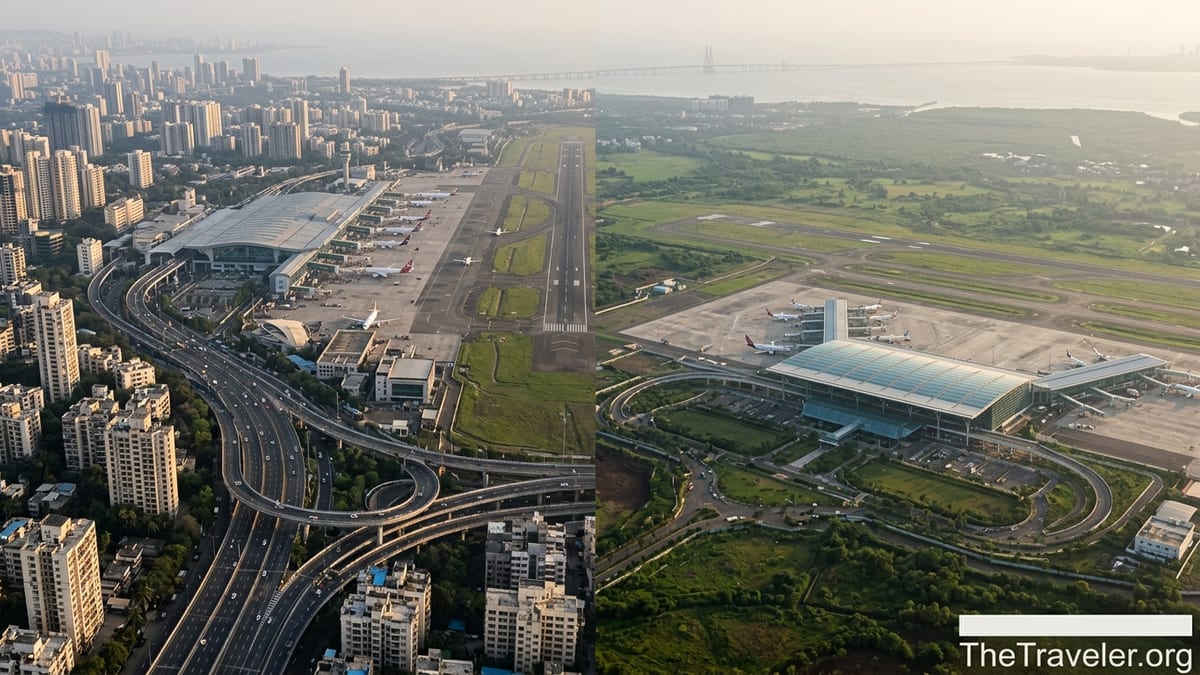
Understanding the Two Mumbai Airports
Mumbai’s original gateway, Chhatrapati Shivaji Maharaj International Airport, commonly referred to as Mumbai Airport or simply BOM, is located in the western suburb of Andheri. It has two main terminals: Terminal 1 for most low-cost domestic carriers and Terminal 2 for international flights and full-service domestic airlines. This is the airport most people still mean when they say “Mumbai Airport,” and it remains India’s second-busiest hub with an extensive global and domestic network.
Navi Mumbai International Airport sits on the opposite side of the harbor, near Ulwe and Panvel in Raigad district. The site is roughly 40 kilometers east of South Mumbai and around 35 kilometers southeast of the existing BOM terminals. It was conceived to relieve congestion at Andheri and to serve the rapidly growing planned city of Navi Mumbai and the industrial belt stretching toward Pune and the Konkan coast.
For travelers, the key point is that both airports serve the greater Mumbai Metropolitan Region, but they are in very different places and are connected to different urban cores. If your business meeting is in Bandra Kurla Complex, the airport in Andheri usually makes more sense. If you are heading to Vashi, Kharghar, Panvel or the new residential corridors along the Mumbai Trans-Harbour Link, Navi Mumbai airport may cut your ground travel dramatically.
Because the new airport is being phased in, capacity and airline presence still lag far behind the main Mumbai airport. Early operations focus on a limited set of domestic routes and select carriers, while BOM continues to handle the overwhelming majority of international and long-haul traffic. This imbalance will gradually change, but for now it strongly shapes which airport you can realistically use.
Which Airport Is Better for Your Destination in Mumbai
The simplest way to decide is to look at where you actually need to be after you land. Greater Mumbai sprawls from the historic Fort area in the south to Mira Road and beyond in the north, and far across the harbor into Navi Mumbai and Panvel. A taxi ride from one side to the other can feel like a mini road trip, especially at rush hour.
If your destination is South Mumbai, such as Colaba, Fort, Marine Drive or Nariman Point, the established BOM airport in Andheri typically wins. In off-peak traffic, a prepaid taxi or ride-hail car to Colaba might take about 60 to 75 minutes. From Navi Mumbai airport, that same journey involves crossing the harbor and can stretch well beyond 90 minutes once you factor in transfers, even with the newer sea link bridges in place.
For western and central suburbs, including Bandra, Khar, Juhu, Andheri, Powai, Ghatkopar and Mulund, BOM is the natural choice. The airport is effectively embedded within this belt. A traveler staying in a mid-range hotel in Bandra Kurla Complex, for example, may reach their room from BOM Terminal 2 in 25 to 40 minutes by cab outside peak hours. Reaching BKC from Navi Mumbai airport requires crossing the harbor, adding time, distance and tolls.
Where Navi Mumbai airport comes into its own is for the satellite city and mainland districts. If you are staying in Vashi, Nerul, Belapur, Kharghar, Panvel, Taloja or heading toward Pune by road, Navi Mumbai airport can save an hour or more each way. A business traveler flying in for meetings at an IT park in Kharghar can step out of Navi Mumbai airport and typically reach the office in under 40 minutes by taxi in moderate traffic, compared with well over 90 minutes from BOM during busy times.
Airlines, Routes and Who Flies Where
At this stage, BOM remains the overwhelming leader in terms of airlines and destinations. It is the primary base for a wide roster of domestic carriers and hosts most major international airlines serving India. Long-haul routes to places such as London, New York, Dubai, Singapore and Frankfurt all operate from BOM’s Terminal 2, alongside domestic services from full-service airlines like Air India and Vistara and several regional and low-cost players.
Navi Mumbai airport has opened with a much more modest portfolio, centered on domestic routes to major Indian cities. Expect to find a handful of daily flights to metros like Delhi, Bengaluru, Hyderabad and possibly some tier-two cities, often with one or two key partner airlines. Early schedules have typically focused on connecting Navi Mumbai and Panvel residents to the national network without requiring a trek across the harbor to Andheri.
This asymmetry matters when you start searching for tickets. If you are flying in from Europe, North America, the Gulf or Southeast Asia, nearly all nonstops and one-stop itineraries into Mumbai currently default to BOM. To use Navi Mumbai, you would probably need to connect via another Indian city on a domestic leg, which may or may not be efficient compared with simply landing at BOM and taking a taxi.
Domestic travelers, on the other hand, increasingly have a choice. Suppose you are flying from Bengaluru for a week-long project in Nerul. You might find morning and evening departures into both airports. In that case, choosing Navi Mumbai could save you a significant amount of time on the ground, even if the flight timings or fares are roughly similar. Conversely, if you are connecting onward internationally the same day, it is usually safer to route everything through BOM to avoid an airport change.
Getting To and From Each Airport
Ground transport is where the practical differences between the two airports become most obvious. BOM sits close to Mumbai’s Western Express Highway and is integrated into the city’s established taxi, app-based cab and suburban rail ecosystem. Prepaid taxis operate from official counters, and ride-hailing services serve dedicated pickup zones. Depending on traffic, a straightforward cab from BOM to South Mumbai can cost a moderate amount at metered rates, while a ride to Bandra or Powai is typically cheaper and quicker.
Navi Mumbai airport, by contrast, is being built as a flagship multimodal hub from scratch. It connects to the mainland highway network toward Pune and Goa, and its planning includes links to upcoming metro lines and the Mumbai Trans-Harbour Link. In practice, this means that for now, most travelers will rely on taxis, app-based cabs and private car transfers, but over time they can expect direct metro and bus corridors to important nodes like Navi Mumbai’s CBD Belapur, Vashi and eventually even connections across to Mumbai’s metro grid.
Ride times are still evolving as roads open and settle into regular traffic patterns. A traveler landing at Navi Mumbai and heading to Panvel might be in a car for as little as 20 to 30 minutes outside peak periods. The same trip from BOM could push an hour or more, often involving slow sections through Sion, Chembur and Vashi. For someone heading the other way, for instance from Navi Mumbai airport to Bandra Kurla Complex, even optimistic estimates can tip over an hour once you cross the harbor and hit city congestion.
Public transport integration remains strongest at BOM. Several city bus routes connect the airport to rail hubs such as Andheri, Vile Parle and Ghatkopar, where you can hop onto the suburban trains or metro corridors. Budget travelers often combine a short auto-rickshaw ride from the terminal to a nearby station with a suburban train ticket that costs a fraction of a taxi fare to South Mumbai. Navi Mumbai airport’s equivalent budget options are still being built out, so for now you should plan on private road transport when landing there.
Traffic, Delays and the On-the-Ground Experience
One of the main arguments for building Navi Mumbai airport was congestion. BOM handles a heavy volume of flights on limited runway capacity, which means aircraft can face holding patterns in the air and queues for takeoff on the ground, especially during peak evening hours. Inside the terminals, security and immigration queues fluctuate depending on the time of day and holiday seasons. Many frequent flyers build in generous buffers for departures from BOM, particularly for international flights.
The newer Navi Mumbai airport, with fewer flights and a modern layout, often feels calmer in these early years. Shorter queues at check-in and security can translate into a smoother door-to-gate experience. A traveler on a Monday morning domestic hop to Hyderabad, for example, might arrive at Navi Mumbai airport 90 minutes before departure and clear formalities in 20 to 30 minutes, leaving ample time to find a coffee or work from a seating area near the gate.
That said, new airports also go through teething troubles. Initial months can see temporary closures of certain access roads, signage that still confuses drivers, and occasional last-minute gate changes as airlines fine-tune operations. BOM, by contrast, is a known quantity with mature systems and well-practiced staff, even if it can be crowded. Its international Terminal 2 is often praised for its architecture, art displays and relatively efficient layout once you are past security.
Weather and air traffic control constraints affect both airports in a similar way, since they share the same coastal climate and fall under the same regional airspace. During the monsoon, heavy rain can disrupt operations and slow down ground access, so it becomes even more important to leave extra time whether you are using BOM or Navi Mumbai.
Common Booking Mistakes and How to Avoid Them
The rise of a second airport in any city tends to generate confusion on booking platforms, and Mumbai is no exception. One of the most common mistakes is assuming that any reference to “Mumbai” or the familiar “BOM” code automatically means the Andheri airport, without checking which gateway the airline actually uses. Some domestic carriers are beginning to market Navi Mumbai services with descriptors like “Mumbai – Navi Mumbai” alongside “Mumbai – Andheri,” which can be easy to overlook in a hurry.
Another frequent pitfall involves mixed-airport itineraries. A traveler might book an inbound international flight into BOM and then pick a separate domestic ticket from Navi Mumbai on the same day, thinking both flights share the same general “Mumbai” label. In reality, this requires an airport transfer across the metropolitan region, with all the added time, cost and stress that entails. If your connection is under six hours and you are crossing during peak traffic, this plan can be very risky.
Travelers also sometimes misjudge the impact of ground transport on late-night arrivals and early-morning departures. For example, landing at Navi Mumbai at midnight when your hotel is in Juhu means a long cab ride when you are most tired. Conversely, booking a 6 a.m. departure from BOM when you are staying in Kharghar or Panvel means leaving your hotel in the middle of the night. It is easy to focus on flight price and timing while forgetting that the city-side journey may be just as significant.
To avoid these headaches, always confirm the exact airport name and, where possible, the terminal number before you click “buy.” Cross-check it against your accommodation or meeting address in an online map, and estimate both time and cost door to door. If you see separate listings such as “Mumbai (BOM)” and “Navi Mumbai” for the same route, take a moment to decide which actually fits your ground plans rather than defaulting to the cheapest fare.
Practical Scenarios: Which Airport Should You Choose?
Consider a family from Dubai flying in for a week-long holiday in Mumbai, with a serviced apartment booked near Marine Drive. Because they are arriving from overseas and staying in South Mumbai, BOM is the clear choice. They can fly nonstop into Terminal 2, clear immigration and customs, and then take a prepaid taxi directly to their accommodation in about 60 to 75 minutes in moderate traffic, without navigating an extra domestic connection or an inter-airport transfer.
Now imagine a consultant from Bengaluru who has a three-month assignment in a corporate park near Kharghar. They fly home most weekends and value a predictable commute to and from the airport. In this case, Navi Mumbai airport can be a strong option if their preferred airline operates there. A short domestic flight into Navi Mumbai followed by a 30 to 40 minute taxi ride to Kharghar is far easier than fighting across the city from Andheri every Friday and Monday.
For a traveler connecting internationally, timing and risk tolerance come into play. Suppose you are flying from Nagpur to Mumbai and then on to London the same evening. If your domestic airline offers flights into both BOM and Navi Mumbai, it is almost always wiser to choose BOM and stay within the same airport complex. Even if the domestic fare into Navi Mumbai is slightly cheaper, the potential cost and stress of crossing the city to catch your long-haul flight are rarely worth the savings.
On the other hand, if you are planning a coastal Maharashtra road trip down to Alibaug, Kashid and beyond, starting from Navi Mumbai airport could fit nicely. You can land close to the mainland highway network, pick up a rental car or meet a pre-booked driver, and head south without needing to navigate central Mumbai at all. Here, the choice of airport becomes part of crafting a smoother, more relaxed itinerary.
The Takeaway
The decision between Mumbai’s established BOM airport and the new Navi Mumbai airport is less about which is “better” overall and more about which is better for your specific trip. BOM still dominates in terms of international connectivity, airline choice and integration with Mumbai’s western and central suburbs. If your plans center on South Mumbai, Bandra, Juhu, Andheri, Powai or onward international connections, it usually remains the smart default.
Navi Mumbai airport, meanwhile, is steadily carving out a role as the preferred gateway for the mainland. Travelers whose business or family ties lie in Vashi, Nerul, Belapur, Kharghar, Panvel or the corridors toward Pune and Goa can save considerable time and frustration by flying there when airline schedules allow. Its newer infrastructure and relatively lighter crowds can make for an efficient, low-stress airport experience.
Whichever airport you pick, the key is to think beyond the flight itself. Map your full door-to-door journey, factor in traffic, tolls and time of day, and be wary of itineraries that involve changing airports on the same day. With a bit of planning and a clear understanding of how the two gateways differ, Mumbai’s twin-airport system can work in your favor instead of becoming an unpleasant surprise.
FAQ
Q1. Is Navi Mumbai airport closer to South Mumbai than BOM?
Not in most practical cases. BOM in Andheri generally offers quicker access to South Mumbai by taxi or car, especially outside peak traffic hours.
Q2. Which airport should I choose if I am staying in Vashi or Nerul?
If your airline operates from Navi Mumbai airport, that is usually the better choice for Vashi, Nerul and other Navi Mumbai neighborhoods, as it reduces your ground travel time.
Q3. Can I connect from an international flight at BOM to a domestic flight at Navi Mumbai on the same day?
It is technically possible but often risky. You would need to clear immigration, collect bags and then travel across the metropolitan region, which can take several hours with traffic.
Q4. Do both airports use the same city code when booking?
Some booking systems group them under the broader Mumbai area, while others list Navi Mumbai separately. Always check the full airport name on your ticket before confirming.
Q5. Which airport has more international flights?
BOM currently has far more international routes and airlines. Navi Mumbai airport is starting mainly with domestic services and has limited or no long-haul international options so far.
Q6. Are taxi and ride-hailing services easily available at both airports?
Yes. BOM has a long-established network of prepaid taxis, metered cabs and app-based services, while Navi Mumbai airport also offers taxi and ride-hail pickups at designated zones.
Q7. Is public transport better from BOM or Navi Mumbai airport?
At present, BOM has stronger links to suburban rail and city buses. Navi Mumbai airport’s metro and bus connections are planned but still developing, so taxis are more common there for now.
Q8. Which airport is better for catching a flight during the monsoon?
Neither airport is completely immune to monsoon disruptions. BOM has more experience handling adverse weather, while Navi Mumbai may benefit from newer infrastructure, but you should allow extra time at either.
Q9. If I am flying only within India, does it matter which Mumbai airport I use?
It matters mainly for where you are staying or working. Choose the airport that minimizes your road travel at your arrival and departure times, even if flight times or fares look similar.
Q10. How can I avoid booking the wrong Mumbai airport by mistake?
Always read the airport name carefully, compare it with your accommodation location on a map, and be cautious of separate listings for “Mumbai” and “Navi Mumbai” on flight search engines.