


Landing at Seattle–Tacoma International Airport (SEA) can feel like a maze, especially if you are jet lagged or arriving for the first time. The good news is that once you know where to walk and what signs to follow, getting from your aircraft door to downtown Seattle, a nearby hotel, or a rental car is straightforward. This guide walks you through each stage after landing, with concrete details on baggage claim, customs, ATMs, SIM cards, light rail, taxis, rideshares, shuttles, buses, and rental cars at SEA.
Get the latest updates straight to your inbox!
Understanding SEA’s Layout After You Land
Seattle–Tacoma International Airport has one main terminal building with four concourses, plus a separate South Satellite that handles most long haul international flights. If you arrive on an Alaska Airlines or Delta domestic flight from cities such as Los Angeles, Denver, or Chicago, you will usually park at one of the main concourse gates. Many international flights from Europe and Asia, including services from London, Frankfurt, and Seoul, often arrive at the South Satellite and then connect to SEA’s international arrivals facility.
Once you step off the aircraft, overhead signs become your best navigation tool. Signs for “Baggage Claim” and “Ground Transportation” are color coded and repeated at nearly every junction. If you are continuing to another flight, look for “Connecting Flights” or your airline’s recheck counters. If Seattle is your final stop, follow the baggage claim icons all the way to the lower level of the main terminal, where all carousels are located in a single continuous hall.
Distances at SEA can feel long, especially if you arrive at the South Satellite. From there, you take an automated people mover or an overhead walkway into the main terminal and then continue to passport control or baggage claim, depending on your flight. Elevators and escalators are available at each transition point, and airport volunteers in bright, branded vests are frequently stationed near major decision points to answer questions or point you to ground transportation and transit.
The main terminal’s baggage claim level is also where you find most arrival amenities such as restrooms, a few coffee kiosks, information desks, and indoor access to the parking garage. Once you reach this level, you can think in three directions: toward your baggage carousel, toward the exits and garage, or toward the walkway that leads to the light rail station.
Baggage Claim and Customs: Domestic and International Arrivals
If you arrive on a domestic flight, baggage claim is straightforward. Check the digital monitors just outside the escalators for your flight number and carousel assignment. For example, an Alaska Airlines flight from Phoenix might list “Carousel 12” while a Delta flight from Atlanta uses “Carousel 3.” Bags typically appear within 15 to 30 minutes, but during peak evening bank times you may wait a bit longer. Free luggage carts are not guaranteed, so if you know you will have multiple bags, booking a wheelchair or porter service through your airline in advance is wise.
For most international passengers, SEA’s process involves passport control, baggage claim, and customs inspection before you exit to the public arrivals hall. Flights from cities that do not have U.S. preclearance, such as Tokyo or Paris, arrive into the international arrivals facility. You follow “Arrivals / Baggage Claim” and “Passport Control” signs, queue according to your passport type and any trusted traveler program you have, and then collect your checked bags from a dedicated international carousel hall before passing U.S. Customs and Border Protection inspection.
If you arrive from a Canadian or Irish airport with U.S. preclearance, such as Vancouver, Toronto, or Dublin, you generally clear U.S. immigration and customs before boarding your flight. At SEA this usually means you land like a domestic passenger. You simply walk straight to the main baggage claim hall and then out to ground transportation without another passport check. It still pays to follow airline and airport signage closely, as gate routing can change and some precleared flights occasionally share concourses with other international services.
Passengers connecting onward from an international flight usually have to collect their bags and then drop them at a dedicated recheck belt after customs if their airline and ticket support through-checking. The recheck counters are located just beyond customs exit doors and are clearly marked with airline logos. If your final destination is somewhere like Spokane or Portland and you are on one ticket, airline staff in the arrivals hall can point you straight to the drop point so you can proceed to the security checkpoint and your next gate without reentering the public departures level.
Cash, ATMs, SIM Cards and Connectivity on Arrival
Once you have cleared baggage claim and customs, you may want local cash or mobile data before heading into the city. On the baggage claim level, you will find bank branded ATMs scattered along the hall and near the walkways into the parking garage. These machines generally dispense U.S. dollars in a mix of 20 and 10 dollar bills and accept major international card networks such as Visa, Mastercard, and Plus. Airport ATMs typically charge a higher usage fee than machines in the city, so withdrawing a modest amount for immediate needs, such as a taxi tip or bus fare, is usually sufficient.
For mobile connectivity, most major U.S. carriers such as T Mobile, AT&T, and Verizon cover the airport area well. If you are an international visitor planning to stay longer than a few days, a prepaid eSIM is often the most convenient option. Many travelers purchase a digital plan from companies such as Airalo or Holafly before departure and activate it while taxiing to the gate, which allows them to use data the moment the aircraft doors open. If you prefer a physical SIM, you may find small kiosks or electronics shops on the ticketing or concourse levels selling starter kits for common U.S. carriers, but availability can vary by day and time.
SEA offers free airport Wi Fi throughout the terminal, including baggage claim and the walkways to parking and transit. The network typically appears in your device list as an airport branded name and may require accepting simple terms and conditions but does not usually require payment. This makes it easy to order a rideshare, check public transit schedules, or message your hotel while you are still standing at the carousel. If you plan to use mobile boarding passes on your return trip, confirm that you have a data option that will still work when you come back to the airport in case the Wi Fi is busy.
Travelers arriving late at night or very early in the morning should be aware that some retail shops and kiosks on the public side of the terminal may be closed. If you rely on buying a SIM card or small electronics accessory on arrival, it helps to travel with a backup solution, such as a partially loaded eSIM or an unlocked phone capable of tethering to a companion device, so you are not stuck without navigation and rideshare apps.
Finding the Link Light Rail and Buses into the City
The Link light rail is one of the easiest and most budget friendly ways to reach downtown Seattle from the airport. Trains on the 1 Line typically run every 8 to 15 minutes during the day and evening, with slightly longer gaps late at night. The trip between SEA and central downtown stations such as Westlake averages around 35 to 40 minutes. Fares depend on distance but are generally comparable to other U.S. urban rail systems and noticeably cheaper than taxis or rideshare for solo travelers.
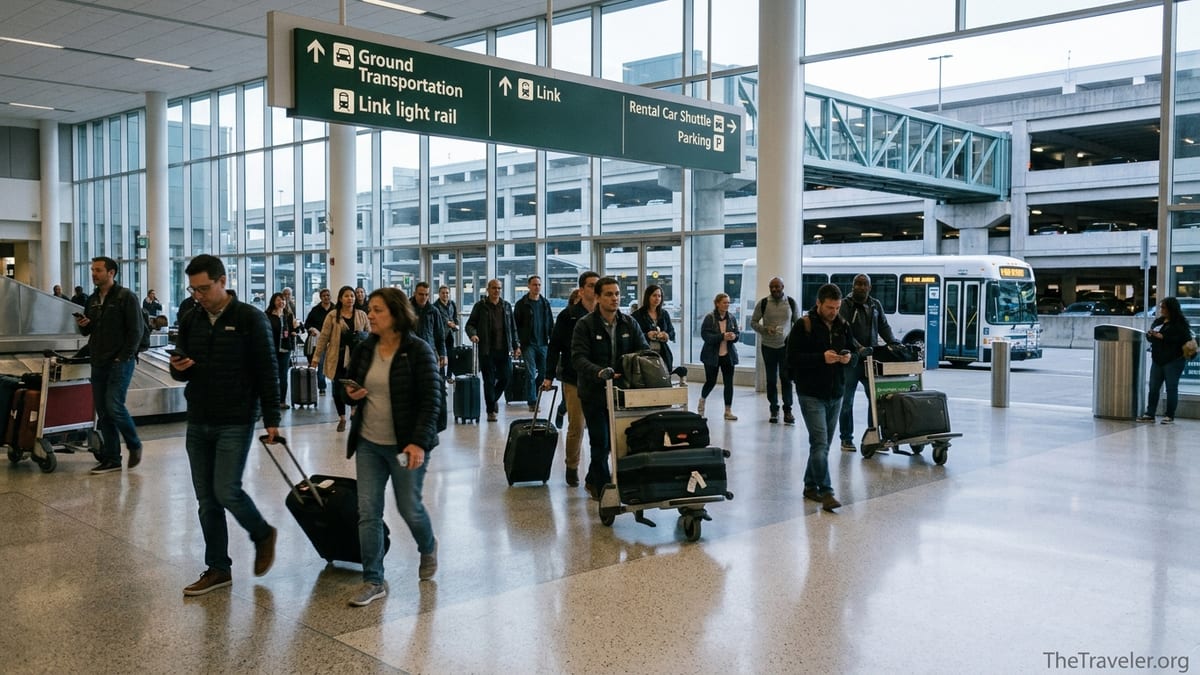
From baggage claim, look for overhead signs that read “Link light rail” or “Trains.” These guide you along the baggage claim hall toward the north end of the terminal, where you cross into the parking garage via a skybridge. Once you enter the garage, additional signs direct you along a covered walkway toward the light rail station on International Boulevard. Elevators and escalators connect the skybridge and station platforms, so you can avoid stairs if you have heavy luggage or a stroller.
At the station, you will find ticket vending machines that accept cards and cash, along with fare information posters for the 1 Line. Many travelers choose to purchase a reusable transit card, such as an ORCA card, if they plan to use buses and trains during their stay. Others simply buy a one way ticket for the next train. If you are heading to a hotel near downtown, neighborhood station names to watch for include International District/Chinatown, University Street, Westlake, and Capitol Hill, depending on where you are staying.
Several local and regional buses connect near the airport as well. King County Metro and other operators run routes along International Boulevard, which you can access by walking from the terminal through the garage and past the light rail station toward street level stops. For example, travelers connecting to nearby suburbs or to the Tukwila International Boulevard Station area often use these buses as a first leg. If you are carrying bulky luggage, light rail is usually more comfortable, but buses can be useful if your destination is south or east of the airport and not on the train line.
Taxis, Rideshare Pickups, and Hotel Shuttles
After collecting your bags, you have several ground transportation options. Official taxis line up on the same general level as baggage claim, in designated zones along the terminal drives. You follow “Taxi” and “Ground Transportation” signs toward the center or north of the terminal, where dispatchers direct riders to the next available cab. Taxi fares into downtown Seattle are metered and can vary with traffic, but many visitors report approximate costs that are competitive with peak time rideshare prices, especially during heavy demand.
App based rideshare services such as Uber and Lyft must use a dedicated pickup area inside the airport’s parking garage, not the curb outside baggage claim. From the baggage claim hall, follow signs for “Parking” and “Rideshare” into the garage and then up or down to the level marked for TNC or rideshare pickups, currently on a mid level floor with numbered stalls. Once you request a ride in your app, it will specify the exact row or stall number where your driver will meet you. This system helps reduce congestion at the terminal curb and is actively enforced, so do not expect your driver to collect you right outside the sliding doors.
During busy arrival waves, such as Sunday evenings, rideshare wait times and prices can increase significantly. Travelers on tighter budgets sometimes ride Link light rail one or two stops away from the airport, for instance to Tukwila International Boulevard Station, and then request a rideshare from there to reduce the airport surcharge and demand driven price spikes. This approach involves more walking and some luggage handling on transit but can be a useful strategy for cost conscious solo travelers heading to neighborhoods not directly on the rail line.
Many airport hotels in the SeaTac area offer complimentary shuttle buses. These typically pick up from marked “Courtesy Hotel Shuttles” islands along the curb outside baggage claim, often near the entrances to specific skybridges. After you exit the terminal, look for tall signs labeled with hotel names or a generic courtesy shuttle symbol. Shuttles generally run every 15 to 30 minutes, and some hotels require you to call the front desk upon landing so they can dispatch a driver. If you are staying at a downtown Seattle hotel, check in advance whether they offer any private shuttle or recommended transfer service, as most rely primarily on light rail or rideshare.
Rental Cars and the Consolidated Rental Car Facility
SEA uses a consolidated rental car facility located a short distance from the main terminal. Major agencies such as Hertz, Avis, Enterprise, Budget, National, and Alamo cluster in this single complex, which is reached by a dedicated, frequent airport shuttle. This setup reduces traffic around the terminal and makes it easier to compare rental counters once you arrive, since most brands are in the same building rather than scattered around the airport perimeter.
After you collect your luggage, follow the “Rental Car Shuttle” signs toward the outer curb areas near specific skybridge entrances on the baggage claim level. Here you will find clearly marked bus stops where large, branded rental car facility shuttles pull up. Buses are free, run frequently throughout the day, and accommodate luggage in onboard racks or at your seat. The ride to the rental car center generally takes around 5 to 10 minutes, depending on traffic and any construction near the access roads.
Inside the rental car facility, you will find a row of rental company counters similar to those at other large U.S. airports. If you reserved a car in advance, you can proceed directly to your company’s counter or, for some loyalty programs, directly to the garage area where your name and stall number appear on digital boards. If you are arriving without a reservation, staff at competing counters may be able to quote walk up rates, but during peak summer or holiday travel periods inventory can be tight, so advance booking is strongly recommended.
When you return your car at the end of your trip, you bring it back to the same facility and then ride the shuttle back to the terminal. Shuttles drop departing passengers near the ticketing level and security checkpoints. If you have an early morning flight, factor in the time required to refuel your car, complete the return inspection, and take the shuttle back to the terminal. Many travelers aim to arrive at the rental facility at least 45 to 60 minutes before their recommended airport check in time to avoid a last minute rush.
Practical Tips for a Smooth Arrival at SEA
A few simple habits can make your arrival at Seattle–Tacoma International Airport smoother. First, keep your boarding pass and any checked baggage receipts handy until you are outside the customs and baggage claim areas. Airline staff may request them if you need help locating a delayed bag or confirming a recheck connection. Taking a quick photo of your baggage tag numbers on your phone before you leave check in at your departure airport can also speed up any tracing process if something goes missing.
Second, plan your ground transportation before you land. If you know you will take Link light rail, check the latest schedule and fare information and note which stop is closest to your hotel. If you expect to use rideshare, confirm that your app is set up with a valid payment method and updated phone number so your driver can reach you. Travelers on expense accounts or tight schedules often prefer taxis for their simplicity, while budget travelers and solo visitors frequently favor light rail for its predictable cost and travel time into downtown.
Third, consider your luggage strategy with SEA’s layout in mind. The walks between gates, baggage claim, and the light rail station can be long for travelers with heavy suitcases. Using a rolling suitcase plus a backpack instead of multiple small bags can make these transfers easier. Families with young children often find it worthwhile to bring compact strollers that can be gate checked and quickly collected on arrival, especially if they plan to use public transit instead of a door to door car service.
Finally, be ready for Pacific Northwest weather the moment you leave the protected terminal and garage. Even a short wait at the taxi or shuttle stand can feel chilly and damp in winter or during spring rain showers. Keeping a light waterproof jacket or compact umbrella in an accessible pocket of your carry on can make those first minutes outside more comfortable, whether you are walking to the rideshare pickup area, waiting for a hotel shuttle, or crossing the pedestrian bridge to the light rail station.
FAQ
Q1. How long does it usually take to get from landing to the curb at Seattle–Tacoma International Airport?
For domestic flights with checked bags, many travelers report 30 to 45 minutes from gate arrival to the curb. International arrivals can range from 45 minutes to over an hour, depending on passport control and customs lines.
Q2. Is it better to take Link light rail or a rideshare into downtown Seattle?
Link light rail is usually cheaper and more predictable in heavy traffic, making it a strong choice for budget travelers and solo visitors. Rideshare or taxi can be faster door to door very late at night or if your hotel is far from a light rail station.
Q3. Where exactly do Uber and Lyft pick up passengers at SEA?
App based rideshare pickups occur in a designated area inside the airport parking garage, on a level signed for TNC or rideshare. You access it from baggage claim by following “Parking” and “Rideshare” signs, then meet your driver at a numbered stall shown in your app.
Q4. How do I reach the light rail station from baggage claim?
From the baggage claim level, follow overhead signs for “Link light rail” toward the north end of the terminal, cross a skybridge into the parking garage, and continue along the marked, covered walkway to the station on International Boulevard.
Q5. Are there ATMs and currency exchange services available on arrival?
Yes. You will find several bank branded ATMs along the baggage claim level and near the walkways to the parking garage. Dedicated currency exchange counters may have limited hours, so many visitors rely on ATMs or prepaid cards instead.
Q6. Can I buy a SIM card at Seattle–Tacoma International Airport when I land?
Availability of physical SIM cards on the public side of the terminal can vary, and opening hours are not always aligned with late night arrivals. Many international travelers now use prepaid eSIM services purchased before departure and activate them while taxiing to the gate.
Q7. How do I get to the rental car facility from the terminal?
After collecting your bags, follow “Rental Car Shuttle” signs to the outer curb near specific skybridge entrances, where large rental car shuttles pick up. These free buses take about 5 to 10 minutes to reach the consolidated rental car facility.
Q8. Do hotels near SEA offer free shuttles from the airport?
Many airport area hotels provide complimentary shuttles that pick up from the “Courtesy Hotel Shuttles” zones outside baggage claim. Schedules vary, so check with your hotel in advance and call upon landing if required.
Q9. Is it safe to arrive late at night and use public transit from SEA?
Link light rail and local buses generally operate into the late evening, and many travelers use them safely. As in any major city, it is sensible to stay aware of your surroundings, keep valuables secure, and sit near other passengers or train operators where possible.
Q10. What should I do if my checked luggage does not appear on the carousel?
Remain near your assigned carousel until it stops, then visit your airline’s baggage service office located near the baggage claim area. Provide your baggage claim tag number and contact details so staff can trace your bag and arrange delivery or pickup once it is found.