


Mumbai’s metro has quietly transformed how travelers move to and from Chhatrapati Shivaji Maharaj International Airport (CSMIA). With Line 1 and the newer underground Line 3 now linking both terminals to key neighborhoods and railway hubs, it is finally possible to skip long traffic jams and unpredictable taxi queues. This guide explains, in practical detail, how to use the metro from Terminal 1 and Terminal 2, how Marol Naka and Sahar Road fit into the network, what to expect with tickets and luggage, and when the metro genuinely beats taking a cab.
Get the latest updates straight to your inbox!
Understanding the Airport Metro Network: The Basics
Mumbai’s airport is served by two separate metro corridors that work together. Line 1, often called the Blue Line, runs elevated from Versova in the west to Ghatkopar in the east, with key stations such as Andheri, Airport Road and Marol Naka. This line is crucial because it connects into the city’s suburban rail system at Andheri and Ghatkopar, making it the workhorse for budget-conscious travelers heading to major railway hubs or suburbs.
Complementing this is Line 3, the underground Aqua corridor that runs broadly north–south from Aarey in the north towards Cuffe Parade in South Mumbai. Along the way, it serves CSMIA’s Terminal 1 and Terminal 2 with dedicated underground stations and interchanges with Line 1 at Marol Naka and with long-distance rail at Mumbai CSMT. In practice, this means you can step out of the airport, descend directly into a climate-controlled station, ride to Marol Naka, switch to Line 1 and continue to Andheri or Ghatkopar without going outdoors for long stretches.
For a typical visitor, the key nodes to remember are: CSMIA Airport T1 station on Line 3, CSMIA Airport T2 station on Line 3, Marol Naka on both Line 1 and Line 3, Sahar Road on Line 3, Airport Road station on Line 1 and the bigger interchanges at Andheri and Ghatkopar on Line 1. Once you know these names, it becomes fairly simple to piece together a route from the airport to almost anywhere in the metropolitan region.
Service on both lines generally runs from early morning to late evening, with trains roughly every 5 to 10 minutes during the day. While exact headways can vary by time of day and day of week, the experience for most travelers is that you rarely wait longer than one regular traffic signal cycle in Mumbai’s notorious road congestion.
CSMIA Terminal 1: From Check-out to Metro Platform
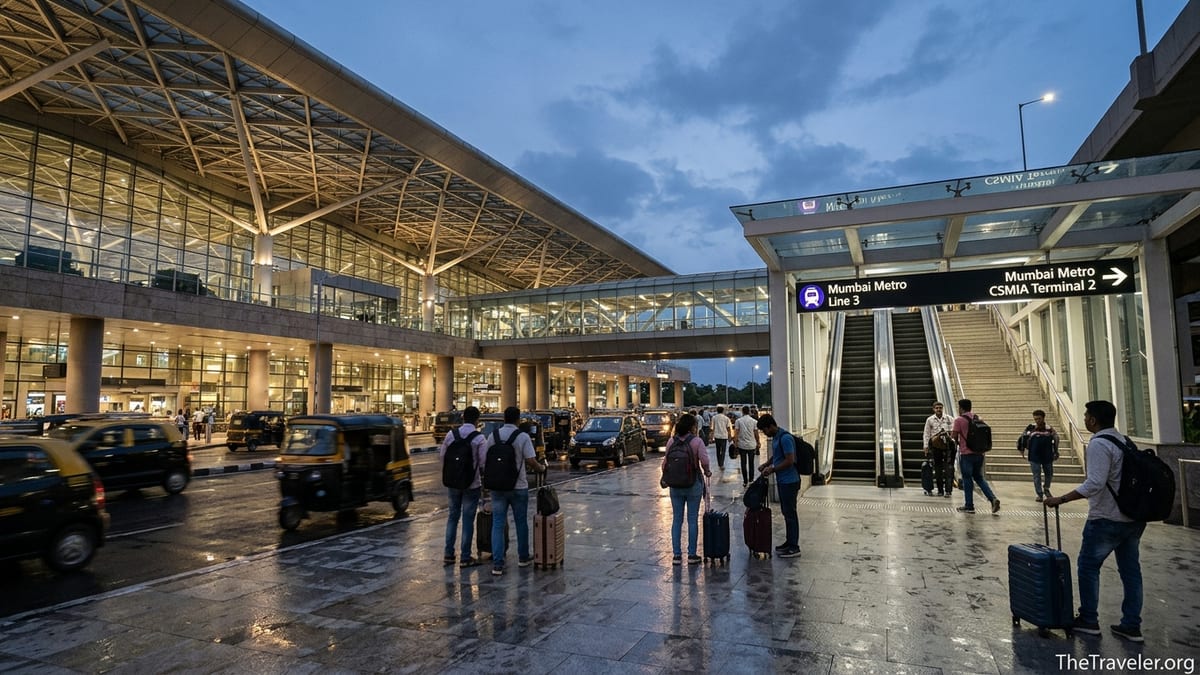
CSMIA’s domestic Terminal 1 is popular with low-cost carriers and sees heavy footfall during morning and evening peaks. The dedicated CSMIA Airport T1 metro station on Line 3 lies just outside the terminal complex, connected by clearly signed walkways and shuttle paths. After exiting baggage claim, follow signs for “Metro / Line 3 / CSMIA T1” rather than “Taxi” or “App cabs.” The walk for most gates is roughly 5 to 10 minutes, which is manageable even with a medium suitcase and cabin bag.
Once at the station entrance, you pass standard security screening before reaching the concourse level. Ticket counters and automatic vending machines sell single-journey QR tickets and, increasingly, reusable smartcards or wristbands compatible with Mumbai Metro systems. A typical one-stop ride from CSMIA T1 to Marol Naka on Line 3 costs in the low double digits in rupees, often less than what you would tip a taxi driver. Even a longer journey, for example T1 to CSMT in South Mumbai via Line 3, usually stays under a couple of hundred rupees per person, which is substantially cheaper than a cab in moderate traffic.
Because Terminal 1 primarily serves domestic flights, peak arrival waves around early morning and late evening can mean short queues at ticket counters. Regular commuters often use the official mobile app to purchase QR tickets in advance, but as a visitor you can safely rely on the machines. They accept cash and cards, and staff on the concourse are used to guiding first-time users through the process. If you are landing with family or a small group, buying separate single-journey QR tickets for each traveler is usually simpler than attempting a shared smartcard on your first ride.
From the concourse, escalators and elevators lead down to the Line 3 platforms. Trains are fully air-conditioned, with level boarding and wide doors that make boarding with suitcases much easier than climbing into a crowded local train. If you are heading to Marol Naka for Line 1, CSMIA T2 or Sahar Road, listen for in-train announcements and watch the overhead route maps. The travel time from T1 to Marol Naka is generally around 5 to 7 minutes, which is dramatically faster than battling airport flyover traffic at busy times.
CSMIA Terminal 2 and Sahar Road: Gateway to North and South Mumbai
International Terminal 2, with its high ceilings and art-filled concourses, now has its own underground metro station on Line 3: CSMIA Airport T2. This station sits beneath the terminal complex, with elevator and escalator access from arrival and departure areas. After clearing immigration and customs, look for “Metro / Aqua Line / CSMIA T2” signage. For most arriving passengers, the walk to the metro entrance is shorter than the walk to some of the more distant prepaid taxi queues.
Ticketing at CSMIA T2 mirrors Terminal 1. You can buy single-journey tokens or QR tickets for Line 3, and then either continue along the same line or interchange later. For example, an international passenger heading to a business hotel in Lower Parel could ride from CSMIA T2 directly down Line 3, alighting at stations such as Mahalaxmi or nearby stops, instead of navigating multiple flyovers in a cab. The fare will typically be a fraction of a taxi bill, especially during late-night surcharge hours.
One station away from T2 is Sahar Road on Line 3, which sits under the dense airport-adjacent neighborhood historically known for airport staff housing and modest hotels. Some travelers staying in budget hotels along Sahar Road or old Airport Road prefer to alight here and walk or take a short auto rickshaw ride to their lodging. Others might use Sahar Road as a back-door entry to the broader Andheri–Kurla corridor, avoiding the busier T2 entrances. In practice, though, most visitors will find it simpler to stay on the train until Marol Naka, where interchange with Line 1 is seamless.
For passengers continuing to other parts of the metro system, CSMIA T2 is also strategically placed. From here, you can head north on Line 3 towards SEEPZ and Aarey for corporate parks, or south towards Bandra Kurla Complex and South Mumbai. As more stretches of Line 3 open and train frequency increases, T2 is steadily becoming one of Mumbai’s most important multi-modal hubs, reducing dependence on taxis for both office commuters and air travelers.
Marol Naka and Line 1: Connecting Airport Metro to the City
Marol Naka is where the underground Line 3 and the elevated Line 1 meet, making it the key transfer point for airport passengers heading to Andheri, Ghatkopar, the Western Railway line or Central Railway. On street level, Marol Naka sits along Andheri Kurla Road, one of Mumbai’s busiest east–west corridors, but as a traveler you primarily experience it as a dual-level metro node: Line 3 platforms below ground, Line 1 platforms above.
Arriving from CSMIA T1 or T2 on Line 3, you follow interchange signs at Marol Naka to exit the fare-paid area, ascend via escalators, and re-enter through Line 1 ticket gates. This involves a short but clearly marked indoor walk. Travelers with luggage should look for elevator signs; both lines are designed with lifts, though during peak commuter hours they can be busy. A typical connection from a Line 3 train to a Line 1 train can easily be done in under 10 minutes if you walk at a moderate pace.
Line 1 trains from Marol Naka run west towards Andheri and Versova, and east towards Saki Naka and Ghatkopar. For example, if you are catching a long-distance train from Lokmanya Tilak Terminus or have a suburban connection at Ghatkopar, you would board an eastbound Line 1 train. The ride from Marol Naka to Ghatkopar usually takes under 15 minutes with no interchange needed. From Ghatkopar, a short skywalk leads directly to the Central Railway station, where frequent local trains connect to Thane, Dombivli and beyond.
Westbound, Andheri on Line 1 links directly to Andheri’s Western Railway station via an elevated walkway. This is especially useful if you are heading to western suburbs such as Bandra, Borivali or Vasai. A passenger arriving at T2 at 9 am, for instance, could reach Andheri railway station via T2 to Marol Naka on Line 3 and Marol Naka to Andheri on Line 1 in around 25 to 30 minutes, while a taxi might spend the same time simply clearing the airport junction and Western Express Highway interchange.
Reaching T1 and T2 From Other Parts of Mumbai
For travelers starting in the city and heading to the airport, the combined Line 1 and Line 3 network offers a predictable and often faster alternative to road travel, particularly during rush hour. From the central suburbs, a common pattern is to ride a Central Railway local to Ghatkopar, walk up to the connected metro terminal and take Line 1 west to Marol Naka. There, you switch to Line 3 and ride one stop to CSMIA T1 or CSMIA T2 depending on your departure terminal.
From the western suburbs, passengers might board Line 1 at Versova, DN Nagar or Andheri and ride east to Marol Naka, then change to Line 3 for T1 or T2. A commuter departing from Versova for a late-evening domestic flight at Terminal 1 could reasonably budget 40 to 45 minutes of train time plus transfer margins, which often beats a cab traveling during heavy evening traffic on Link Road and the Western Express Highway.
From South Mumbai, Line 3 is especially transformative. A traveler in Fort or Colaba can use the Aqua corridor from CSMT or future southern terminals directly to CSMIA T2, bypassing the chronic bottlenecks around Haji Ali, Mahalaxmi and the airport approach roads. Even when you include walking time inside stations, the total journey can be significantly more reliable than a taxi, where a traffic incident can quickly stretch a 45-minute ride into 90 minutes or more.
Travelers from Navi Mumbai or Thane typically combine suburban trains with the metro. For example, someone coming from Thane might take a local to Ghatkopar, connect to Line 1, and then use Marol Naka and Line 3 to reach T2. For Navi Mumbai, routes via Kurla or Thane to Ghatkopar and then onto Line 1 and Line 3 are increasingly common among budget-savvy passengers who prefer to avoid surge pricing on app-based cabs at peak times.
Tickets, Fares and Luggage: How It Works in Practice
Ticketing on Mumbai Metro is designed to be straightforward, but airport travelers benefit from knowing a few practical details. On Line 1, fares are distance-based and typically range from around 10 to 40 rupees for a single journey. A ride from Ghatkopar to Andheri sits somewhere in the middle of this band, while shorter trips like Marol Naka to Airport Road cost less. Line 3 has its own fare table, but in broad terms, a short hop like CSMIA T2 to Marol Naka is at the lower end, and a long run such as CSMIA T2 to CSMT costs more yet remains very competitive compared with taxi fares over the same distance.
Most occasional travelers buy single-journey QR tickets at vending machines or counters. You select your destination station, pay the calculated fare and receive a printed QR slip or a token. At automated gates, you tap or scan the ticket to enter and exit. Regular commuters often switch to stored-value smartcards or contactless wristbands, which speed up gate passage and sometimes offer small discounts on fares. If you plan to use the metro multiple times across several days, especially combining airport trips with city sightseeing, purchasing a card can simplify your life and reduce queues.
Luggage on the metro is permitted within reasonable limits. Cabin bags, backpacks and medium checked suitcases are common on airport-bound trains, especially on Line 3. Larger items such as oversized sports equipment or multiple large suitcases can be more cumbersome, particularly on busy Line 1 services where commuters stand shoulder-to-shoulder during peak office hours. If you are carrying one large suitcase and one cabin bag, aim for off-peak trains where possible, and stand near door areas where there is more floor space instead of blocking the aisle.
Security screening at metro entrances includes baggage scanning similar to airport checks, so factor in an extra 5 to 10 minutes during busy periods. It is worth packing neatly so electronics and liquids are easy to manage if security staff request further inspection. Power banks, small electronics and duty-free purchases are broadly accepted, but obviously hazardous materials are not. As a general rule, if an item would be problematic at airport security, it will not be welcome at the metro either.
Metro vs Taxi: When Each Option Makes More Sense
Choosing between the metro and a taxi in Mumbai largely comes down to three variables: time of day, group size and destination. During weekday peak hours, roughly 8 am to 11 am and 5 pm to 9 pm, road congestion around the airport, Western Express Highway and Andheri Kurla Road can be intense. In these windows, a metro journey from T2 to Andheri or Ghatkopar is often predictably faster than a taxi. For instance, T2 to Ghatkopar by metro via Marol Naka and Line 1 might take 25 to 30 minutes end-to-end, whereas a cab can easily take 45 minutes or more if there is a jam near Saki Naka junction.
Cost is another factor. A solo traveler or couple with light luggage will almost always pay less by metro. A taxi from T2 to South Mumbai can run into several hundred rupees, and app-based cabs add dynamic surge pricing. In contrast, Line 3 fares for the same corridor are fixed and far lower, even when you include a short auto rickshaw or cab ride on either end of the metro journey. Over a week-long stay involving multiple airport and city trips, the savings can comfortably cover a nice dinner or attraction tickets.
Where taxis still shine is door-to-door convenience, particularly late at night, very early in the morning or when traveling with small children, elderly passengers or very heavy luggage. While metro services run into the late evening, first and last train times do not always align perfectly with red-eye international flights. If you land at 2 am with two oversized suitcases and a tired toddler, a prepaid airport taxi or trusted app cab may be more practical than negotiating station transfers, elevators and escalators.
Finally, consider your exact destination. If you are heading to a location far from any metro station, such as a residential pocket deep inside a western suburb or a secluded industrial area, a direct taxi might still be better despite traffic. On the other hand, if your hotel is within a 10 to 15 minute walk of a metro station like Andheri, Saki Naka, Ghatkopar, CSMT or any station along Line 3, it can be more efficient to ride the metro and only use a short last-mile rickshaw or cab hop if needed.
Real Routes and Examples: Putting It All Together
To see how this works in practice, imagine you land at CSMIA T2 around 7 pm on a weekday and need to reach a hotel near Ghatkopar station. By road, this journey can be frustrating at that hour, as traffic from Andheri Kurla Road and Saki Naka often backs up towards the airport flyover. Instead, you could take Line 3 from CSMIA T2 to Marol Naka, transfer upstairs to Line 1 and ride directly to Ghatkopar. Including transfers, you might spend 30 to 35 minutes and pay a modest combined fare, versus double that time in a slow-moving cab.
As another example, consider a business traveler based in Lower Parel who has a morning flight from Terminal 1. Rather than battling central Mumbai traffic, they could board Line 3 at a central station such as Mahalaxmi or Worli, ride northbound towards the airport, and alight directly at CSMIA T1. The metro journey is air-conditioned and shielded from rain, and even with a small wheeled suitcase it is usually more predictable than guessing how long a cab will take through multiple choke points.
Travelers from Thane heading to T2 also benefit from the network. A typical route involves taking a Central Railway local to Ghatkopar, using the connected walkway to Line 1, boarding a westbound train to Marol Naka and then changing to Line 3 for CSMIA T2. The entire rail-and-metro combination might take around an hour door-to-door from Thane station, but it is largely protected from the variability of road congestion and often cheaper than an app cab especially during rain or peak festival days.
Even within the airport area, Line 3 simplifies terminal transfers. Passengers who land at T1 and depart later from T2, or vice versa, can use Line 3 between CSMIA T1, Sahar Road, Marol Naka and CSMIA T2 instead of braving surface shuttles in traffic. The cost of a one-stop or two-stop metro ride between terminals is minimal, and travel time is measured in minutes rather than stressing over whether an airport bus will be delayed by an accident or sudden downpour.
The Takeaway
Mumbai’s evolving metro network has finally given CSMIA’s Terminals 1 and 2 a modern, reliable connection to the rest of the city. With Line 3 linking both terminals to key business districts and major rail hubs, and Line 1 tying Marol Naka into the fast east–west spine between Andheri and Ghatkopar, travelers now have a realistic alternative to unpredictable road traffic.
For solo travelers and small groups with manageable luggage, the combination of CSMIA T1 and T2 stations on Line 3, the interchange at Marol Naka and the reach of Line 1 usually offers the best balance of cost, speed and comfort. Taxis still have a role for late-night flights, door-to-door trips and large families or heavy baggage, but they are no longer the only practical option.
If you learn a few station names, understand how to change at Marol Naka and give yourself sensible transfer buffers, you can navigate from the plane door to most of Mumbai’s key neighborhoods without ever sitting in a traffic jam. For a city long defined by its road congestion, that alone makes the Mumbai Airport metro connection one of the most useful transport upgrades travelers can take advantage of.
FAQ
Q1. Can I reach both Mumbai airport terminals by metro?
Yes. CSMIA Terminal 1 and Terminal 2 each have dedicated Line 3 metro stations, signed inside the terminals as CSMIA Airport T1 and CSMIA Airport T2.
Q2. How do I get from the airport metro to Andheri or Ghatkopar?
From CSMIA T1 or T2, take Line 3 to Marol Naka, interchange to Line 1 and then ride west to Andheri or east to Ghatkopar.
Q3. Is the metro cheaper than a taxi from the airport?
For one or two people, the metro is usually significantly cheaper than a taxi, especially for longer trips such as T2 to South Mumbai or T2 to Ghatkopar.
Q4. How luggage friendly is the Mumbai Metro for airport passengers?
Moderate luggage such as a suitcase and cabin bag is manageable on both Line 1 and Line 3, thanks to level boarding, wide doors and elevators at major stations.
Q5. What is the best route from Thane or Navi Mumbai to CSMIA?
Many travelers take a suburban train to Ghatkopar, Line 1 metro to Marol Naka and then Line 3 to CSMIA T1 or CSMIA T2, avoiding highway congestion.
Q6. Are the airport metro stations open late at night?
Metro services generally run from early morning to late evening. For very late-night or early-morning flights, check last train times and consider taxis if needed.
Q7. How long does it take to go from T2 to South Mumbai by metro?
Travel time varies by exact station, but Line 3 typically offers a faster and more reliable trip to central and South Mumbai than a taxi during peak traffic.
Q8. Is there mobile network and internet inside the airport metro stations?
Mobile coverage and data quality inside some underground Line 3 sections can be patchy, so it is wise to download tickets or maps before entering the station.
Q9. Do I need a special card for Line 3 if I already have a Line 1 smartcard?
Ticketing systems are gradually moving toward more integration, but as a visitor you can simply buy separate single-journey QR tickets for each line if needed.
Q10. When is a taxi still better than using the metro from CSMIA?
A taxi can be preferable very late at night, with elderly travelers, young children, very heavy luggage or when your destination is far from any metro station.