


Landing in Mumbai for the first time can feel intense: humid air, bright lights, crowds of families, porters and drivers waiting at the barriers. In the middle of all this, you need one simple thing: a safe, fairly priced ride into the city. This guide explains how to use Mumbai Airport’s official prepaid taxis at both Terminal 1 and Terminal 2, what fares to expect for popular neighborhoods, and how to avoid the small but real risk of taxi scams, particularly if you are arriving late at night with luggage.
Get the latest updates straight to your inbox!
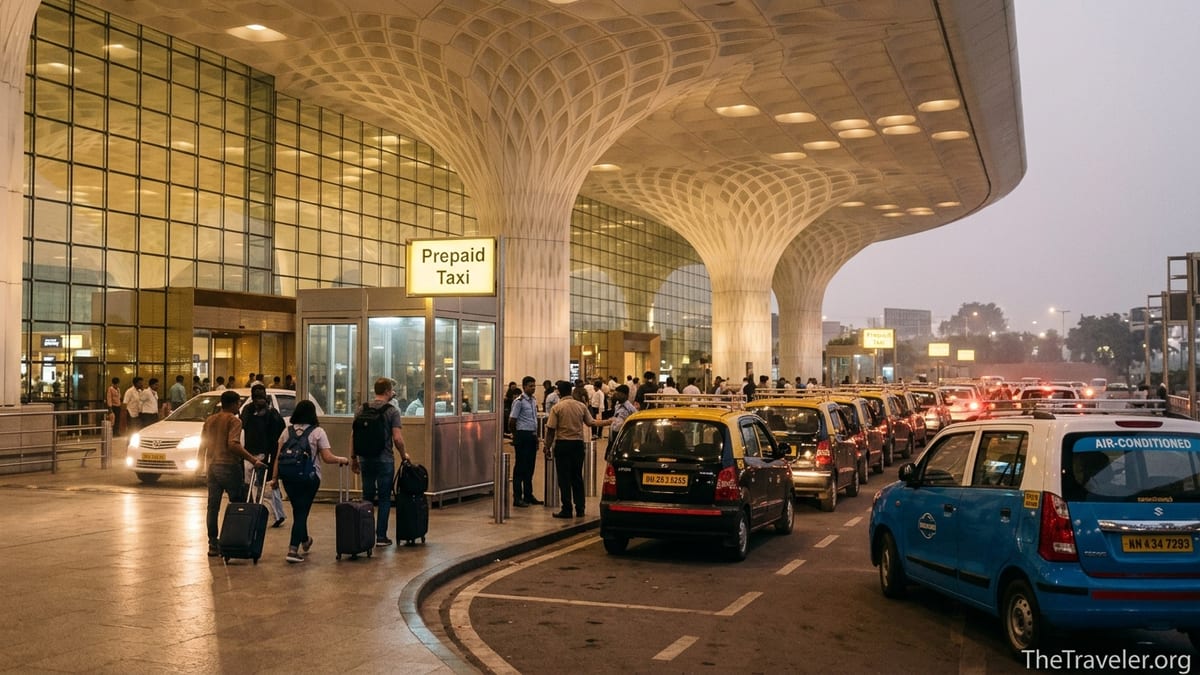
Understanding Mumbai Airport and Its Terminals
Mumbai’s Chhatrapati Shivaji Maharaj International Airport uses two main terminals that sit a few kilometers apart: Terminal 1 in Santacruz for most domestic flights, and Terminal 2 in Sahar for almost all international flights and some domestic services. Although they are technically part of the same airport, they function like two separate hubs, each with its own arrivals halls, taxi ranks and prepaid counters. A ride between T1 and T2 by taxi typically takes 15 to 25 minutes depending on traffic, so it is important to know which terminal you land at and where you need to go next.
Terminal 2 is the large glass and steel building with the famous peacock-inspired roof and extensive duty free. International arrivals come out into a controlled hall where you will see currency exchange booths, SIM card desks and, crucially, an official prepaid taxi counter near the exits. Terminal 1 is older and more compact, serving low-cost domestic carriers. It has its own prepaid taxi desk just outside the baggage claim area and a separate taxi holding area outside.
Because T1 and T2 sit in different neighborhoods, taxi fares into the city can vary slightly depending on where you start. For example, a prepaid taxi from T2 to South Mumbai (Colaba or Fort) might be quoted around ₹900 to ₹1,200 for a non-air-conditioned black-and-yellow cab, while the same journey from T1 might come in slightly lower or higher depending on traffic patterns and which route is used. Think of these as ballpark figures to help you recognize a reasonable quote at the counter.
Most first-time visitors do not need to worry about moving between terminals unless they have a domestic connection. If you do, you can either use the airport’s inter-terminal shuttle bus, which typically departs from near the prepaid taxi and bus counters, or you can take a prepaid taxi specifically to the other terminal. Expect to pay roughly the equivalent of a short city ride, often under ₹400, though surcharges and time of day can nudge this higher.
Where to Find the Official Prepaid Taxi Counters
The safest way to arrange a taxi at Mumbai Airport is to walk directly to an official prepaid counter inside the arrivals hall before you exit to the public pickup area. At Terminal 2, after you collect your luggage and clear customs, follow signs for “Prepaid Taxi” and “Taxis.” You will usually find the main prepaid taxi counter on the arrivals level near the exit doors and sometimes close to other transport desks such as inter-terminal shuttles or tour operators. The counter is typically operated under the authority of Mumbai International Airport Ltd or a contracted operator, and staff sit behind glass with printed rate cards and computer terminals.
At Terminal 1, the layout is more straightforward. Once you exit the baggage claim, look ahead or slightly to the side for a counter labeled “Prepaid Taxi” or “Local Prepaid Taxi.” This desk can be fairly basic, sometimes just a kiosk with a printed sign and a queue in front of it. What matters is that the counter issues a printed slip showing your destination, the amount paid and, often, the taxi number. If someone in the hall offers to take you to a “better counter” away from the obvious desk, politely decline and head for the official window in clear view of airport security.
The process is similar at both terminals. You queue at the counter, tell the clerk your destination, and they consult a computer or table to calculate the fare based on distance and category of cab, such as standard black-and-yellow taxi or air-conditioned “cool cab.” You then pay in cash or, at some counters, by card or UPI. In return you receive a receipt or token that you hand to the dispatcher at the taxi line outside. The dispatcher matches you to a cab and records your taxi number, which creates a basic paper trail and discourages driver misbehavior.
It is important to understand that independent drivers and touts sometimes position themselves just past customs and near the exits, offering “cheaper than prepaid” rides or insisting that the official counter is closed. Even if they look professional, your safest option is almost always the manned prepaid desk or, alternatively, a clearly branded app-based pickup zone. If in doubt, ask a uniformed airport security officer to point you to the official counter rather than relying on anyone who approaches you first.
How Mumbai’s Prepaid Taxi System Works
A prepaid taxi is exactly what it sounds like: you pay in advance for a fixed fare from the airport to a specific destination zone, and the driver receives a voucher or token to claim the money later. This protects you from bargaining after a long flight, from drivers refusing to use the meter and from most forms of route-based overcharging. Mumbai’s prepaid system uses distance slabs and official tariff tables approved by transport authorities, with night surcharges typically added for journeys between midnight and early morning.
Here is how a typical journey works in practice. Imagine you arrive at T2 around 23:00 and need to reach a hotel in Bandra West, about 8 to 10 kilometers away depending on the exact address. At the counter you say “Bandra West, near Bandra Talao” or show the hotel address on your phone. The clerk checks the appropriate zone and quotes you an all-inclusive fare, which might be around ₹500 to ₹700 for a standard taxi, with a slightly higher amount for an air-conditioned cab or SUV. You pay, receive a receipt and walk out to the taxi stand, where a dispatcher directs you to a car. The driver should not ask for more money at the end unless you request an extra stop, significantly change destination, or freely choose to tip.
Fare levels shift over time as official tariffs are revised, and the exact amount for the same trip can differ slightly depending on which operator runs the counter. That is why it is better to think in ranges. As of 2026, many travelers report paying roughly ₹400 to ₹800 for central suburbs like Bandra, Juhu or Andheri from T2, and around ₹900 to ₹1,400 for longer runs into South Mumbai areas such as Dadar, Fort or Colaba in a basic taxi. Air-conditioned cool cabs and larger vehicles usually cost more, sometimes by 20 to 40 percent.
The key protections of the prepaid system are the printed receipt with your vehicle number and the fact that money changes hands inside the terminal rather than on a dark roadside. If anything feels off during the ride, such as the driver attempting to add new “airport charges” at the end, you can show the receipt and state calmly that you have already paid the official fare. If the situation escalates, stepping out of the car near a hotel entrance or a police post and asking staff for help is usually enough to settle the matter quickly.
Realistic Fare Expectations for Popular Routes
To feel confident at the counter, it helps to have some realistic fare benchmarks in mind. Exact prices will fluctuate with traffic, time of day and tariff revisions, but you can still anchor yourself with reasonable ranges. From T2 to Bandra or Khar in the western suburbs, travelers currently report prepaid fares in the approximate range of ₹500 to ₹800 for a standard non-AC taxi. To Juhu or Versova, with their beachside hotels and serviced apartments, fares often land in a similar band, maybe ₹600 to ₹900 depending on distance from the highway.
For South Mumbai, which includes well-known tourist neighborhoods like Marine Drive, Churchgate, Colaba and Fort, the drive usually takes 45 to 75 minutes outside rush hour, and more in peak traffic. Prepaid fares for these areas commonly fall around ₹900 to ₹1,400 for a regular taxi, with cool cabs or premium sedans charging extra. If someone at a counter quotes you ₹2,500 for a single standard cab to Colaba in normal conditions, that would be a red flag and a reason to step away and double-check at a different official counter or ask airport staff.
Short hops are cheaper but can still surprise first-time visitors. A prepaid taxi from T2 to a hotel cluster near the airport perimeter road might cost around ₹300 to ₹500, even though the distance on a map looks small. This reflects minimum fare slabs, airport access fees and sometimes parking or waiting charges embedded in the prepaid rate. Similarly, going from T1 to T2 or vice versa by prepaid taxi might feel pricey for the distance, but the advantage is that you retain a clear paper trail in case of baggage or timing issues.
If you are traveling as a group with large suitcases, consider the incremental cost of a larger vehicle. For example, two standard taxis from T2 to Powai or Hiranandani might collectively cost more than a single prepaid SUV or van if such an option is offered at the counter. Always ask the clerk to outline the options and total cost for your group instead of automatically defaulting to the cheapest single-car quote, especially late at night when juggling multiple vehicles can be stressful.
T1 vs T2: Pickup Experience, Luggage and Late-Night Arrivals
The experience of finding your taxi can feel quite different between Terminal 1 and Terminal 2. At T2, after paying at the prepaid counter, you usually follow signs to an organized taxi bay area divided into lanes, sometimes with covered walkways and a clear queuing system. Security staff, dispatchers and sometimes police are present, and there can be separate zones for app-based cabs and traditional taxis. The area is busy but relatively structured, which is reassuring if you land after midnight or are managing multiple bags.
At T1, the setup is more compact and can feel more chaotic at peak domestic arrival times when multiple flights land close together. After exiting the terminal, you might find a crowd of passengers waiting for their rides, porters pushing trolleys and drivers calling out destinations. The prepaid taxi stand is usually off to one side, and the dispatchers will point you to a waiting cab. Because the space is tighter, keep your luggage close and avoid placing small bags on the ground out of sight even for a moment.
Late-night arrivals are common into Mumbai, especially for long-haul flights that land between midnight and 4 a.m. The good news is that the airport operates 24 hours, and prepaid taxi counters typically stay open through the night or have alternative desks available. Expect a night surcharge built into your prepaid fare during these hours. Having cash on hand in rupees is sensible, as card terminals can be finicky in the wee hours, and lines at airport ATMs or currency exchange counters can be shorter immediately after landing than later in the morning rush.
With heavy luggage, do not hesitate to use official porters inside the terminal if the distance feels daunting, especially at T2 where the walk from baggage claim to the taxi bays can involve long corridors. Official porters usually wear numbered vests and work under airport authority; they charge standardized fees or expect a reasonable tip. When you reach the taxi bay, help the driver lift your larger suitcases into the trunk to ensure nothing is left on the pavement. Take a quick photo of the license plate and the driver side of the car before you get in, which is a simple, discreet safety habit at any hour.
Safety Tips: Avoiding Unofficial Drivers and Common Scams
Most Mumbai taxi drivers are honest professionals simply trying to earn a living in heavy traffic. Nonetheless, airports are classic targets for small-scale scams worldwide, and Mumbai is no exception. The simplest safeguard is to refuse any unsolicited offers from drivers or “agents” who approach you inside the terminal before you reach the prepaid counter or the clearly marked app cab area. These individuals may quote extremely high flat fares, claim the meter is broken, or take you to a vehicle that is not registered for airport pickups.
One pattern that has surfaced in recent news reports involves grossly inflated fares for very short rides near the airport, sometimes with drivers preying on jet-lagged passengers unfamiliar with rupee values. For example, a traveler heading to a hotel only a few hundred meters away has been quoted many thousands of rupees by a curbside driver who bypassed official channels. The remedy is straightforward: arrange your ride at a prepaid counter inside, use a trusted app with an upfront fare estimate, or, if a hotel is truly within walking distance, confirm its location at an information desk before considering a taxi.
Another risk involves drivers pressuring passengers to pay extra mid-journey for fabricated reasons such as “new tolls,” “luggage fees” or “airport entry tax,” even when those charges are already included in the prepaid fare or should be covered by the meter. If you have used the prepaid system, simply refer back to your receipt and calmly say that you have paid the official amount. Do not hand over additional cash on the highway. If necessary, ask the driver to stop at a well-lit petrol station or police checkpoint to clarify the fare with a third party.
In the worst case, if you feel unsafe or are clearly being extorted, prioritize getting yourself and your luggage to a safe, populated place such as a major hotel, police station or toll plaza office. Once there, you can ask staff to help contact local police or airport authorities. Take photos of the taxi number, driver and receipt while still in the car if possible. These steps are rarely needed, but knowing them in advance will boost your confidence so that you can firmly decline questionable behavior long before it escalates.
Prepaid Taxis vs Ride-Hailing Apps and Hotel Cars
At Mumbai Airport you have several competing options: prepaid taxis, metered city taxis waiting outside, app-based cabs such as local ride-hailing services, and hotel-arranged cars with drivers holding name boards in the arrivals hall. Safety-focused travelers often gravitate to prepaid taxis or reputable hotel cars, especially when arriving around midnight or carrying expensive equipment like cameras or laptops.
Ride-hailing apps can sometimes undercut prepaid fares, particularly during off-peak hours. A ride from T2 to Bandra might show an app estimate around ₹350 to ₹600 for a standard sedan when surge pricing is low. The catch is that you must have mobile data or Wi-Fi to book, know exactly where the pickup zone is, and be prepared to navigate packed multi-level car parks and ramps. There have also been reports of unofficial “helpers” in app pickup areas who offer to find you a car at a marked-up cash price, which defeats the point of using an app. Stick with in-app bookings and verify the license plate and driver name before getting in.
Hotel cars are usually the most expensive but also the most straightforward. A mid-range business hotel in Bandra Kurla Complex might quote ₹1,800 to ₹2,500 for a private airport transfer in an air-conditioned sedan, inclusive of parking and tolls. Luxury properties in South Mumbai may charge even more, but they send a uniformed driver with a sign, track your flight and wait if you are delayed. For solo travelers anxious about arrival logistics, especially at odd hours, the peace of mind and door-to-door accountability can justify the premium.
A sensible middle ground is to compare your options before you land. If you are comfortable with your phone, you might open a ride-hailing app as you wait for your bags and check the current price to your hotel. If it seems reasonable and you have clear instructions on where to meet the driver, you can proceed with the app. If not, you simply walk to the prepaid counter. The key from a safety standpoint is to avoid improvising with random curbside offers that involve no receipt, no booking record and no clear recourse.
Practical Tips for Families, Solo Travelers and First-Timers
Different types of travelers face different challenges at arrivals. Families with young children may prioritize minimizing walking and waiting time, while solo travelers care more about clear documentation and backup plans. If you are traveling with kids, consider sending one adult straight to the prepaid counter while the other gathers luggage and keeps an eye on the children. Meeting again at the counter or just outside reduces the amount of time everyone spends standing in the heat and crowd of the taxi bay.
Solo travelers, especially women arriving late at night, often appreciate small extra precautions. Choose a regulated option such as prepaid or a well-rated app cab, sit in the back seat, and share your taxi number or live location with a trusted contact via messaging app. When you get into the cab, confirm the destination and approximate route on your phone’s map. A short, friendly but firm conversation at the start, such as “We are going straight to Colaba via the Sea Link, no stops” sets expectations clearly.
If you are new to India, currency and tipping can be confusing. For prepaid taxis, the fare you pay at the counter covers the ride itself. Tipping is optional but appreciated; rounding up by ₹20 to ₹50 for helpful drivers who handle heavy luggage is common practice. Have small notes ready, as drivers and counters may struggle to make change for large bills. Avoid flashing big wads of cash while standing in the open; discreetly count money with your wallet or pouch partly shielded by a bag.
Finally, build a little buffer into your timing when leaving the airport, especially if you have meetings or connecting trains in the city. Although prepaid queues usually move, delays can occur when multiple wide-body flights land close together, during heavy monsoon rains or when roadworks disrupt the taxi flow. Planning on at least 30 to 60 minutes from stepping out of baggage claim to actually leaving the airport in a taxi is prudent, with more during peak travel seasons.
The Takeaway
Using a prepaid taxi at Mumbai Airport is one of the simplest ways to secure a safe, fairly priced ride into the city, whether you land at the older domestic Terminal 1 or the sleek international Terminal 2. The system is designed to protect arriving passengers from haggling, inflated fares and most curbside tricks by moving the price conversation into an official counter inside the terminal and giving you a paper record of the journey.
If you remember a few core principles, you will be in good shape. Head straight to the official prepaid counter or a clearly marked app pickup zone, ignore unsolicited offers from drivers or “agents,” sanity-check any quoted fare against broad ranges like ₹400 to ₹800 for nearby suburbs and ₹900 to ₹1,400 for central and South Mumbai, and keep your luggage and documents close at all times. These habits, combined with simple steps like photographing your taxi plate and sharing your route with a friend, make arriving in India’s busiest city far less stressful.
Whether you are a business traveler rushing to Bandra Kurla Complex, a backpacker headed to Colaba or a family on your way to Juhu’s beach hotels, the prepaid taxi system is there to get you from the terminal doors to your front desk with minimal drama. Approach it with a clear plan, a bit of local fare knowledge and firm but polite boundaries, and your Mumbai arrival will likely be memorable for the right reasons: the warm night air, the first glimpse of the skyline and the realization that your India journey has truly begun.
FAQ
Q1. Is it safer to use a prepaid taxi or a ride-hailing app at Mumbai Airport?
Both can be safe if used correctly, but prepaid taxis have the advantage that you pay inside the terminal, receive an official receipt, and avoid relying on mobile data or finding a pickup zone in a busy car park. Ride-hailing apps can be cheaper at off-peak times, but make sure you only get into the exact car shown in the app and avoid anyone offering an off-app “deal.”
Q2. Where exactly are the prepaid taxi counters at Terminal 2?
At Terminal 2, you will find the prepaid taxi counter in the international arrivals area after customs, usually near the main exit doors and other transport desks. Follow the overhead signs for “Prepaid Taxi” or ask a uniformed airport staff member to point you to the official counter rather than accepting guidance from drivers or touts.
Q3. Can I pay by card or UPI at the prepaid taxi counter?
Some prepaid counters at Mumbai Airport accept cards or UPI, but reliability can vary and terminals sometimes go offline, especially late at night. It is wise to carry enough Indian rupees in cash to cover at least your first taxi ride, whether by changing a small amount of money or withdrawing from an ATM inside the terminal.
Q4. How much should I expect to pay from T2 to South Mumbai (Colaba or Fort)?
Exact fares change with tariff updates, but a realistic ballpark for a standard prepaid taxi from Terminal 2 to South Mumbai areas like Colaba or Fort is often around ₹900 to ₹1,400, with air-conditioned or larger vehicles costing more. If you are quoted dramatically higher for a basic cab in normal conditions, double-check at the counter or with airport staff.
Q5. Are there extra charges for luggage in prepaid taxis?
Prepaid fares typically factor in normal luggage for one carload, so you are not charged separately for a couple of suitcases and carry-ons. Very large or unusual items, or choosing a bigger vehicle category, can increase the fare. If you are unsure, mention your baggage situation at the counter and ask whether the quoted price covers everything.
Q6. What should I do if a driver asks for more money at the end of a prepaid ride?
If you used the prepaid counter, show your receipt and politely explain that you have already paid the official fare in full. Do not hand over extra cash for invented fees like “airport tax” or “toll” unless they were clearly excluded and discussed in advance. If you feel uncomfortable, move to a hotel entrance or busy spot and ask staff to help mediate.
Q7. Is it safe to arrive alone late at night and take a taxi into the city?
Many passengers arrive in Mumbai after midnight and use taxis without incident, but it is sensible to take extra precautions. Use an official prepaid taxi or a reputable hotel car, sit in the back seat, share your taxi details or location with someone you trust, and avoid making unnecessary stops on the way. Staying at a hotel that offers airport pickup can add another layer of reassurance.
Q8. How do I avoid taxi touts and overcharging at Mumbai Airport?
The simplest way is to ignore unsolicited offers in the arrivals hall, walk directly to the official prepaid counter or app pickup area, and insist on a printed receipt or in-app booking record. Do not get into any vehicle that does not match your booking or that was arranged entirely by word of mouth without documentation.
Q9. Can I share a prepaid taxi with another passenger to split the cost?
Yes, you can share a prepaid taxi with another passenger if you agree among yourselves to split the cost, but the airport counter will still issue a single fare for the journey and hold one person responsible for payment. Make sure all passengers and the driver agree on the destination and any intermediate stops before you leave the airport.
Q10. What if my hotel is very close to the airport; do I still need a taxi?
If your hotel is genuinely within walking distance, you might be able to walk, but busy roads, humidity and late-night conditions often make a short prepaid taxi ride more comfortable and secure, especially with luggage. Confirm the exact location with your hotel in advance and, if in doubt, choose a regulated ride rather than trying to navigate unfamiliar streets on foot immediately after landing.