


More news on this day
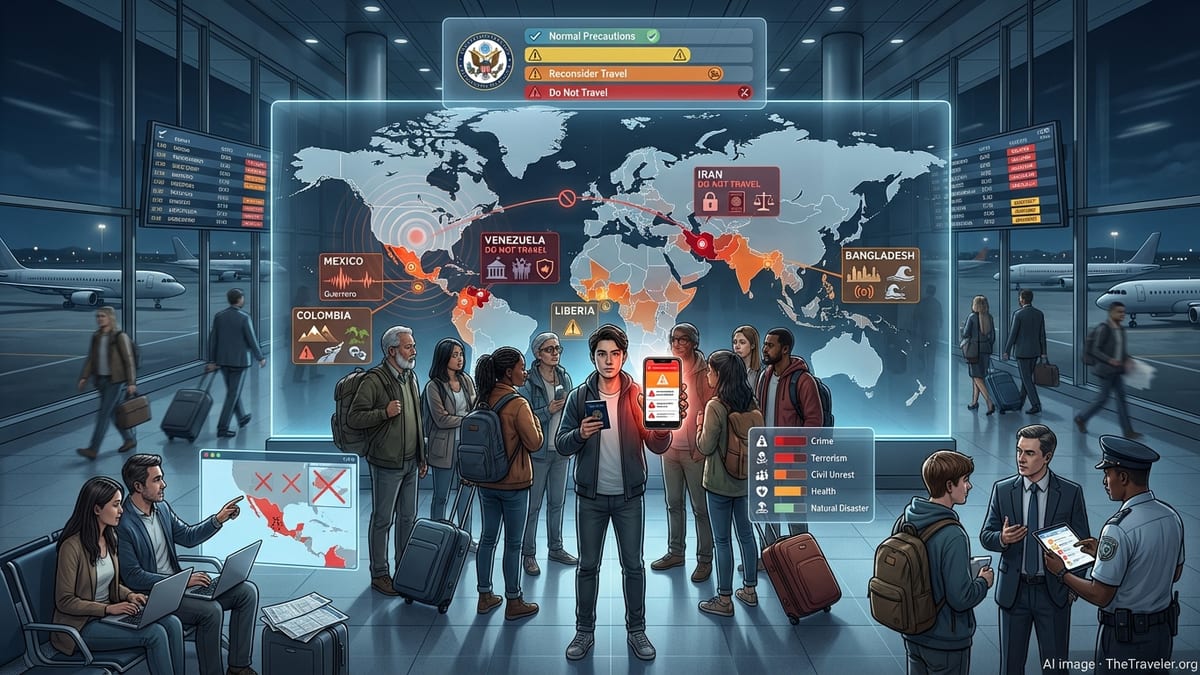
The United States has issued an updated worldwide caution for its citizens overseas, advising travelers to heighten their security awareness amid ongoing conflict with Iran, regional instability in the Middle East, and a shifting global risk environment.
Get the latest news straight to your inbox!
What the New Worldwide Caution Actually Covers
The latest worldwide caution urges Americans abroad to exercise increased vigilance, with particular attention to countries in and around the Middle East. Publicly available information indicates that the advisory highlights an elevated potential for attacks against U.S. interests, including diplomatic facilities, tourist locations, transport hubs, and large public gatherings. The message focuses less on specific cities and more on broad patterns of risk that could affect travelers in multiple regions at once.
The advisory does not ban travel outright. Instead, it emphasizes that the global security picture has become more volatile since the escalation of hostilities involving the United States, Israel, and Iran earlier in 2026. Travelers are encouraged to stay alert in places that typically draw international visitors, from historic sites and markets to transportation nodes such as airports, bus terminals, and train stations.
The wording reflects a shift in how the U.S. government frames travel risk. Rather than issuing narrowly targeted alerts in response to isolated incidents, the worldwide caution responds to a combination of geopolitical tensions, the possibility of retaliatory attacks, and the potential for unrest to spill over into traditionally popular destinations.
Context: Iran Conflict and Regional Flashpoints
The renewed advisory comes in the wake of the 2026 war involving the United States and Iran, a conflict that has redrawn risk maps across parts of the Middle East. Open source timelines show that strikes earlier in the year and the subsequent ceasefire have been followed by recurring security alerts for multiple countries in the region, some already classified under higher travel advisory levels for terrorism, civil unrest, or instability.
In recent months, travel notices for Bahrain, Jordan, Kuwait, Oman, Qatar, Saudi Arabia, the United Arab Emirates, Israel, the West Bank, and other nearby locations have consistently urged U.S. citizens to reconsider travel or depart if conditions permit. The worldwide caution builds on those existing country specific advisories by acknowledging that potential threats may extend well beyond defined conflict zones or active war theatres.
Analysts note that global events rarely remain geographically contained. Airspace closures, redirected flight paths, and heightened security at international airports have become recurrent features of the post escalation travel environment. Even travelers en route to or from low risk destinations may experience knock on delays, rerouting through higher risk hubs, or sudden changes to airline schedules.
How the Advisory May Affect Trip Planning
For many leisure and business travelers, the worldwide caution will not automatically cancel plans but it may change how trips are organized and insured. Public guidance on the State Department’s travel platform emphasizes preparing for disruptions, building in extra time for connections, and staying flexible in case commercial options are curtailed or rerouted at short notice.
Travel insurers and corporate travel managers often look to official advisories when adjusting coverage or duty of care policies. A broad caution of this kind can prompt companies to review non essential travel to higher risk regions, require additional approvals, or offer employees alternatives such as virtual meetings. Individual travelers may find that policies require close reading to understand what is and is not covered if security conditions deteriorate mid trip.
Popular destinations far from current conflict zones are not immune from the ripple effects. Increased security screening, sporadic demonstrations, or local responses to global events can alter the feel of a visit even where the underlying travel advisory level remains moderate. Travelers are being encouraged to monitor local news in their destination, keep family or friends informed of their movements, and maintain updated contact details through official enrollment tools.
Safety Measures Recommended for Americans Abroad
The worldwide caution is accompanied by familiar but increasingly urgent safety recommendations. Public materials point travelers to check country information pages and travel advisories before departure, enroll in alert systems, and develop contingency plans that do not rely solely on government assisted evacuations. The message underscores that commercial options are often the first and best way out in a fast moving crisis.
Staying aware of surroundings in crowded spaces, avoiding demonstrations, and keeping a low profile are among the core behaviors urged for Americans overseas. The advisory highlights that potential attackers may target locations associated with Westerners, including hotels, restaurants, and entertainment venues that attract foreign visitors.
Digital preparedness is also a growing focus. Travelers are advised in public guidance to store copies of key documents securely, maintain charged devices and backup power, and know how to reach local emergency services. In countries with higher advisory levels, some travelers are choosing to register itineraries with their employers or travel security firms so that assistance can be coordinated if events escalate quickly.
What Travelers Should Watch in the Weeks Ahead
Although the worldwide caution does not come with an official end date, such advisories are typically reviewed as conditions evolve. Developments in the Iran conflict, potential retaliatory actions by aligned groups, and the broader security climate around U.S. embassies and consulates will likely drive any future updates.
Travelers with upcoming itineraries through the Middle East and surrounding regions are being urged by public information sources to pay particular attention to changes in commercial flight operations, border policies, and local curfews or movement restrictions. Shifts in airspace availability or diplomatic tensions can translate quickly into cancelled routes or lengthy diversions.
For Americans with long planned international trips, the message is one of caution rather than panic. The advisory signals that risk levels have risen unevenly across the globe, with certain regions facing greater uncertainty than others. Careful monitoring of official advisories, flexible planning, and a realistic assessment of personal risk tolerance will be key for anyone heading abroad while the worldwide caution remains in force.