


I did not expect convenience to be the headline of my first TUI holiday. I booked because the price was competitive and the hotel looked right. Yet somewhere between tapping “confirm booking” and stepping back onto the plane home, I realised the biggest surprise about TUI was how much friction it quietly removed from the trip. It was not one single wow moment, but a long chain of small, practical conveniences that added up to a very different kind of package holiday.
Get the latest updates straight to your inbox!
A Single Booking That Actually Covers the Whole Journey
The first sign that this trip would run differently came at the booking stage. Instead of piecing everything together across multiple tabs and airline sites, TUI’s package wrapped flights, hotel and transfers into one transaction. I picked a seven-night all-inclusive stay at a TUI BLUE resort in Antalya, paired with non-stop flights and shared coach transfers, and walked away with a single reference number that covered the lot. There was no separate flight PNR to keep track of, no third-party transfer voucher to download, and no mystery about whether the hotel would know when we were due to arrive.
That bundled approach matters more when things shift. When our UK departure airport changed the flight time by ninety minutes, the new details appeared automatically in the TUI app and the transfer was quietly re-timed in the background. I did not have to call a shuttle company, reprint anything or update the hotel. For many TUI customers this kind of automation is now standard, particularly on mainstream routes to Spain, Turkey, Greece and the Canary Islands, where the company controls both the charter flights and the destination transfers.
There is also a subtler convenience in having one company responsible from take-off to check-out. If a weather delay had pushed us into the early hours, the rep at Antalya airport would have had real-time passenger lists and coach allocations based on the flight manifest, not a spreadsheet updated days earlier. For families travelling with children or older relatives, that knowledge that “it’s all in the system” reduces the mental load in ways that only become apparent when you compare it with a self-assembled itinerary.
The package model is not unique to TUI, but the breadth of what it can include today is more extensive than many travellers realise. Beyond standard sun holidays, you can now package multi-centre itineraries such as a week in a TUI BLUE beach resort followed by a short city break, or combine flights with TUI-run river cruises, while still keeping everything under the same booking umbrella.
Check In Before You Leave the Sofa
The next convenience appeared well before we reached the airport. On routes operated by TUI Airways or TUI fly, online check in opens automatically ahead of departure, accessible via the TUI app or the “Manage My Booking” section of the website. In the UK, for example, passengers on TUI Airways flights with TOM or BY flight numbers can generally check in online from 48 hours before departure, or up to 14 days in advance if they have paid for seat selection or extra legroom upgrades. Online check in typically closes one hour before departure, aligning with new baggage cutoff times at major UK and European airports.
Using the app, I could add passport details, confirm Advance Passenger Information and save mobile boarding passes directly into my phone wallet without printing anything. It took less than five minutes. For travellers flying from Scandinavia or the Netherlands with TUI fly, similar digital processes are in place, with guidance on local TUI sites explaining that online check in is open from several days before departure and that mobile boarding passes can be downloaded or printed at home, depending on the route.
At some airports, particularly in Belgium and the Netherlands, TUI fly has moved strongly toward online and kiosk-based processes. On many of these flights, passengers who choose not to check in online now face a counter check-in fee in the region of 30 euros per person, a nudge towards using the more efficient digital route. Conversely, if online check in is not possible because of destination rules, TUI’s regional sites make it clear that airport check in remains free of charge and that boarding passes will be printed there.
Of course, there are exceptions. Long-haul flights to destinations like Mexico, Jamaica or certain Caribbean islands may have tighter document checks, and mobile boarding passes are not always accepted at every foreign airport. In practice, though, the routine for most European leisure routes is simple: check in at home using the app, drop bags at the airport, and walk straight to security. The time saved standing in serpentine check-in queues is measurable in coffee breaks and reduced stress.
Airport Time: Shorter Queues, Smoother Handoffs
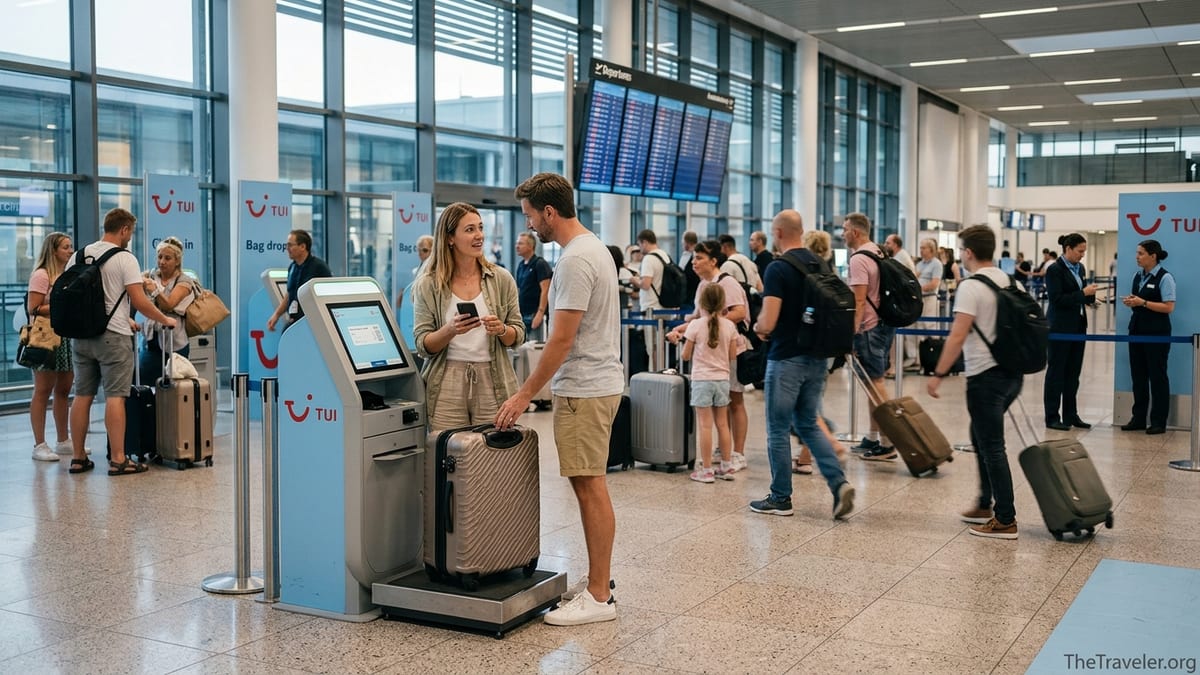
The payoff for digital check in becomes most obvious when you reach the terminal. Flying from a major hub, we were able to use self-service bag drop machines marked for TUI customers. After scanning the mobile boarding passes, the kiosk printed luggage tags, and a separate automated belt weighed and accepted the bags. The whole process took under ten minutes, compared with the thirty-minute lines still forming at traditional counters.
TUI’s regional sites in the Netherlands and Belgium now actively encourage this model, highlighting that those who have checked in online can go straight to security after using bag drop, and only need to see staff at a counter if they have special baggage or could not obtain a boarding pass online. At some airports, extended check-in desk opening hours from early morning allow travellers on the first wave of departures to drop bags from around 4 am, then relax in the terminal rather than hovering outside closed check-in zones.
For travellers used to low-cost carriers that charge for almost every airport interaction, it is worth noting that TUI’s approach mixes incentives with reassurance. Yes, at certain bases the company applies a fee for using staffed counters where self-service options are available and clearly communicated, but where online check in is not offered for operational or regulatory reasons, check in at the desk remains free. In practice, most holidaymakers only interact with staff for edge cases such as special assistance, travelling with pets, or complex group seating.
Once airside, one more convenience appears in the app: live departure information linked to your specific flight number. While you can always consult the general departure boards, having push notifications for gate changes or schedule tweaks is particularly useful at larger airports where journeys from one end of a pier to another can take twenty minutes or more. For nervous travellers, a simple “boarding now” prompt in their pocket feels like an extra set of eyes on the clock.
On-the-Ground Support Without Queueing at a Desk
The real revelation, though, was not the airport experience but what happened after landing. TUI still maintains traditional destination reps at many resorts, but much of the routine support has moved into its apps and hotel-specific tools. At our TUI BLUE property, the dedicated BLUE App acted as a digital concierge for the entire stay. Before arrival, I could browse the resort map, restaurant information and the weekly activities schedule, from yoga sessions to live music on the terrace.
Once checked in, the app opened up more tools that used to require a visit to the lobby desk. I could reserve a table at the à la carte restaurant, book a tennis court, or secure two spots on a stand-up paddleboarding session. Extras like private daybeds by the pool or late checkout could also be requested inside the app. TUI BLUE’s own FAQ materials emphasise this 24/7 self-service approach, noting that guests can use the app to access hotel information, book services and manage reservations without re-entering personal details each time, as the booking is already linked to their profile.
What surprised me was how quickly this changed our daily rhythm. Instead of joining the queue at the guest relations desk mid-morning to ask about availability for a fitness class, I simply checked the app while still on the balcony and locked in a time slot. When the kids spotted a taster scuba session in the pool on the digital activity board, we booked it in two taps. The app did not remove staff from the equation; rather, it moved the repetitive errands to an interface and left the face-to-face time for when it actually mattered, such as discussing late check-out options or arranging a last-minute taxi.
Outside TUI BLUE, the mainstream TUI app plays a similar role on standard package holidays. It brings together flight times, transfer details, excursion bookings and in-resort contact options, increasingly including live chat with TUI teams. For a generation used to messaging rather than phone calls, being able to ask “What time is the coach back to the airport?” or “Can I change my pickup point?” in a chat window is significantly less stressful than standing in a line by the information board.
Transfers and Excursions That Fit Around the Flight
One of the most underrated sources of convenience on a TUI holiday is the way transfers and excursions are tied to flight schedules. When we arrived in Antalya, the coach bays outside the terminal were organised by hotel area and clearly labelled with TUI branding. Each coach had a passenger list generated from the flight manifest and booking data, which meant check-in onboard was as simple as confirming names. Our luggage was stowed, and we were rolling out of the airport within thirty-five minutes of stepping off the plane.
Because TUI controls both the flight and the ground operation on many routes, delays tend to be handled in a joined-up way. If your inbound aircraft is running late, transfer companies are informed centrally rather than relying on individual reps noticing a board update. In resort, pick-up times for the return transfer are automatically adjusted to match any official schedule changes, and updates appear in the app and on noticeboards at partner hotels. On our trip, a minor change to departure time overnight translated into a revised coach pick-up time pushed to the app by breakfast.
Excursions work in a similar way. When I booked a boat trip and a city tour through TUI’s “Experiences” offering, available in many popular destinations, I did so through the same booking environment as the main holiday. The dates presented accounted for our arrival and departure times, so I was never offered an excursion that would clash with a flight or transfer. In practice, this trimming of options is invisible to the user, but it prevents the all-too-common independent traveller mistake of booking an ambitious day trip that leaves no buffer before the flight home.
For independent-minded travellers, there is sometimes a perception that booking excursions through a tour operator will feel rigid. In our case, the opposite was true. Because the TUI app held all the timings in one place and factored in the official schedule, it was easier to mix operator-run experiences with self-planned wandering, confident that we were not inadvertently double-booking ourselves.
When Things Go Wrong, One Point of Contact Helps
Convenience is not only about the smooth days. Its value becomes clearest when something goes wrong. On the fourth day of our stay, a minor medical issue meant we needed to speak with someone about adjusting our return transfer in case we had to see a doctor on departure morning. Rather than hunting for a local agency number, we used the in-app contact options linked to our booking reference.
Within minutes we were in touch with an English-speaking TUI agent who could see our full holiday record, including the flight number, hotel name and existing coach pick-up time. When we asked about pushing the transfer to a slightly later bus, the agent could see which services still had seats and which would leave enough time for airport check in. We did not have to explain our location, re-quote dates or juggle separate confirmation emails. The request was logged, adjusted and confirmed in a single channel.
Other travellers report similar experiences, particularly at TUI BLUE properties and Sensatori by TUI BLUE resorts, where a blend of in-person reps and app-based chat operates around the clock. This hybrid model of support is increasingly common in leisure travel, but TUI’s advantage lies in the integration. Because flights, transfers and hotel stays are usually part of a single package, there is less hand-off between unrelated companies when changes are needed.
There are limits, of course. TUI still relies on partner airlines for certain itineraries, and when that is the case, changes may involve external policies or longer response times. Yet even here, having an intermediary that understands both the tour operator and airline practices and can front the conversation on your behalf removes a great deal of legwork.
The Takeaway
Before this trip, I thought I knew what to expect from a traditional package holiday: charter flight, transfer coach, welcome meeting. What I did not anticipate was how thoroughly TUI has woven convenience into each layer of the experience, often without fanfare. Online and mobile check in, linked transfers, integrated hotel apps and centralised support channels turn dozens of once-familiar hassles into background processes.
For seasoned independent travellers, some of these conveniences might sound trivial. After all, anyone can book a private transfer or download a boarding pass. The difference with TUI is the way these elements are chained together, so that timing changes cascade automatically, support teams can see the whole picture, and you rarely have to repeat yourself. It is an ecosystem more than a menu of add-ons.
The model is not perfect, and it will not suit every style of trip. If you thrive on improvisation and delight in chasing last-minute deals across different platforms, you might find the closed loop of a package restrictive. But if your priority is to reduce friction, especially when travelling with family or on time-poor breaks, the level of convenience TUI now offers is likely to be the biggest and most pleasant surprise of your holiday.
FAQ
Q1. Do I have to use the TUI app to check in for my flight?
If online check in is available for your route, you can usually check in via the TUI app or the website. If digital check in is not offered for your specific flight or destination, airport desk check in remains available and, in those cases, is generally free of charge.
Q2. Are mobile boarding passes accepted on all TUI flights?
Mobile boarding passes are widely accepted on many European routes operated by TUI Airways and TUI fly, especially from major UK and EU airports. Certain long-haul destinations or airports with stricter document checks may still require printed passes, which you can obtain either at home or at the check in desk.
Q3. Can I still check in at the airport if I do not check in online?
Yes. If online check in is not available or you prefer not to use it, you can check in at the airport. At some TUI fly bases where online and kiosk check in are clearly offered, a service fee may apply for choosing a staffed counter, but when digital check in is not an option, airport check in is typically free.
Q4. How early can I check in online for a TUI flight?
The exact timing varies by market and ticket type. In the UK, standard TUI Airways customers usually gain access to online check in 48 hours before departure, while those who have paid for specific seats or extra legroom may be able to check in up to 14 days ahead. Other regional TUI sites specify similar windows tailored to their routes.
Q5. Does TUI automatically adjust my transfer if my flight time changes?
On most classic package holidays where TUI provides both flights and transfers, pick-up and drop-off times are linked to the official flight schedule. If your flight time changes, transfer times are typically adjusted in the background, with updated information shown in the app, travel documents or hotel noticeboards.
Q6. Is the TUI BLUE App only for TUI BLUE hotels?
Yes, the BLUE App is designed specifically for TUI BLUE properties. It lets guests view information about their hotel, browse daily activities, book services like restaurant tables or fitness classes and, in many cases, access local tips. For non–TUI BLUE stays, similar information is usually available through the main TUI app or resort representatives.
Q7. Can I book excursions through TUI after I arrive at the resort?
In most destinations you can. Excursions and experiences can often be booked in person with a TUI rep, through hotel information desks or directly in the TUI app. Availability may be limited in peak periods, so popular activities such as boat trips or theme park visits are best reserved early in your stay.
Q8. What happens if I need help during my holiday and there is no rep in the hotel?
In many resorts, support is available via phone or in-app chat rather than a permanent physical desk. By using the contact options linked to your booking in the TUI app, you can reach English-speaking teams who can see your flights, hotel and transfers in one place and advise or make changes where possible.
Q9. Are there extra charges for using self-service check in or bag drop with TUI?
Self-service options themselves are not usually charged, and using them can sometimes help you avoid service fees that apply when airport staff must complete tasks that could be done online or at kiosks. Any applicable fees are normally listed in your booking conditions or on regional TUI websites before you travel.
Q10. Is a TUI package holiday more convenient than booking flights and hotels separately?
For many travellers, yes. With a TUI package, flights, accommodation and transfers are managed under a single booking, schedules are linked, and support teams can see the full picture if plans change. Independent booking can offer more flexibility, but typically requires more coordination and hands-on problem solving if disruptions occur.