


For most first-time visitors to Azerbaijan, Baku’s Old City, the Caspian promenade and a quick trip to Gobustan’s mud volcanoes top the wish list. The Absheron Peninsula, stretching east and north of the capital, often appears in itineraries as an optional add-on. With fire temples, burning hillsides, semi-desert national parks and wind-battered beaches, it can be fascinating. But is it worth carving out precious time on a first trip, or better saved for a return visit? This guide walks through what the Absheron Peninsula actually offers, what it costs in time and money, and when it deserves a firm yes on your Azerbaijan itinerary.
Get the latest updates straight to your inbox!
Understanding the Absheron Peninsula and How It Fits Into an Azerbaijan Itinerary
The Absheron Peninsula is the tongue of land that juts into the Caspian Sea around Baku. It includes Baku’s outer suburbs and a string of semi-desert villages, oil fields, beach settlements and nature reserves. In practical terms, almost everything marketed as a “Baku surroundings” tour for day-trippers is somewhere on Absheron. For a first-time traveler, this means you do not need to relocate or repack: you can base yourself in central Baku and reach most Absheron sights in 30 to 70 minutes by car.
Travel writers and tour operators increasingly divide Azerbaijan into three zones for visitors: Baku and Absheron, the mountain and countryside regions like Sheki and Gabala, and the subtropical south. In most one-week trips, travelers spend three or four nights in Baku and use one of those days for an Absheron-focused excursion that combines history and unusual geology. Sample group tours that pair Ateshgah Fire Temple with Yanar Dag Burning Mountain are now standard in packages sold for long weekends in Baku, which indicates how firmly Absheron has become part of the “first look” at the country.
From a logistics standpoint, this makes Absheron relatively low-effort compared with more distant regions. You can, for instance, join a half-day tour that leaves Baku around 10:00 in the morning, visits Ateshgah and Yanar Dag, and has you back in the city by late afternoon for a walk along the boulevard. That is a very different level of commitment from, say, an overnight trip to the Caucasus mountains. For many first-time visitors, this convenience alone is a strong argument in favor of including the peninsula.
On the other hand, Absheron is not universally loved. Some travelers expecting an untouched natural paradise are surprised by oil infrastructure, wind farms and rather scrubby landscapes. The key question is not whether the peninsula is objectively beautiful, but whether its particular mix of fire worship heritage, semi-industrial scenery and Caspian coast matches what you want most from your limited time in Azerbaijan.
Signature Absheron Experiences: Fire, Faith and Semi-Desert Landscapes
The two headline attractions on Absheron are Ateshgah Fire Temple and Yanar Dag. Ateshgah, in the suburb of Surakhani, is a walled complex of stone cells and a central fire altar that once drew Zoroastrian and Hindu pilgrims who believed the naturally burning flames to be sacred. Today the gas supply is controlled, and the fire in the central altar is fed via modern pipes, but the site still offers a compelling walk through courtyards and small museum rooms explaining the history of fire worship and the trade routes that once ran through the area.
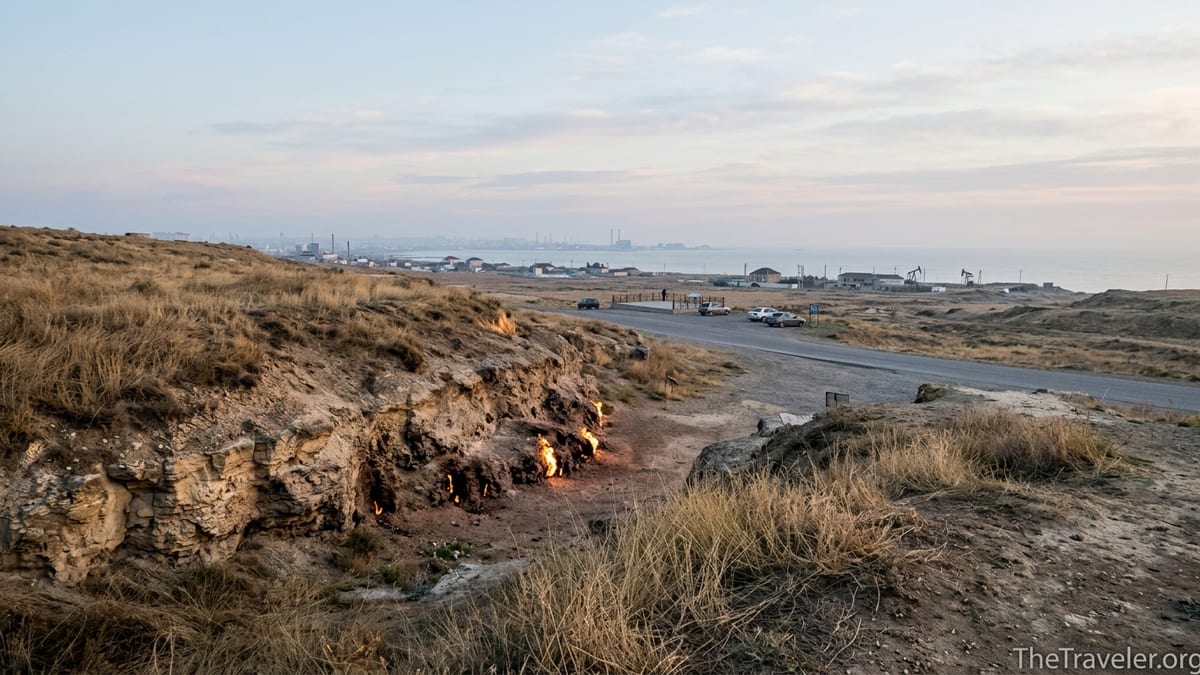
Yanar Dag, about 25 to 30 kilometers north of central Baku, is a hillside with a strip of rock that burns continuously as natural gas seeps to the surface. After recent refurbishments, the area includes a visitor center, viewpoints and walkways. The fire itself is smaller than many expect: a band of flames several meters long licking out of a low cliff. Visitors sometimes describe it as underwhelming in daylight but atmospheric at dusk, when the fire contrasts sharply with the darkening sky and the wind whips across the semi-desert slopes.
Beyond these two sights, the peninsula offers quieter, less commercial experiences. Absheron National Park occupies the southeastern tip of the peninsula and protects a strip of Caspian coastline and steppe. Travelers who make the one-hour drive from Baku can walk along rough tracks with views of shallow turquoise water, look out for migratory birds, and, in cooler months, experience a sense of wide open space that is hard to find near the capital. This is not a manicured park: there are few facilities, so it appeals most to travelers who enjoy simple, windswept landscapes rather than developed resort beaches.
Historic villages such as Balakhani and Ramana, with stone houses, narrow lanes and surviving towers or castle fragments, add another layer for culture-focused visitors. A guided trip that combines Balakhani’s restored historic quarter with Ateshgah and Yanar Dag gives a much richer feel for how the oil boom, trade routes and religious traditions shaped everyday life on the peninsula than visiting the fire sights alone.
Time, Cost and Practical Logistics: What First-Timers Should Expect
From central Baku, a typical small-group Absheron tour that combines Ateshgah and Yanar Dag runs to about half a day and usually costs somewhere in the range of a modest city excursion in Europe, including transport and entry fees. Private drivers and tours cost more but appeal to travelers who want control over timing, photo stops and add-ons such as Balakhani or a seaside meal. For budget travelers, it is technically possible to reach Ateshgah by suburban bus and Yanar Dag by a combination of metro and bus, but routes can change and signage is not always intuitive in English, so many first-time visitors choose an organized outing for simplicity.
One common approach for visitors with three full days in Baku is to devote one day to the Old City and waterfront, one to Gobustan’s rock art and mud volcanoes, and one to Absheron’s fire sites. Shared tours that combine Gobustan and Absheron into a long single day also exist, but they can feel rushed, with only brief stops at each place. If you are someone who prefers unhurried exploration and photography, it may be better to focus on either Gobustan or Absheron rather than trying to cover everything off in a single sweep.
Transport times are relatively manageable. Reaching Ateshgah by car from downtown Baku often takes 30 to 40 minutes outside peak traffic; Yanar Dag is closer to an hour in normal conditions. The drive to Absheron National Park takes roughly an hour one way. This means that a well-planned day that starts mid-morning can comfortably include two or even three sites with a break for lunch, but it is harder to fit the peninsula into a tight layover of just a few hours.
In terms of other practicalities, the peninsula can be extremely windy and, outside the peak summer months, cooler than visitors expect, especially in the evenings near Yanar Dag and on the Caspian shore. Simple snack kiosks and small restaurants exist near the main attractions, but they are not guaranteed to be open at all hours. First-time travelers are usually happier if they bring water, a layer for the wind and, if visiting the national park or more remote beaches, some snacks rather than assuming there will be cafes on arrival.
How Absheron Compares With Other First-Trip Priorities in Azerbaijan
Deciding whether Absheron is “worth it” for a first visit hinges on what else is on your list. Many travelers come to Azerbaijan primarily for the mountain scenery of the Greater Caucasus, such as the villages around Quba or the alpine resort of Shahdag, or for the forests and lakes around Gabala and Sheki. Reaching those regions typically requires several hours by road each way and at least one overnight stay. In contrast, Absheron gives a taste of Azerbaijan’s trademark elements fire, oil history, semi-desert and the Caspian in a concentrated, day-trip format.
Compared with Gobustan, Absheron feels more curated and less wild. Gobustan’s rock art reserve and mud volcano fields sit in a stark badlands landscape that many visitors rank as a highlight of their entire Caucasus trip. Absheron’s Ateshgah and Yanar Dag, by contrast, are more structured heritage attractions with clear paths, explanatory panels and defined viewpoints. If you have to choose, history and archaeology enthusiasts often favor Gobustan, while travelers fascinated by religion and mythology may lean towards the fire temple on Absheron.
Within Baku itself, you will find polished museums, contemporary architecture like the Heydar Aliyev Center and the walled Inner City of Icherisheher. If your stay is short, you might wonder whether leaving the city is necessary at all. For some visitors, the answer is no: if you are mainly interested in cafés, nightlife and city photography, you can easily fill two or three days without ever seeing the peninsula. However, those who do venture out to Absheron often say it helped them understand why Azerbaijan brands itself as the Land of Fire and how closely its identity is tied to oil, gas and the Caspian shoreline.
In short, Absheron is best seen as a thematic extension of Baku rather than a separate destination on the level of the Caucasus mountains. It is less about dramatic new scenery and more about context: how religion, resources and geography intersect on this windy strip of land. If that context matters to you, it is a strong addition to a first-time trip. If you are chasing purely scenic spectacles, you might prioritize other regions and leave Absheron for another visit.
Beaches, Villages and Nature: The Quieter Side of the Peninsula
Beyond the famous fire sights, Absheron’s northern and eastern coasts host a patchwork of beach settlements and simple resorts that draw locals in summer. Areas like Bilgah, Mardakan and Buzovna have stretches of sand, beach clubs and modest hotels. For first-time international visitors, these beaches are rarely the main reason to come to Azerbaijan, but they can provide a change of pace from city sightseeing, especially on a hot afternoon when a quick swim in the Caspian appeals more than another museum.
The quality of the beach experience varies. Some clubs charge an entrance fee that includes a sunbed and umbrella, while public stretches can be free but less maintained. Travelers who go in with realistic expectations usually enjoy the scene: local families picnicking, teenagers playing music, and a mix of Soviet-era and newer buildings lining the shore. Those expecting pristine, isolated coves may be disappointed; the Absheron coast reflects its proximity to an oil-producing metropolis, with some visible infrastructure and a generally developed feel.
Inland, villages like Balakhani have seen restoration programs that cleaned stone facades, repaved lanes and highlighted historical buildings, transforming what used to be rough oil-worker settlements into atmospheric heritage quarters. A stroll through Balakhani’s narrow streets, with views over old derricks and modern Baku on the horizon, gives a sense of the layers of industrial and cultural history that define the peninsula. Combined with stops at local bakeries or tea houses, it can be one of the more authentic-feeling experiences for travelers who enjoy wandering beyond polished tourist districts.
For nature-minded visitors, Absheron National Park remains the primary attraction. Guides who know the area can point out birdlife and explain how the ecosystem survives in such a windy, saline environment. Even without formal guiding, simply walking the tracks and watching waves break on the low dunes gives a very different impression of Azerbaijan than the urban focus of Baku. For a first-time traveler who wants at least one encounter with open landscapes but lacks time for multi-day mountain trips, this park can serve as a useful compromise.
Who Will Love Absheron, and Who Might Skip It?
Certain types of first-time travelers are especially likely to find Absheron worthwhile. If you are fascinated by religion, mythology and the symbolism of fire, Ateshgah and Yanar Dag will probably rank high among your favorite stops in Azerbaijan. Likewise, travelers interested in industrial heritage, oil history, or how natural resources shape cities will appreciate seeing oil wells, gas flares and semi-desert villages just beyond Baku’s futuristic skyline.
Photography enthusiasts often enjoy the stark contrast between the beige semi-desert and the blue Caspian, especially on days with broken clouds that cast moving shadows across the hills. Visiting Yanar Dag around sunset can produce striking images of flames against a darkening sky, while Ateshgah’s symmetrical courtyards and stone arcades photograph well in soft morning or late afternoon light. If you travel specifically to capture distinctive images rather than classic postcard views, Absheron can be surprisingly rewarding.
On the other hand, travelers whose top priorities are lush mountain scenery, hiking or traditional village life might feel underwhelmed. The peninsula’s vegetation is sparse, and the presence of oil infrastructure and suburban development is hard to ignore. Families with very young children sometimes find Yanar Dag and Ateshgah interesting for a short time but not engaging enough to justify long drives, particularly if kids are more excited by playgrounds or cable cars in mountain resorts.
Personality also matters. Independent travelers who enjoy figuring out local buses and wandering without detailed plans may find parts of Absheron frustrating because information in English can be patchy once you leave the main sights. Those who are happy to join a structured tour, on the other hand, often come away with a strong appreciation of the stories guides tell about fire worship, Soviet industry and contemporary energy politics. Thinking honestly about your interests and travel style is the best predictor of whether Absheron belongs in your first-time itinerary.
Practical Tips for Visiting Absheron on Your First Trip
For first-time visitors, the simplest way to see Absheron is to book a half-day or full-day tour that departs from central Baku. These typically include hotel pickup, transport in an air-conditioned vehicle and guided visits to Ateshgah and Yanar Dag, sometimes with extra stops in villages or at viewpoints. Joining a small group helps keep costs reasonable while still giving access to explanations that are not always available on signage alone.
If you prefer to travel independently, taxis and ride-hailing apps can be arranged from Baku to specific sights on the peninsula. In that case, it is sensible to agree on a round-trip fare in advance that includes waiting time, since arranging onward transport from remote sites can be difficult. For example, you can arrange for a driver to take you from your hotel to Ateshgah, wait while you explore, then continue on to Yanar Dag and finally return you to the city, turning separate transfers into a simple loop.
Clothing and timing matter. The Absheron Peninsula is known for strong winds, and even in late spring or early autumn, temperatures can drop quickly after sunset, especially near open hillsides and the sea. Bringing a windproof layer, comfortable shoes for walking on uneven ground and, in summer, sun protection will make the experience more pleasant. Many travelers aim to visit Ateshgah earlier in the day and arrive at Yanar Dag toward evening to see the flames in fading light rather than under the full glare of midday sun.
Finally, consider how Absheron fits into the rhythm of your wider trip. If you arrive in Baku after a long international flight, it may be wise to spend your first full day within the city limits, adjusting to the time zone and learning the layout. An Absheron excursion then works well on the second or third day, once you are comfortable navigating Baku and ready to explore its surroundings without feeling rushed or exhausted.
The Takeaway
For a first-time traveler to Azerbaijan, the Absheron Peninsula is neither an absolute must-see nor an expendable afterthought. Instead it occupies a middle ground: a convenient, thematically rich extension of Baku that can deepen your understanding of the country without requiring major time or logistical investment. Its core attractions, Ateshgah and Yanar Dag, are distinctive enough to justify a half-day or full-day outing for most visitors who are curious about fire worship, geology or the interplay between natural gas and national identity.
If your trip is very short and you are primarily interested in urban culture or high mountain scenery, you might reasonably prioritize Baku’s Old City and the Gobustan area or the Caucasus over Absheron. But if you have at least three full days in and around Baku, or if the idea of standing beside an eternally burning hillside and a historic fire temple appeals, the peninsula is well worth a place on your first Azerbaijan itinerary. Approach it with realistic expectations, a bit of wind-ready clothing and an eye for the stories behind the landscape, and Absheron is likely to become one of the most thought-provoking chapters of your journey.
FAQ
Q1. Is the Absheron Peninsula worth visiting on a very short trip to Baku?
It depends on your priorities. If you have only one full day, most visitors focus on Baku’s Old City and waterfront. With two or three days, adding a half-day Absheron tour to see Ateshgah and Yanar Dag becomes much more worthwhile.
Q2. Can I visit Ateshgah and Yanar Dag in one day?
Yes. Many tours combine both sights into a single half-day or full-day excursion from Baku, with enough time to explore Ateshgah’s courtyards and then continue to Yanar Dag, often arriving around sunset.
Q3. Is it better to visit Absheron or Gobustan if I have to choose?
Gobustan is usually favored by travelers who love ancient rock art and raw landscapes, while Absheron appeals more to those interested in fire worship, religion and the oil history around Baku. If you must pick one, choose based on whether archaeology or spiritual heritage interests you more.
Q4. How much time should I set aside to see the main Absheron sights?
A half-day is usually enough to visit Ateshgah and Yanar Dag from Baku. If you want to add a village like Balakhani, a beach stop or Absheron National Park, plan on a full day.
Q5. Do I need a guided tour to explore the Absheron Peninsula?
You can travel independently by taxi or public transport, but many first-time visitors find a guided tour easier. Guides provide context on fire worship and local history, and organized transport removes the need to negotiate fares or navigate changing bus routes.
Q6. What should I wear when visiting Absheron?
Wear comfortable walking shoes and bring a windproof layer, even in warmer months. The peninsula is known for strong winds, and it can feel unexpectedly cool near the coast or at Yanar Dag in the evening.
Q7. Are the beaches on the Absheron Peninsula good for swimming?
Some areas such as Bilgah and Mardakan have popular beaches and beach clubs, and locals do swim there in summer. However, the coastline is more developed than pristine, so travelers who expect untouched, remote beaches may find it more suitable for a casual swim and people-watching than for a classic seaside holiday.
Q8. Is Absheron suitable for families with children?
Yes, but with realistic expectations. Older children often enjoy seeing the flames at Yanar Dag and exploring Ateshgah’s courtyards, while younger children may tire quickly of long drives. Planning short stops, bringing snacks and avoiding the hottest or coldest times of day helps.
Q9. When is the best time of day to see Yanar Dag?
Many visitors prefer late afternoon or early evening. Arriving before sunset lets you see the surroundings clearly, then watch the flames grow more dramatic as the sky darkens and the temperature cools slightly.
Q10. Should I save Absheron for a second trip to Azerbaijan?
If your first visit is extremely short or heavily focused on mountain regions, you can reasonably postpone Absheron. But if you have several days in Baku and want a deeper sense of Azerbaijan’s fire culture and energy history, the peninsula is a meaningful addition even on a first trip.