


Wedged between historic Antibes and glitzy Cannes, Juan les Pins could easily have become just another resort along the Côte d’Azur. Instead, this small seaside town has carved out a very different personality: part beach playground, part open-air concert hall, part Belle Époque hideaway shaded by stone pines. For travelers weighing up where to stay on the French Riviera, understanding what makes Juan les Pins distinct can mean the difference between a pleasant base and a place that genuinely matches their style.
Get the latest updates straight to your inbox!
A Riviera Town Built Around Sand, Sea and Stone Pines
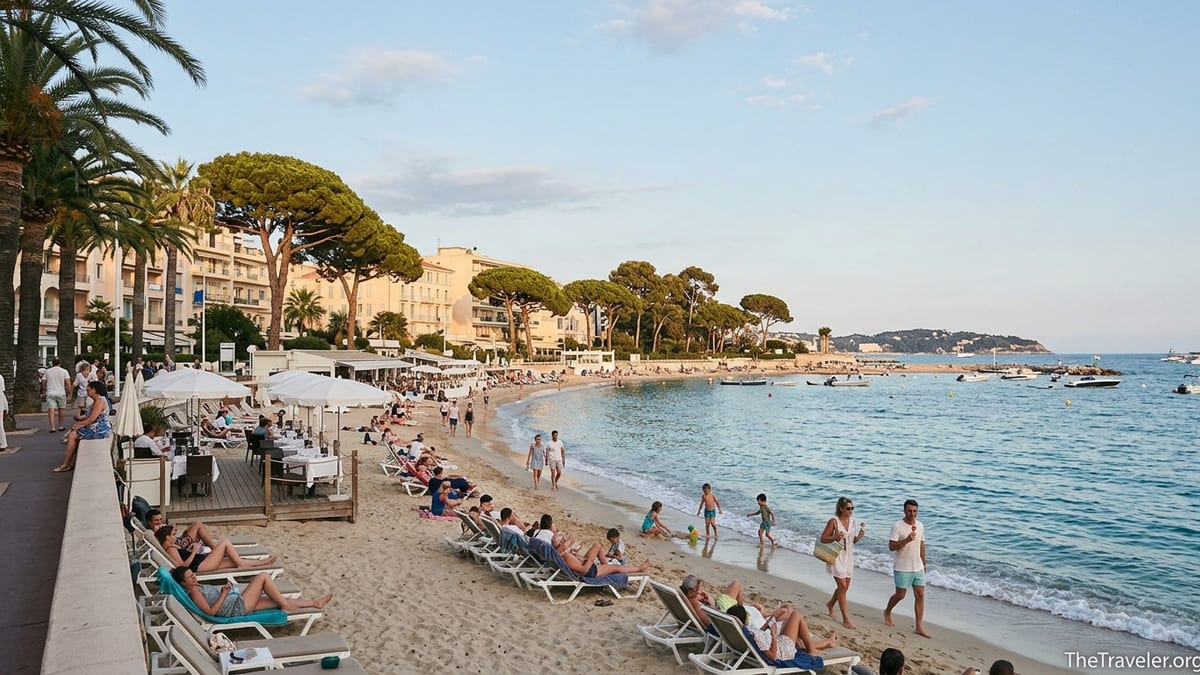
Many towns on the Côte d’Azur face the sea, but Juan les Pins lives at beach level. Much of the resort spreads along a curving bay of golden sand, backed not by a traffic-heavy corniche but by low-rise hotels, pine groves and beach clubs. Compared with Nice, where you walk across a wide road and step onto pebbles, here you go directly from café terrace to soft sand. In practical terms, that means you can leave your hotel or apartment in flip-flops and be swimming five minutes later without worrying about water shoes or beach mats.
The town grew up in the 20th century as a “station balnéaire” rather than an old fishing port, so its layout still feels purpose-built for seaside holidays. Along Boulevard Edouard Baudoin and Boulevard Guillaumont, private beach clubs line up almost continuously, punctuated by pockets of public sand. In high season, you see families wheeling strollers straight onto the promenade, locals doing an after-work swim at sunset and teenagers wandering between gelato stands and beach volleyball courts. The sea is usually calm and shelving gently, which makes it especially popular with families compared with the deeper, rockier shoreline in Nice or Villefranche-sur-Mer.
Then there are the pines themselves, which give the town its name. La Pinède, the central pine grove, forms a green pocket right behind the main beach. On hot July afternoons, you can sit on a bench in its resin-scented shade and still hear the clink of cutlery from the seafront restaurants and the sound of parasols rustling on the sand. In other Riviera towns, public gardens often sit back from the water or on hilltops. Here the grove effectively merges with the seaside, so you can step off the sand, rinse your feet and be in the cool of the trees within a few strides.
Unlike the manicured promenades in Cannes, Juan les Pins still feels relatively low-rise and human in scale. You will find Belle Époque villas behind hedges, mid-century hotels and a few contemporary apartment blocks, but no wall of high-rise towers. Walk two or three streets inland and you are in a compact, lived-in neighborhood of bakeries, local supermarkets and schools, a reminder that this is part of Antibes rather than a standalone luxury enclave. For visitors, that combination of seaside infrastructure and everyday life is a major part of the appeal.
Jazz at the Heart: A Town With Its Own Soundtrack
What truly sets Juan les Pins apart from most coastal towns on the Côte d’Azur is that it is not just a beach destination; it is also one of Europe’s classic open-air jazz stages. Jazz à Juan, founded in 1960 in the Pinède Gould, is widely recognised as one of the oldest outdoor jazz festivals in Europe and has hosted legends from Miles Davis and Ella Fitzgerald to Ray Charles and Herbie Hancock. The stage itself is a simple metallic structure set among the pines, looking out toward the Mediterranean, so audiences listen to sax solos while swifts loop overhead and boats slide across the bay.
In practical terms, that jazz heritage shapes the town well beyond ten festival evenings in July. A “walk of fame” of handprints from performers lines the boulevard near the sea, so you can literally step over the imprints of Oscar Peterson or Dizzy Gillespie on the way to dinner. Bars and hotel lounges often weave live music into their summer programming, especially in the weeks around Jazz à Juan. On a typical July night you might hear a trio playing standards in a courtyard bar, a funk-leaning band at a beach club and a marching brass group crossing town after a set in the pine grove.
Compared with Cannes, where music is often tied to private events and film-festival parties, Juan les Pins’ concerts feel more accessible. Tickets for Jazz à Juan typically start around a few dozen euros for lawn or upper-tier seating, with premium places closer to the stage rising into three figures for the biggest names. There are also free or lower-cost fringe events in the streets and smaller squares. For example, before the main evening concerts, the “Before” sessions bring food trucks, drinks stands and informal performances into the Pinède so people can enjoy the atmosphere without committing to a full show.
Even outside festival dates, the town’s identity is intertwined with music in a way you rarely find elsewhere on the Riviera. Locals talk about summers in reference to who played “under the pines” that year, and hotel concierges routinely check the festival program before advising guests on dates. For a traveler choosing between Juan les Pins and, say, Saint‑Raphaël or Menton, those cultural layers mean nights here are less about quiet seafront strolls and more about live sets echoing through the trees until late.
A Different Kind of Nightlife: Lively but Compact
The Riviera often divides between very quiet towns that “roll up the sidewalks” early and high-gloss party hubs where nightlife revolves around VIP rooms. Juan les Pins sits somewhere in the middle. Its nightlife is livelier and more youthful than neighboring Antibes, yet more compact and relaxed than the superclub scene of Cannes. In summer the main streets between the train station and the sea become a dense strip of cocktail bars, small clubs, piano lounges and late-opening restaurants, all within an easy ten-minute walk.
On a typical July evening, seaside terraces are still buzzing at midnight with couples sharing carafes of Provence rosé, groups of friends splitting pizzas at outdoor tables and families treating children to late ice creams. Bars around Place du Général de Gaulle in Antibes tend to skew toward pub-style evenings and rugby on screens; in Juan les Pins, beats from beach lounges lean more toward house, funk and Latin. Many venues have small dance floors or space to stand with a drink rather than full-blown mega-club layouts, which suits travelers who want atmosphere without dedicating the whole night to one spot.
Prices mirror that middle ground. Cocktails on the seafront typically run in the low to mid-teens in euros, slightly cheaper than in the flashiest Cannes addresses but higher than in quieter inland towns like Grasse. Cover charges are not common outside a handful of late-night clubs, and dress codes are generally relaxed: resort-casual is more than enough in most places, although beachwear is usually discouraged once the sun goes down. Solo travelers and small groups often appreciate that you can bar-hop a handful of venues safely on foot without needing late-night taxis or long walks along dark roads.
This compact nightlife also suits visitors who are basing themselves in nearby Antibes or on Cap d’Antibes. It is common for families to stay in a quieter hotel or rental in Antibes’ old town and then hop over to Juan les Pins after dinner for a livelier atmosphere. The train journey between Antibes and Juan les Pins is literally a few minutes, and local buses run late in season, so you can enjoy a concert or a couple of drinks by the water and still be back at your base before the small hours.
Beach Culture: From Laid-back Loungers to Full-service Clubs
While several Côte d’Azur towns offer a mix of public and private beaches, Juan les Pins is particularly dense with options along a relatively small stretch of shoreline. This variety is a key difference from Antibes, where sandy beaches are more spaced out, and from Nice, where renting a lounger often means perching above pebbles and a steeper drop-off. Here, much of the sand is fine and soft underfoot, with clear, shallow water that stays inviting well into October in most years.
Public sections are free, and you will see locals arriving early with umbrellas, folding chairs and cool bags to claim their patch for the day. Showers are usually available at the back of the beach, and lifeguard stations operate in summer. For travelers watching their budget, this makes Juan les Pins competitive with less glamorous Mediterranean resorts: you can easily spend the day on the sand with only the cost of snacks and drinks from nearby bakeries, where a baguette sandwich might cost roughly the same as in any French town.
Private beach clubs offer a different experience. Many operate from around 10:00 to 18:00 or later, renting sunbeds that typically include mattress, parasol and waiter service. As of recent seasons, a full-day lounger on the front row by the water often starts in the range of a few dozen euros, rising for weekend days in July and August and for premium spots with extra space. Menus lean toward Mediterranean staples: salads with local tomatoes and mozzarella, grilled fish, seafood platters, and desserts such as tarte tropézienne or scoops of artisanal ice cream. Ordering a coffee or a glass of chilled rosé directly to your sunbed remains part of the classic Juan les Pins ritual.
Some clubs, particularly those with lounge-style decor and DJs, transition into evening venues with live music or relaxed sunset sessions. You might spend the afternoon swimming and reading, then freshen up in the club’s facilities and stay on for a casual dinner as fairy lights come on and the bay darkens. Compared with Cannes’ Croisette, where beach clubs often attach to luxury hotels and target a more formal clientele, many in Juan les Pins feel slightly more approachable, with a mix of locals, families and young visitors sharing the same space.
Location and Everyday Practicalities: An Easy-Going Base
Geographically, Juan les Pins sits in a sweet spot on the Côte d’Azur. It shares a municipality with Antibes, which means that within a 20 to 30-minute walk or a short bus ride you can swap beach bars for the ramparts, Provençal market and Picasso Museum of the old town. At the same time, regional trains link Juan les Pins directly with Cannes to the west and Nice, Monaco and even the Italian border to the east. For travelers without a car, that combination of sandy beaches at the doorstep and easy day-trip options in both directions is a strong argument for using the town as a base.
In daily life terms, Juan les Pins is also straightforward. The town center concentrates shops and services into a few compact blocks: small supermarkets, pharmacies, bakeries and takeaway stands sit alongside boutiques selling beachwear and locally made soaps. Compared with hyper-luxury enclaves such as Saint‑Jean‑Cap‑Ferrat or parts of Saint‑Tropez, you are never far from somewhere to buy an affordable picnic or a reasonably priced coffee. Accommodation ranges from older two-star hotels a few streets inland to polished four- and five-star properties with pools and sea views, giving a broader spectrum of budgets than some neighboring resorts.
Because Juan les Pins is less of an international business hub than Nice or Cannes, its rhythm still tracks the tourist calendar quite closely. In July and August, streets stay busy until late at night, especially during Jazz à Juan. Outside those peak months, life slows considerably: beach clubs may reduce service or close, and evenings lean more toward locals walking dogs along the promenade than big nights out. Travelers who want warmth, swimming and a buzz might aim for June, early July or early September, when sea temperatures are usually pleasant but the town is slightly less crowded and prices for hotels and loungers can be more forgiving.
Importantly, Juan les Pins manages to retain a sense of safety and approachability. You will see multigenerational families strolling at night, groups of teenagers out together and solo travelers sitting comfortably on café terraces. Street lighting along the seafront and main arteries is good, and because the area is relatively small, navigation on foot is uncomplicated. For parents, this often makes the town feel more manageable than larger cities like Nice, where nightlife is spread across a wider area and crossing big boulevards with children in tow can be more stressful.
How Juan les Pins Compares With Its Neighbors
When people consider the Côte d’Azur, their shortlists often start with Nice, Cannes and Antibes. Juan les Pins shares a coastline with these places yet offers a different mix of assets. Compared with Nice, it trades big-city museums, tram lines and a major airport for soft sand, compact scale and a resort-like feel. There is no vast Promenade des Anglais here, no large port with cruise ships; instead, the town’s life focuses on a narrower arc of beach and the pine grove, which creates a more intimate sense of place.
Against Cannes, the contrast lies in branding as much as in bricks and mortar. Cannes has film-festival prestige, luxury boutiques and a harbor crowded with yachts, but many visitors experience it as a day-trip destination rather than somewhere to settle for a week unless they are committed to designer shopping and five-star hotels. Juan les Pins has its share of smart boutiques and stylish hotels, yet its core identity is not built around red carpets. Travelers wearing flip-flops and carrying inflatable rings do not feel out of step with the tone of the town, even in high season.
Within the wider Antibes area, Juan les Pins feels like the extroverted younger sibling. Antibes’ old town offers stone ramparts, museums and a traditional market, with evenings spent in wine bars on narrow streets and restaurants tucked behind stone arches. Walk or ride a few minutes around the headland and the mood shifts to sea-facing terraces, live jazz and late-night gelato. For many visitors, the ideal compromise is to treat Antibes and Juan les Pins as one combined destination: base yourself in one, and spend alternate days between the quiet charm of the old town and the lively, beach-first atmosphere of Juan les Pins.
It is this balance that makes Juan les Pins different from smaller coastal villages such as Villefranche-sur-Mer or Beaulieu, which lean more toward picturesque views and quiet evenings, and from highly exclusive spots where prices and formality can be intimidating. Here you can attend a world-class jazz concert one night, rent a reasonably priced beach lounger the next day, and still find an everyday boulangerie selling standard-priced baguettes each morning. That versatility is particularly attractive to mixed groups and families where some people crave cultural experiences while others simply want to swim and relax.
The Takeaway
Juan les Pins stands out on the Côte d’Azur because it refuses to be just one thing. It is not solely a glamorous resort, a historic town or a party hub. Instead, it blends accessible sandy beaches, a serious jazz pedigree and a walkable nightlife scene into a compact package that feels both practical and slightly glamorous. Under the pine trees of the Pinède Gould, music and sea air mix in a way you will not easily find along the rest of the Riviera shoreline.
For travelers deciding where to anchor a French Riviera trip, that mix can make Juan les Pins a smart choice. Those who want museums, bustling markets and an old harbor are minutes from Antibes. Those craving a quiet swim and a book by the water can find it on a public strip of sand or from a sunbed at a beach club. And those who prefer their evenings with live music and a glass of rosé in hand will not run out of options in July and August.
Ultimately, what makes Juan les Pins different is how quickly it slips from day into night without forcing you to change gears completely. You can have breakfast at a local bakery, spend the afternoon in the sea, wander through pine-scented air toward an open-air concert at dusk and end the day with your feet in the sand and music in your ears. On a coastline full of famous names, that easy, seamless rhythm is Juan les Pins’ quiet superpower.
FAQ
Q1. Is Juan les Pins a good base for exploring the Côte d’Azur without a car?
Yes. Juan les Pins has a central railway station with frequent regional trains to Antibes, Cannes and Nice, plus connections further afield to Monaco and Italy. Local buses link the town with Cap d’Antibes and other nearby areas, so you can comfortably explore the main Riviera highlights using public transport.
Q2. How does the beach in Juan les Pins compare to Nice or Cannes?
Juan les Pins is known for its soft, sandy beaches and shallow, usually calm water, which many visitors find more comfortable than the pebbles in Nice. Compared with Cannes, the scale is smaller and the atmosphere slightly more relaxed, with a high concentration of both public sand and private beach clubs in a compact area.
Q3. When is the best time to visit Juan les Pins?
June, early July and September are often ideal, with warm weather, swimmable sea temperatures and a lively but not overwhelming atmosphere. July and August bring peak crowds and higher prices, along with major events such as Jazz à Juan, while spring and autumn outside those months are quieter and better for walks and day trips than for full-on beach days.
Q4. What makes Jazz à Juan special compared with other festivals?
Jazz à Juan is one of Europe’s longest-running outdoor jazz festivals, staged among the pine trees of the Pinède Gould with the sea as a backdrop. Its history of hosting major jazz legends, combined with the intimate open-air setting and fringe events in the town, gives it a distinctive character that mixes top-tier performances with a relaxed Riviera atmosphere.
Q5. Is Juan les Pins suitable for families with children?
Yes. The gently shelving beaches, generally calm water and availability of family-friendly beach clubs and restaurants make Juan les Pins popular with families. The town is walkable, playgrounds and the pine grove offer shaded spaces away from the sand, and nearby Antibes adds aquariums, markets and ramparts to explore on family day trips.
Q6. How expensive are beach clubs in Juan les Pins?
Prices vary by location and season, but a full-day sunbed with parasol at a typical beach club in high season often costs in the range of a few dozen euros. Food and drinks on-site are usually more expensive than at local bakeries or supermarkets, but still generally a little lower than the most exclusive clubs in Cannes or Saint‑Tropez.
Q7. What is the nightlife like outside of July and August?
Outside peak summer, nightlife in Juan les Pins becomes more low-key. Many bars and some beach clubs remain open, especially on weekends, but the overall pace slows and evenings tend to focus on relaxed dinners, drinks on terraces and occasional live music rather than a constant party scene. Travelers seeking big, late-night crowds will find the most action in high season.
Q8. Can I easily visit Antibes’ old town from Juan les Pins?
Yes. Antibes’ old town is only a short bus ride, quick train hop or roughly 20 to 30-minute walk away, depending on where you are staying in Juan les Pins. Many visitors split their time between the two, spending days on the beaches of Juan les Pins and evenings or mornings exploring Antibes’ markets, museums and ramparts.
Q9. Do I need to book accommodation and beach clubs in advance?
In July and August, and during major events such as Jazz à Juan, it is wise to book accommodation several months ahead and reserve sunbeds at popular beach clubs, especially on weekends. Outside those peak times you can usually find hotel rooms with shorter notice, and many beach clubs will have availability without advance reservations, particularly on weekdays.
Q10. Is Juan les Pins a better choice than Nice or Cannes for a first visit to the Riviera?
It depends on your priorities. Choose Juan les Pins if you value sandy beaches, a compact and walkable resort feel and the option of live jazz and relaxed nightlife. Nice suits travelers who want museums, markets and a bigger-city atmosphere, while Cannes appeals more to those drawn to luxury shopping and a polished, film-festival image. Many visitors combine them, basing in one and using trains for easy day trips to the others.