


On a coastline known for superyachts, celebrity sightings and eye-watering prices, Juan-les-Pins slips under the radar. Tucked between Nice and Cannes, this compact resort on the Cap d’Antibes peninsula has something many of its flashier French Riviera neighbors do not: long, genuinely sandy beaches right in town, a relaxed seaside promenade, and a holiday rhythm built around swimming, strolling and lingering over sunset apéritifs. For travelers who want a real beach escape with easy access to the rest of the Côte d’Azur, Juan-les-Pins makes a compelling base.
Get the latest updates straight to your inbox!
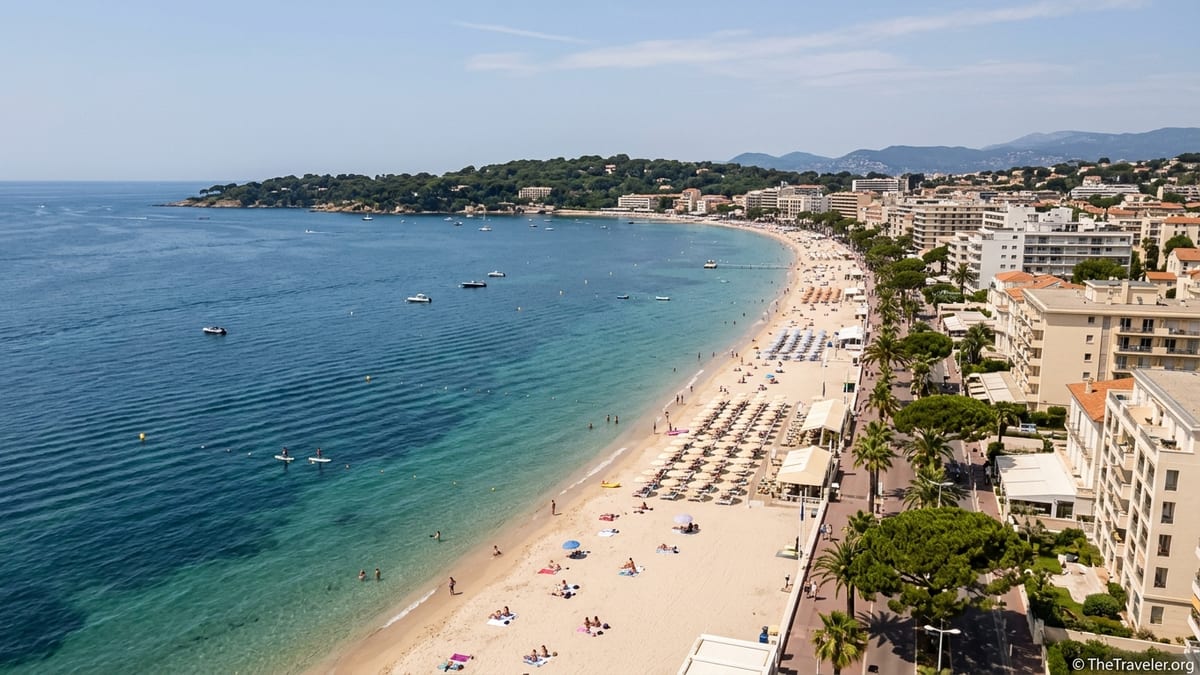
Sandy, Swimmable Beaches Right in the Heart of Town
One of the main reasons Juan-les-Pins stands out on the French Riviera is the simple but crucial fact that its beaches are sandy. Much of the coastline between Nice and Monaco is covered in large pebbles, which means water shoes, awkward entries and less-than-comfortable sunbathing. In Juan-les-Pins, the majority of the shoreline from Port Gallice in the east to the border with Golfe-Juan in the west is a broad curve of sand, so you can walk barefoot straight into the water and spread out a towel without needing a lounger.
Travelers will quickly notice how close the beaches are to the everyday life of town. The main stretch, often referred to as Grande Plage, runs alongside the Boulevard du Littoral with only a low wall and a strip of promenade between you and the sea. Step out of a café with a morning espresso, cross the street, and you are on the sand within seconds. Families staying in nearby apartment rentals on avenues like Rue du Docteur Fabre or Boulevard Charles Guillaumont can realistically pop back to their accommodation in five minutes for naps or forgotten toys, something that is much harder to do in more spread-out resorts.
There is also variety along this short coastline. At the quieter eastern end, near Port Gallice, Plage de la Gallice is a small public cove with clear, usually calm water that appeals to swimmers and couples looking for a less crowded feel. Closer to the center you will find a mix of public sections and private beach clubs with neat rows of loungers. Further west, around Pont du Lys, the beaches tend to be a little wider and more local, popular with residents who walk down from the neighborhoods set back from the sea.
For visitors comparing bases along the Riviera, the sandy beaches are not just a comfort issue. They shape how you spend your day. Instead of budgeting extra for a lounger to escape the pebbles, you can throw down a towel and stay for hours at minimal cost, then splurge on a seaside lunch or an extra scoop of gelato later. Over the course of a week-long trip, that can make Juan-les-Pins noticeably more affordable than high-profile pebble resorts, even before you factor in its more moderate hotel prices.
Beach Clubs, Public Strips and Realistic Prices
Juan-les-Pins is famous along the Riviera for its long line of classic French beach clubs. Many of them open from late spring to early autumn and offer packages that include a sun lounger, parasol, and sometimes a towel and a small locker. On a typical July or August day, a front-row lounger at a mid-range club along Boulevard Edouard Baudoin might cost around 40 to 50 euros, while second or third rows are often closer to 25 to 30 euros. That is not cheap, but it is often less than what you would pay for a similar setup on the prime sands of Cannes or in certain parts of Saint-Tropez.
Crucially, you do not have to rent a chair at all. Between the private concessions are public strips of sand where you can bring your own towel and umbrella free of charge. These public sections can get busy in high summer, but many regular visitors learn to arrive by 9:30 or 10:00 in the morning to stake out a spot. For travelers on a budget, a good strategy is to alternate: perhaps book loungers at a beach club one or two days a week for the full pampered experience, then use the public beaches on other days and pack a picnic from one of the town’s bakeries or supermarkets.
The atmosphere of the beach clubs here also tends to be more laid-back than ultra-exclusive. At many places, such as those near the Eden Casino, staff are used to families and multigenerational groups spending the day together. It is not unusual to see grandparents reading under parasols while children build sandcastles near the water’s edge and parents drift in and out of the sea. Service is typically efficient but informal, and you can order everything from grilled fish and niçoise salads to simple plates of fries and carafes of chilled rosé without feeling pressured to turn your lounger into a pricey restaurant table.
Because the beach runs directly parallel to the main promenade, you are never far from alternatives. If you tire of club prices, you can step off the sand and find a café offering a lunch formule, perhaps a salad and main course, for 20 to 25 euros, or pick up takeaway panini and fruit for even less. It is this mix of polished service and easy, low-commitment options that helps Juan-les-Pins appeal to both splurge travelers and those watching their spending.
Relaxed Riviera Vibe with Nightlife When You Want It
Juan-les-Pins strikes a useful balance between mellow beach town and lively seaside resort. By day, the pace is unhurried. Locals wander the Promenade du Soleil with small dogs, older couples read in the shade of the pines at the Pinède park, and beachgoers drift in and out of the water. Compared to Nice’s urban bustle or Cannes during a major event, the streets feel compact and manageable, especially if you are traveling with children or older relatives.
At the same time, there is enough nightlife to keep younger travelers and groups of friends entertained. After sunset, many of the bars along the seafront open their terraces; you might hear a live band playing jazz standards at one place and a DJ set at another. The area around the Eden Casino and the side streets just behind the promenade host cocktail bars, small clubs, and late-opening cafés. In summer, it is common to see people in beachwear at early evening apéritif time, then the same bars slowly shift toward a more dressed-up crowd as the night progresses.
Compared to Saint-Tropez or Monaco, the dress code here is forgiving. A simple sundress and sandals or a short-sleeve shirt and chinos are more than adequate in most restaurants and bars. That can make packing easier and ease the pressure to bring formal outfits that might only be worn once. It also means travelers can transition smoothly from sand to aperitif hour, stopping only to rinse their feet at the public showers scattered along the promenade.
This relaxed atmosphere extends to mealtimes. While there are a few refined addresses, much of Juan-les-Pins’ dining scene consists of mid-range brasseries, pizzerias and seafood restaurants along the sea. Expect to pay around 18 to 25 euros for a main course of grilled fish or pasta, with more upscale menus edging higher. It is straightforward to find a decent dinner for two, including a shared starter and a carafe of local wine, for under 80 euros, which is notably easier than in some of the region’s showier hotspots.
Jazz Under the Pines and a Strong Cultural Identity
Juan-les-Pins is not just about sun loungers. The resort has built an international reputation thanks to Jazz à Juan, one of Europe’s longest-running jazz festivals. Each July, the Gould pine grove, a natural amphitheater of stone terraces and tall umbrella pines only steps from the sand, becomes an open-air concert venue facing the Mediterranean. Over the decades, legends such as Ella Fitzgerald and Miles Davis have played under those trees, and their handprints are commemorated on plaques along the nearby pedestrian alleys.
Planning a trip to coincide with the festival can transform a simple beach holiday into a cultural escape. Programmes in recent years have mixed established jazz names with soul, funk and world music acts, making the event accessible even for travelers who would not call themselves jazz experts. Evening concerts typically start around 8:30 or 9:00 pm, and attendees often arrive early to picnic on the grass or enjoy a drink on the seafront before the music begins. Ticket prices vary by artist and seating category, but visitors can expect a range from roughly 40 euros for upper stands to higher prices for premium seats nearer the stage.
Even outside festival dates, music is woven into the fabric of the town. Smaller venues host live performances throughout the summer, and buskers frequently play on the side streets leading toward the pine grove and the beach. For many travelers, an enduring memory of Juan-les-Pins is an evening stroll where the sounds of a saxophone drift from the park while waves lap against the sand just beyond.
This blend of cultural history and seaside holiday atmosphere is unusual along the Riviera. Where some resorts lean almost entirely toward shopping and beach clubs, Juan-les-Pins invites visitors to connect with a specific artistic legacy. Stopping to read the names on the jazz handprints or flipping through old photos of past festivals in local galleries helps ground your stay in a sense of place that goes beyond sun and sea.
Effortless Access to the Best of the French Riviera
Location is another reason Juan-les-Pins makes one of the Riviera’s best beach escapes. The town sits between Nice and Cannes on the Marseille to Ventimiglia rail line, and its small train station is just a few minutes’ walk from the seafront. Regional TER trains typically link Juan-les-Pins to Nice in about 20 to 25 minutes and to Cannes in roughly 15 minutes, making day trips straightforward. Walk from your accommodation to the station, board a train, and you can be strolling along Nice’s Promenade des Anglais or Cannes’ La Croisette before a mid-morning coffee break.
For international visitors, Nice Côte d’Azur Airport is roughly 13 kilometers away. One common route is to take the tram from the airport terminals to Nice Saint-Augustin station and then catch a TER train west; the overall journey time is often under an hour, even with connections. Taxis and pre-booked transfers are another option, especially for travelers with large luggage or young children, and tend to cost significantly less than long transfers to more remote Riviera villages.
Once based in Juan-les-Pins, it is easy to explore nearby highlights without sacrificing too much beach time. Antibes’ atmospheric old town and the Picasso Museum are only one or two stops away by train or a short local bus ride; fit them into a half day and return to the sand by late afternoon. Cap d’Antibes, with its coastal path and small coves like Plage de la Garoupe, can be reached by local bus or even on foot for keen walkers. Farther afield, day trips to Monaco, Menton, or inland hill towns such as Saint-Paul-de-Vence are feasible by public transport.
This combination of genuine beach convenience and rail connectivity is rare. Many travelers report that staying in Juan-les-Pins allows them to alternate between deeply relaxed beach days and high-energy urban excursions, all without needing to rent a car. For visitors who are wary of navigating narrow Riviera roads or paying high parking fees in busy towns, that ease of movement can be a deciding factor.
Family-Friendly and Manageable, Yet Still Romantic
Families often find Juan-les-Pins an easy place to settle in. The sandy shoreline and generally shallow water close to the beach give parents peace of mind, especially on calmer days when small children can paddle at the edge. Public showers and changing cabins along the promenade make it simpler to rinse off sand before walking back to a rental apartment or hotel. Supermarkets and bakeries within a few blocks of the seafront allow for quick snack runs or impromptu picnic dinners eaten on the sand at sunset.
The compact size of the resort helps, too. Distances are short, so toddlers in strollers or older relatives with limited mobility are not faced with long, tiring walks. Renting a small apartment within a few blocks of the beach means all-day access to the sea without the logistics of catching buses or packing elaborate beach bags. Parents report being able to take children back for midday naps and then returning to the water in the cooler late afternoon, when the light softens and the beach crowds thin.
At the same time, Juan-les-Pins retains a romantic side. Couples can stroll hand in hand along the promenade at dusk, when the sky over the Esterel mountains turns pink and the lights of Golfe-Juan glimmer across the bay. A simple dinner on a terrace overlooking the sand, followed by a nightcap under the pines listening to live music, feels far removed from the traffic and crowds of larger Riviera cities. With a bit of planning, it is easy to time a visit to coincide with a special occasion such as an anniversary, booking a sea-view room at one of the waterfront hotels and reserving a table at a more intimate restaurant slightly set back from the main drag.
Group trips also work well here. Friends traveling together can choose different daily rhythms, with some heading out on boat excursions or shopping trips while others linger on the beach. Because everything is close, it is simple to agree on a meeting point, such as the square by the pine grove or a favorite café, at a set time in the evening. This flexibility makes Juan-les-Pins a smart choice when group members have varying energy levels and travel styles.
When to Go and How Long to Stay
Choosing the right time to visit Juan-les-Pins can make a big difference to your experience. July and August bring hot weather, buzzing nightlife and the full program of events, including the jazz festival, but also the highest prices and densest crowds. Beaches can be shoulder to shoulder in the middle of the day, and booking accommodation and beach loungers well in advance becomes almost essential. For travelers who want to combine beach time with a busy social scene and do not mind the heat, this peak season is exciting and full of energy.
For many visitors, however, late May, June and September offer the sweet spot. Sea temperatures are usually pleasant enough for swimming, the majority of beach clubs and restaurants are open, and yet the sand and streets are less crowded. Shoulder season also tends to bring more moderate hotel rates and the possibility of last-minute table reservations at popular restaurants. Couples and solo travelers often favor these months for a more relaxed pace and easier sightseeing in nearby towns without intense summer heat.
In terms of trip length, a minimum of three full days is sensible if Juan-les-Pins will be your only base, allowing time for a mix of beach hours and at least one or two excursions. Many travelers choose to stay a full week, particularly if they are using the town as a hub for the wider Riviera. A typical seven-night itinerary might include three or four dedicated beach days, one day exploring Antibes and Cap d’Antibes, one day in Nice or Cannes, and a final flexible day for a boat trip or simply repeating whichever experience was most enjoyable.
Even in the cooler months, Juan-les-Pins can appeal to visitors who prioritize seaside walks and day trips over swimming. While some beach facilities close in winter, the promenade, pine grove and rail connections remain, and the lower season can offer a gentler, more local side of the Riviera. Travelers should simply be prepared for changeable weather and limited seasonal services compared with summer.
The Takeaway
Juan-les-Pins rarely dominates Riviera postcards in the way that Nice, Cannes or Monaco do, but that under-the-radar status is part of its charm. For beach-focused travelers, its long sandy shoreline, easy sea access and mix of public stretches and approachable beach clubs are significant advantages over many neighboring resorts. Add in the shade and atmosphere of the pine grove, the music and history of Jazz à Juan, and the almost effortless rail links to other coastal highlights, and it becomes clear why so many visitors quietly return year after year.
For anyone planning a French Riviera trip and torn between multiple bases, Juan-les-Pins is worth serious consideration, especially if daily swimming, relaxed evenings and simple logistics matter more than red carpets and designer boutiques. It offers the best of both worlds: the freedom to do very little beyond reading and swimming under the sun, and the possibility to step onto a train and tap into the glamour and energy of the wider Côte d’Azur whenever the mood strikes. In a region famous for spectacle, Juan-les-Pins proves that one of the best beach escapes is also one of the most easygoing.
FAQ
Q1. Is Juan-les-Pins a good base for exploring the French Riviera without a car?
Yes. Juan-les-Pins has its own train station on the main coastal line, with frequent regional trains to Nice, Antibes, Cannes and beyond. Most popular day-trip destinations can be reached in under an hour by public transport, so many visitors happily skip renting a car.
Q2. Are the beaches in Juan-les-Pins sandy or pebbly?
The majority of the shoreline in Juan-les-Pins is sandy, which sets it apart from many pebble beaches elsewhere on the Riviera. You can usually walk into the sea comfortably without water shoes, and both public sections and private beach clubs sit directly on the sand.
Q3. How expensive are beach clubs and loungers in Juan-les-Pins?
Prices vary by club and season, but in high summer a front-row lounger at a mid-range club often falls in the range of about 40 to 50 euros per day, with cheaper options in back rows. Between concessions there are free public stretches where you can simply bring your own towel.
Q4. Is Juan-les-Pins suitable for families with young children?
Yes. The sandy beaches, generally shallow water near the shore and compact layout make it popular with families. Many parents appreciate being able to walk from their accommodation to the beach in a few minutes and return easily for naps or meals.
Q5. What is the best time of year to visit Juan-les-Pins for a beach holiday?
July and August offer the warmest sea and the fullest program of events, but also the biggest crowds. Late May, June and September are often ideal for many travelers, with pleasant swimming conditions, open facilities and a more relaxed atmosphere.
Q6. How long should I stay in Juan-les-Pins?
A stay of at least three full days allows for a good mix of beach time and short excursions. Many visitors opt for a week so they can enjoy several all-day beach sessions and still fit in day trips to nearby towns like Antibes, Cannes and Nice.
Q7. Is Juan-les-Pins more relaxed than Nice or Cannes?
In general, yes. Juan-les-Pins feels more like a dedicated seaside resort, with life centered on the beach and promenade. Nice and Cannes have busier city centers and larger crowds, especially during major events, while Juan-les-Pins retains a smaller, more laid-back character.
Q8. Do I need to dress up for evenings out in Juan-les-Pins?
Not usually. While some upscale venues exist, most bars and restaurants are comfortable with smart-casual attire. Sundresses, light shirts and sandals are common, which makes it easy to transition from beach days to relaxed evenings without elaborate outfits.
Q9. Can I enjoy Juan-les-Pins outside the summer season?
Yes, although the experience is different. In spring and autumn, the town is quieter but still pleasant for seaside walks and day trips. In winter, some beach facilities and seasonal restaurants close, but the promenade, pine grove and rail connections remain.
Q10. Is Juan-les-Pins safe for solo travelers?
Juan-les-Pins is generally considered safe, particularly in the central areas around the promenade and station, which are well frequented. As in any busy seaside resort, standard precautions such as watching your belongings on the beach and at night are sensible.