


I went to La Pedrera, Gaudí’s Casa Milà on Barcelona’s Passeig de Gràcia, expecting a quick look at a famous façade and a few photo opportunities. Instead, I walked out two hours later slightly dazed, my camera full, my neck sore from looking up, and my understanding of Gaudí completely rewritten. What I thought would be a routine tourist stop turned into one of the most surprising, layered experiences of my trip.
Get the latest updates straight to your inbox!
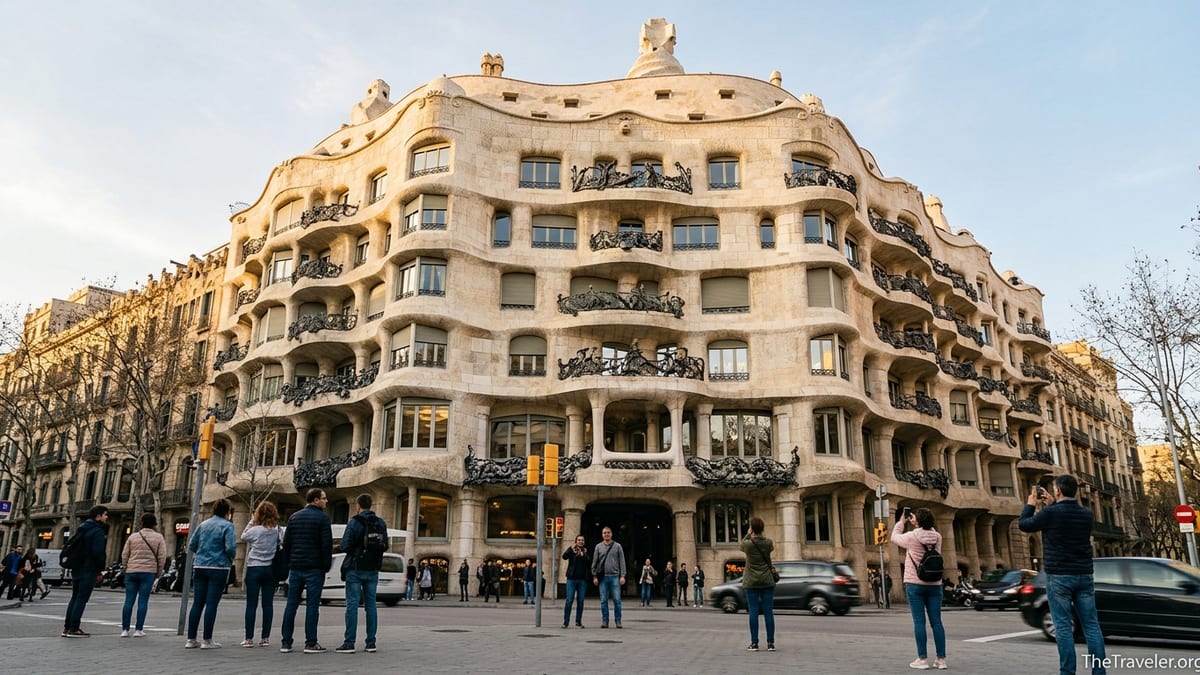
Arriving With Low Expectations on Passeig de Gràcia
I had slotted La Pedrera into a busy day almost as an obligation. Everyone talks about Sagrada Família and, increasingly, Casa Batlló with its immersive projections and theatrical rooms. La Pedrera, by contrast, I associated with a wavy stone façade I had seen on postcards and Instagram. I bought a basic daytime ticket online the night before for around 28 euros, selecting a mid-morning slot to dodge the worst crowds and heat.
As I walked up Passeig de Gràcia, past luxury boutiques and office blocks, La Pedrera’s bulk emerged like a piece of sandstone cliff embedded in the city. The nickname “the quarry” suddenly made sense. The façade looked less pretty and more geological: pale stone swirling around irregular iron balconies that seemed closer to twisted seaweed than traditional railings. There were no straight lines to comfort the eye, and for the first time that day I stopped walking just to stare.
Security and ticket control were quick and organized. Staff scanned my mobile ticket, and within a few minutes I was standing inside the main courtyard, the city noise falling away. I had expected a cramped, dark interior. Instead, daylight poured down through the open central patio, painting the walls in soft gradients of beige, blue, and pale yellow. The building felt unexpectedly open and breathable, more like a sculpted canyon than a residential block.
I picked up the included audio guide, chose English, and slipped on the headphones, still half convinced this would be another standard loop of dates and names. Within minutes, the narration started pointing out details I would have missed entirely, from tiny marine motifs on door handles to the way the curved windows channeled air. The visit was off to a much stronger start than I had anticipated.
The Rooftop: From Nice Viewpoint to Stone Dreamscape
The first true shock of La Pedrera came as I stepped out onto the rooftop. I had seen photos of the chimneys before, but nothing prepared me for how otherworldly they feel in person. Instead of a flat terrace with a railing and some views, I found myself in a stone landscape of slopes, staircases, and sculpted guardians looming above the Eixample grid.
The chimneys and ventilation towers, wrapped in broken ceramic and stone chips, looked like helmets and masks, somewhere between medieval warriors and abstract sculptures. Up close, the texture of the materials was rough and tactile, catching the morning light so that parts glowed while others sank into shadow. I watched a child reach out and run their hand along the mosaic, their parents whispering that these “soldiers” were actually just functional structures keeping the building alive.
From one side of the rooftop, the view stretched across Barcelona’s ordered grid to the Sagrada Família, its cranes still puncturing the skyline. On the other, I could trace the elegant line of Passeig de Gràcia and pick out Casa Batlló’s shimmering façade a few blocks away. It dawned on me that for the residents of La Pedrera, this rooftop had always been more than a tourist platform. It was their daily horizon, a place to dry laundry and watch thunderstorms roll in from the sea.
Walking the uneven steps and ramps required a bit of attention, especially for older visitors, but the route felt well signposted and secure with discreet railings. Staff were present to keep people from climbing where they should not and to help those who moved more slowly. The combination of a practical circulation system and such surreal design was surprising. It was as if the building had decided to disguise its utilities as an art installation long before that term existed.
Inside the Attic: Discovering Gaudí the Engineer, Not Just the Dreamer
If the rooftop shows Gaudí as a sculptor of space, the attic reveals him as a meticulous engineer. The attic level, known as the Espai Gaudí, was the part of the visit I had almost written off while planning. It sounded like a museum annex: models, texts, perhaps a few dusty displays. Instead, it turned out to be one of the most atmospheric and informative sections of the entire building.
The space is formed by a series of slender brick arches, over 250 of them, repeating like the ribs of a stone whale. Walking through this sequence feels like moving inside the skeleton of the building itself. The audio guide explained how these catenary arches distribute weight and allowed Gaudí to free the apartments below from heavy internal walls. It was the first time I truly understood that the building’s organic shapes were not just aesthetic whims but solutions to structural questions.
Between the arches, I found scale models of La Pedrera and other Gaudí works, along with detailed explanations of how he used gravity-based models to test his ideas. There were sections showing how rainwater drains through the building and how ventilation shafts help cool the apartments naturally. For someone who had always associated Gaudí with colorful surfaces and religious symbolism, seeing this level of rational problem-solving was unexpectedly compelling.
Around me, other visitors were lingering longer than I had seen in many architectural exhibits. Couples paused to compare the models to photos on their phones, and a group of architecture students debated which structural innovations would be considered sustainable design today. This was not the rushed, obligatory museum floor I had anticipated. It was a quiet, almost meditative environment that connected the fantastical rooftop above with the lived-in apartments below.
The Tenants’ Apartment: Life Inside a Radical Experiment
The reconstructed apartment, set up to resemble an early 20th-century bourgeois home, was the point where the building stopped being an abstract masterpiece and became a place you could imagine living in. I had expected staged furniture and a quick walk-through. Instead, each room offered clues to how radical this building must have seemed when it was completed more than a century ago.
Corridors gently curved instead of meeting at right angles. Doors were subtly tapered, and even the door handles had ergonomic, hand-shaped forms. Standing in the kitchen, with its tiled walls and heavy cast-iron stove, the audio guide pointed out the hidden shafts for ventilation and the way natural light was drawn in from internal courtyards. It was clear that Gaudí had considered not only aesthetics but also hygiene, airflow, and daily domestic routines.
In the children’s bedroom, vintage toys and clothing were laid out to suggest a family mid-routine. I overheard a parent explain to their child that people once lived here without elevators going to every private level, and the child looked unconvinced that anyone would choose that. The parquet floors creaked gently underfoot, reminding me that despite the constant flow of visitors, this had once been a quiet, private home where people worried about school exams, grocery lists, and family gossip.
What surprised me most was the sense that Gaudí’s wild exterior had sheltered a very functional, almost cozy interior world. It contradicted the easy assumption that visionary architecture must be impractical. In La Pedrera, curved walls created clever storage, irregular windows pulled in cross-breezes, and the thick stone façade insulated against heat. This was avant-garde architecture that had been forced to reckon with laundry days and noisy neighbors.
Practical Surprises: Accessibility, Organization, and Ticket Value
Given its age and complex forms, I expected La Pedrera to be a logistical challenge. In reality, the visit felt more smoothly organized than many newer attractions. Timed entries meant the courtyards and rooftop never felt dangerously crowded, even on a busy weekend morning. Security checks were firm but friendly, and staff moved the line along without the brusqueness you sometimes encounter at overburdened sites.
I also noticed thoughtful touches for visitors with reduced mobility. While not every slope on the rooftop is accessible, there are lifts and adapted routes that provide partial views and access to key areas. Clear signage explained which sections might be difficult to navigate, and I watched staff patiently guide a wheelchair user toward an alternative platform with a decent rooftop vista. It was not perfect, but it was far more inclusive than I had feared from a century-old building.
From a budgeting perspective, La Pedrera is not a cheap stop, especially for families. By the time you factor in a standard daytime ticket of around the high twenties in euros per adult, plus a coffee or snack nearby, it can be a noticeable line item. Yet, compared with other Gaudí sites that lean heavily on digital effects and theatrical storytelling, La Pedrera’s value felt grounded in the building itself. The audio guide was included and of high quality, and I never felt rushed along by staff eager to clear the flow.
Several travelers I chatted with in the gift shop mentioned they had expected to spend less than an hour and ended up staying close to two. That extra unplanned time may be the clearest sign that La Pedrera over-delivers. When a place exceeds your expectations so thoroughly that you rewrite your day’s schedule, the cost begins to feel more like an investment than a ticket fee.
La Pedrera by Night: A Different Personality After Sunset
I did not originally intend to see La Pedrera at night, but an unexpected gap in my evening plans and a glance at the timing boards changed my mind. The Night Experience, which costs more than a standard daytime ticket, includes a guided tour after sunset, a rooftop light show, and a glass of cava or juice at the end. It sounded marketing-heavy, yet curiosity won.
Returning after dark felt like visiting a different building altogether. Passeig de Gràcia’s traffic noise softened, and the façade glowed gently, its stone skin catching the warm street lighting. Inside, our small group followed a guide through the courtyards and up toward the rooftop, the usual daytime crowds replaced by a more intimate atmosphere. Without the midday sun, the colors of the walls and tiles took on deeper, moodier tones.
On the rooftop, the famous chimneys were illuminated, their contours emphasized by carefully placed lights that picked out textures invisible during the day. An audiovisual sequence played across the surfaces, with projections and music echoing Gaudí’s obsessions with nature and geometry. I had been wary of a light show overwhelming the architecture, but here it felt more like a conversation with it, using technology to draw attention to forms that might otherwise blend into the twilight.
The evening ended with a drink served on the terrace, the sky over Barcelona fading into a deep blue. Around me, visitors from different countries compared their impressions. A couple who had visited only during the day said the night visit had surprised them even more, giving the building a mysterious, almost introspective character. If the daytime La Pedrera was about understanding structure and function, the nighttime version was about emotion, mood, and quiet contemplation.
How La Pedrera Changed My View of Gaudí
Before this visit, I had placed Gaudí in a mental category labeled “eccentric genius,” the architect responsible for Instagram-friendly façades, colorful mosaics, and a basilica still under construction more than a century after it began. Leaving La Pedrera, that label felt embarrassingly thin. What struck me most was how thoroughly the building weaves together aesthetics, engineering, and everyday life.
In the attic, I saw the rigorous structural thinking behind the flowing lines. In the reconstructed apartment, I felt how those lines translated into drawers that opened easily, windows that let in just enough light, and rooms that could adapt to family needs. On the rooftop, the playful chimneys revealed their hidden role in ventilation and temperature control. At each step, my assumptions about form versus function were quietly challenged.
La Pedrera also reframed Barcelona itself for me. Standing on the terrace, I could see other modernist buildings dotting the grid, each with its own personality. Yet none of them seemed to blend such daring experimentation with such practical livability. In a city known for architectural icons, La Pedrera made a case for itself as an unsentimental, working building that just happens to be one of the most important examples of modernism in Europe.
Most of all, the visit reminded me that some of the most memorable travel experiences happen when expectations are modest. I had not built this visit up in my mind the way I had with Sagrada Família. Because of that, each new space, each unexpected detail, landed with more force. La Pedrera did not just meet my expectations. It quietly, methodically dismantled them and built something more complex in their place.
The Takeaway
Looking back, my visit to La Pedrera was more surprising than I expected because it refused to stay in a single category. It was not just an architectural pilgrimage or a photo stop, not simply a museum or a viewpoint. It was a layered experience that moved from street-level spectacle to intimate domestic detail, from structural logic to nighttime poetry.
If you are planning a trip to Barcelona and weighing how to allocate your time and budget, do not relegate La Pedrera to a quick façade photo on your way to somewhere else. Consider booking a timed entry during the day and, if your schedule and means allow, returning for the Night Experience to see how the building’s personality shifts after dark. Wear comfortable shoes, bring a bit of patience, and let the audio guide lead you without rushing.
You may arrive expecting a nicely designed apartment block with a famous rooftop. You are likely to leave with a much richer understanding of Gaudí, a deeper appreciation for how architecture can shape everyday life, and a set of images in your mind that no camera, however good, can fully capture. La Pedrera is not the loudest of Barcelona’s icons, but for many visitors, it quietly becomes one of the most unforgettable.
FAQ
Q1. Is it worth going inside La Pedrera, or is seeing the façade enough? It is very much worth going inside. The rooftop, attic exhibition, and reconstructed apartment reveal layers of Gaudí’s work you simply cannot appreciate from the street.
Q2. How long should I plan to spend at La Pedrera? Most visitors who engage with the audio guide and explore all areas spend between 1.5 and 2 hours, sometimes a little more if they like to linger on the rooftop.
Q3. Do I need to buy La Pedrera tickets in advance? It is strongly recommended, especially in high season and on weekends. Timed entries can sell out for popular mid-morning and late-afternoon slots.
Q4. What is the difference between the daytime visit and the Night Experience? The daytime visit is self-paced with an audio guide, ideal for understanding the architecture and daily life inside. The Night Experience is a guided evening tour with a rooftop audiovisual show and a drink, offering a more atmospheric, intimate feel.
Q5. Is La Pedrera suitable for children? Yes, many children enjoy the rooftop “soldier” chimneys and the apartment rooms. Just be prepared to keep a close eye on them on the rooftop steps and ramps.
Q6. How accessible is La Pedrera for visitors with reduced mobility? The building has lifts and adapted routes that allow access to key areas and a partial rooftop view, although not every slope and stairway can be reached. Staff are generally helpful in guiding visitors who need assistance.
Q7. Can I visit La Pedrera and Casa Batlló on the same day? Yes, they are within walking distance along Passeig de Gràcia. Many travelers visit one in the morning and the other in the afternoon or evening, but it can feel like an architecture-heavy day.
Q8. Are there good times of day for photography at La Pedrera? Early morning and late afternoon often provide softer light and fewer harsh shadows on the rooftop. At night, the illuminated chimneys create very different, moodier images.
Q9. Is there a dress code for visiting La Pedrera? There is no formal dress code, but comfortable shoes are highly recommended because of the uneven rooftop surfaces and the amount of walking involved.
Q10. Can I visit La Pedrera without an audio guide? You can, but you would miss a lot of context. The included audio guide or app adds valuable explanations that help you understand how the building works and why certain details matter.