


N26 has become one of the most talked-about digital banks in Europe, especially among people who travel frequently. With its app-based account, Mastercard debit card and promise of low or no fees abroad, it looks like an obvious choice for travelers who are tired of traditional banks. But in 2026, with changing fees, new competitors and some important geographic restrictions, is N26 still worth using for travel banking?
Get the latest updates straight to your inbox!
Where N26 Is Available and Who It Really Suits
N26 is a German-founded fully licensed bank that now focuses almost entirely on Europe. After pulling out of the United States and United Kingdom, it currently serves customers in eurozone and selected European markets. That means it can be an excellent travel bank if you live in countries such as Germany, France, Italy, Spain, Austria or the Netherlands and travel both inside and outside Europe. If you are based in North America, Asia or Australia and do not have a European residency or tax status, N26 will not be an option for you in 2026.
For a concrete example, a student living in Berlin can open an N26 Standard account remotely in minutes and receive a German IBAN. They can use that same account to pay rent in Berlin, book hostels in Prague, buy museum tickets in Vienna and pay for a flight to Lisbon, all in either euros or foreign currencies. By contrast, a U.S. citizen living in Boston cannot directly open N26 anymore and would instead have to look at local options or multi-currency providers like Wise or Revolut for similar travel features.
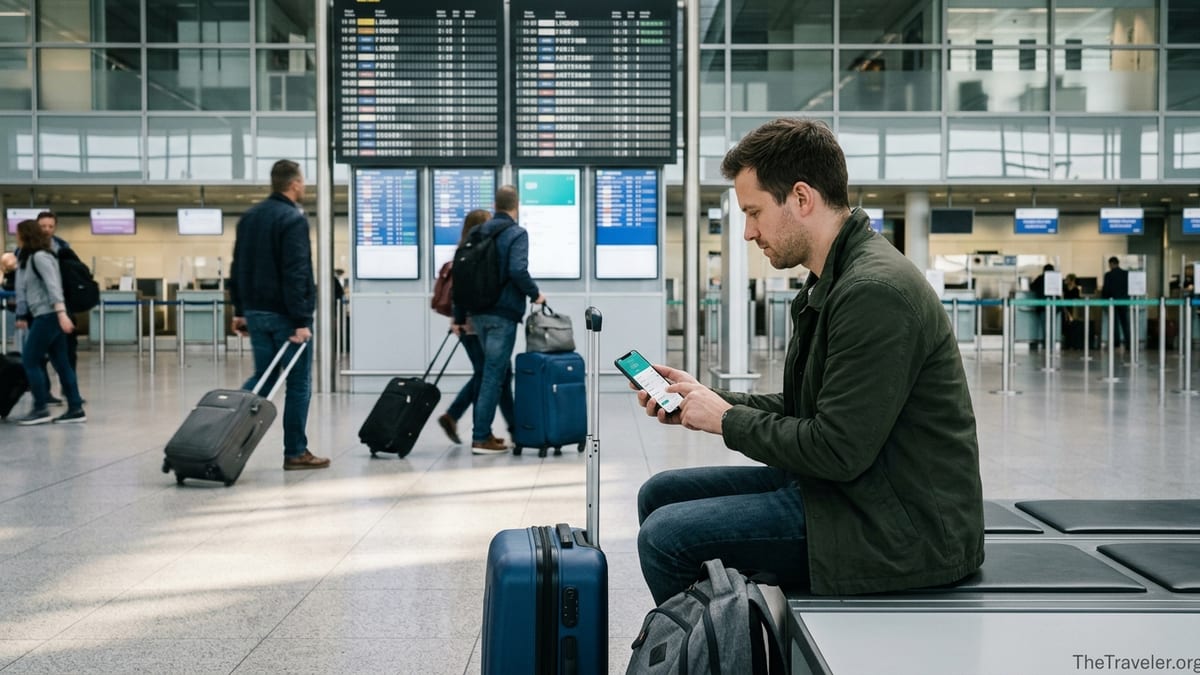
Because N26 runs entirely through its mobile app, it particularly suits travelers who are comfortable managing everything digitally. You open the account by video identification, control your card settings on your phone and receive real-time notifications for every card payment or ATM withdrawal. If you spend a week in Bangkok, for example, you can instantly see when a restaurant adds a tip line or an ATM charges a local fee, which is reassuring in places where you may not recognize the bank names on the screen.
The trade-off is that N26 is not ideal for travelers who rely heavily on in-branch support or who handle a lot of cash. There are no physical N26 branches to walk into if you lose your card while hiking in rural Portugal, and cash deposits often require partner retailers and can be restricted by limits and fees. For digital-first travelers who mostly pay by card or phone, this will not be a major issue, but it is an important limitation if you regularly travel in cash-heavy regions.
Account Plans, Monthly Costs and What You Get
N26 currently offers four main personal plans in Europe: Standard, Smart, Go and Metal. The exact branding can vary slightly by country, but the structure is similar. N26 Standard is generally free with no monthly account maintenance fee, Smart sits around the mid single-digit euro range per month, Go is more expensive and oriented to frequent travelers, and Metal is the top tier with premium insurance and a metal card. When you are planning long trips, the key question is whether the extra monthly fee of a Smart, Go or Metal plan pays for itself in saved ATM and foreign transaction costs.
On N26 Standard, card payments in foreign currencies are typically free of extra N26 foreign transaction fees. If a Barcelona-based traveler flies to New York and pays for a 50 dollar restaurant bill with their N26 card, N26 will generally apply the Mastercard exchange rate without tacking on the 2 to 3 percent foreign transaction fee that a traditional Spanish bank might charge. That alone can save around 1 to 1.50 euros per meal compared with many legacy cards, especially over a two-week trip.
The trade-off appears when you withdraw cash. On the Standard plan, ATM withdrawals in the euro area come with a limited number of free withdrawals per month and then a fixed euro fee, while withdrawals in other currencies incur a percentage fee of around 1.7 percent of the amount. If our Barcelona traveler withdraws the equivalent of 200 euros in Thai baht from an ATM in Chiang Mai, they would pay roughly 3.40 euros in N26’s own fee, plus any fee the Thai bank itself adds at the machine. For a trip where you mainly pay by card, this may be manageable, but for cash-heavy itineraries it adds up quickly.
N26 Go and Metal, which charge higher monthly fees, remove that 1.7 percent ATM surcharge in foreign currencies and offer more free cash withdrawals in euros, as well as travel insurance coverage. A French remote worker who spends three months a year nomading in Southeast Asia might find that an N26 Metal card pays for itself through fee-free overseas ATM withdrawals, airline delay insurance and baggage coverage. However, if you only take one short international trip per year and mostly use your card, the free Standard account plus a separate travel credit card might still be more economical.
Foreign Payments, Exchange Rates and Hidden Costs
From a pure travel spending perspective, one of N26’s strongest advantages is how it handles card payments in foreign currencies. For most plans, N26 uses the standard Mastercard exchange rate, which tends to track the mid-market rate reasonably closely. This is different from many high-street banks in Europe that apply a small, often invisible, markup on top of card network rates, in addition to an explicit foreign currency fee of about 2 to 3 percent on every transaction.
Imagine a couple from Paris traveling through Japan. They use their N26 card to pay 10,000 yen for dinner in Tokyo. N26 charges their account in euros at the Mastercard rate for that day, without adding an extra foreign transaction percentage of its own. Their friend paying with a typical French high-street bank card might face an additional 2.5 percent foreign fee, which on a 10,000 yen dinner could add roughly 2 to 3 euros. Over ten days of travel, with hotel, meals and transport all paid by card, N26’s approach can save well over 50 euros.
There is sometimes confusion about “markups” because many comparison sites use the mid-market rate, such as the European Central Bank reference rate, as a benchmark. N26’s pricing can be described as zero N26 markup on the Mastercard rate for card payments, but the Mastercard rate itself usually differs slightly from the mid-market rate. In everyday travel use this difference is small, often a fraction of a percent, and similar to what other competitive travel cards offer. You are still avoiding the big 2 to 3 percent surcharge that traditional banks charge on top.
A more significant hidden cost to watch out for is dynamic currency conversion, or DCC. This happens when a merchant or ATM abroad offers to charge you in euros instead of the local currency. For example, in a London shop you might be asked whether you want to pay a 100 pound purchase in pounds or in euros. Choosing euros often means the retailer applies a poor exchange rate with a markup of 3 to 6 percent. N26 cannot control this; it only processes the transaction that the merchant sends. For the best rate with N26, always choose to pay in the local currency of the country you are in and let Mastercard handle the conversion in the background.
ATM Withdrawals: Limits, Fees and Real Travel Scenarios
Cash withdrawals are where N26 becomes more nuanced for travelers. Within the euro area, N26 sets a daily ATM limit around 1,000 euros in many European countries, configurable within the app. That is typically enough for most short trips, such as withdrawing 200 euros on arrival in Rome for a weekend, another 150 euros in Naples and 100 euros in Florence. Travelers who plan to pay large deposits in cash, such as a landlord insisting on 1,500 euros for a rental deposit in one go, may find the daily ATM limit restrictive and need to withdraw over several days.
The more important factor for travel is costs outside the eurozone. On N26 Standard and Smart, each foreign-currency ATM withdrawal is subject to about a 1.7 percent N26 fee on the amount withdrawn. On Go and Metal, that percentage fee is removed, and withdrawals abroad are fee-free from N26’s side, although local ATM operators can still add their own charge. A concrete example: a digital nomad with N26 Go spends a month in Mexico City and withdraws 5,000 Mexican pesos three times during their stay. N26 does not charge a foreign withdrawal fee, but the local Mexican bank may charge a fixed fee of, say, 50 to 100 pesos per transaction, which is displayed on the ATM screen before they confirm.
If the same traveler had N26 Standard, each 5,000 peso withdrawal could incur a 1.7 percent N26 fee, roughly equivalent to about 8 to 10 euros each time depending on the exchange rate, plus the local ATM fee. Over three withdrawals, that might mean 25 to 30 euros paid just to access cash. In such a situation, upgrading to Go or Metal or combining N26 with a separate ATM-friendly card can clearly make financial sense.
Because N26 encourages card payments over cash, travelers who visit countries where cards are widely accepted, such as Sweden, Canada or Australia, can spend almost their entire trip using the N26 card directly. Someone on a road trip through Scandinavia, for instance, might only take out physical cash once in a small village in Norway, while paying for ferries, fuel, groceries and accommodation all by card or mobile wallet. In contrast, travelers heading to rural Morocco, parts of Southeast Asia or Central America should plan that they may need a backup debit card from another bank or a small reserve of emergency cash because N26’s fees and limits on repeated foreign ATM use can become noticeable over several weeks.
App Experience, Card Controls and Security When You Are Abroad
The N26 mobile app is one of the main reasons many travelers choose it over traditional banks. Every card payment and transfer generates a push notification almost instantly, often within seconds of tapping your card in a café in Lisbon or paying a metro fare in Athens. This real-time overview reduces the risk of unnoticed fraud and helps you track spending by trip. Many users create separate “Spaces” or sub-accounts within N26, such as a “Japan 2026” space, moving a fixed budget there before their flight and using it as their travel wallet.
From a security standpoint, the app allows you to lock and unlock your card, disable foreign payments or online payments and adjust ATM or purchase limits with a few taps. If you lose your wallet on a night train between Vienna and Budapest, you can open the app, freeze the card immediately and review the last few transactions for suspicious activity. If the card is found the next day, you simply unfreeze it; if not, you can request a new one. This is more flexible than many legacy banks that still require a phone call to a hotline and a permanent card cancellation even for a short-term misplacement.
For travelers, the budgeting tools inside N26 can also be useful. The app categorizes spending by merchant type, so you can see how much you spent on transport in London versus accommodation in Barcelona during a particular month. Before a multi-country Interrail trip, for example, you might set a soft daily budget of 70 euros, then check the app each evening to see if your average spending in Paris, Brussels and Amsterdam is staying near that line. While this is not unique to N26 anymore, the interface remains clean and accessible even for people new to digital banking.
The main limitation is customer support when issues arise while you are on the road. N26 offers in-app chat support and email, and higher-tier plans like Metal typically include priority access. However, there is no option to walk into a branch in Athens or call a local office in Rome for face-to-face help. If you are backpacking in South America with an unstable internet connection and your card is unexpectedly declined, you will depend entirely on your phone and N26’s remote support while also juggling hostel Wi-Fi and roaming data.
Travel Insurance and Extra Travel Perks
N26’s paid plans are increasingly marketed not just as bank accounts but as travel products. Go and especially Metal usually include travel insurance underwritten by a major insurer such as Allianz. Coverage often includes trip cancellation or interruption, delayed baggage, flight delays and sometimes rental car insurance or medical assistance abroad, with coverage limits and conditions that vary by country of residence. For example, a Metal customer from Italy booking a 700 euro flight to Argentina might be covered if an airline strike forces them to cancel, provided the conditions in the policy are met.
Real-world feedback suggests that N26’s bundled insurance can be useful for relatively standard mishaps, such as lost luggage on a flight from Madrid to Berlin or a delayed departure leading to an extra hotel night. However, the claims process involves dealing with the insurance provider, not N26 itself, and requires documentation such as airline confirmations and receipts. A traveler relying entirely on the Metal card for high-cost medical cover in the United States or long trekking trips in Nepal should read the detailed policy wording very carefully and consider a standalone specialist travel insurance if their itinerary is complex or high risk.
Beyond insurance, N26 has started to add travel-adjacent perks in certain markets. In Italy in 2026, for instance, N26 has promoted travel eSIM mobile plans that can be purchased directly through the app, allowing customers to land in countries like the United States or Thailand and activate mobile data instantly without hunting for a SIM card vendor at the airport. For a frequent flyer who hops between Milan, Dubai and Singapore, this combination of banking and connectivity in one app can be genuinely practical.
Nevertheless, many of these perks are limited to specific countries and roll out gradually. A traveler based in Germany may not yet have the same eSIM offers as one based in Italy, and some of the discounts with partner brands, such as hotel booking sites or car rental companies, may apply only in certain regions or for specific booking channels. When comparing N26 with rivals like Revolut, Bunq or local premium credit cards, it is worth listing which concrete perks you will realistically use in the next twelve months rather than assuming the full advertised package will apply evenly everywhere.
Key Drawbacks and When N26 May Not Be Enough
Despite its strengths, N26 is not a universal solution for travel banking. The most obvious limitation is availability. If you are a U.S. resident or have become a U.S. tax person, N26 will not open an account for you in 2026, and you may even be required to close an existing account if your tax residency changes. For someone planning a move from Berlin to New York, that means treating N26 as a European travel account that might eventually need to be replaced by a local U.S. bank plus a multi-currency provider.
Another drawback is its reliance on card and digital payments. In countries where card acceptance is strong, such as much of Western Europe, N26 works brilliantly. But in rural areas of the Balkans, North Africa or parts of Latin America, cash can still be king. Repeated foreign ATM withdrawals on the Standard or Smart plans quickly become expensive, and even on Go or Metal, you still face unpredictable local ATM fees and occasional technical incompatibilities. A long-term traveler driving from Croatia through Bosnia and Herzegovina, Montenegro and Albania would be wise to carry a secondary debit or credit card from a different bank as a backup.
Some travelers also report that N26’s approach to compliance and risk can be strict. Large incoming transfers from unfamiliar sources, repeated high-value ATM withdrawals in different countries or patterns that trigger fraud checks can lead to temporary account reviews. While this is not unique to N26, it can be particularly stressful if it occurs while you are in a foreign country needing access to funds. Keeping a second account in another bank, or holding part of your money in a separate provider such as Wise, Revolut or a local bank account in your home country, is a prudent safety measure.
Finally, N26’s lack of credit products in many markets limits its usefulness for travelers seeking credit card-specific advantages like extensive purchase protection, large sign-up bonuses or strong airline and hotel reward programs. A traveler from Spain who collects airline miles through a co-branded credit card may find that their miles-earning credit card is still the best choice for booking long-haul flights, while using N26 as a debit-style spending and ATM solution for day-to-day expenses on the trip.
The Takeaway
For travelers who live in supported European countries and prefer digital banking, N26 remains a compelling option in 2026. Its strongest points are straightforward foreign card payments at Mastercard rates, a user-friendly app with powerful card controls and budgeting tools, and the ability to open a euro account quickly and manage everything from a smartphone. Frequent travelers who choose the Go or Metal plans can also benefit from fee-free foreign ATM withdrawals and bundled travel insurance that covers many common mishaps on the road.
However, N26 is not a perfect or universal travel bank. The geographic limitation to Europe, fees on foreign-currency ATM withdrawals for lower-tier plans, and reliance on app-based support mean it fits best as one part of a broader travel money strategy. In practice, many seasoned travelers pair an N26 account with at least one other card, such as a local bank debit card with strong domestic ATM terms or a credit card with robust rewards and travel insurance.
If you are planning upcoming trips in Europe and beyond and you already live in a supported N26 country, opening a free N26 Standard account can be a low-risk way to test its strengths on a city break to London, a week in Istanbul or a rail journey across Central Europe. After a trip or two, you will have concrete data on how much you are saving on foreign spending and whether upgrading to a paid plan, or combining N26 with other providers, makes sense for your travel style.
FAQ
Q1. Is N26 available to travelers living in the United States?
N26 is not available to U.S.-resident customers in 2026. The bank withdrew from the U.S. market and now focuses on customers in Europe, mainly the eurozone and selected European countries.
Q2. Does N26 charge foreign transaction fees when I pay by card abroad?
On most N26 plans, card payments in foreign currencies use the Mastercard exchange rate without an extra N26 foreign transaction percentage on top, although the rate may differ slightly from mid-market rates.
Q3. How expensive are ATM withdrawals with N26 when traveling outside the eurozone?
On N26 Standard and Smart, withdrawals in foreign currencies typically incur about a 1.7 percent fee from N26, plus any fee charged by the local ATM operator. On Go and Metal, N26 removes its own percentage fee, but local ATM charges can still apply.
Q4. Is the free N26 Standard account enough for occasional travelers?
For many people who take one or two trips a year and mainly pay by card, N26 Standard can be sufficient, especially for saving on foreign card transaction fees. If you rely heavily on cash abroad, a paid plan or a separate ATM-friendly card may be better.
Q5. Does N26 include travel insurance, and is it good enough on its own?
N26’s higher-tier plans such as Go and Metal usually include travel insurance for issues like trip delays and lost baggage. It can cover many routine problems, but long or high-risk trips often still warrant a dedicated travel insurance policy.
Q6. Can I use Apple Pay or Google Pay with N26 while traveling?
Yes. N26 supports major mobile wallets, including Apple Pay and Google Pay, in many of its markets. This allows you to pay via your phone or smartwatch in places that accept contactless payments, even if your physical card is in your bag or hotel safe.
Q7. What happens if I lose my N26 card while abroad?
You can immediately freeze your card in the N26 app to block new transactions, review recent activity and then request a replacement card. While you wait, you can still use your virtual card with Apple Pay or Google Pay where available.
Q8. Are there limits on how much I can spend or withdraw when I travel?
Yes. N26 sets daily and monthly limits for card payments and ATM withdrawals, which you can usually adjust in the app. A common pattern is a card payment daily limit in the tens of thousands of euros and an ATM daily limit around 1,000 euros in many European countries.
Q9. Is N26 better than competitors like Revolut or Wise for travel?
N26 is strong as a primary euro bank account with good travel features, while Revolut and Wise focus more on multi-currency wallets and cross-border transfers. Which is better depends on your base country, currencies used and whether you prioritize full banking services or the cheapest exchanges.
Q10. Should I rely only on N26 for money when I travel?
It is safer not to rely on a single bank. Many experienced travelers use N26 alongside at least one other debit or credit card from a different provider so they still have access to funds if a card is lost, a network goes down or an account is temporarily reviewed.