


More news on this day
Manila’s Ninoy Aquino International Airport (NAIA) restored operations on its main runway on Sunday evening, November 29, 2026, after a disabled Philippine Airlines Airbus A320 was towed from the tarmac, allowing airlines to begin clearing a backlog of flights that had been diverted or delayed during the busy Bonifacio Day long weekend.
Get the latest news straight to your inbox!
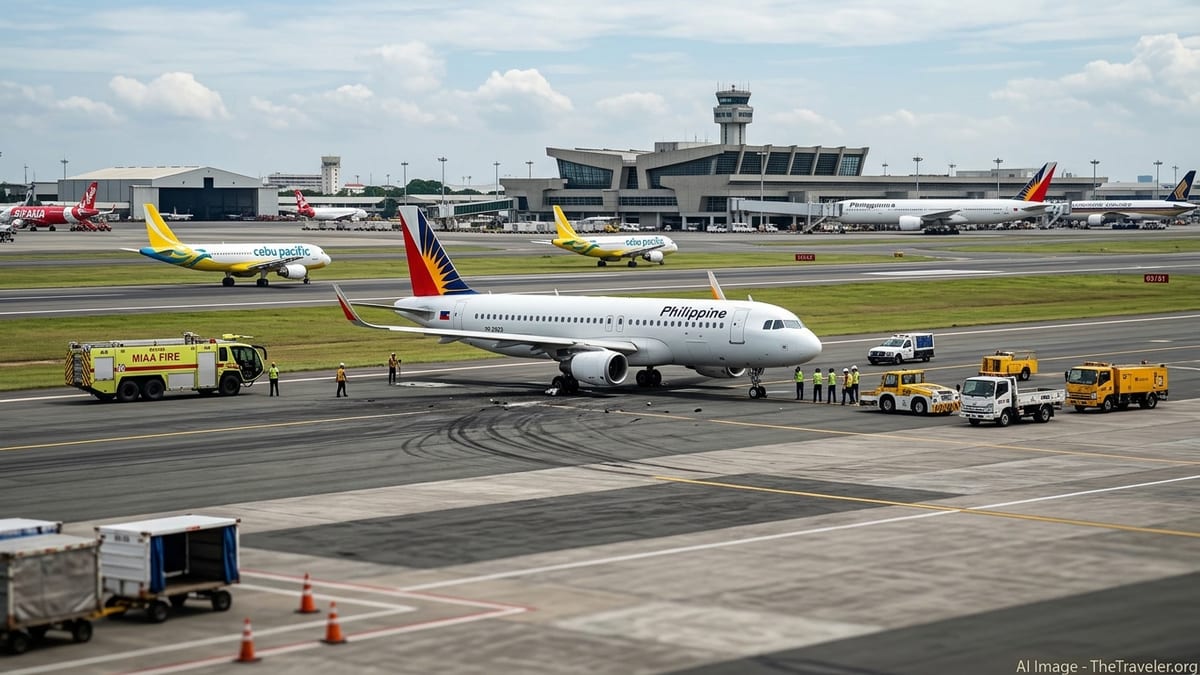
What happened on NAIA’s main runway
According to advisories from the Civil Aviation Authority of the Philippines and airport officials, Philippine Airlines flight PR 2923, an Airbus A320 service originally bound for Daraga in Albay, returned to Manila late Sunday morning after reporting a hydraulic system problem during approach. The aircraft landed at NAIA’s primary Runway 06/24 shortly before midday and came to a stop on the runway, with local media and regulators later confirming burst main landing-gear tires and a disabled aircraft that could not be moved under its own power.
Standard safety protocols required authorities to close Runway 06/24 to traffic while emergency services attended to the aircraft and engineers assessed the runway surface. Initial reports from the Civil Aviation Authority described the closure as temporary but did not immediately provide a firm reopening time, leading airlines to adjust their afternoon schedules as conditions evolved. Secondary runway 13/31 remained available under more limited conditions, but capacity at the country’s busiest airport was significantly reduced during the closure period.
Airport bulletins and airline statements indicate that the closure lasted for several hours through the middle of the day. NAIA’s main runway was cleared and declared back in service in the early evening, with one detailed timeline placing the reopening at around 5:45 p.m. on November 29, once the aircraft was towed away and the runway inspected for debris or surface damage. Only after that inspection could full operations resume.
Impact on flights and the seven PAL diversions
The loss of NAIA’s principal runway during a peak travel weekend quickly affected both domestic and international operations. Advisories from the Civil Aviation Authority and airport operator New NAIA Infrastructure Corp reported multiple diversions as aircraft approaching Manila were sent to alternative airports. One Civil Aviation Authority tally earlier in the afternoon cited diversions to Clark International Airport in Pampanga, while later briefings and airline communications identified additional reroutings to other regional hubs as the disruption unfolded.
Philippine Airlines confirmed that seven of its inbound flights were diverted while the main runway remained unavailable. These included both domestic and long-haul international services that would normally use NAIA as their Manila gateway. Among them, at least two widebody flights operating from long-haul points such as Los Angeles and Doha were reported by aviation outlets as having diverted to other international airports, including Guam and Bangkok, to refuel and await clearance to continue to Manila once capacity stabilized. Other PAL services diverted to Clark or held in extended airborne holding patterns until controllers could safely sequence them into NAIA using the secondary runway.
In addition to diversions, airport and airline updates pointed to cancellations and delays across several carriers’ schedules on Sunday afternoon. A Civil Aviation Authority advisory issued while Runway 06/24 was still closed mentioned a small number of confirmed cancellations alongside the diversions, with airlines retaining discretion to cancel, delay or reroute further services depending on aircraft positioning and crew duty limits. Because the disruption coincided with the tail end of the Bonifacio Day long weekend, many affected flights were heavily booked, adding pressure to rebook or reroute travelers once operations resumed.
How Philippine Airlines and NAIA handled stranded passengers
After the incident aircraft was secured and the runway was closed, Philippine Airlines issued statements emphasizing that all passengers on flight PR 2923 were safe and had disembarked at NAIA. The airline said it was coordinating with airport authorities and government agencies to remove the disabled aircraft, inspect the runway and gradually restore normal operations. In parallel, PAL’s customer service and ground operations teams began working on contingency arrangements for passengers impacted by diverted and delayed flights.
For the seven diverted PAL services, the carrier indicated that it was arranging onward travel from the diversion points to Manila once slots became available at NAIA and crew resources allowed. At Clark International Airport, this included organizing ground assistance for arriving passengers and preparing recovery flights or bus transfers to Metro Manila when onward sectors could not be operated promptly. For long-haul passengers whose aircraft diverted to international airports outside the Philippines, PAL’s immediate focus was reported to be refueling, coordinating with local ground handlers, and securing departure slots to bring passengers to Manila later in the day or overnight.
Airport authorities and the Civil Aviation Authority repeatedly advised all travelers to check directly with their airlines before heading to NAIA on Sunday evening, highlighting that recovery operations would vary by carrier. Even with the main runway reopened, airlines needed time to reposition aircraft, rotate crews and re-sequence departures and arrivals, meaning that some delays and schedule changes were expected to persist into the late evening and possibly into Monday, November 30, for certain routes.
Operational context and safety considerations at NAIA
Manila’s NAIA is the Philippines’ primary international gateway and one of Southeast Asia’s more capacity-constrained airports, relying heavily on its main Runway 06/24 to handle a dense mix of domestic narrowbody flights and long-haul widebody services. When an incident blocks that runway, the airport’s secondary runway can maintain limited operations, but overall throughput falls and air traffic control has fewer options to manage peaks in arrivals and departures. This structural constraint partly explains the scale of diversions and delays that followed Sunday’s incident despite the relatively short duration of the closure.
Regulators stressed that the immediate priority was safety. Following the hydraulic issue and reported tire bursts on PR 2923’s landing, emergency responders and engineers had to reach the aircraft, verify that there was no fire risk or fuel leak, confirm the condition of the landing gear and fuselage, and assess any impact on the runway surface. Only once the aircraft was secured could towing operations proceed. After the removal, runway inspections and cleaning were required to ensure that no rubber fragments or debris remained that could endanger subsequent landings and takeoffs.
The Civil Aviation Authority and airport operator also needed to coordinate closely with airlines to manage air traffic during the closure. This included issuing NOTAMs to pilots, allocating holding patterns, and agreeing diversion strategies, particularly for long-haul flights with limited fuel margins to wait over Manila. Aviation advisories issued on November 29 urged passengers not to proceed to the airport without checking their flight status first, underscoring that capacity constraints could lead to last-minute adjustments even after the technical issue had been contained.
What travelers should do after the runway reopening
With NAIA’s main runway back in service from the early evening of November 29, airlines have been working through the backlog of delayed and diverted flights. However, travelers scheduled to fly into or out of Manila on Sunday night and Monday should continue to expect possible knock-on effects, such as retimed departures, equipment changes, or residual delays as operations normalize. Carriers may prioritize certain long-haul, connecting-bank or high-load flights when allocating newly available slots, which can lead to differing recovery timelines across routes.
Passengers whose flights were among the seven PAL diversions or who experienced cancellations should monitor official communications from Philippine Airlines, including booking-system updates, email or SMS notifications, and advisories posted through the airline’s channels. Rebooking options, accommodation or transport assistance, and arrangements for onward connections will depend on each traveler’s itinerary, fare conditions and the specific nature of the disruption. Travelers already at diversion airports such as Clark are being processed locally, with onward travel to Manila organized as additional capacity becomes available.
For upcoming trips over the remainder of the long weekend and into the following week, the main takeaway for travelers using NAIA is to build extra time into itineraries, especially when making same-day international connections or time-sensitive domestic transfers. Before heading to the airport, passengers should verify their flight’s latest status with their airline, check whether any revised check-in or boarding times apply, and keep receipts and documentation related to delays or diversions in case they are needed for after-travel claims under airline policies or applicable regulations. While Sunday’s incident has been contained and normal runway operations have resumed, recovery across the network is expected to remain in progress for several more flight cycles.