


Step off the train in New Brunswick, New Jersey, and the first thing you notice is the college crowd. Rutgers sweatshirts on the platform, flyers for student improv nights, and lines outside Easton Avenue pizza joints all reinforce the idea that this is just a classic American campus town. Give it more than an afternoon, though, and a different New Brunswick starts to emerge: a compact, walkable city where major arts institutions sit next to indie galleries, where Friday-night jazz and regional theater share the spotlight with falafel joints and vegan bakeries. It may feel like a college town at first, but New Brunswick quickly reveals itself as one of New Jersey’s most concentrated pockets of cultural energy.
Get the latest updates straight to your inbox!
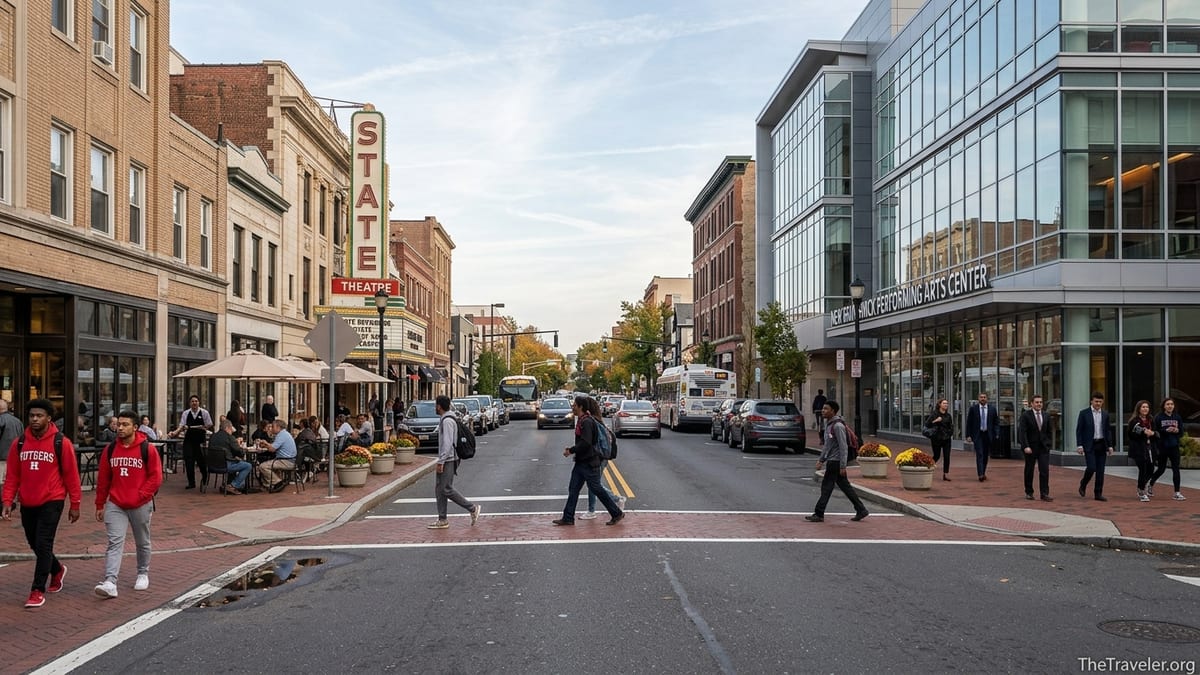
First Impressions: A College Town on the Surface
Most travelers meet New Brunswick through Rutgers University. The New Brunswick campus is the historic heart of New Jersey’s flagship state university, with more than 50,000 students across Rutgers–New Brunswick and a skyline dotted with residence halls and classroom towers. Walking out of the station, you are funneled toward College Avenue and Easton Avenue, where lineups of slice shops, bubble tea counters, and crowded bars make it easy to assume you have the city figured out in a single glance.
On a weekday afternoon, the rhythm feels pure campus life. Students rush between lectures with iced coffees from small storefront cafes, delivery riders weave through traffic, and bus stops hum with Rutgers buses shuttling between the New Brunswick and Piscataway campuses. Along Easton Avenue, spots serving inexpensive ramen, tacos, and shawarma stay packed well into the night, while sports bars show Rutgers football and basketball games on big screens. For many visitors, this student-facing corridor is all they see, so New Brunswick gets filed away mentally as “just another college town.”
Yet even a short detour off this circuit begins to complicate that story. A ten-minute walk drops you into neighborhoods where historic rowhomes and 19th-century churches sit beside community centers, Latino bakeries, and Portuguese eateries. Rutgers is woven into this fabric, but it does not define it entirely. Instead, the university acts as an anchor for a broader urban community, one that has used its academic presence as a springboard for serious investment in the arts.
The key shift comes when you turn away from College Avenue and follow George Street toward Civic Square. Within a few blocks, the tone changes from late-night pizza to red-carpet marquis, glass-fronted theaters, and banner ads for museum exhibitions. This is where New Brunswick stops feeling like a campus and starts feeling like a cultural district.
George Street & Civic Square: A Downtown Built Around the Arts
New Brunswick’s downtown is unusually dense with cultural venues for a city of just over 55,000 residents. Along George Street and Livingston Avenue, you move from restaurant host stands to theater lobbies in a matter of steps. The layout is walkable in the most practical way: you can leave your hotel or train, have dinner on George Street, and be in your seat for a performance at the State Theatre New Jersey or the New Brunswick Performing Arts Center in minutes.
The State Theatre New Jersey, dating back to the 1920s and now carefully restored, functions as the city’s marquee stage. It hosts national touring Broadway productions, big-name comedians, family shows, and symphony performances, giving New Brunswick a programming calendar that rivals far larger cities. A traveler might book tickets for a midweek touring musical, arrive by train from New York or Philadelphia, and find themselves in an ornate, historic auditorium rather than a campus black box.
Next door, the New Brunswick Performing Arts Center amplifies that momentum. Opened in recent years as a 24-story mixed-use complex, it houses multiple resident companies, including George Street Playhouse, Crossroads Theatre Company, American Repertory Ballet, and performance spaces for Rutgers’ Mason Gross School of the Arts. This means that on any given night, you could choose between a new play at George Street, an African American theater production at Crossroads, or a contemporary ballet performance, all under the same roof.
For travelers, this concentration of venues in Civic Square makes planning easy. You can build an evening around local theater instead of defaulting to a generic dinner-and-drinks routine. Take a Friday: start with small plates and a glass of wine at a restaurant along George Street, stroll two or three blocks to the performing arts center for an 8 p.m. curtain, and finish with a nightcap at a nearby bar, all without needing a car. It is here that New Brunswick truly flips the script from student hub to cultural destination.
Rutgers’ Creative Engine: Museums, Galleries, and Conservatory-Level Arts
Beneath New Brunswick’s cultural infrastructure is a powerful creative engine: Rutgers–New Brunswick and its Mason Gross School of the Arts. Together they feed the city with a constant stream of exhibitions, concerts, and performances that are open to the public, often for free or at very low cost. For travelers, this means that a couple of days in town can easily include museum visits and high-caliber performing arts that would be far more expensive in major cities.
The Zimmerli Art Museum sits at the edge of Voorhees Mall on the College Avenue campus, an easy walk from downtown. It occupies a large modern building and maintains a collection that ranges from American and European art to one of the most significant holdings of Soviet nonconformist art in the United States. Rotating exhibitions can shift from contemporary photography to historically focused shows, such as a recent exhibition highlighting Indigenous artists and the Lenni-Lenape lands on which Rutgers stands. Admission is typically free or very modest, which allows visitors to drop in for an hour between other plans.
Downtown, the Mason Gross Galleries at Civic Square turn Rutgers’ art school into a public-facing attraction. These contemporary spaces exhibit work by current students, faculty, and visiting artists, and they often host opening receptions that draw a mix of students, professors, and city residents. For travelers, it is a chance to see emerging artists at the moment when their work is still experimental and charged with the energy of critique and collaboration.
The performing arts programs at Rutgers also spill directly into city life. The Mason Gross School of the Arts organizes around two hundred events each year, from orchestra concerts and opera productions to dance recitals and new music performances. Many take place right in New Brunswick, either on campus or in partnership with venues like the New Brunswick Performing Arts Center. A visitor might see a ticketed opera on one night and stumble across a free student jazz concert at a campus venue the next, both at a level of quality that reflects conservatory-style training.
Cultural Centers & Community Life: More Than Student Events
New Brunswick’s cultural energy is not confined to traditional art forms. Rutgers hosts a network of cultural centers that serve as hubs for communities that extend far beyond the student body. The Paul Robeson Cultural Center, the Center for Latino Arts and Culture, the Asian American Cultural Center, and the Center for Social Justice Education and LGBT Communities collaborate on film series, lectures, performances, and festivals that are open to the broader public.
For travelers, this can translate into serendipitous discoveries. A walk across campus might lead to a Latin American dance workshop at the Center for Latino Arts and Culture or a spoken-word night highlighting Black artists at the Paul Robeson Center. Schedules shift seasonally, but fall and spring semesters tend to be packed with events, often free and advertised through posters, social media, and the Rutgers events calendar.
These spaces help explain why New Brunswick’s cultural life feels broader than its footprint. The city’s demographics are diverse, with strong Latino, African American, South Asian, and Caribbean communities, and that diversity is reflected in the programming you see advertised around town. Prospective visitors should pay attention to seasonal festivals and heritage celebrations, such as Hispanic Heritage Month events, Diwali celebrations, or LGBTQ+ pride programs that blend academic discussions with performance and community gatherings.
Even outside university structures, community groups and local organizers regularly animate public spaces. On George Street, the city has periodically converted sections into a pedestrian plaza with outdoor dining and live entertainment, turning the downtown core into a communal living room in warm weather. Street musicians, small-scale performances, and pop-up markets layer additional texture onto a city that might otherwise be dismissed as a classroom corridor.
Eating Your Way Through the Scene: From Soul Food to Vegan Bakeries
New Brunswick’s restaurant scene is another area where the city breaks out of the college-town mold. Yes, you will find late-night slices and quick burritos, but you will also encounter Southern-inspired dining rooms with live music, inventive vegan kitchens, and family-owned spots that reflect the city’s global makeup.
Delta’s, on Dennis Street, is a long-standing reference point. It pairs Southern and soul food classics with craft cocktails and live music on weekend nights, transforming dinner into a full evening out. Diners come in for fried chicken, shrimp and grits, or braised short ribs and stay for the band, turning the restaurant into an unofficial jazz and R&B lounge. For visitors, it is an easy way to experience both regional cuisine and local music without leaving downtown.
At the other end of the spectrum, New Brunswick has developed a reputation for plant-based dining. Veganized, just off George Street, offers a creative vegan take on comfort food and global flavors, often featuring organic ingredients and a casual, contemporary interior. A short walk away, Veganica operates as a dedicated vegan bakery and cafe, with cannoli, cakes, and pastries that draw both plant-based eaters and curious omnivores. Paired with coffee and occasional live entertainment, it turns a simple dessert run into a small cultural outing.
Layered between these anchors are numerous smaller eateries: Latin American spots serving arepas and empanadas, Middle Eastern counters dishing out falafel and shawarma, and South Asian restaurants where you can grab a plate of chaat or a hearty curry. Prices tend to skew student-friendly, which is an advantage for travelers. You might pay modestly for a generous lunch on Easton Avenue, then invest in a slightly more upscale dinner before a performance downtown, all without stretching a typical weekend budget.
Nightlife: College Bars, Underground Shows, and Emerging Scenes
Nightlife is where New Brunswick most clearly straddles the line between college town and independent city. Easton Avenue and parts of George Street deliver exactly what you would expect from a major university hub: busy bars, drink specials, and crowds that skew heavily toward undergraduates and graduate students. For some travelers, that energy is part of the attraction. For others, it is something to navigate around.
Bars like Huey’s Knight Club and long-running neighborhood pubs near campus attract lines on weekend nights, with DJs, dance floors, and a generally high-energy scene. Visitors looking to relive their own college days will find plenty of places to do it. Yet there are also quieter spots tucked into downtown for an older, more local crowd, where conversation-level music replaces blaring speakers and the focus shifts to craft beer or well-mixed cocktails.
Beyond the visible bar strip, New Brunswick is known among locals for its DIY and underground music culture. Traditional rock clubs like the legendary Court Tavern and the Melody Bar once defined the city’s live music identity, and while some of those venues have gone quiet, the spirit has migrated into basements, house shows, and occasional pop-up events. Online discussions about the local scene consistently point visitors toward semi-private concerts in residential neighborhoods and small venues across central New Jersey where New Brunswick bands frequently perform.
Travelers curious about this side of the city’s cultural life should approach it with respect and a bit of research. Many of these shows are informal and promoted through word of mouth or social media rather than official listings. Asking at independent cafes, record shops in nearby towns, or checking regional music communities online can reveal low-cost or donation-based concerts during your visit. The payoff is an authentic, hyper-local experience that feels far removed from polished campus events and large theaters.
Daytime Discovery: Walking Tours, Public Art, and River Views
New Brunswick’s cultural energy does not disappear when the curtain falls. By day, it appears in the city’s architecture, public art, and riverfront spaces. A loose walking tour can begin at the train station, loop through downtown, cross College Avenue, and finish along the Raritan River, covering multiple layers of the city in a couple of hours.
Start on George Street to see how historic facades coexist with new glass-and-steel structures housing theaters and apartments. Murals and street art appear on side walls and utility boxes, reflecting everything from Rutgers pride to local social issues and cultural narratives. The walk up to the College Avenue campus passes brick academic buildings and open lawns where student groups rehearse dance routines or practice instruments in warm weather, effectively turning the campus into an informal performance space.
From there, continue toward Voorhees Mall and the Zimmerli Art Museum, then cut back through residential streets toward the Raritan. The riverfront, lined in sections with paths and overlooks, offers a quieter, contemplative side to the city. It is a place to take a break between gallery visits and performances, watch rowing teams glide by, or catch a sunset before heading back into the dense downtown core.
Along the way, watch for event posters taped to lampposts and community boards: yoga sessions in parks, open-air movie nights, small cultural festivals hosted by local organizations, and university talks that welcome the public. New Brunswick rewards curiosity at street level, and the more you pay attention to these analog signals, the more you realize how much is happening beyond the glossy brochures.
Planning Your Visit: Seasons, Budgets, and Practical Tips
To experience New Brunswick’s cultural energy at its peak, timing matters. The city is strongly shaped by the academic calendar. From September through early December and again from late January through April, the combination of university events and downtown performances creates a dense schedule. Weeknights can feature guest lectures, film screenings, and gallery openings, while weekends bring theater premieres, concerts, and restaurant promotions. Summer is quieter on campus but often busier downtown, with outdoor dining, occasional street festivals, and more space at restaurants and museums.
Budget-conscious travelers will find New Brunswick relatively kind to their wallets, especially compared with New York City, just a train ride away. Many university events are free or cost less than a typical movie ticket. Tickets at the State Theatre New Jersey and the New Brunswick Performing Arts Center vary by production, but it is not unusual to find balcony seats at prices that make a night at the theater accessible for families or small groups. Pair that with student-oriented dining prices, and a full cultural weekend can remain reasonable.
Location is another advantage. New Brunswick sits roughly an hour by train from both New York and Philadelphia, making it a practical base or side trip. You can visit for a single performance, stay overnight in one of the downtown hotels, and explore the city on foot. The compact geography means you rarely need a car once you arrive, though rideshares and local buses are available for reaching more distant neighborhoods or nearby towns.
For planning, use a combination of official calendars and on-the-ground exploration. Check the event listings for Rutgers and Mason Gross School of the Arts for concerts and exhibitions, look at State Theatre New Jersey and New Brunswick Performing Arts Center schedules for major performances, and then leave space for spontaneous finds: a flyer for a cultural center event, a pop-up market off George Street, or a recommendation from a bartender about a local band playing nearby.
The Takeaway
New Brunswick is easy to underestimate. At first glance, it reads like a prototypical college town: student crowds, modestly priced food, busy bar streets, and campus buses crisscrossing through everything. Spend even a single full day moving intentionally between its theaters, museums, cultural centers, restaurants, and nighttime venues, and a different story emerges. This is a small city that punches far above its weight in the arts.
Its strength lies in how seamlessly student life and civic life overlap. Rutgers brings intellectual and creative heft, but the city’s residents, restaurateurs, community organizers, and cultural leaders ensure that New Brunswick’s energy does not evaporate when classes let out. For travelers, that means you can build an itinerary that includes both marquee performances and underground shows, both museum visits and neighborhood eateries, all inside a walkable downtown.
In the end, New Brunswick rewards those who look beyond the sweatshirts and stadiums. Come for the convenience of a college town with easy train access. Stay for the art on its gallery walls, the voices on its stages, the flavors on its plates, and the sense that, for a small city, New Brunswick carries an unusually big cultural heartbeat.
FAQ
Q1. Is New Brunswick worth visiting if I am not connected to Rutgers?
Yes. While Rutgers gives the city its student energy, New Brunswick’s theaters, museums, restaurants, and riverfront make it a worthwhile destination even for visitors with no university ties.
Q2. How many days should I spend in New Brunswick to experience its cultural side?
A weekend is ideal. Two nights allow time for at least one major performance, a museum visit, a campus walk, and exploration of downtown dining and nightlife.
Q3. Is New Brunswick walkable for visitors without a car?
Yes. The train station, downtown theaters, main restaurant corridors, and parts of the Rutgers campus are all within walking distance, making it easy to explore on foot.
Q4. Are cultural events in New Brunswick expensive?
Not usually. Many university events are free or low cost, and even tickets at larger venues often have affordable tiers, especially for balcony or off-peak performances.
Q5. What is the best time of year to visit for arts and culture?
Fall and spring semesters offer the richest mix of events, with full university schedules and active downtown programming. Summer brings more outdoor dining and a slightly slower pace.
Q6. Can I visit New Brunswick as a day trip from New York or Philadelphia?
Yes. Regular train service makes it realistic to come in for a matinee or evening show, have a meal, and return the same day, although staying overnight allows a deeper experience.
Q7. Is New Brunswick safe for travelers at night around downtown?
Downtown and the main campus corridors are generally busy and feel comfortable for most visitors, especially on event nights. As in any city, basic urban awareness is advisable.
Q8. Are there family-friendly cultural activities in New Brunswick?
Yes. The State Theatre New Jersey and university venues often host family shows, and the Zimmerli Art Museum and campus green spaces are suitable for children accompanied by adults.
Q9. Do I need to book tickets in advance for performances?
For popular shows and weekend dates, advance booking is recommended. Smaller university events and some weekday performances may have same-day availability.
Q10. Is New Brunswick only active when classes are in session?
No. The city remains lively year-round, though the mix changes. During breaks, university events slow, but downtown restaurants, theaters, and seasonal outdoor programming continue to draw visitors.