


More news on this day
Travel disruptions rippled across the Northeast after an FAA-related communications problem triggered ground stops at Newark Liberty International Airport, Philadelphia International Airport, and New Jersey’s Teterboro Airport, with Newark delays peaking around 150 minutes and schedule recovery stretching well beyond the initial outage window.
Get the latest news straight to your inbox!
What happened and which airports were affected
Published coverage indicates the disruption centered on the Philadelphia Terminal Radar Approach Control facility, commonly referenced as Philadelphia TRACON, which manages critical flows in and out of the region’s tightly coordinated airspace. The issue led the FAA to temporarily halt some inbound flights to Newark (EWR), Philadelphia (PHL), and Teterboro (TEB), a major reliever airport that primarily handles business and private aviation.
Reports described the problem as an equipment or telecommunications outage affecting certain radio frequencies used for air traffic control communications. As the issue unfolded, multiple outlets characterized it as a systems failure that constrained how safely and efficiently controllers could sequence arrivals into the affected airspace, prompting ground stops and broader traffic management measures.
Even travelers not flying directly into those three airports felt the knock-on effects. When a major arrival stream pauses, aircraft already in the system need new routings or holding plans, and departures from other cities can be held at the gate to prevent congesting a constrained destination area.
How bad the delays got at Newark and why recovery takes longer than the outage
Newark’s disruption became especially visible in flight-tracking data. Published reporting citing Flightradar24 indicated that commercial arrivals at Newark were effectively halted for a large portion of the day, with a gap spanning from roughly mid-morning into the early evening on Monday, September 21, 2026. That kind of interruption can quickly inflate average delay times and produce cascading cancellations as aircraft and crews end up out of position.
By the time inbound flows begin moving again, airports and airlines typically face a secondary problem: the backlog. The FAA often uses traffic management initiatives such as ground delay programs to meter arrivals and prevent a sudden surge that would overwhelm airspace and runway capacity. That metering can keep delays elevated long after the underlying equipment problem is resolved.
In Newark’s case, the average delay figure that circulated widely, about 150 minutes at peak, reflected the depth of the arrival backlog and the difficulty of rebalancing one of the nation’s most delay-prone hubs. As recovery progresses, average delays can fall quickly, but the passenger experience may remain uneven for hours as individual flight disruptions work through the system.
What caused the outage: early reporting points to damaged telecom infrastructure
Multiple news accounts pointed to a construction-related mishap affecting telecommunications lines feeding air traffic control systems in the region. Coverage in outlets including Axios and The Philadelphia Inquirer described a scenario in which work at a construction site damaged a line connected to backup communications, contributing to the broader interruption.
Other reporting framed the incident as a communications-frequency problem affecting Philadelphia TRACON operations, a key facility that handles approach and departure services for busy Northeast corridors. The details varied by outlet, but the common thread was a breakdown in the communications or supporting infrastructure controllers rely on to manage traffic into Newark, Philadelphia, and nearby airports.
The episode also renewed attention on the region’s complex air traffic control arrangements. In recent years, Newark-area traffic has been tied operationally to facilities beyond New Jersey, a structure intended to manage staffing and workload but one that can also concentrate risk when a supporting facility experiences a technical disruption.
What travelers should do now if flying through EWR, PHL, or TEB
For passengers traveling in the next 24 to 72 hours, the most practical step is to check flight status repeatedly, not just once. During irregular operations, departure times can change in small increments as airlines receive updated slots and routing options, and a flight that appears “on time” can later be held for aircraft, crew, or air traffic flow constraints.
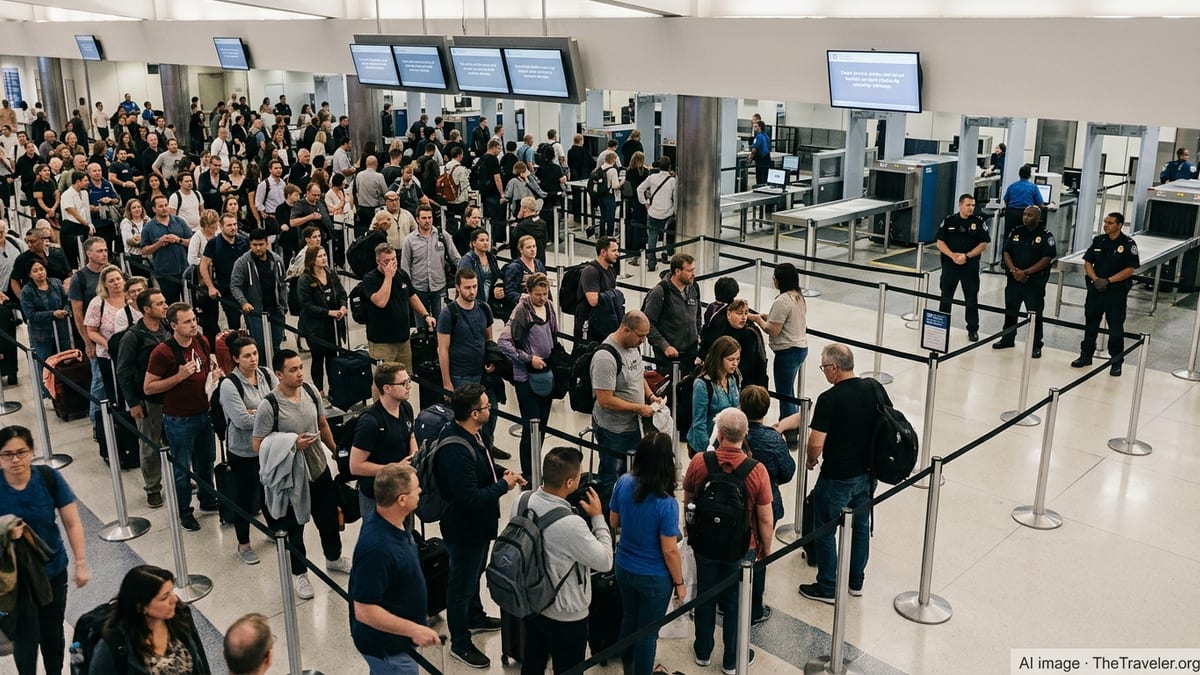
Travelers heading to Newark should also factor in the non-aviation side of the disruption. When a large wave of flights is delayed or canceled, airport terminals can see spikes in rebooking lines, customer-service demand, and crowded curbside areas. Plan extra time for terminal access, security checkpoints, and potential gate changes, especially if your itinerary includes a connection.
If a flight is canceled, rebooking options may be tighter across the region because nearby airports can also be impacted by the same airspace constraints. Travelers may want to compare alternative departures from the broader New York-Philadelphia market, but availability can shift quickly during recovery. Keeping flexible timing, considering later departures, and confirming baggage policies before switching airports can reduce last-minute surprises.
The broader context: why Northeast disruptions spread fast
The New York-New Jersey-Philadelphia airspace is among the most capacity-constrained in the country, and Newark has long been vulnerable to compounded delays when equipment issues, staffing constraints, weather, or runway limitations overlap. FAA materials and prior published reporting have highlighted Newark’s recurring delay challenges and the use of operational limits and scheduling measures to manage congestion.
Monday’s outage illustrated how quickly a technical failure at a single facility can ripple through the national network. When arrivals are paused at a major hub, aircraft and crews get displaced, inbound flights from dozens of origins are held, and carriers face difficult choices about whether to wait out delays or cancel to protect later rotations.
As airlines, airports, and the FAA work to restore normal flow, the near-term traveler takeaway is simple: irregular operations can linger into evening bank periods and into the following day, even when the initial ground stop has ended. For the busiest Northeast airports, the path back to a normal schedule often depends on how quickly aircraft and crews can be repositioned and how much additional disruption, such as weather, occurs during the recovery window.