


More news on this day
Governments and rail operators in Norway, Denmark, the Netherlands and England are accelerating investments in international and overnight trains, positioning low-carbon rail travel as a practical alternative for tourists worried about mounting flight disruption across Europe this summer.
Get the latest news straight to your inbox!
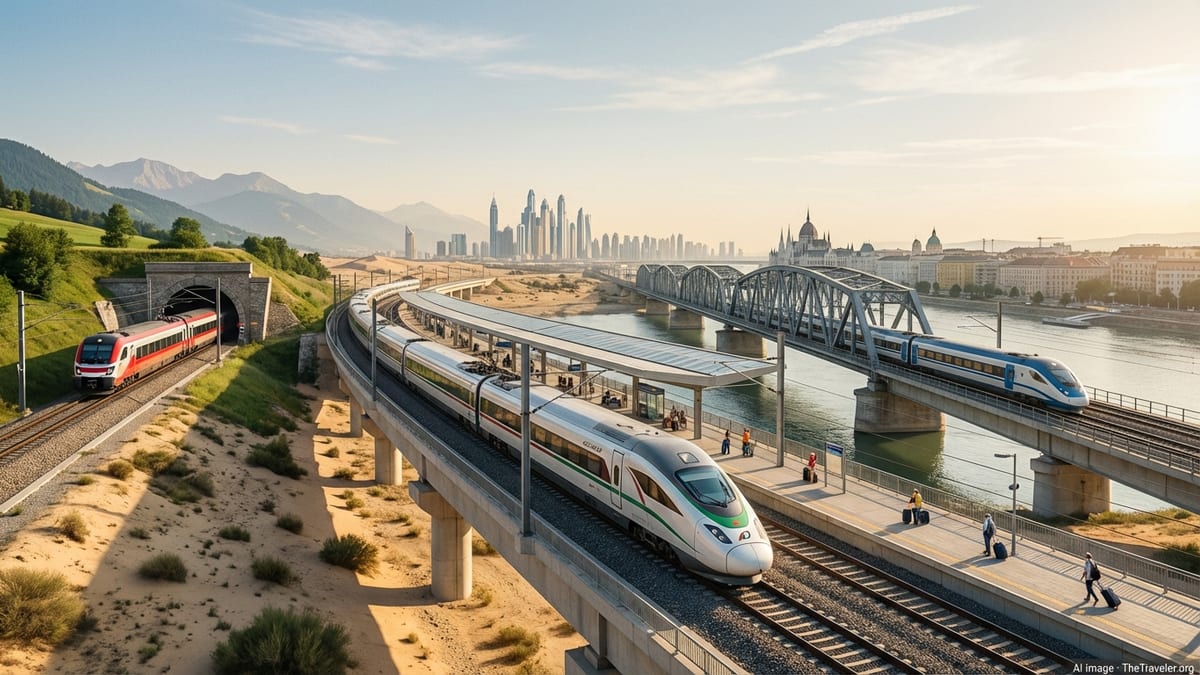
Flight Reliability Concerns Drive Interest in Trains
Reports of air-traffic control bottlenecks, labor disputes and extreme weather have raised fresh questions about the reliability of short-haul flights across Europe. Aviation and tourism analysts have warned that even limited strikes or storm systems can cascade through the continent’s tightly scheduled flight network, leading to missed connections and long delays for leisure and business travelers. That backdrop is supporting renewed attention on rail, particularly where journey times between major cities are under eight hours.
Publicly available information from industry groups indicates that cross-border rail remains a small share of Europe’s overall travel market, but it is growing faster than many domestic air segments. Research on European mobility trends suggests that investment in high-speed and night trains can meaningfully reduce emissions when services run at high occupancy, making rail an attractive option for climate-conscious travelers as well as those seeking to hedge against airport disruption.
Travel search platforms and rail-booking specialists report that demand for international trains typically spikes whenever major flight disruption hits headlines. With several rail operators in Norway, Denmark, the Netherlands and the United Kingdom adding capacity on key corridors through 2025 and 2026, more of that demand can now be captured by trains instead of short-haul aircraft.
Norway and Denmark Build a Cross-Border Night Train Network
Scandinavian routes are among the most visible examples of the shift toward sustainable long-distance rail. Norway’s current timetable already includes overnight services linking Oslo with Trondheim, Bergen and Stavanger, and the national rolling-stock company has ordered a new generation of long-distance trainsets designed for both day and night travel. Public documents on the order show that the first of these trains are intended to support more comfortable sleeper and couchette accommodation, a key selling point for travelers comparing overnight trains with early-morning flights.
Across the border in Denmark, the country’s rail system is becoming an essential bridge between Scandinavia and continental Europe. A Swedish-operated night train, marketed under the SJ Euronight brand, runs between Sweden and Germany via Denmark and has gradually expanded its role. Open data on service patterns shows that Swedish operators have taken on more of the driving and operations responsibility across Danish territory, creating a more seamless overnight link between northern cities and destinations such as Hamburg and Berlin.
Additional private and state-backed operators are positioning Denmark as a through-route rather than just a terminus. A Swedish company running seasonal and overnight services between Stockholm, Copenhagen and Berlin has registered interest in extending some trains into Norway and starting additional daytime connections via Denmark. Industry press material indicates that these services rely on renewable electricity contracts and modern rolling stock, reinforcing their branding as low-emission alternatives to flights on corridors where air connections are frequently congested.
For North American travelers planning multi-country itineraries, these developments mean that journeys which once required separate flights between Nordic capitals and central European hubs can increasingly be made by a single night train with a standard rail pass or through-ticket.
Netherlands Boosts International Links to Belgium and Beyond
The Netherlands has moved quickly to expand its role as a rail crossroads between northern Europe, Belgium and France. Government transport briefings and operator announcements highlight a major timetable change that took effect in December 2024, doubling the number of Amsterdam–Brussels trains from 16 to 32 per day. New faster trains, jointly provided by the Dutch and Belgian rail companies, now connect Amsterdam Zuid and Brussels Midi with journey times of around two hours, cutting up to 45 minutes compared with previous schedules.
Policy documents from The Hague state that the Dutch objective is to increase the number of international rail journeys by several million per year by the middle of this decade. The upgraded Amsterdam–Brussels service is identified as a central element of that strategy, alongside high-speed and intercity links to Paris, Berlin and Frankfurt. Amsterdam’s role as a hub for through-ticketing is growing, with national operators coordinating schedules so that passengers arriving from Germany can connect more easily to Belgium and, via Brussels, to France and the United Kingdom.
For travelers weighing rail against short-haul flights between Amsterdam and Belgian or northern French cities, the new frequencies and faster timings significantly alter the calculation. Trains now depart as often as every half hour across much of the day, reducing the risk that any single delay will severely disrupt an itinerary. Because these services run from city center to city center, travelers also avoid potential airport queues and ground-handling issues that have contributed to recent flight disruptions.
England Eyes New International Routes Amid Eurostar Capacity Strains
In England, the focus is shifting to how the country can support more sustainable rail links to continental Europe beyond the existing high-speed services through the Channel Tunnel. Analysis from the UK Parliament and the government’s transport department points to strong economic and environmental benefits from additional international trains, but also highlights capacity constraints at border-control facilities and on the high-speed line from London to the tunnel.
Despite those bottlenecks, planning work has advanced on future direct services between the United Kingdom and Germany. A joint taskforce involving British and German transport experts has been examining how to remove technical and regulatory barriers to a London–Germany link, and recent government communications describe the project as one step closer following meetings in Berlin at the end of 2025. In parallel, Eurostar has publicly discussed longer-term ambitions to operate new services to cities such as Frankfurt and Geneva, supported by an order for additional trainsets.
Eurostar’s network has also seen adjustments driven by border-processing limits and infrastructure works in the Netherlands, including a temporary reduction in the number of direct London–Amsterdam trains. However, official Dutch and company documents indicate that a fully direct service is scheduled to resume, with Amsterdam Zuid expected to play a larger role as a high-speed hub once station redevelopment is complete. That would give England-based travelers more rail options to reach the Netherlands and connect onward to Germany, Denmark and Norway with a single through journey.
Travelers are advised to monitor operator notices for potential disruption on the Channel Tunnel route, as rail demand can surge when flights are cancelled or delayed. Service quality reports from the operator show that it publishes real-time disruption alerts and alternative routing information when problems arise, which can help passengers rebook on earlier or later departures instead of turning immediately to air travel.
What the New Rail Landscape Means for Travelers
For visitors planning trips from the United States or other long-haul markets, the combined effect of these national rail strategies is a more resilient, lower-emission web of options once they land in Europe. A traveler arriving in London or Amsterdam can now reach Brussels, Paris, Cologne, Hamburg or Copenhagen mostly by rail, and new or planned night trains extend those possibilities to cities in Norway, Sweden and central Europe without the need for multiple short flights.
Industry research on modal shift suggests that travelers are most likely to choose rail over air when three conditions are met: journey times are competitive, booking and ticketing are straightforward, and services run frequently enough to absorb disruption. Recent decisions by Norway, Denmark, the Netherlands and the United Kingdom to add capacity, modernize rolling stock and coordinate timetables directly address those points, even if prices and seat availability remain pain points during peak periods.
Given the lingering risk of air-traffic disruption, travel planners increasingly recommend that passengers whose itineraries depend on a single key connection, such as a cruise departure or major event, consider rail as either a primary mode or a built-in backup. With more overnight trains and denser daytime frequencies, it is becoming easier to build redundancy into European itineraries, whether by scheduling an earlier train or keeping an alternative rail route in reserve if flights run into trouble.