


Some countries you can cross in a day and feel you have at least tasted their essence. Russia is not one of them. No guidebook warning about “the world’s largest country” prepared me for what it means, in real time and real distance, to move from its western borders toward the Pacific. The maps look abstract until you are counting time zones instead of hours, stepping off trains into climates that feel like different planets, and hearing new languages and accents long before you see another major city.
Get the latest updates straight to your inbox!
The First Shock: Distance Measured in Time Zones
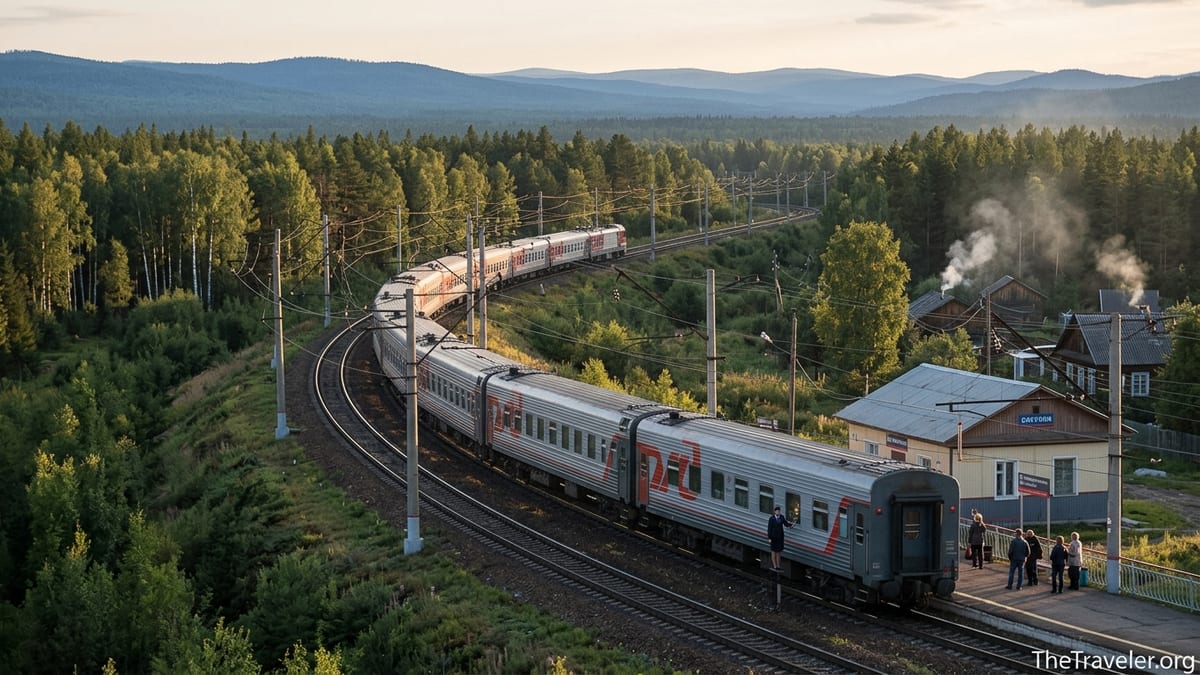
My introduction to Russia’s scale was not a mountain range or a skyline. It was the departure board at Moscow’s Yaroslavsky Station. One line promised a journey of more than 9,000 kilometers from Moscow to Vladivostok, crossing eight time zones in a single, continuous ride. The famous Rossiya train can cover this distance in about eight nights if you stay onboard the whole way, but most travelers break it into sections to remain sane. Sitting on the platform with a paper cup of tea, I realized that this one train line was longer than many intercontinental flights, yet it operated daily as if it were just another commuter connection.
Once you board, the distance stops being a statistic and becomes a rhythm. The carriage clock is set to Moscow time, but station clocks along the way switch to local zones. After a day or two you begin waking up in one time zone and eating dinner in another, even though the scenery outside still looks like the same endless birch forest. A fellow passenger from Yekaterinburg joked that, in Russia, you do not ask how far something is, only how long the train takes. It was not unusual for people in my carriage to discuss journeys that lasted three days as casually as a weekend city break.
Even short segments feel disproportionate compared to Western Europe. The ride from Moscow to Yekaterinburg, for example, can take around 26 hours on a standard long-distance service, the kind of time you might associate with crossing oceans rather than a single country. Yet on the map, Yekaterinburg is barely halfway to Lake Baikal, let alone to the Pacific. On paper, these numbers are just data about a large state. In the narrow corridor of a night train, as you rock through the Urals with a samovar hissing at the end of the carriage, they feel like a different philosophy of space.
European Facades to Asian Gateways: A Country That Changes Face
Leaving St Petersburg and Moscow, it is tempting to think you understand Russian cities. St Petersburg, with its pastel palaces, baroque cornices and orderly canals, looks closer to Vienna than to Vladivostok. Nevsky Prospekt is lined with international brands and smart cafes where oat milk lattes cost only slightly less than in Paris. Moscow’s grand avenues and glittering shopping galleries around Red Square project a distinctly European urban confidence. In both cities, museums are full, traffic is dense, and the metro feels like an underground palace system connecting near-futuristic business districts with 19th-century boulevards.
Then you cross the Urals and watch the country’s face shift. Yekaterinburg, straddling Europe and Asia, mixes Soviet-era concrete blocks with surprising glass towers and a lakeside promenade where families stroll on summer evenings. Farther east, cities like Novosibirsk and Krasnoyarsk feel more utilitarian, with wide streets, industrial edges and a rougher climate that makes practical clothing more visible than polished style. Yet even here you find small, stylish coffee bars tucked beneath aging apartment blocks, and bookshops that sell both Russian classics and regional histories printed in limited runs.
By the time you reach the Far East, the architecture and atmosphere have changed again. In Vladivostok, hilly streets drop toward the harbor in scenes that look oddly similar to San Francisco, complete with suspension bridge silhouettes and sea fog rolling in over the bay. Korean and Japanese cars dominate the used-vehicle market, their interiors sometimes displaying right-hand drive even though traffic flows on the right. Menus in inexpensive canteens list borscht next to Korean-style noodles, and you are as likely to hear fragments of Mandarin or Korean on the street as standard Moscow Russian. It is still the Russian Federation, still the same passport control stamp, yet the feeling is unmistakably Asiatic port city rather than European capital.
From Arctic Ports to Subtropical Shores
Russia’s climate diversity is discussed in school geography lessons, but encountering it in person is a different experience. On one winter trip north to Murmansk, above the Arctic Circle, I stepped out of the airport into air that sparkled with fine ice crystals at minus fifteen degrees Celsius. The city’s port was fringed with snow, and daylight felt like a drawn-out twilight, a pale band hovering near the horizon for only a few hours. Locals in padded parkas navigated streets lined with snowbanks that might last for months. Prices in supermarkets reflected the logistics of this latitude, with fresh fruit costing noticeably more than in central Russia, while frozen fish from the Barents Sea was comparatively affordable.
Yet in summer, a flight of roughly three hours from Moscow in the opposite direction delivers you to Sochi on the Black Sea, where palm trees line the promenade and the air can feel almost Mediterranean. In July, daytime temperatures frequently rise well above 25 degrees Celsius, beach umbrellas dot the pebbled shoreline, and the sea is warm enough for evening swims. Street vendors sell local peaches and churchkhela, the grape-and-nut sweets more commonly associated with Georgia, reflecting the region’s historical ties to the Caucasus. For domestic travelers arriving from Siberia or the Far North, a week in Sochi can feel like traveling abroad without crossing a national border.
Between these climatic extremes lie even more specialized regions. In the Altai Republic, summer mountain valleys bloom with wildflowers while high passes can still hold patches of snow. Guesthouses there often offer simple rooms heated by wood stoves, and many are run by local families who serve dishes based on lamb, buckwheat and sour-milk products. In contrast, the semi-desert landscapes of Kalmykia feature Buddhist temples under wide skies, where wind is more constant than rain. Within one country’s territory, it is possible to experience Arctic auroras, temperate forests, alpine meadows, steppe grasslands and subtropical beaches in the space of a single season, if you have the time and the stamina.
Many Nations Within One Border
Official maps of the Russian Federation list more than 20 republics, each associated with a titular ethnic group and often with its own language alongside Russian. Statistics note that ethnic Russians still form a majority of the population overall, but traveling across these regions changes what that means in daily life. In Kazan, the capital of Tatarstan, the Kul Sharif Mosque rises inside the old Kremlin walls, its minarets reflecting in the same river that passes Orthodox churches and Soviet monuments. The streets echo with both Russian and Tatar speech, and cafe menus might list echpochmak pastries a few lines below borscht, all written in Cyrillic but flavored by different histories.
Farther south in the North Caucasus, republics like Dagestan, Chechnya and Kabardino-Balkaria hold a mosaic of peoples with their own languages, traditions and cuisines. In a Dagestani mountain village, I was offered chudu, a local stuffed flatbread, along with tea poured from a metal pot that looked older than the house. Conversations there frequently moved between Russian and local tongues, sometimes within the same sentence. Hospitality had its own rules: shoes left at the door, guests seated at the table’s head, and plates refilled almost automatically. While large cities like Makhachkala have chain supermarkets and smartphone shops like anywhere else, village life is still closely tied to clan ties and highland customs.
In southern Siberia and the Far East, diversity takes another form. In the Republic of Buryatia, centered on Ulan-Ude near Lake Baikal, you find Buddhist datsans with prayer flags snapping in the wind, and statues of historical Buryat and Mongol figures sharing space with Soviet-era war memorials. Traditional dishes here might include buuzy, steamed dumplings similar to Mongolian buuz, served in modest canteens where a plate can be relatively inexpensive compared to capital-city prices. In the Altai Republic, Turkic-speaking Altai people maintain traditions of throat singing and epic storytelling, sometimes performing for visitors in small cultural centers. To move across these republics is to watch “Russian culture” dissolve into a layered set of local identities that challenge any monolithic idea of the nation.
Train Compartments as Microcosms of a Continent
Nothing reveals Russia’s internal diversity as efficiently as its long-distance trains. In the shared air of a four-berth second-class compartment, strangers quickly become traveling companions. On one leg from Novosibirsk toward Irkutsk, my cabin filled with a grandmother returning to Ulan-Ude, a student from Yakutsk changing trains in Krasnoyarsk, and a salesman from Perm. Each brought their own provisions: the grandmother unpacked home-cooked chicken and pickles in glass jars, the student had instant noodles and chocolate bars, and the salesman bought pelmeni and tea from the dining car. Over the course of 20-odd hours, the conversation ranged from regional dialects and army service to the best rivers for fishing.
The train’s public spaces tell their own stories. At the end of every carriage, a samovar dispenses boiling water, and passengers line up with metal cups and instant coffee sachets, or tea bags and slices of lemon wrapped in napkins. Vendors at station stops sell smoked fish, pirozhki pastries and berries in plastic cups through open carriage doors, turning short halts into impromptu markets. In older third-class open carriages, where dozens of berths are arranged without internal walls, children roam the aisles while adults play cards or watch dubbed films on tablets. The social mix is wider than in many city cafes: off-duty soldiers, migrant workers from Central Asia, schoolteachers returning from conferences, and grandparents visiting grandchildren in distant regions.
These rolling microcosms come with their own etiquette. Soon after departure, the provodnitsa, or carriage attendant, appears to check passports and tickets, then offers bedlinen sets for a modest fee if they are not included. Shoes are usually exchanged for slippers, and it is common for passengers to change into more comfortable clothes like sweatpants or long T-shirts for the night. There is an unspoken rule to offer snacks to your compartment-mates and to accept at least a small portion in return. Stories are shared late into the evening, although politics and the war are topics many people now prefer to avoid with strangers. For travelers used to more impersonal air travel, these hours of conversation and shared silence can be the most memorable part of the journey.
Modern Realities: Visas, Safety and Practical Constraints
In recent years, traveling to Russia has become more complicated for many foreign visitors, especially those coming from Western countries. Entry rules have tightened in several aspects, and some national governments, including the United States, currently advise their citizens against travel to Russia due to security and political risks. Official advisories cite concerns such as the potential for arbitrary enforcement of local laws, limited consular assistance and the broader effects of the ongoing conflict involving Ukraine. Travelers who still consider making the journey need to weigh these warnings carefully against their personal risk tolerance and stay updated on their home country’s latest guidance.
On a practical level, most visitors continue to require visas, obtained in advance through Russian consular services or authorized visa centers. Recent changes have introduced requirements for some categories of foreign travelers to provide biometric data, such as fingerprints and photographs, on arrival at certain major airports. Border officials may also ask for proof of accommodation, return or onward travel, and sometimes travel insurance documents at the point of entry. These procedures can lengthen arrival times, particularly during peak travel periods when queues for biometric collection and passport checks grow long.
Inside the country, law enforcement tends to be highly visible in large cities and around transport hubs. Incidents involving tourists are not widespread but can occur, especially petty theft in crowded areas or unofficial taxi scams at some airports and major stations. Travelers who do come despite advisories typically minimize risk by using reputable hotel transfers or licensed taxi apps where available, carrying copies of identification, and avoiding political gatherings or sensitive discussions in public. Card payments remain common in many urban areas, though international sanctions have changed how some foreign bank cards function, so carrying additional cash or locally issued payment options can be sensible.
The Emotional Weight of Vastness
Over time, the sheer size of Russia does something to your sense of proportion. Distances that once seemed unimaginable begin to feel routine. A twelve-hour overnight train becomes a convenient way to “save a day,” and the idea of flying five or six hours while remaining within a single country stops sounding unusual. This gradual recalibration affects not only logistics but also mood. Passing through endless forests, wide rivers and small stations with names you struggle to pronounce, you experience a steady hum of motion that can feel almost meditative. It is easy to understand why some travelers describe long Russian train journeys as existential experiences rather than just transport.
The emotional tone of these journeys has also changed in recent years. Conversations that might once have turned easily to politics or grand historical narratives now often skirt sensitive subjects. Several Russians I met on trains or in guesthouses spoke more readily about family, work, and the price of groceries than about the country’s direction. Some mentioned relatives who had left for Armenia, Georgia or Central Asia, others talked about reservist mobilizations or friends serving near the front. The landscape outside the window remained as vast and serene as ever, but the stories inside the compartment carried more anxiety and caution than many older travel accounts might suggest.
Yet despite these tensions, moments of everyday kindness still accumulate. A provodnitsa quietly setting aside a lower bunk for an elderly passenger, a stranger insisting you take the last slice of homemade pie, a taxi driver in Ulan-Ude detouring past the giant Lenin head statue because “you came all this way, you should see it.” These gestures, repeated hundreds of times across thousands of kilometers, complicate any simple narrative about the country. They are small, local acts that coexist with large-scale geopolitical realities, reminding you that a state on a map and the people who inhabit it are never quite the same thing.
The Takeaway
Nothing in a classroom atlas or a news headline prepares you for the lived reality of Russia’s size and diversity. It is not just that it takes days to cross or that its climate ranges from Arctic to subtropical. It is that each region, each republic, and sometimes each city expresses a different version of what “Russia” means, from the mosque domes of Kazan to the Buddhist temples of Buryatia, from the Arctic docks of Murmansk to the Pacific hills of Vladivostok. Train compartments become temporary communities, cities reshape themselves every thousand kilometers, and the language you hear on the street shifts in accent and vocabulary long before border posts appear.
For now, political circumstances, security concerns and complex entry rules make such journeys less accessible for many foreign travelers than they were a decade ago. Anyone considering a trip must pay close attention to official advisories, visa regulations and on-the-ground developments. But as a case study in how geography, culture and history intertwine, Russia remains unique. Even if your encounter with it is limited to a single region or a truncated rail segment, the experience is likely to recalibrate your sense of distance and diversity. No matter how much you read beforehand, the country you meet on the ground will almost certainly be larger, stranger and more varied than you imagined.
FAQ
Q1. Is it currently safe for foreign tourists to travel across Russia?
Safety assessments vary by nationality, and several governments, including the United States, currently advise against travel to Russia due to security and political risks. Conditions can change quickly, so travelers should consult their own foreign ministry or state department for the most up-to-date guidance before considering any trip.
Q2. How long does a full Trans Siberian journey from Moscow to Vladivostok take?
A direct ride on the main long-distance service typically takes around eight days and nights without extended stopovers. Many travelers, however, break the trip into segments over two or three weeks, spending extra days in cities such as Yekaterinburg, Novosibirsk, Irkutsk and Ulan-Ude to avoid fatigue and to see more than the view from the train window.
Q3. Do I need a visa to visit Russia as a tourist?
Most foreign nationals still require a visa issued in advance of travel, usually based on an invitation or confirmed accommodation booking. Some countries have limited visa-free arrangements or special electronic visas for specific regions, but rules are subject to change, so it is important to check current requirements with a Russian consulate or official visa center well before departure.
Q4. What is daily life like on long Russian train journeys?
Life on board revolves around simple routines: drinking tea from the samovar, sharing snacks with compartment-mates, reading, watching films offline and stepping out briefly at station stops. Passengers sleep in bunks, change into comfortable clothes, and quickly develop informal schedules around meal breaks and conversation. It is basic but usually orderly, and for many travelers the atmosphere itself becomes the highlight of the trip.
Q5. How diverse is Russia culturally and linguistically?
Russia officially contains more than 20 republics linked to specific ethnic groups, and dozens of languages are spoken across its territory. In cities like Kazan, Ulan-Ude or Makhachkala, you may hear local languages alongside Russian, see mosques or Buddhist temples near Orthodox churches, and encounter regional cuisines that differ markedly from the dishes common in Moscow or St Petersburg.
Q6. What kind of climates can travelers encounter within Russia?
The country spans Arctic, subarctic, temperate and even subtropical zones. In winter, places like Murmansk can be extremely cold and dark, while in summer the Black Sea coast around Sochi can feel almost Mediterranean. Inland Siberian cities have long, harsh winters and short, warm summers, so packing for Russia often means preparing for significant temperature swings depending on region and season.
Q7. Are there modern amenities like mobile coverage and card payments on the journey?
Mobile coverage is strong in and around major cities and along many rail corridors, but long stretches of Siberia still experience weak or intermittent signal. In large urban centers, card payments are widely used in shops, restaurants and hotels, though international sanctions have affected how some foreign bank cards function. In smaller towns, cash remains important, so carrying a mix of payment options is prudent.
Q8. How expensive is it to travel by train across Russia?
Ticket prices vary widely depending on class, route, season and how far in advance you book. Third-class open carriages are typically the cheapest, while first-class sleepers cost more but offer greater privacy. Food from the dining car or station kiosks can be moderate compared to Western European prices, though imported items may be more expensive. Overall, long-distance train travel can still be relatively good value for the distance covered.
Q9. Can travelers explore Russia without speaking Russian?
It is possible but more challenging outside major tourist centers. In cities like Moscow and St Petersburg, younger people and hospitality staff often speak some English, and transport signage may include bilingual elements. In regional towns and on long-distance trains, Russian is usually essential for nuanced communication. Many independent travelers rely on translation apps, phrasebooks and a willingness to gesture, write things down and accept occasional misunderstandings.
Q10. What should potential visitors consider before planning a trip now?
Anyone thinking about travel to Russia should weigh several factors: current political tensions, official travel advisories from their home country, visa and biometric entry requirements, the reliability of international transport links and the possibility of sudden regulatory changes. It is wise to build flexibility into any plans, arrange robust travel insurance where available, and accept that routes which once felt straightforward may now carry additional risks and uncertainties.