


For years, Helsinki Airport has quietly built a reputation as one of Europe’s most passenger-friendly hubs. While larger airports in London, Paris or Frankfurt often dominate headlines, Helsinki consistently tops industry rankings and traveler surveys for service quality, cleanliness and overall experience. Recent awards from Skytrax and Airports Council International again placed the Finnish capital’s gateway among Europe’s best, underlining a simple truth frequent flyers already know: this is one of the few major airports where the journey often feels refreshingly calm.
Get the latest updates straight to your inbox!
Award-Winning Performance Backed by Passenger Feedback
Helsinki Airport’s status as one of Europe’s top-performing hubs is not just a matter of national pride. It is supported by a steady stream of international awards. In 2024 the airport was once again named Best Airport in Northern Europe in the Skytrax World Airport Awards, based on passenger surveys that rate everything from check-in to security, comfort, dining and cleanliness. Around the same time, Airports Council International recognized Helsinki as the best European airport in its size category, highlighting both service quality and operational performance.
These accolades sit on top of a longer track record. Helsinki has repeatedly appeared near the top of rankings for cleanest airport in Europe and for overall customer satisfaction. Finavia, the Finnish airport operator, reports passenger satisfaction scores that remain high even as traffic has rebounded to well over 16 million travelers a year. The consistency matters: a single good year can be luck, but maintaining strong scores across boom times, disruptions and winter weather speaks to solid systems and a culture of service.
For travelers, the awards translate into visible benefits. Short queues at security, tidy washrooms, uncluttered gate areas and staff who are generally willing to switch seamlessly between Finnish and fluent English all contribute to a stress-free experience. Business travelers routing between Europe and Asia often choose Helsinki precisely because the odds of an on-time arrival and a smooth connection are higher than at many busier hubs. Families, meanwhile, notice the details like stroller-friendly layouts, play areas and clear signage.
Importantly, Helsinki’s recognition is not limited to aviation insiders. Consumer-focused travel media and frequent-flyer communities routinely call out the airport’s efficient transit process and relaxed atmosphere. In forums and lounge reviews, travelers compare experiences at Helsinki with more chaotic hubs, often noting that missed connections and long queues are less common in the Finnish capital. That word-of-mouth endorsement reinforces what the awards are already signaling: this is a hub that quietly delivers.
A Single, Intuitive Terminal Built Around the Passenger
One of Helsinki Airport’s biggest advantages is structural. In 2022 Finavia completed a major phase of a terminal overhaul that effectively brought all passenger operations under one integrated terminal, replacing the old split between Terminal 1 and Terminal 2. The result is a layout that feels closer to a modern rail station than a sprawling multi-terminal mega-hub. Regardless of airline or destination, you enter through the same arrivals and departures hall, with direct elevator links from the train station and adjacent parking.
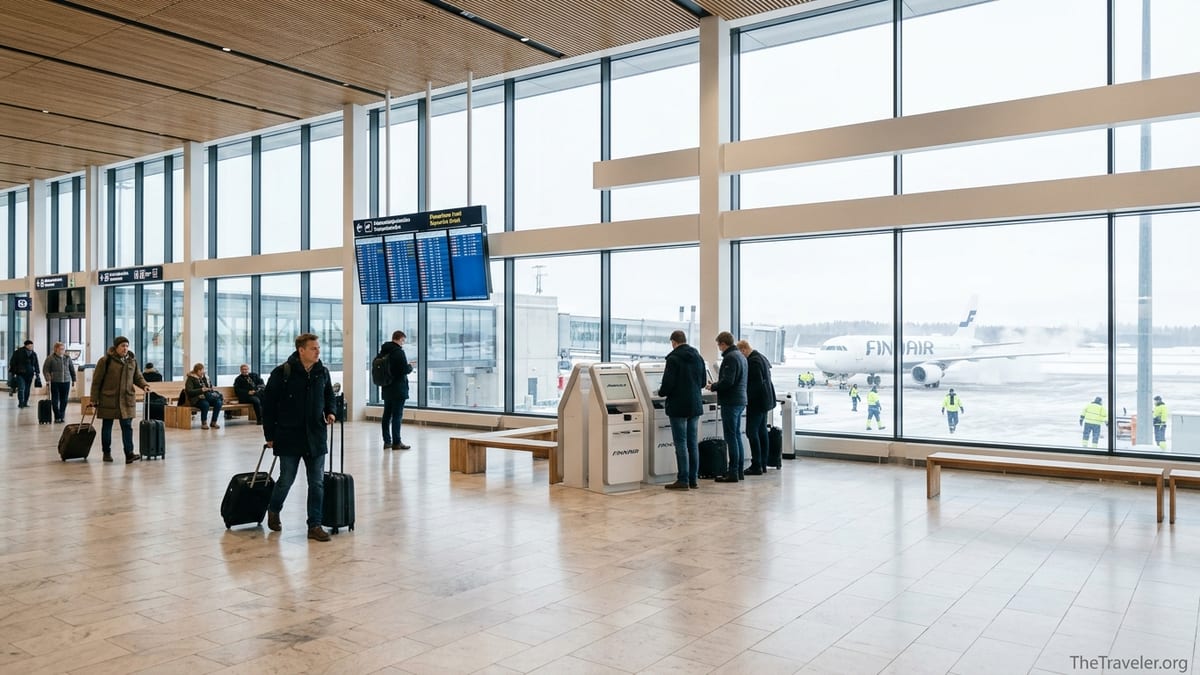
The design philosophy is Scandinavian clarity. The check-in hall is spacious, with high timber ceilings, large glass façades and simple wayfinding. Self-service kiosks for Finnair and partner airlines stand alongside staffed counters for more complex itineraries. Bags drop at clearly numbered points, and security control is accessed via one central zone instead of a maze of competing checkpoints. For a traveler arriving on the commuter train from central Helsinki, the entire journey from platform to security can easily be under 10 minutes at off-peak times.
After security, passengers branch into Schengen and non-Schengen zones, but the core experience remains cohesive. Walking distances between most gates are shorter than at mega-hubs like Frankfurt or Amsterdam, and the path is almost always straightforward: flat corridors, wide walkways, plenty of travelators and consistent signage in multiple languages. Travelers with reduced mobility benefit from accessible routes and a relatively compact footprint, which can make Helsinki a less daunting prospect than many transfer airports in Europe.
Even the landside infrastructure is designed with convenience in mind. Car parks P1 and P2 are attached directly to the terminal via elevators, so passengers driving from the suburbs can park and be inside the departures hall within minutes. Regional buses and long-distance coaches arrive at a forecourt in front of the main entrance, and the rail link to Helsinki’s city center and beyond operates frequently throughout the day. For travelers staying overnight, several airport hotels sit either within walking distance or a short shuttle ride away, allowing early-morning departures without a long commute.
Fast, Predictable Transfers on a Europe–Asia Bridge
Helsinki Airport has long marketed itself as a bridge between Europe and Asia, and its transfer process largely lives up to that promise. Minimum connection times for many itineraries are around 35 to 40 minutes, which airlines like Finnair routinely sell on a single ticket. In practice, that means a traveler flying from Paris to Tokyo or from Stockholm to Bangkok via Helsinki can often make tight connections that would be impossible at larger, more congested hubs.
The strength of the experience lies in predictability. The non-Schengen transfer process is typically straightforward: passengers disembark, follow clear transfer signs, pass through passport control and reach their next gate without re-clearing security if they remain in transit. Border control areas are sized for the airport’s traffic volume, so queues often remain manageable, even during busy morning and afternoon banks of Asian departures. Dedicated lanes are usually available for EU citizens and sometimes for passengers with short connections, helping to smooth the flow further.
Real-world examples illustrate how this works. A traveler arriving from Copenhagen on a late-afternoon flight with a 50-minute connection to a Dallas service on Finnair will usually find that the two gates are within the same pier or a short walk apart. Provided the inbound flight is roughly on time, they can move from one aircraft to the next with only one passport check in between. Another passenger flying from Berlin to Rovaniemi, with a winter connection of 45 minutes at Helsinki, can often walk from their Schengen arrival gate directly to the domestic departure gate in under 10 minutes.
Of course, no hub is immune to disruption, and winter storms or air traffic control issues can cause delays. But Helsinki’s relatively compact size and unified terminal make it easier to recover from irregular operations. When flights do run late, airlines and airport staff can more readily hold a connection for a cluster of passengers or rebook them onto alternative routes. For travelers who value reliable transfers, especially on long-haul journeys to Japan, South Korea or Southeast Asia, this combination of scale and efficiency is a major reason Helsinki stands out.
Nordic Calm: Design, Cleanliness and Everyday Comforts
Walking into Helsinki Airport, many travelers immediately notice a sense of calm. The architecture leans heavily on wood, glass and natural light, a conscious nod to Finnish design traditions. High ceilings and open sightlines reduce the feeling of crowding, even during busy departure waves. Seating areas are thoughtfully spaced, with clusters of armchairs and benches oriented towards windows that look out onto the apron and runways, offering a sense of space instead of claustrophobia.
Cleanliness is another area where the airport consistently draws praise. Washrooms are regularly serviced, floors are kept tidy even in high-traffic corridors, and waste bins are plentiful. This level of upkeep extends to details such as spotless windows in the departures hall and well-maintained family facilities. For parents, dedicated baby-care rooms and play zones in the Schengen area make it easier to manage a long wait with small children. Simple features like low sinks and child-height toilets may sound minor, but in the moment they can transform a stressful layover.
Connectivity and basic comforts are also strong. Free, fast Wi-Fi blankets both landside and airside areas, and many gate zones now feature power outlets and USB charging built into seating or nearby pillars. Travelers working on laptops can find quiet corners near gates or in open seating areas between shops and restaurants. During a winter evening bank of departures, it is common to see passengers sipping coffee at café tables while charging their devices and watching the snow outside through floor-to-ceiling glass.
Food and retail options reflect both international brands and Finnish character. Global names in coffee and fast food sit alongside local bakeries serving rye bread sandwiches, cinnamon buns and salmon soup. Duty-free shops stock Nordic cosmetics brands and Finnish design labels, while smaller outlets sell Lapland souvenirs and Moomin-themed gifts. Prices are broadly in line with other Northern European airports, but the atmosphere often feels more relaxed. Seating areas near restaurants are less hectic, and queues at cash registers are typically shorter than at major hubs further south.
Premium Lounges and a Finnish Sauna in the Sky
For many frequent travelers, Helsinki Airport’s lounges are a defining part of its appeal. Finnair operates several lounges that cater to both Schengen and non-Schengen passengers, and recent renovations have elevated them into some of the more attractive business-class spaces in Europe. The non-Schengen Finnair Business Lounge, used by long-haul passengers to Asia and North America, has drawn strong reviews for its modern Nordic interiors, natural wood finishes, large windows and varied seating zones.
Above that, the Finnair Platinum Wing in the non-Schengen area has become something of a cult favorite among oneworld Emerald frequent flyers. Access is generally reserved for Finnair’s top-tier Finnair Plus members and equivalent status holders on partner airlines. Inside, travelers find quieter workspaces, an a la carte dining menu alongside a buffet, a well-curated wine and spirits selection, and shower suites. Most distinctively, the lounge includes a traditional Finnish sauna with changing rooms and private showers, allowing travelers on, for example, a Tokyo to London routing via Helsinki to enjoy a sauna session mid-journey.
On the Schengen side, Finnair recently refreshed its main lounge near the domestic and European gates. Reviews note expanded seating, improved food offerings and practical additions such as phone booths for private calls and plentiful power points. During peak morning departures, the lounge can feel busy, but it still offers a calmer alternative to the main concourse, with light Nordic meals, salads, soups and pastries reflecting Finnish flavors. Lounge access is generally complimentary for business-class passengers on Finnair and oneworld partners, as well as status holders, while other travelers can sometimes purchase access depending on fare rules and availability.
Beyond airline-operated spaces, independent lounges such as Plaza Premium offer alternatives for passengers flying on carriers without their own facilities or those traveling in economy. These lounges typically provide hot food, soft drinks, beer and wine, Wi-Fi and shower access for a fixed fee or via membership programs. For a traveler facing a long layover between, say, a low-cost European arrival and a later long-haul departure on another airline, paying for a few hours of quiet workspace and comfortable seating can dramatically improve the experience.
Sustainability and Winter Reliability in a Nordic Climate
Finland’s climate presents unique challenges to airport operations, with long winters, heavy snowfall and extended hours of darkness. Helsinki Airport has invested heavily in snow-removal fleets, de-icing pads and runway management systems that allow it to keep operating when many other European hubs struggle. During a typical January morning, travelers might see a procession of snowplows clearing runways while aircraft line up at dedicated de-icing stands, yet departures often proceed with only modest delays.
From a passenger perspective, this reliability matters. Travelers connecting from southern Europe to Lapland’s popular winter destinations such as Rovaniemi or Ivalo depend on tight connections in Helsinki to make same-day journeys. The airport’s ability to keep its runways clear and turn aircraft efficiently minimizes missed connections and overnight disruptions. Finnair and other airlines build their schedules around this capability, offering winter packages where, for example, a family can depart London in the morning, change planes in Helsinki and reach a Lapland resort by late afternoon.
Sustainability is another pillar of Helsinki Airport’s strategy. Finavia has pursued ambitious emissions reduction goals, including carbon-neutral airport operations through the use of renewable energy, energy-efficient terminal design and careful waste management. The new terminal areas make extensive use of natural light to reduce the need for artificial lighting during the day, and building materials have been selected with lifecycle impacts in mind. While the global aviation sector still faces a long path toward decarbonization, Helsinki’s focus on its own operational footprint puts it among Europe’s more forward-looking hubs.
These efforts extend into everyday details that travelers can see. Recycling bins for different waste streams are common throughout the terminal, and information displays sometimes highlight the airport’s environmental initiatives. Catering partners increasingly feature vegetarian and plant-based options, and some shops stock reusable bottles or cups with Finnish design motifs. For environmentally conscious travelers, these touches signal that Helsinki is at least trying to align airport operations with the broader sustainability conversation taking place across the Nordics.
Practical Advantages for Different Types of Travelers
One reason Helsinki keeps ranking among Europe’s best airports is that it works well for multiple traveler profiles at once. For business travelers, the key attractions are reliability, connectivity and efficient transfers. A consultant flying from Brussels to Shanghai via Helsinki can often leave later in the morning and still make a same-day connection, thanks to the airport’s tight transfer windows and punctual operations. Fast Wi-Fi, plentiful charging spots and quiet corners in lounges and public areas make it feasible to work productively during a layover.
Leisure travelers, especially families, appreciate the calm environment and manageable scale. Parents with small children can navigate between gates without long hikes, and family-friendly facilities such as play areas and nursing rooms help break up the journey. During school holidays, flights to Finnish Lapland, the Canary Islands and Mediterranean resorts are busy, but the airport’s spacious halls and clear wayfinding reduce stress. Travelers often comment that even at peak times Helsinki feels more like a well-run regional hub than a chaotic mega-airport.
Solo travelers and first-time flyers benefit from the straightforward layout and strong English-language support. Information desks are visible in the main departure hall and near transfer points, and digital screens provide clear updates on gates and boarding times. If plans change, rebooking counters and airline service desks are clustered in obvious places rather than scattered across multiple terminals. Even arriving passengers find the process simple: after passport control and baggage claim, the exit leads almost directly onto the rail platform and bus stops, making onward travel into Helsinki or beyond relatively frictionless.
Price-conscious travelers also find small but meaningful advantages. While Nordic prices can be high compared to Southern Europe, Helsinki’s food and beverage offerings include several mid-range options where a simple hot meal and a drink cost roughly in line with airport pricing in Germany or France. Supermarket-style outlets in the terminal sell snacks, sandwiches and bottled water at more reasonable prices than full-service restaurants. Combined with the ability to move quickly between landside and airside areas, this gives passengers some flexibility in how and where they spend money during a wait.
The Takeaway
Helsinki Airport’s reputation as one of Europe’s best is earned more through consistent execution than dramatic gestures. There is no indoor waterfall or theme-park spectacle here. Instead, travelers find an airport that functions smoothly, feels human in scale and reflects Finnish values of practicality, cleanliness and understated design. Awards from Skytrax and Airports Council International simply confirm what many regular passengers already know: this is a hub where connections work, facilities are well maintained and the overall experience is calm.
For anyone planning travel between Europe and Asia, or connecting to the increasingly popular winter destinations in Finnish Lapland, routing via Helsinki can be a smart strategic choice. The compact, single terminal makes tight connections realistic, premium lounges add comfort for long-haul flyers, and everyday touches like free Wi-Fi, clear signage and family facilities reduce stress for everyone else. As competition between European hubs intensifies, Helsinki’s blend of efficiency and Nordic warmth looks set to keep it near the top of the rankings for years to come.
FAQ
Q1. Why does Helsinki Airport often rank as one of Europe’s best airports?
Helsinki Airport combines a compact, single-terminal layout with strong on-time performance, high cleanliness standards, efficient transfers and passenger-focused design, which consistently earns it top marks in international awards and traveler surveys.
Q2. Is Helsinki Airport easy to navigate for first-time visitors?
Yes. All passengers use the same integrated terminal, signage is clear in multiple languages, and walkways are straightforward, so even first-time visitors usually find moving between check-in, security and gates intuitive.
Q3. How long do I need for a transfer at Helsinki Airport?
Many itineraries are sold with minimum connection times of around 35 to 40 minutes, and the compact layout makes such transfers realistic, though travelers who prefer more margin often choose one to two hours for added peace of mind.
Q4. What makes Helsinki a good hub for flights between Europe and Asia?
Helsinki’s geographic location shortens the great-circle route between many European cities and Asian destinations, and the airport’s efficient transfer process allows tight, reliable connections on airlines such as Finnair that specialize in Europe–Asia traffic.
Q5. Are the lounges at Helsinki Airport worth visiting?
For eligible passengers, yes. Finnair’s non-Schengen Business Lounge and Platinum Wing are particularly well regarded for their Nordic design, food quality, quiet workspaces and, in the Platinum Wing, access to a traditional Finnish sauna.
Q6. How family-friendly is Helsinki Airport?
The airport caters well to families, with stroller-friendly routes, children’s play areas, baby-care rooms and generally short walking distances between gates, which make it easier to manage connections with young children or multiple bags.
Q7. What are the food and shopping options like at Helsinki Airport?
Travelers will find a mix of international chains and Finnish outlets, including cafés, fast food, local bakeries, duty-free shops and stores selling Nordic design and Lapland-themed souvenirs, offering options at different price levels.
Q8. Does Helsinki Airport handle winter weather well?
Yes. The airport is equipped with extensive snow-removal equipment, de-icing facilities and winter operating procedures, which help keep runways open and connections reliable even during heavy snow and freezing temperatures.
Q9. Is Helsinki Airport a good choice for budget-conscious travelers?
While Finland is not a low-cost destination, the airport offers mid-priced cafés, supermarket-style outlets and efficient public transport links, helping budget-conscious travelers control costs during layovers or arrivals.
Q10. How easy is it to reach Helsinki city center from the airport?
It is very straightforward: frequent commuter trains run between the airport and central Helsinki, and the station is connected to the terminal by elevators and escalators, with buses, taxis and parking located directly outside the main entrance.