


More news on this day
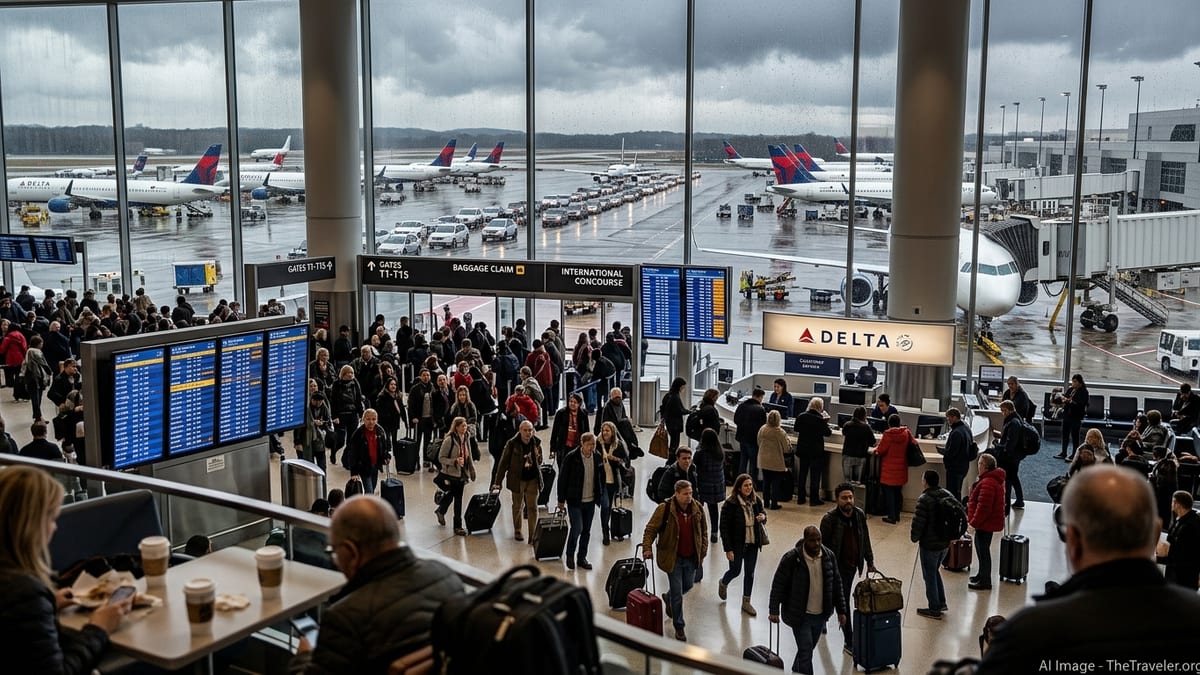
Thanksgiving 2026 delivered the heaviest U.S. flight schedule in more than a decade, but a mix of stormy weather, a rare nationwide Federal Aviation Administration network failure earlier in the month and a separate Delta Air Lines automation outage left millions of travelers navigating delays and cancellations during one of the year’s most critical travel periods.
Get the latest news straight to your inbox!
Record holiday flight volumes meet fragile infrastructure
According to a forecast released by the U.S. Department of Transportation ahead of the holiday, the FAA expected more than 417,000 flights to operate between November 23 and December 1, 2026, with Tuesday, November 24 projected as the single busiest day at over 52,000 departures and arrivals. The agency described it as the most heavily scheduled Thanksgiving period in 16 years and warned that any disruption could propagate quickly through the system given how tightly aircraft and crews were rostered.
That forecast has broadly matched the traffic that materialized in the run up to and through Thanksgiving Day. TSA figures cited in national media and live airport dashboards showed consistently high passenger volumes from Tuesday, November 24, through the Sunday return, while real time FAA status pages displayed multiple traffic management initiatives at major hubs during peak hours. Airlines for America, the trade body for large U.S. carriers, reiterated its projection that nearly 29 million passengers would fly between November 20 and 30, keeping many flights close to or at capacity even on secondary routes.
Within that tight operating environment, the majority of disruption during the core Tuesday to Friday rush came from familiar causes rather than new systemic failures. Preliminary FAA statistics and delay categorizations indicate that roughly four in five delay minutes over those four days were attributed to either extreme weather or the broader national aviation system category, which includes nonextreme weather, heavy traffic volumes and some air traffic control constraints. Those proportions are similar to past busy holiday periods, even though the absolute number of delays increased in line with the higher volume of scheduled flights.
How weather shaped the busiest travel days
Storm systems moving across the Midwest and up the East Coast in the days before Thanksgiving played a major role in how reliably the network ran. Forecasts issued on November 23 highlighted the risk of strong winds, heavy rain and pockets of coastal flooding that could affect low visibility operations at New York area airports and other major hubs. As the systems moved through, arrival rates were trimmed at times at New York, Boston and Chicago O’Hare, and holding patterns and ground delay programs were used to manage flows into already congested airspace.
Operational logs and delay feeds showed that these weather-related constraints had their sharpest impact on the Wednesday before Thanksgiving and the Sunday return, historically two of the most pressured days in the U.S. aviation calendar. Airlines were forced to consolidate some frequencies, swap aircraft types and resequence crews to keep priority trunk routes moving, leaving thinner buffers on connecting services and regional spokes. By contrast, Thanksgiving Day itself once again saw comparatively smoother operations, with fewer scheduled departures and somewhat lighter loads on selected routes reducing the scope for cascading disruption.
At the airport level, Chicago O’Hare and the New York region were among the most sensitive choke points. Even relatively short-lived reductions in accepted arrival rates at these hubs quickly generated queues of inbound traffic stretching across multiple air routes, delaying flights from distant origin airports that were themselves enjoying clear weather. Travelers connecting onward from these hubs often felt the impact as missed connections or rolling delays, illustrating how localized meteorological problems at a few airports can shape the wider national picture during peak periods.
Delta’s November 22 automation outage and its ripple effects
The Sunday immediately before the core Thanksgiving window brought a separate challenge for one major airline. On November 22, Delta Air Lines reported a failure affecting its automated system for calculating aircraft weight and balance, a safety-critical input used to determine how aircraft are loaded and how much thrust and runway length they require for departure. The malfunction was confirmed in statements from the airline and in notices from the FAA, which at Delta’s request briefly instituted a ground stop for some flights into Hartsfield Jackson Atlanta International Airport as the problem unfolded.
With the automated system offline, Delta shifted to manual processes for calculating weight and balance across parts of its network. That change significantly slowed departures at Atlanta, the carrier’s primary hub, where gate crews and pilots had to wait for manually generated load sheets before pushback. Data from flight tracking services and reports from national news outlets indicate that more than a thousand Delta flights experienced delays of varying length on November 22, with some early morning departures in Atlanta held for several hours and a smaller number of services ultimately cancelled when crew duty time limits were reached.
Although Delta said late on November 22 that the underlying technical issue had been resolved and that the automated system was back in service, the disruption did not disappear immediately. Residual aircraft and crew dislocation persisted into November 23 and the early part of November 24, particularly on tightly scheduled connecting itineraries that relied on feeds through Atlanta. Passengers flying on busy transcontinental and transatlantic routes reported missed connections, diverted routings and overnight delays, underscoring how a carrier-specific technology failure can compound broader weather and volume pressures at the start of a peak travel week.
The November 13 nationwide ground stop and modernization questions
The Thanksgiving period unfolded in the shadow of an even more unusual event that occurred earlier in the month. On Friday, November 13, the FAA ordered a rare nationwide ground stop affecting virtually all U.S. departures and inbound international flights for approximately 4 hours and 45 minutes after a telecommunications disruption hit multiple air traffic control facilities. Flights already in the air were allowed to continue, but the freeze on new departures rapidly produced queues of aircraft at airports across the country and left many passengers stranded as airlines attempted to recover.
A Congressional research brief and subsequent public statements from the Department of Transportation have identified two remote FAA facilities as key to the ongoing investigation: a radar site near Amarillo, Texas, and a radio communications facility near El Dorado, Arkansas. During an upgrade project at the Arkansas site, a contractor was replacing older copper lines with fiber optic cable when a newly installed router began sending unexpected volumes of traffic into parts of the FAA’s network that still relied on legacy equipment. According to preliminary federal analysis, that router behavior overwhelmed systems at 17 of the agency’s 22 en route centers, degrading both surveillance data and radio communications and prompting the nationwide ground stop on safety grounds.
In the days after the incident, Transportation Secretary Sean Duffy told reporters that early findings pointed to the El Dorado router as the initiating point of the disruption, with network “instability” and “inconsistencies” cascading through connected systems as they attempted to process the excess data. He emphasized that reviews by U.S. intelligence agencies and the FBI had, to date, found no evidence of a cyberattack, and that the working assumption remained a combination of equipment behavior and inadequate safeguards around the interaction of new and old technology. Both the FAA’s technical investigation and an FBI supported security review remain active, and officials have cautioned that a definitive root cause report is still pending.
The scale of the November 13 ground stop has reignited long running debates about the pace of FAA modernization. Lawmakers on key House and Senate committees have requested detailed briefings on how previous modernization funding was allocated, what testing preceded the router installation at El Dorado and Amarillo, and why network safeguards did not isolate the malfunctioning equipment before the failure impacted so many en route centers. Early tallies compiled from federal datasets and airline schedule information suggest that more than 17,000 flights were delayed or cancelled between November 13 and 15 as a direct or knock on consequence of the outage, but those figures are still being reconciled across carriers and may be revised.
Delay statistics, choke points and what travelers should do next
For passengers trying to make sense of this year’s holiday performance, official U.S. delay categories offer a window into where the main problems lay. “Extreme weather” delays cover events such as severe thunderstorms, major winter storms and other pronounced meteorological disruptions, while “national aviation system” delays aggregate a wide array of factors including nonextreme weather, airport operations, heavy traffic and some air traffic control restrictions. Early FAA breakdowns for Tuesday, November 24, through Friday, November 27, indicate that together these two classifications again accounted for the majority of delay minutes, with smaller shares assigned to carrier level issues such as crew and maintenance and to infrastructure factors like runway construction.
Geographically, several nodes stood out as recurring pressure points during the nine day window. In addition to the New York region and Chicago O’Hare, Atlanta was a particular focus because it combined weather impacts typical of the Southeast in late November with the consequences of Delta’s automation outage on November 22. Some passengers who were disrupted by the nationwide FAA network failure on November 13 also encountered residual effects when travelling in the following week, as aircraft and crews were repositioned and airlines worked through rebooked passengers on already full holiday flights.
Looking ahead to the final two days of the official Thanksgiving period on Saturday, November 28, and Sunday, November 29, federal projections still show elevated traffic levels, with more than 50,000 flights expected on at least one of those days and seat factors likely to remain high on popular routes. For travelers who have not yet completed their journeys, the practical guidance from both regulators and airlines is consistent: allow additional time to reach the airport, particularly at large hubs; monitor flight status closely through airline apps and official FAA airport status pages; and be prepared for late schedule or gate changes if further traffic management initiatives or localized weather issues arise.
On the policy front, the repercussions of the November 13 telecommunications failure will extend long beyond the holiday. Multiple Congressional committees have signaled their intention to hold hearings in the coming weeks once preliminary investigative reports are available, and the Department of Transportation has already indicated that it will renew its push for additional multi year funding targeted at communications, navigation and surveillance upgrades. Until those modernization decisions are agreed and implemented, passengers will continue to rely on a patchwork of legacy and newer systems for the rest of the 2026 winter travel season, with the understanding that both traditional weather risks and the possibility of further technical issues will remain part of the landscape they need to plan around.